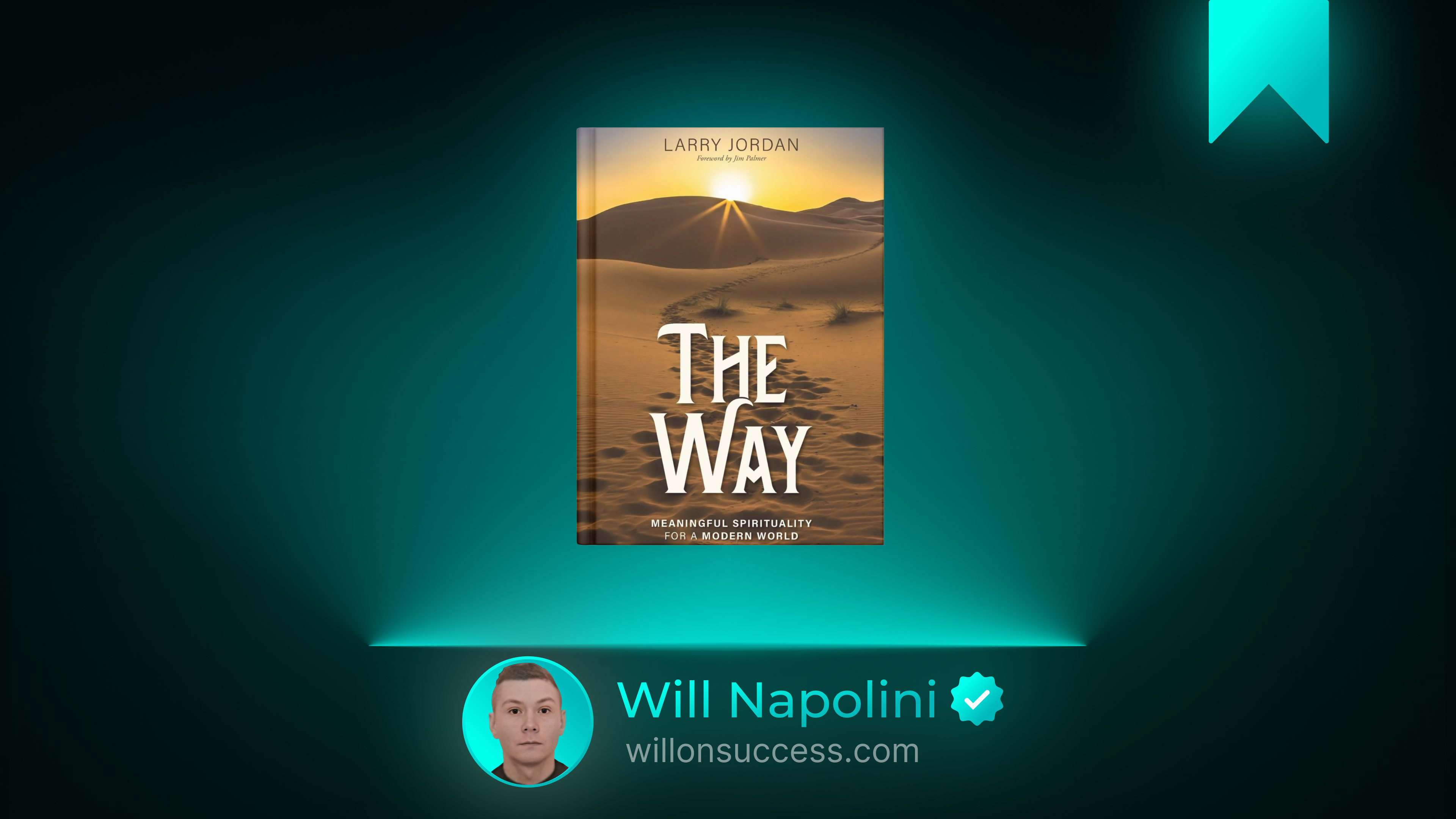
The Way: How to Rebuild Your Spirit When Old Beliefs No Longer Fit
Have you ever felt a quiet, persistent ache that the way you were taught to see the world no longer matches the world you actually experience?
Maybe you were raised with a set of beliefs that promised clarity, but over time, those beliefs began to feel like a heavy coat in the summer. They separated you from others. They separated you from nature. Worst of all, they separated you from your own sense of peace.
If I could sit across the table from you, I would tell you this: You are not losing your faith. You are outgrowing a container that is too small for the truth you are ready to hold.
In The Way: Meaningful Spirituality for a Modern World, Larry Jordan offers a compassionate, clear-eyed roadmap for exactly this moment. It is not a book that demands you abandon your past. Rather, it is an invitation to deconstruct what no longer serves you and reconstruct a worldview rooted in a single, profound reality: everyone is related, and everything is connected.
The Big Idea: From Separation to Oneness
The central thesis of The Way is that we can build a meaningful, transformational spirituality for the modern world by bridging the gap between Eastern nondual wisdom, mystical traditions, and modern science.
Jordan argues that the traditional Western worldview is largely built on separation: light and dark, sacred and secular, us and them. In contrast, the Eastern worldview—and the cutting edge of modern physics—points to Oneness. Any perceived sense of separation between ourselves and the rest of existence is an illusion.
The goal is not to argue you into a new dogma. The goal is to help you shift your perspective from a universe of isolated fragments to a universe of profound, living connection.
The Story: The Two-Sided Puzzle
To understand this shift, Jordan shares his own deeply personal journey. He describes his spiritual evolution not as a sudden revelation, but as the careful dismantling of a two-sided puzzle.
For years, he held a conventional, dualistic belief system. But as he studied, reflected, and honestly assessed his own experiences, he realized that the picture on his puzzle no longer matched reality. He found himself feeling more spiritual connection and aliveness in non-Christian practices, in the writings of mystics, and in the discoveries of scientists than he ever had sitting in a traditional church pew.
So, he took the puzzle apart.
This deconstruction was not angry or judgmental. It was an act of honest self-analysis. Once the old pieces were set aside, he began to build a new image on the other side. This new picture was reconstructed from the timeless insights of Eastern religions, the experiential wisdom of mystics, and the empirical truths of modern science.
What I discovered was that this is exactly how genuine growth happens. We do not just add new information to an old, crumbling foundation. Sometimes, we must be brave enough to take the foundation apart, piece by piece, and build something that can actually hold the weight of our adult lives.
The Major Principles
The Illusion of Separation
The root of much human suffering is the belief that we are separate. Separate from each other. Separate from nature. Separate from the divine. This dualistic thinking creates walls where there should be bridges. It fuels judgment, fear, and isolation.
The principle of Oneness teaches us that these boundaries are conceptual, not real. Just as a wave is not separate from the ocean, you are not separate from the universe. You are a unique expression of it. When you internalize this, your relationship with the world shifts from competition to collaboration, and from fear to belonging.
The Ground of Being, Not a Distant Judge
Many of us were taught to view the divine as a separate, external being—a cosmic judge watching from afar, keeping a ledger of our mistakes. This creates a spirituality based on anxiety and performance.
Jordan invites us to consider a different metaphor: the “ground of being.” Think of the soil in a forest. The soil does not judge the oak tree for being tall or the moss for being small. It simply provides the foundation from which all life emerges and to which all life returns. When you view the universe this way, spirituality becomes less about pleasing a distant authority and more about aligning yourself with the life force that already sustains you.
Science and Mysticism Are Allies, Not Enemies
We are often told we must choose between reason and faith. The Way dismantles this false dichotomy.
Modern science, particularly quantum physics and ecology, increasingly confirms what mystics have known for millennia: everything is deeply interconnected. The atoms in your body were forged in the hearts of dying stars. The mycelial networks beneath a forest floor communicate and share resources. Science describes the mechanics of the web; mysticism describes the experience of being part of it. You do not have to check your intellect at the door to find spiritual meaning.
Experiential Faith Over Rigid Doctrine
Doctrines are maps. But a map is not the territory.
Jordan emphasizes that a meaningful spirituality must be experiential, open-hearted, and open-minded. It is not about memorizing the right answers or defending the right team. It is about cultivating a direct, personal experience of peace, compassion, and presence. It is the difference between reading a menu and actually tasting the meal.
Why This Matters in Your Daily Life
You may be wondering how a shift in cosmic perspective changes your ordinary Tuesday. Let me show you.
- In Your Relationships: When you operate from separation, a disagreement with a partner or colleague is a battle to be won. When you operate from oneness, it becomes a shared problem to be solved. You realize that hurting the other person is, in a very real sense, hurting a part of the whole to which you belong.
- In Your Work: If you believe you are separate and alone, your work is a grind to prove your worth. If you know you are part of an interconnected system, your work becomes a contribution. You focus on the value you add to the web, not just the status you extract from it.
- In Your Self-Talk: The old paradigm tells you that your mistakes make you fundamentally flawed. The new paradigm recognizes that you are a work in progress, growing within a supportive ground of being. You can extend the same grace to yourself that you would offer to a struggling friend.
What you repeat in private eventually becomes visible in your life. If you repeatedly tell yourself you are separate and lacking, you will live in scarcity. If you repeatedly remind yourself of your inherent connection, you will live with quiet confidence.
Practical Application: Turning Insight into Behavior
Understanding oneness is a beautiful concept. But action before intention is what changes your life. Here are three concrete ways to bring The Way into your daily routine.
1. The “A Part Of” Reframe
The next time you feel isolated, anxious, or in conflict with someone, pause. Silently shift your language. Instead of thinking, “I am apart from them,” remind yourself, “I am a part of this.” Notice how that simple linguistic shift changes the physical sensation in your chest. It moves you from defense to connection.
2. The Contemplative Pause
Jordan notes that our prayers and intentions often sound like “talking, not listening… saying ‘please’ not ‘thank you’.” Once a day, take three minutes to do nothing but listen. Sit quietly. Do not ask for anything. Do not try to fix anything. Simply rest in the awareness of the ground of being. Let the silence be your teacher.
3. Seek the Common Thread
When you encounter a belief system, a culture, or a person that seems entirely foreign to you, ask one question: “Where is the shared humanity here?” Look past the surface-level doctrines or habits to find the universal desire for safety, love, or meaning. This practice builds the muscle of oneness in real time.
Who Should Read This Book
The Way is a profound resource for the open-minded seeker. It is for you if:
- You are actively deconstructing an old faith and feel untethered.
- You consider yourself “spiritual but not religious” and are looking for a framework that honors both intellect and intuition.
- You feel exhausted by the polarization and separation in modern culture and crave a worldview based on connection.
- You are curious about how ancient mystical wisdom aligns with modern scientific discovery.
This book may be less useful for you if you are looking for a rigid set of new rules to replace your old ones, or if you prefer a strictly dogmatic, black-and-white approach to spirituality. Jordan’s work is an exploration, not a manifesto. It asks questions; it does not demand blind allegiance.
One Small Step
Do not wait for a grand spiritual awakening to begin. Awakening is built in the micro-moments of daily attention.
Here is your one small step: Today, step outside for just two minutes.
Feel the ground beneath your feet. Look at the sky. Take one deep breath and silently acknowledge this truth: The same energy that sustains this earth is sustaining me right now. I am not separate from this.
You start small. You stay consistent. You let time do its work.
The puzzle pieces of your old life may feel scattered right now. But that is not a sign of failure. It is the necessary first step of building a picture that is finally large enough to hold the truth of who you are.
The way forward is not a lonely path. It is a return to the whole.