The Way of the Superior Man Summary: Purpose, Polarity, and the Courage to Lead
You have likely been told, directly or indirectly, that the ultimate measure of your success as a man is how happy you can make the people around you. You work hard to provide, you listen carefully to understand, and you bend over backward to keep the peace. You want to be a good partner, a reliable friend, and a present father.
Yet, despite your best efforts, you might feel a quiet, persistent hollow in your chest. You are giving away pieces of your identity to maintain harmony, and in the process, you are slowly disappearing. You may find yourself waiting for permission to act, or constantly scanning the room to see if everyone is pleased with you.
If you have ever felt this specific kind of exhaustion, I want to show you a different way forward. It requires you to stop looking outside yourself for validation and start looking inward for direction.
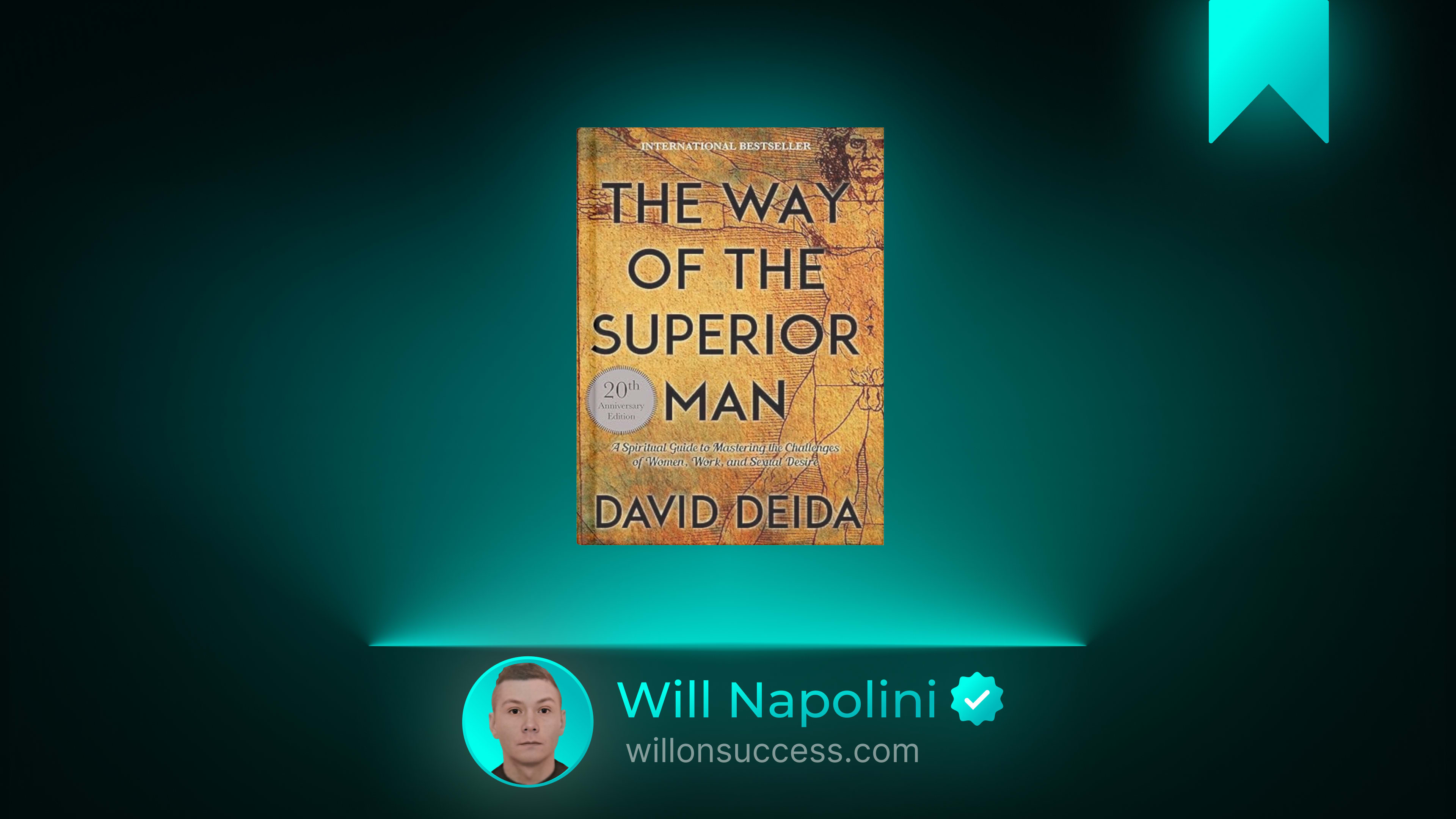
In his landmark book, The Way of the Superior Man, David Deida offers a path for men who are tired of shrinking themselves to fit into a comfortable, inoffensive box. The central idea is deceptively simple but profoundly difficult to practice: your highest purpose must come before your primary relationship.
If you put your partner’s approval above your own mission, you do not become a better lover; you become a hollow shell. True masculinity is not about controlling the world through force, nor is it about abandoning your backbone to avoid offending anyone. It is about living with an open heart while remaining deeply rooted in your own direction.
The Three Stages of Modern Men
To understand where you are going, you must first understand where you have been. Deida maps out the evolution of modern men through three distinct stages. Recognizing which stage you currently inhabit is the first step toward genuine growth.
The first stage is the traditional macho man. He is closed off, rigid, and attempts to rule his world through force and emotional detachment. He believes that showing vulnerability is a weakness. Eventually, the world rejects his hardness. He realizes that his rigidity isolates him, and he decides he must change.
This leads to the second stage: the sensitive man. He is emotionally available, deeply empathetic, and highly attuned to the feelings of others. He wants to heal the wounds of the macho man. But in his desperation to be good and to please everyone, he often loses his own spine. He becomes so focused on making others comfortable that he abandons his own truth. The sensitive man is a wonderful friend, but he often lacks direction. His partners eventually lose respect for him because he has no solid ground to stand on; he shifts his shape to fit whatever container he is poured into.
This realization brings a man to the third stage: the superior man. He integrates the best of both previous stages. He possesses the emotional depth, empathy, and open heart of the sensitive man, but he retains the unshakeable backbone, mission, and purpose of the traditional man. He does not need to dominate, and he does not need to submit. He simply stands firm.
Think of it like water. The first stage is a frozen glacier—hard, unyielding, and brittle. The second stage is a flooded marsh—spreading everywhere, touching everything, but going nowhere. The third stage is a deep, directed river. It is fluid and life-giving, but it carves a clear, powerful path through the stone.
Your Purpose Must Anchor Your Life
The most challenging pill to swallow in Deida’s philosophy is this: if you have to choose between your relationship and your deepest purpose, you must choose your purpose.
This sounds harsh to the modern ear. We are taught that love and relationship are the ultimate goals of life. But Deida argues that when a man makes his relationship his highest priority, he inadvertently destroys the very attraction and respect he is trying to cultivate.
Think about it from the perspective of your partner. If your entire sense of identity, your mood, and your direction are dictated by whether she is happy with you, you have placed a massive burden on her shoulders. She becomes responsible for your fulfillment. Worse, she realizes that you have no mission of your own. A woman wants to be loved by a man, but she also wants to be led by a man who knows where he is going. If you abandon your purpose to please her, she will eventually resent you for having no purpose to begin with.
You cannot be the anchor for someone else’s ship if you are constantly drifting with their tide.
When your purpose is first, you bring a grounded, directed energy into your relationship. You are not looking to her to complete you; you are looking to share the fullness of who you are. This creates a dynamic where love is a choice between two whole individuals, rather than a desperate negotiation between two incomplete halves. Your purpose is not a distraction from your relationship; it is the very foundation that makes a healthy relationship possible.
Stop Trying to Fix the Weather
One of the most practical and transformative concepts in the book is how the masculine and feminine energies interact, particularly during emotional conflict.
Deida explains that the masculine essence is associated with consciousness, direction, and stillness. The feminine essence is associated with energy, light, and flow. In a romantic relationship, these poles create a spark. But they also create friction.
When a man is operating from his masculine core, his instinct when faced with a problem is to fix it. He uses logic, he looks for solutions, he tries to resolve the issue. But when his partner is operating from her feminine energy, she is not dealing with a logical problem; she is experiencing an emotional state.
Deida uses a brilliant metaphor: treat her emotions like the weather.
You do not yell at a rainstorm to stop. You do not try to logically argue with a thunderstorm. You simply put on a coat, or you offer shelter. When you try to fix a woman’s emotional storm with logic, she feels invalidated and unheard. You feel frustrated and unappreciated. The conflict escalates.
The superior man learns to stop trying to fix the weather. When an emotional storm arises, he does not take it personally. He does not try to argue her out of her feelings. Instead, he remains the mountain. He stays grounded, present, and loving. He holds her, listens to her, and lets the emotional weather pass through.
This is not about dismissing her feelings. It is about recognizing that her emotions are a natural expression of her energy, and they do not require you to abandon your own center to solve them. When you stop reacting to the storm and start providing the shelter, the dynamic shifts entirely. She feels safe to feel, and you maintain your peace.
Live Constantly at Your Edge
Growth does not happen in the comfort zone. It happens at the edge.
Deida defines your edge as the boundary between your known world and the unknown. It is the exact point where your fear, uncertainty, and discomfort meet your desire to grow. Most men spend their lives retreating from their edge. They choose the safe job, the comfortable routine, the conflict-free conversation. They numb their anxiety with distractions, believing that avoiding discomfort is the key to happiness.
But a life lived entirely within your comfort zone is a life unlived. It is a slow fading of the spirit.
The superior man makes a daily practice of leaning into his edge. If he is afraid of public speaking, he takes the stage. If he is avoiding a difficult conversation with his partner, he initiates it. If his business has plateaued because he is afraid to scale, he takes the risk.
Living at your edge is uncomfortable. It requires you to sit with the physical sensation of fear—the tightening in the chest, the urge to retreat—without letting it dictate your actions. But it is the only way to expand your capacity. Every time you lean into your edge and survive, your edge moves outward. Your comfort zone expands. You become a man who can handle more, lead better, and love deeper.
Cultivate Polarity to Keep the Spark Alive
In a culture that often strives for absolute equality in all things, Deida introduces a counterintuitive idea: in romantic intimacy, sameness kills the spark.
Attraction requires polarity. Just as a magnet needs a positive and a negative pole to generate a magnetic field, a romantic relationship needs a distinct masculine and feminine pole to generate sexual and energetic spark. If you and your partner become exactly the same—if you both act as the man in the relationship, or if you both dissolve into a genderless blur of sameness—the polarity collapses. The relationship becomes a comfortable friendship, but the passionate spark dies.
This does not mean enforcing rigid, outdated gender roles. It means allowing yourself to fully inhabit your masculine presence so that your partner can fully relax into her feminine presence. When you are grounded, decisive, and present, you create a safe container. In that container, she can let go of her need to be in control, to plan, and to direct. She can simply be.
Cultivating this polarity requires intention. It requires you to look at how you show up in your relationship. Are you constantly deferring to her? Are you waiting for her to initiate? Are you trying to be her equal in every single moment rather than her complementary partner? Stepping into your masculine polarity means taking the lead in love, in planning, and in presence, allowing the natural dance between the two energies to flourish.
Why It Matters on an Ordinary Tuesday
Philosophy is only useful if it survives contact with real life. So, what does this actually look like on an ordinary Tuesday?
It looks like coming home after a long, draining day at work. Your mind is tired. You just want to sit on the couch and decompress. But your partner is upset. She is frustrated about a miscommunication at her job, and she is taking it out on you in subtle, sharp ways.
The old you—the sensitive man trying to keep the peace—would either apologize for things you didn’t do, or you would snap back defensively. You would try to fix her problem with logical advice, which would only make her more frustrated.
The superior you takes a deep breath. You recognize the weather. You do not take her sharp words as a personal attack on your worth. You walk over, you put your hand on her shoulder, and you say, “That sounds incredibly frustrating. I’m here.” You do not try to solve her job. You just offer your presence. You remain the mountain. She softens. The storm passes. You both move on with your evening, connected rather than divided.
It looks like sitting at your desk on Wednesday morning. You have a choice between working on a passion project that aligns with your deepest purpose, or answering emails that make you feel busy but move you nowhere. The edge is calling. You close the email tab. You open the project. You lean into the discomfort of doing the hard, meaningful work.
It looks like Friday night. You are with your partner. Instead of falling into the routine of watching television in silence, you look at her. You initiate. You lead the evening. You create a space where the polarity is alive, where you are fully masculine and she is fully feminine, and you remember why you fell in love in the first place.
Practical Application
Understanding these concepts is only the beginning. Wisdom requires action. Here is how you can begin integrating these principles into your life immediately.
1. Define Your Highest Purpose You cannot prioritize your purpose if you do not know what it is. Take an hour this weekend with a blank piece of paper. Ask yourself: If money and approval were completely irrelevant, what would I dedicate my life to? What is the contribution I want to make? Write it down. Refine it. Make it the North Star by which you make your daily decisions. When you face a choice this week, ask yourself which option aligns with that North Star.
2. Practice the Mountain Protocol The next time your partner (or a family member) is caught in an emotional storm, make a conscious decision not to fix it. When your instinct is to offer a solution, swallow it. Instead, offer your presence. Breathe deeply, keep your body relaxed, and say, “I hear you. That makes sense.” Practice being the mountain. Watch how the dynamic changes when you stop fighting the weather and simply hold space for it.
3. Identify and Lean Into Your Edge Identify one area of your life where you have been playing it safe. Is it a difficult conversation you are avoiding? A creative project you are too afraid to start? A physical challenge you have been putting off? Choose one thing. Do it this week. Feel the fear, acknowledge the physical sensation of it in your body, and take the action anyway.
4. Audit Your Polarity Look at your relationship dynamics. Where are you shrinking yourself to avoid conflict? Where are you waiting for her to lead? Identify one specific way you can step more fully into your masculine presence this week. It could be as simple as planning the entire date night from start to finish without asking her what she wants to do, or simply holding eye contact a little longer when she speaks. Take the lead in a small, loving way.
Who Should Read This Book
The Way of the Superior Man is essential reading for any man who feels he has lost his way, particularly men who feel they have sacrificed their own identity to maintain their relationships. It is highly valuable for men who feel stuck in the sensitive phase of development and want to find their backbone without losing their heart. It is also incredibly useful for men who want to understand the deeper, energetic dynamics of masculine and feminine polarity.
However, this book is not for everyone. If you are looking for tactical manipulation, or if you believe that masculine and feminine energies are purely social constructs with no basis in human experience, this book will likely frustrate you. Deida is not interested in political correctness; he is interested in spiritual and psychological truth. You must be willing to look at your own behavior with radical honesty. It is a book that demands you grow up, and growing up is rarely comfortable.
One Small Step
You do not need to overhaul your entire life today. You just need to take one step toward your edge.
Right now, identify one small thing you have been avoiding because it is uncomfortable. It might be making a phone call you have been putting off, initiating a difficult but necessary conversation, or simply sitting in silence for ten minutes without looking at your phone.
Do that one thing today. Feel the resistance, and do it anyway.
The Door Opens Forward
The world does not need more men who are merely nice. It needs men who are deeply good, fiercely purposeful, and entirely present. It needs men who can hold their ground when the world shakes, and who can keep their hearts open when it would be easier to close them.
When you stop looking for your worth in the eyes of others and start building it through your own daily actions, you become the anchor your own life has been waiting for. You stop drifting. You start leading.
A man who abandons his purpose to please the world eventually has neither purpose nor the world. But a man who stands firmly in his purpose, with an open heart and a clear direction, finds that the world—and the people in it—naturally gravitate toward his light.
Take a breath. Feel your feet on the ground. Now, go build something that matters.