Uncle Styopa by Sergey Mikhalkov: The Quiet Power of Being Too Much
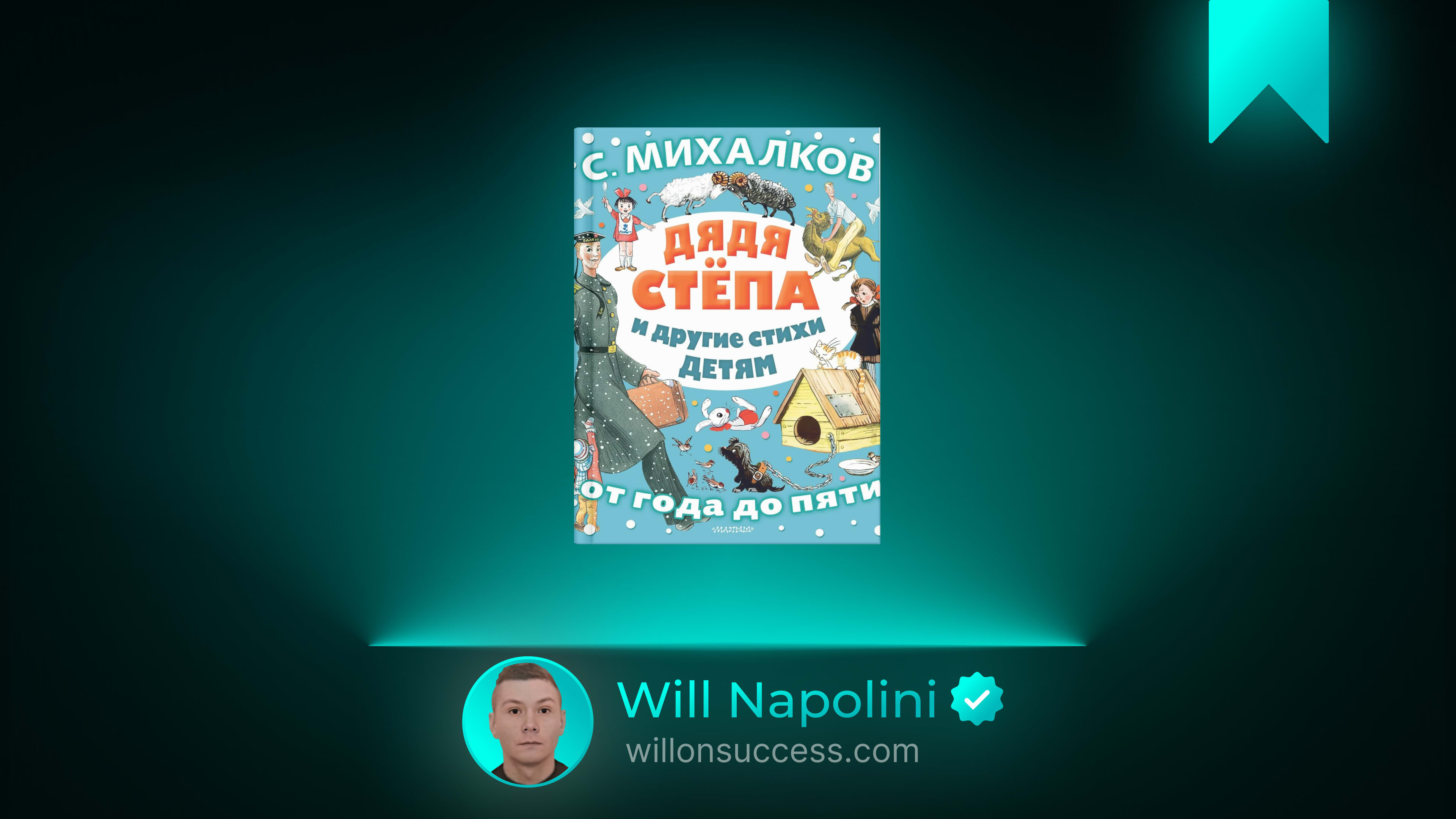
Have you ever felt like you were simply too much? Too tall, too loud, too sensitive, too ambitious, too strange for the room you walked into? Have you ever looked around at everyone else seeming to fit neatly into their lives and thought, Something about me does not match the shape of this world?
I want to talk to you about a children’s poem. Yes, a children’s poem. Written in 1936 by a Russian poet named Sergey Mikhalkov, it tells the story of a man so absurdly tall that he can see over entire crowds, reach rooftops without a ladder, and accidentally duck under doorways just to enter a room. His name is Stepan Stepanov, but everyone calls him Uncle Styopa.
And here is what struck me, reading it again after many years: this poem, written for six-year-olds, contains one of the most honest answers to the question every adult eventually asks. What do I do with the parts of myself that don’t fit?
Mikhalkov’s answer is deceptively simple, and I think it might change how you see your own life.
The Big Idea: Your Difference Is Not a Debt. It Is a Tool.
The central lesson of Uncle Styopa is not complicated, but it is radical. The poem says: the quality that makes you conspicuous, the quality that makes you feel like you stand out in the worst possible way, is not a mistake. It is material. It is the raw substance from which you build a life of service, connection, and quiet heroism.
Uncle Styopa does not shrink himself. He does not apologize for his height. He does not spend the poem wishing he were average. Instead, he finds ways to let his unusual size become useful. He rescues a child from a burning building because he can reach the window no one else can. He helps lost children find their parents because he can see over the entire crowd. He becomes a traffic officer because his height lets him be seen from every direction.
The poem never treats his height as a problem to solve. It treats it as a gift waiting for the right context.
If I could sit across the table from you right now, I would tell you this: most of us spend years trying to file down the edges of ourselves that stick out. We learn to be smaller, quieter, less. And in doing so, we lose access to the very thing that could make our contribution irreplaceable.
The Story of a Man Who Could Not Hide
Let me walk you through the shape of the poem, because the structure itself teaches something.
Uncle Styopa is introduced not as a hero but as a curiosity. People stare. Children point. He is enormous in a world built for ordinary dimensions. Mikhalkov gives us this image of a man who cannot blend in, who cannot be overlooked, who must navigate a world not designed for him.
Then the poem moves. Styopa tries different roles. He serves in the navy, where his height and strength become assets on a ship. He transitions into civilian life. He becomes a policeman, a traffic officer, a helper of children and the elderly. In each role, the same quality that made him strange in the first stanza makes him indispensable in the last.
He puts out a fire. He saves a child from a river. He lifts a kite out of a tree for a crying little girl. He directs traffic at a busy intersection, visible to every driver from blocks away.
None of these acts require him to become someone else. They require him to be fully, unapologetically himself, pointed in a useful direction.
The poem was written in 1936, and Mikhalkov went on to write sequels—Uncle Styopa the Policeman in 1954, and others. The character became a cultural touchstone in Russian-speaking countries, a figure children grew up alongside. But beneath the gentle rhyme and the charming illustrations, there is a philosophy of living that I find more honest than most adult self-help books.
You Were Not Built to Be Comfortable. You Were Built to Be Useful.
Here is the first principle I take from this poem, and it is one I have had to learn more than once in my own life.
There is a difference between being comfortable and being in your right place. Uncle Styopa is never comfortable in the ordinary sense. Doorways are too low. Beds are too short. Chairs are too small. The physical world was not built with him in mind.
But he finds places where his particular shape is needed. And in those places, the discomfort becomes irrelevant. Not because it disappears, but because it is outweighed by purpose.
I have seen this happen with people I know. The person who is “too intense” for casual friendships but becomes the friend everyone calls in a real crisis. The person who is “too detail-obsessed” for brainstorming sessions but becomes the one who catches the error before it costs the company a contract. The person who is “too emotional” for corporate culture but becomes the counselor, the teacher, the writer who makes strangers feel seen.
You start small. You find one place where your particular shape fits. You let that place teach you where else you might belong.
The mistake is not in being unusual. The mistake is believing that the discomfort of not fitting means you are broken, rather than simply unplaced.
Strength Without Kindness Is Just Size. Kindness Without Strength Is Just Wishful Thinking.
The second principle lives in how Uncle Styopa uses what he has.
He is strong. He is tall. He is visible. In a different story, those qualities could make him a bully, a tyrant, someone who dominates the room simply by occupying more of it. Mikhalkov deliberately shows us the opposite. Styopa’s every act is gentle. He bends down to talk to children. He carries the elderly across the street. He rescues without being asked. He serves without being celebrated.
This is the combination that matters. Not strength alone. Not kindness alone. Strength directed by kindness. Capability pointed toward service.
What I have learned is that most of us have one without the other. We develop skills, knowledge, resources—but we keep them turned inward, aimed at our own comfort and security. Or we have enormous compassion and desire to help—but we never build the capacity to actually do anything about it. We wish. We worry. We feel. But we do not act.
Uncle Styopa does not stand in the town square giving speeches about how much he cares. He walks to the burning building. He reaches into the river. He lifts the child onto his shoulders so she can see the parade.
Kindness is a verb in this poem. And I think that is the standard worth holding.
You Do Not Need to Be Chosen. You Need to Show Up.
There is a quiet moment in the poem’s logic that I find deeply encouraging. Nobody recruits Uncle Styopa. No committee selects him. No authority figure taps him on the shoulder and says, You, tall man, we have decided you are worthy of a purpose.
He simply sees a need, and he meets it.
He sees a child in danger, and he acts. He sees confusion in the crowd, and he makes himself visible. He sees a job that suits his particular abilities, and he takes it.
This matters because so many of us are waiting. Waiting to be noticed. Waiting to be invited. Waiting for permission to use what we have. We think purpose is something assigned to us from the outside, and until someone hands it to us, we remain still.
Mikhalkov’s poem suggests something braver. Purpose is not assigned. It is noticed. You look around, you see what needs doing, and you ask yourself, Am I shaped in a way that lets me do this? If the answer is yes, you do not wait for applause. You simply begin.
A small decision becomes a direction, and a direction repeated long enough becomes a life.
The Quiet Heroism of Showing Up Every Day
One more thing about Uncle Styopa that I want you to notice. He is not a warrior. He does not slay a dragon. He does not defeat a villain in dramatic combat. His heroism is domestic, repetitive, small-scale. A child rescued. A kite retrieved. A traffic jam eased. An elderly person helped across the road.
These are not the acts that get statues erected. They are the acts that make a community function. They are the ten thousand small repairs that hold a life together.
And I think this is where most of us actually live. Not in the dramatic rescue, but in the Tuesday-afternoon act of patience. Not in the grand career change, but in the quiet consistency of doing your work well when no one is watching. Not in the viral moment of recognition, but in the repeated, unglamorous choice to be kind to the person in front of you.
What you repeat in private eventually becomes the architecture of your public life. Uncle Styopa’s legend is not built on one heroic afternoon. It is built on a lifetime of small, visible acts of care.
Who Should Read This Poem, and Why
Let me be honest about what this book is and is not.
Uncle Styopa is a children’s poem. It is short. It is written in simple, musical Russian verse. If you are looking for a complex psychological framework or a step-by-step system for career development, this is not that book.
But if you are a parent reading aloud to a child and you want to plant a seed about self-acceptance and service, it is perfect. If you are an adult who has forgotten that your strangeness is not your enemy, it is a gentle, two-minute reminder. If you work with children, teach children, or simply want to reconnect with a story that treats difference as dignity rather than defect, it is worth your time.
It will not change your life in the way a dense philosophy book might. But sometimes what you need is not a philosophy. Sometimes what you need is a picture of a very tall, very kind man bending down to help a small child, and the quiet recognition that you, too, can use whatever makes you unusual in the service of something good.
Read it in Russian if you can. The rhythm and rhyme carry warmth that translation softens. But even in translation, the heart of it survives.
What This Looks Like on an Ordinary Tuesday
Let me bring this down from the realm of story into the realm of your actual week.
You do not need to be seven feet tall to apply this. You need only to ask yourself three questions:
First: What is the thing about me that I have been trying to minimize? The sensitivity, the intensity, the unusual skill, the strange obsession, the way I process the world differently from the people around me?
Second: Where is that quality actually needed? Not where it is merely tolerated, but where it is genuinely useful. Is it in your family? In a specific role at work? In a volunteer capacity? In a creative project you keep postponing?
Third: What is one small act I could perform this week that uses that quality in service of someone else? Not for recognition. Not for a reward. Simply because you are shaped in a way that lets you do this particular thing, and someone nearby needs it done.
That is the Uncle Styopa method. You do not redesign yourself. You redirect yourself.
One Small Step You Can Take Today
Here is what I would ask you to do before this day ends.
Take five minutes. Sit with a notebook or open a blank document. Write down one quality about yourself that you have, at some point, wished you could turn down. The volume of your emotions. The depth of your thinking. The strangeness of your interests. The size of your ambition. The particular way your mind works that does not match the people around you.
Now write one sentence completing this thought: If I stopped apologizing for this quality and pointed it toward someone who needed it, I could…
You do not have to act on it today. You do not have to solve it this week. But write the sentence. Let yourself imagine the version of your life where your difference is not the obstacle but the instrument.
Uncle Styopa never once wished he were shorter. He simply found the doorways tall enough for him, and then he walked through them, bending slightly, smiling, ready to help whoever was on the other side.
You are not too much. You are simply looking for the room built to your height. And until you find it, you can build it yourself, one small act of useful kindness at a time.
The door is not closing. It is waiting for you to stop shrinking and walk through.