How to Rewire Your Reactions and Take Back Control of Your Life
I want to ask you a question that might feel a little uncomfortable.
Think about the last time you lost your temper, broke a commitment to yourself, or procrastinated on a critical project. In the exact moment before you made that choice, what pushed you over the edge?
Was it a specific look from a colleague? A passive-aggressive email? The feeling of being tired after a long day?
If I could sit across the table from you right now, I would tell you that you are not lacking in willpower. You are not fundamentally broken. What you are experiencing is the invisible architecture of your environment quietly overriding your intentions.
We like to believe that our choices are made in a vacuum, driven purely by our internal desires. But the truth is much more complex, and frankly, much more manageable once you understand it. Every choice you make is preceded by a stimulus. In the study of human behavior, we call these stimuli “triggers.”
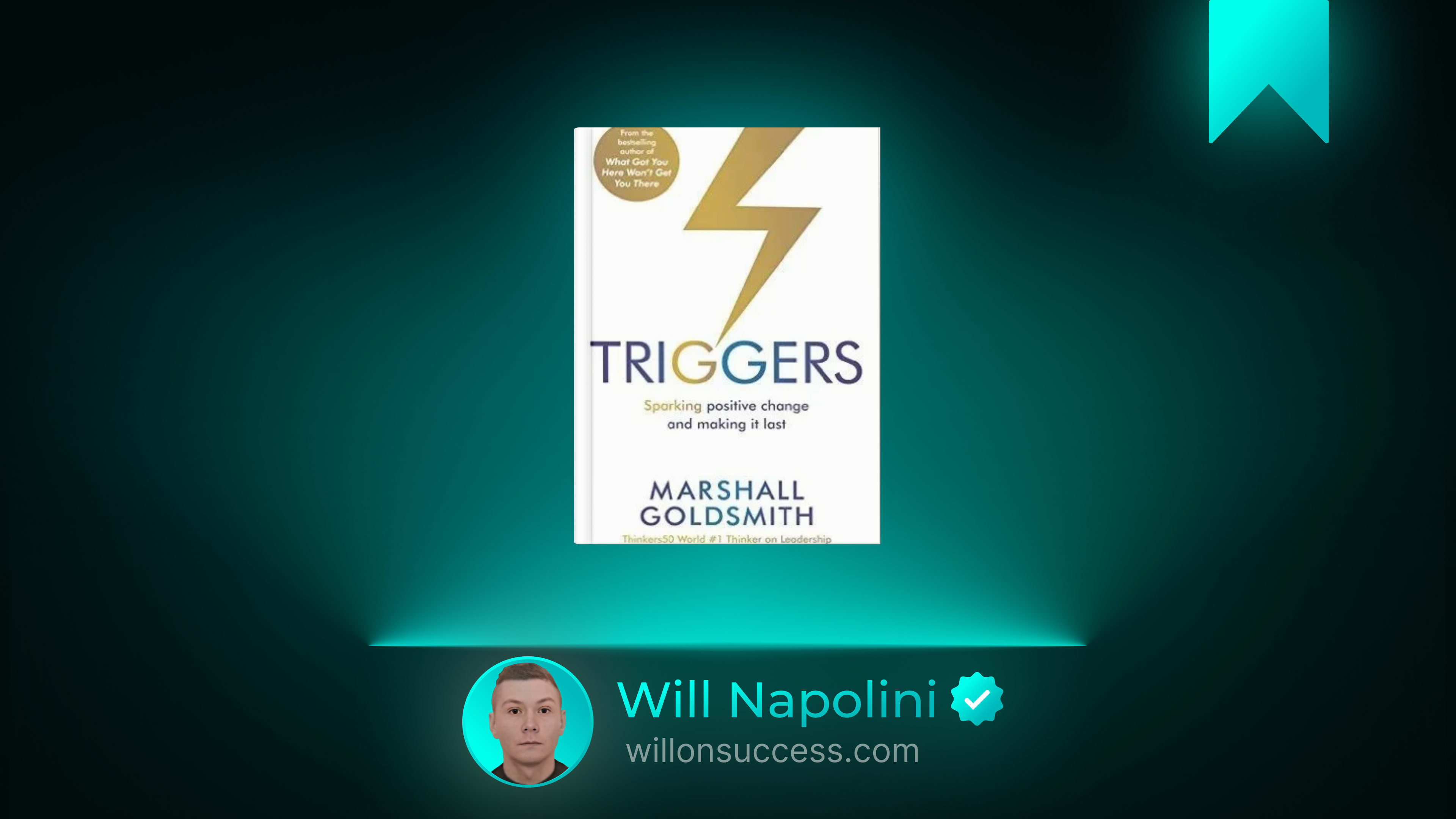
In his transformative book Triggers, executive coach Marshall Goldsmith strips away the illusion that we are entirely in control of our reactions. He reveals that our behavior is constantly being shaped, nudged, and sometimes hijacked by the environment around us. But more importantly, he provides a practical, deeply humane framework for taking that control back.
Here is what I have learned from studying this work and applying it to my own life: You do not need to become a different person to achieve your goals. You just need to understand the triggers around you and change how you respond to them.
The Big Idea: You Are Not a Victim of Your Environment
The central thesis of Triggers is both simple and profound: our behavior is triggered by the stimuli around us, and while we cannot always control those triggers, we can absolutely control our response to them.
Most personal development advice focuses on building massive internal willpower. It tells you to just want it more, to push harder, to be more disciplined. But Goldsmith argues that relying on willpower is like trying to hold back a river with your bare hands. Eventually, you will get tired, and the water will win.
Instead of fighting the river, you need to build a canal. You need to engineer your environment and your daily routines so that the right behavior becomes the default behavior. When you understand what triggers your worst habits, you can neutralize them. When you understand what triggers your best habits, you can amplify them.
Change is not about magic. It is about mechanics, awareness, and a relentless commitment to asking yourself the right questions.
The Motivation Trap and the Power of Active Questions
To understand why this book is so effective, we have to look at the biggest lie we tell ourselves about change: the belief that we need to feel motivated to act.
Imagine a hypothetical executive named David. David wants to be a more patient father. Every Sunday night, he tells himself, “Tomorrow, I am going to be present, calm, and engaged.” But on Tuesday evening, his toddler spills milk on the floor, his phone rings with a work emergency, and he is exhausted. In that moment, the trigger (the mess, the noise, the fatigue) overrides his intention. He snaps. Later, he feels guilty and blames his lack of discipline.
David’s problem isn’t a lack of discipline. His problem is that he relied on motivation, and motivation is a feeling. Feelings are fleeting.
Goldsmith’s breakthrough was realizing that we must shift our focus from outcomes to effort. He introduced a concept that has changed the lives of thousands of leaders and everyday people: Active Questions.
Instead of asking passive questions like, “Was I a patient father today?”—which blames the environment (if the kids were crazy, you weren’t patient)—Goldsmith teaches us to ask, “Did I do my best to be a patient father today?”
Do you feel the difference?
The passive question makes you a victim of your circumstances. The active question places the responsibility squarely on your shoulders. It doesn’t matter if the day was chaotic; what matters is whether you exerted effort. This single shift in language moves you from the passenger seat of your life directly behind the wheel.
Your Environment Is Quietly Shaping Your Behavior
Before you can change your behavior, you must understand the mechanics of a trigger. A trigger is any stimulus that alters your thoughts or actions.
Triggers are not inherently good or bad. The smell of rain is a trigger. A compliment from a friend is a trigger. A harsh word from a boss is a trigger. The danger lies in our unconscious, automatic reactions to them.
When you walk into a room and someone is speaking loudly on their phone, that is a trigger. If your automatic reaction is to feel irritated and snap at your partner, the trigger has controlled you. You reacted. You did not respond.
I have seen this happen countless times. People will spend hours in a seminar feeling inspired, only to walk out the door, get into their car, and immediately turn right back into their old selves because the environment of the car, the traffic, and the radio act as triggers for their old habits.
To break this cycle, you must become a student of your own life. You must observe the moments right before you slip up. What was the stimulus? Was it hunger? Was it a specific tone of voice? Was it the time of day?
Once you identify the trigger, you can intercept it. You can create a pause between the stimulus and your response. In that pause lies your freedom.
Shift the Burden from the World to Yourself
This brings us back to the power of Active Questions, which is the engine that drives the entire Triggers methodology.
When we ask passive questions, we are essentially asking the world to grade us. “Did I achieve my goal?” “Was I happy?” “Did I lose weight?” If the answer is no, we feel defeated, because the world didn’t cooperate.
Active questions change the metric of success from results to effort.
Goldsmith suggests tracking six core active questions daily. They usually look something like this:
- Did I do my best to set clear goals today?
- Did I do my best to make progress toward my goals today?
- Did I do my best to find meaning today?
- Did I do my best to be happy today?
- Did I do my best to build positive relationships today?
- Did I do my best to be engaged today?
Notice that none of these ask if you were happy, or if you found meaning. They ask if you did your best.
This is a profound psychological shift. It means that even on your worst, most difficult day, you can still score a 10 out of 10 if you truly gave it your all. It removes the excuse that the environment was too hard, and it replaces it with the empowering reality that your effort is entirely within your control.
Build a Structure That Makes the Right Choice the Easy Choice
Understanding triggers and asking active questions is only half the battle. The other half is building a structure that holds you accountable.
Willpower is a fragile bridge. Structure is a stone wall.
Goldsmith is a fierce advocate for daily self-monitoring. He doesn’t just suggest that you think about your goals; he demands that you track them. In the book, he describes a process where he has his coaching clients score themselves daily on their active questions, and then send those scores to a loved one or a colleague.
Why does this work so well? Because we are incredibly adept at lying to ourselves. We can easily convince ourselves that we “did pretty well” this week when we actually didn’t. But when you have to score yourself out of 10 every single night, and someone else is going to see that score, the illusion shatters.
The structure does the heavy lifting for you. You don’t have to remember to be mindful; the system reminds you. You don’t have to rely on your memory to track your progress; the spreadsheet does it for you.
When you build a structure, you are essentially building a scaffold for your character. You lean on it while you are weak, and over time, as the habits solidify, the scaffold becomes a part of the building itself.
Choose What to Change, Create, Accept, and Eliminate
One of the most compassionate aspects of Triggers is Goldsmith’s recognition that we cannot fix everything at once. In fact, trying to fix everything is a primary reason people fail.
To navigate this, he introduces the “Wheel of Change,” which divides our efforts into four distinct categories:
- Changing: Improving a negative behavior to make it less destructive.
- Creating: Building a new, positive behavior that didn’t exist before.
- Accepting: Making peace with things we cannot change, stopping the waste of energy on futile resistance.
- Eliminating: Completely removing a toxic behavior or habit from our lives.
This framework is a relief. It gives you permission to accept the things that are out of your control. It tells you that you don’t have to be perfect; you just have to be strategic.
If you are trying to eliminate a bad habit, you are in the “Eliminating” quadrant. If you are trying to be more grateful, you are in the “Creating” quadrant. By categorizing your efforts, you can apply the right strategy to the right problem, rather than throwing every tool at every issue and hoping something sticks.
Why This Changes Everything on an Ordinary Tuesday
You might be wondering how this applies to your actual life, outside of a corporate boardroom or a self-help seminar.
Here is why it matters: because you are tired of starting over every Monday.
You are tired of the cycle of high intention and low execution. You are tired of blaming yourself for a lack of character when the real issue is a lack of systems.
When you apply the principles of Triggers, an ordinary Tuesday changes. You wake up, and instead of just hoping you will have a good day, you review your active questions. When you encounter a trigger—say, a frustrating meeting—you recognize it for what it is. You feel the familiar urge to react defensively, but because you have built a structure of self-awareness, you pause. You take a breath. You choose to respond with the effort you committed to the night before.
You stop being a leaf blown around by the wind of your environment, and you become the tree, rooted in your principles, bending but not breaking.
Practical Application: How to Build Your System
Understanding these concepts is valuable, but understanding without action changes nothing. Here is how you can turn the wisdom of Triggers into your daily reality.
1. Draft Your Six Active Questions Do not use Goldsmith’s exact questions if they do not resonate with you. Write your own. Make them specific to your current season of life.
- Did I do my best to eat nourishing food today?
- Did I do my best to listen deeply to my partner today?
- Did I do my best to focus on deep work today?
2. Create Your Daily Scorecard Open a simple spreadsheet or use a notebook. Create columns for your six questions. Every night before bed, score yourself from 1 to 10 on each question. Be ruthlessly honest. A 3 is a 3.
3. Find an Accountability Partner This is the step most people skip, and it is the step that matters most. Send your daily scores to one person. It could be a spouse, a friend, or a colleague. Tell them, “I am working on my daily triggers, and I need you to just receive these scores.” You do not need them to coach you; you just need them to witness you.
4. Identify One Trigger and Restructure It Look at your lowest scores. What triggered the behavior that led to that score? If you scored low on “deep work” because you checked your phone, your trigger is the phone. Restructure the environment. Put the phone in another room while you work. Do not rely on willpower to ignore it. Remove it from your line of sight.
Who Should Read This Book
Triggers is an essential read for anyone who feels stuck in a loop of good intentions and poor execution. It is particularly valuable for leaders, managers, and parents—anyone whose behavior deeply impacts the people around them. If you have ever been told, “You’re great, but you have a tendency to be difficult when you’re stressed,” this book will give you the tools to fix that tendency.
However, this book may be less useful if you are looking for a quick, effortless hack. Goldsmith’s approach requires daily discipline and a willingness to look at your own shortcomings without flinching. It is also less effective for those who fundamentally refuse to take personal responsibility for their reactions. If you believe your environment is entirely to blame for your misery, the active questions framework will feel like an unfair burden. But if you are ready to take ownership, this book is a masterclass in personal agency.
One Small Step
You do not need to overhaul your entire life today. You just need to take one small step toward awareness.
Tonight, before you go to sleep, take out a piece of paper. Write down three things you want to improve in your life. Next to each one, write an active question starting with, “Did I do my best to…”
Leave that piece of paper on your bathroom mirror. Tomorrow morning, when you look at it, you will have your first prompt for the day.
The Door Opens Forward
I have learned that the journey of personal growth is not about reaching a final destination where you never make a mistake again. It is about shortening the time it takes to recognize when you have slipped, and having the grace and the tools to correct your course.
You cannot stop the world from presenting you with triggers. People will still be rude, traffic will still be heavy, and unexpected crises will still arise. But you no longer have to let those stimuli write the rest of your story.
The next trigger is already on its way. How will you answer it?