The Science of Getting Rich: Why Creating Wealth Starts Before You Earn a Single Dollar
There is a quiet lie most of us absorb before we ever earn our first real paycheck. It whispers that wealth is a fixed pie. That for someone to gain, someone else must lose. That the people who get rich either got lucky, knew someone, or took more than their share.
I carried that lie for years. And I suspect you have felt its weight too, even if you never named it. You work. You save. You try to be smart with money. And still, something feels capped, as though there is a ceiling above you that effort alone cannot break through.
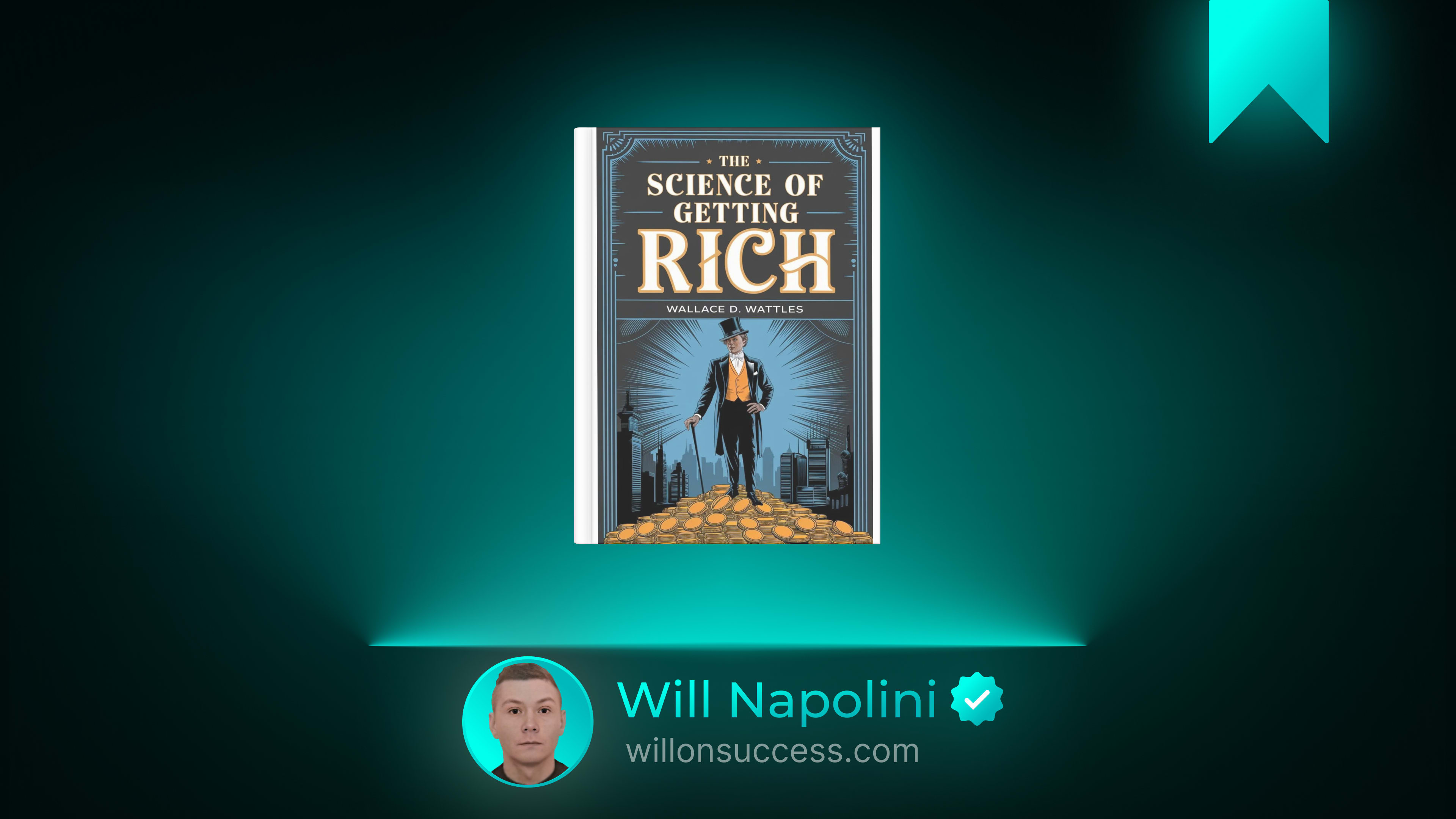
Wallace D. Wattles wrote a short book in 1910 called The Science of Getting Rich, and its central argument struck at exactly that lie. Not gently. He said, plainly, that getting rich is not about scrambling over other people. It is not about hoarding. It is not about being born into the right family or standing in the right place when luck passes by.
He said it is about learning to think and act in what he called “a Certain Way.” And that this way is available to anyone willing to practice it with patience and consistency.
Now, I want to be honest with you. Wattles wrote in the language of his era—metaphysical, sometimes sweeping, occasionally mystical. Some of his phrasing will feel strange if you have never encountered New Thought literature. But underneath the period language sits a set of principles that, once you translate them into plain terms, are remarkably practical. And remarkably relevant to the way you build a career, run a business, manage your money, and shape your daily life right now.
Let me walk you through what this book actually teaches, and more importantly, what you can do with it starting today.
The Big Idea: Wealth Is Built by Creating, Not by Competing
The single most important distinction Wattles draws runs through every page of this book. He separates two fundamentally different orientations toward the world.
The first is the competitive orientation. This is the mindset that says: resources are limited, so I must fight for my portion. I must be sharper, faster, more aggressive than the person next to me. Success means winning something that someone else wanted.
The second is the creative orientation. This is the mindset that says: I can bring something into existence that did not exist before. I do not need to take from anyone. I can add value where there was none, and in doing so, generate genuine wealth for myself and for the people around me.
Wattles insisted, repeatedly, that the creative path is not just morally preferable. It is more effective. He believed that competition traps you in a zero-sum struggle where your energy goes toward outmaneuvering others rather than building something new. Creation, by contrast, opens territory that no one else occupies. You are not fighting for a slice. You are baking a new loaf.
Think about that image for a moment. Two bakers in a town. One spends all his energy watching the other baker, trying to undercut his prices, poach his customers, whisper about his bread. The other baker simply walks into his kitchen before dawn and experiments. New recipes. New combinations. Bread the town has never tasted. Within a year, the second baker is not competing at all. The competition has become irrelevant because he is serving a demand that did not exist until he created it.
That is the shift Wattles is asking you to make. Not once. Daily.
The “Certain Way”: A Framework, Not a Magic Spell
Wattles uses the phrase “a Certain Way” throughout the book, and I think it is worth taking seriously without turning it into something mystical. What he means is this: there is a coherent sequence of thought and action that, practiced consistently, produces results. And there are ways of thinking and acting that, no matter how hard you work, produce frustration.
The Certain Way, as Wattles describes it, has several components working together:
You hold a clear mental image of what you want. Not vaguely. Not “I wish things were better.” A definite picture. What does the work look like? What does the life look like? What are you building? Wattles argued that vague desire produces scattered action. Clear vision gives every small decision a reference point.
You approach that image with gratitude rather than desperation. This is one of the ideas that sounds soft until you test it. Gratitude, in Wattles’ framework, is not about pretending everything is fine. It is about orienting your attention toward what is possible and what is already working, rather than fixating on what is missing. He believed—and I think experience confirms this—that a mind locked in resentment and fear cannot think creatively. It can only react. And reaction builds nothing lasting.
You act now, in the present, with full efficiency. Not someday. Not when conditions are perfect. Today. The action you take today does not need to be enormous. But it needs to be done well, with your full attention, and with the intention of creating value. Wattles was very specific that it is not the number of things you do but the efficiency and purpose behind each act that matters.
You direct your will at yourself, not at others. You do not try to coerce, manipulate, or pressure people into giving you what you want. You hold your vision, you do the work, and you let the results speak. Your will is for your own discipline, not for dominating your environment.
Your Daily Work Is Where the Philosophy Meets the Pavement
Here is where I want to slow down, because this is where most people read a book like this, nod along, and then change nothing.
Wattles argued that every single act, no matter how small, can be done in either the competitive spirit or the creative spirit. The cashier who treats each customer as a transaction to survive. The cashier who treats each interaction as a small act of genuine service. Same job. Same pay, at least at first. But one is grinding down. The other is building something—a reputation, a skill, a way of being in the world that compounds.
You might be reading this and thinking, “That sounds nice, but I have rent due. I have obligations. I cannot afford to be philosophical about my Tuesday morning.”
I understand. I would not ask you to ignore your obligations. But I would ask you to notice something. The frustration you feel in your work, the sense that you are running in place—how much of it comes from the actual work, and how much comes from the belief that you are trapped in a contest you did not choose and cannot win?
Because if even a portion of that frustration comes from the competitive frame—the constant comparison, the sense of scarcity, the feeling that you are always one step behind—then shifting even slightly toward the creative frame changes your experience. And over time, it changes your results.
A small decision becomes a direction, and a direction repeated long enough becomes a life.
What You Repeat in Private Becomes Visible in Public
One of the ideas Wattles returns to, and one I think is profoundly underrated, is the relationship between your inner mental life and your outer circumstances.
He does not argue that you can simply think a house into existence. Do not let anyone summarize this book that way. What he argues is more nuanced and more useful: that the quality of your thinking shapes the quality of your actions, and the quality of your actions, sustained over time, shapes the quality of your results.
If you spend your evenings rehearsing complaints, replaying failures, and narrating your own limitations, you are not being realistic. You are training yourself. You are building a mental environment that makes creative, confident action feel foreign.
If, instead, you spend even ten minutes each day clearly picturing what you are building—reviewing your goals, rehearsing your next move, feeling genuine gratitude for what you already have—you are laying a foundation. The building does not appear overnight. But the ground is being prepared. Every day. Quietly.
What you feed in the silence of your own mind eventually walks into the room with you. It shows up in how you speak in a meeting. In whether you raise your hand or stay quiet. In whether you send the email, make the call, start the project, or let another week slip by.
Enough Is Not a Fixed Number
Wattles pushes back against an idea that keeps people stuck: the belief that wanting more is somehow greedy, or that pursuing wealth means taking from those who have less.
He calls this out directly. He argues that you cannot truly serve others from a place of poverty and depletion. That developing your own capacities, resources, and influence is not selfish—it is the prerequisite for meaningful contribution. A person who is financially stable, skilled, and energized can help more people, more effectively, than a person who is drowning.
This does not mean wealth is the only measure of a life. It does not mean you should step over others to get ahead. Wattles is clear that the creative path requires you to give more in value than you take. Every transaction, every relationship, every job should leave the other person better off than they were before they met you.
But it does mean you are allowed to want more. You are allowed to build. You are allowed to outgrow your current circumstances without apologizing for it.
Permission matters. Many people never build the life they want because, somewhere deep down, they feel they are not supposed to want it. Wattles removes that guilt. He says: wanting a fuller, richer, more capable life is not a character flaw. It is the starting point.
Efficiency Beats Volume Every Time
One practical insight in this book that I think deserves far more attention than it gets: Wattles distinguishes between doing many things and doing things well.
He writes that it is not the number of acts you perform that produces results, but the efficiency of each act. A person who does ten things with full focus, clear purpose, and genuine care will outproduce a person who does a hundred things in a state of scattered anxiety.
I have seen this play out in every area of life. The entrepreneur who tries to launch five projects simultaneously and finishes none of them. The student who studies for eight hours but spends six of them checking a phone. The professional who fills every hour with meetings and then wonders why nothing meaningful got built.
You do not need more hours. You do not need more hustle. You need fewer, more intentional acts, each one done with the full weight of your attention and aimed clearly at what you are building.
One clean swing of the axe cuts deeper than twenty distracted chops.
Who Should Read This Book, and Who Might Skip It
If you are someone who feels stuck in a scarcity mindset—if you work hard but feel like you are always reacting, always behind, always competing for scraps—this book will speak to you. It is short. You can read it in an afternoon. And its central reframe, from competition to creation, can genuinely change the way you approach your career, your finances, and your creative work.
If you are an entrepreneur, a freelancer, or someone building something from nothing, the emphasis on creating value rather than fighting over existing markets will feel immediately relevant.
If you are drawn to practical, step-by-step financial planning—budgets, investment strategies, tax optimization—this is not that book. Wattles is dealing with the layer beneath the tactics. He is addressing the orientation you bring to your work before you ever open a spreadsheet. You will need other resources for the mechanics. This book is for the foundation.
And a fair warning: the language is dated. Wattles writes in the idiom of early twentieth-century metaphysical literature. Some readers find this charming. Others find it distracting. If you find yourself resisting the style, try reading it slowly, translating his ideas into your own words as you go. The substance is worth the effort.
What to Do With This, Starting Today
I do not want you to close this article and simply feel inspired. Inspiration without action is just a pleasant mood, and pleasant moods do not change lives.
So here is what I would suggest. A small experiment. Something you can do before the day ends.
Tonight, before you go to sleep, take a blank piece of paper and write down one clear picture of what you are building. Not a wish list. Not a complaint about what you lack. One specific image of the work, the life, the contribution you want to create. Three sentences are enough. Be concrete. What does it look like? Who does it serve? What does it feel like to be the person doing it?
Tomorrow morning, before you check your phone, before you open your email, read those three sentences aloud. Then choose one task—one small, concrete task—that moves you toward that picture. Not the biggest task. Not the most impressive task. Just the next task. And do it with your full attention, as though it matters. Because it does.
For the next seven days, catch yourself every time you slip into competitive thinking. Every time you measure your progress against someone else’s. Every time you think in terms of scarcity—”there is not enough,” “I will never catch up,” “they have what I want.” You do not need to argue with the thought. Just notice it. And then gently return your attention to what you are creating.
That is the practice. It is not dramatic. It will not make you wealthy by Friday. But it is the Certain Way that Wattles describes, translated into a life that looks like yours.
You start small. You stay consistent. You let time do its work.
The Door Is Open
Wattles wrote this book more than a century ago, and the world has changed in ways he could not have imagined. But the fundamental choice he describes has not changed. You can approach your life as a contest, scanning the room for threats, measuring yourself against every person who seems ahead of you, tightening your grip on what little you have. Or you can approach it as a creative act. You can decide that your energy is better spent building than fighting. That your contribution matters more than your comparison. That the richest version of your life is not something you take from someone else but something you grow, patiently, from the inside out.
You do not need permission to begin. You do not need the perfect plan. You do not need to see the whole staircase. You need one clear image, one honest act of gratitude, and one small step taken today with your whole attention.
The soil does not argue with the seed. It simply receives it, holds it, and does the quiet work of transformation in the dark.
Your turn. Plant something.