The Cat in the Hat by Dr. Seuss: What a Rainy Day and a Mischievous Cat Can Teach You About Chaos, Order, and the Secrets We Keep
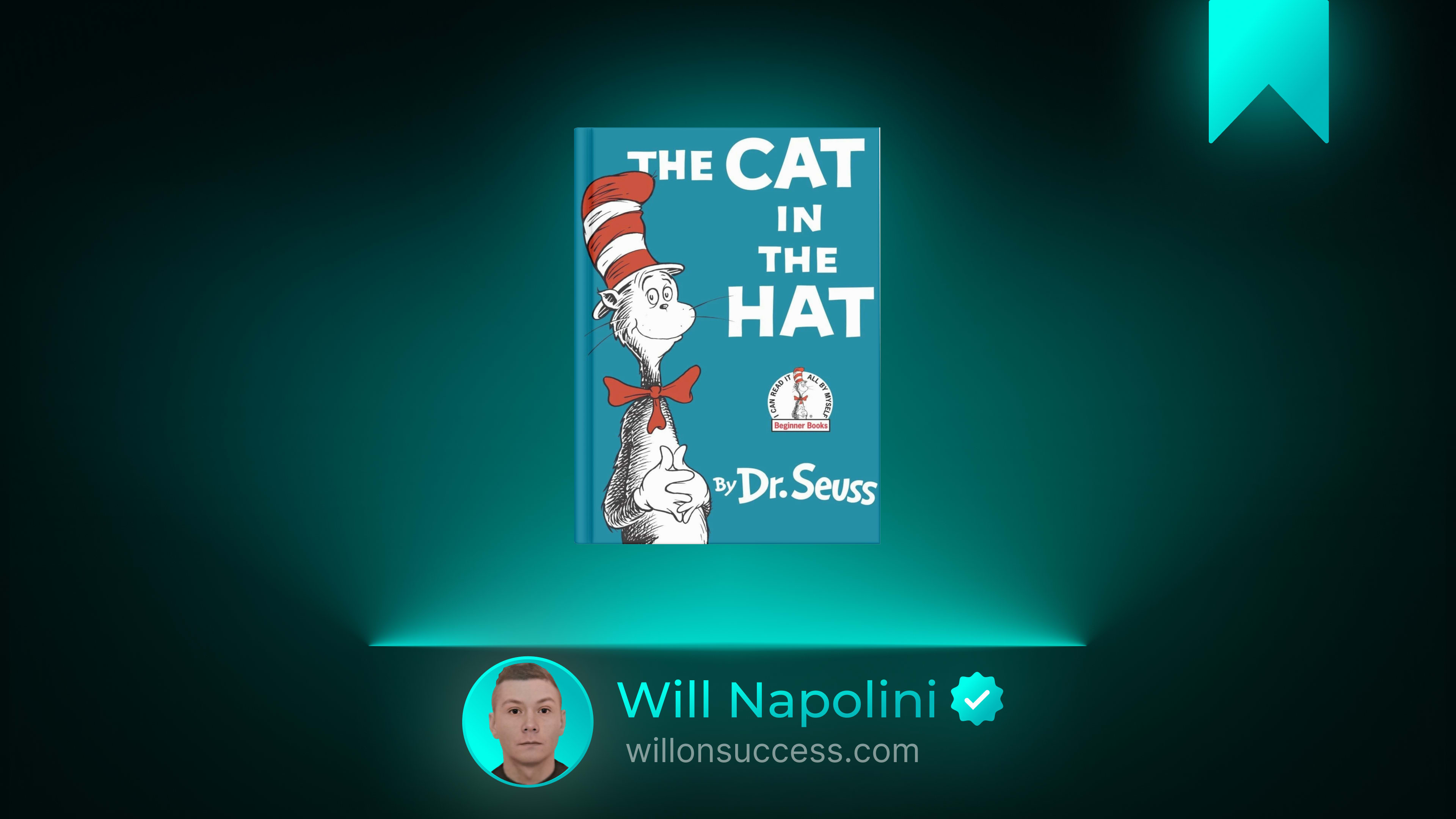
The sun did not shine. It was too wet to play.
We all know that feeling. Not just as children staring out a rain-streaked window, but as adults staring at a calendar that is full but feels entirely empty. You know the gray, stagnant, nothing-to-do feeling of a life that has become too predictable. You are sitting in your house, doing exactly what you are supposed to do, and yet you feel a quiet, creeping sense that you are missing out on your own life.
It is into this exact atmosphere of wet, cold boredom that Dr. Seuss introduces a giant, talking cat wearing a red-and-white striped hat.
Most of us read The Cat in the Hat when we were five years old. We loved the rhymes, the slapstick chaos, and the sheer joy of seeing a living room destroyed and magically repaired before Mom got home. But if you pick up the book today and read it with adult eyes, you will find something startling.
Beneath the anapestic tetrameter and the whimsical illustrations, Theodor Geisel wrote a profound psychological map. It is a story about the tension between order and chaos. It is a story about the anxious voice in your head that keeps you safe but bored. And it ends with one of the most challenging moral questions in modern literature.
Let us sit down and look at what this book is actually trying to tell you.
The Big Idea: You Need the Cat, but You Must Master the Things
The central thesis of The Cat in the Hat is not that rules are bad, nor is it that chaos is good. The thesis is that a life governed entirely by the rules is a life of gray stagnation, but a life surrendered to unchecked impulses is a life of rubble.
To live well, you have to learn how to invite disruption into your living room, let it break the spell of your boredom, and then—crucially—know exactly how and when to put the lid back on the box.
And once the mess is cleaned up, you have to decide what you are going to do with the truth.
The Story of the Wet, Cold Day
The setup is brilliantly simple. Two children, a boy and his sister Sally, are stuck inside on a rainy day. Their mother has gone out for the day. They are sitting quietly in their chairs, doing nothing.
Then, the Cat in the Hat steps inside.
Immediately, the family pet—a fish in a bowl—objects. The Fish tells the Cat to leave. The Cat ignores the Fish, balances a cake on an umbrella, and begins performing tricks. Eventually, the Cat brings in a red wooden crate and releases Thing 1 and Thing 2, who fly kites in the house, knock down pictures, and ruin the mother’s new polka-dot gown.
When the Cat realizes the mother is returning, he catches the Things, puts them back in the box, and uses a bizarre, multi-armed machine to clean the entire house perfectly. He tips his hat and leaves just as the mother walks through the door.
She asks the children if they had any fun. The children sit in silence. The book ends by turning directly to the reader and asking: What would you do if your mother asked you?
It is a masterpiece of narrative structure. Let us break down the three distinct forces at play in that living room, because they are currently at play in your life, too.
The Fish in the Bowl: The Voice of Anxious Compliance
Notice the Fish. The Fish never leaves the bowl. The Fish’s primary function in the story is to say, No. You should not be here. He should not be here. This is against the rules. We are going to get in trouble.
The Fish represents the voice of anxious compliance. It is your inner critic. It is the part of you that is hyper-vigilant about doing the right thing, following the protocol, and avoiding disaster.
We all have a Fish. And we need the Fish. The Fish is the reason you pay your taxes, show up to work on time, and look both ways before crossing the street. Anxiety is a highly effective guard dog.
But a guard dog makes a terrible master.
If you let the Fish run your life, you will never do anything new. You will never start the business, write the book, ask for the raise, or speak up in the meeting. The Fish will always point out that it is raining outside, that it is too wet to play, and that you should just sit quietly in your chair and wait for the day to end.
When the Cat balances a teacup on his nose, the Fish screams that he will fall. The Cat does fall, but he catches himself. The Fish’s job is to predict failure. Your job is to decide whether the risk of falling is worth the joy of the trick.
You must thank your Fish for its concern, and then gently tell it to stay in its bowl while you try something new.
The Cat in the Hat: The Architecture of Disruption
The Cat is the catalyst. He represents disruption, creativity, and the breaking of routine. He looks at the gray, miserable children and says, “I know it is wet and the sun is not sunny, but we can have lots of good fun that is funny.”
The Cat understands something essential about human nature: we cannot always wait for the weather to be perfect to begin living. Sometimes, you have to manufacture your own sunlight.
In your career and your personal life, the Cat is the project that scares you a little. It is the conversation you have been putting off. It is the decision to take a weekend trip to a city you have never seen, or to enroll in a class where you will be a beginner again. The Cat brings color into a monochromatic room.
But notice how the Cat operates. He is chaotic, yes, but his initial chaos is performative. He balances things. He plays games. He is testing the boundaries of the room. He is showing the children that the rules of their boring afternoon are not as rigid as they thought.
We need the Cat. A life with no Cat is a life of quiet desperation. But the Cat cannot be left in charge of the house indefinitely. Which brings us to the red wooden box.
Things One and Two: When Momentum Becomes Destruction
The turning point of the book happens when the Cat opens the crate and lets out Thing 1 and Thing 2.
Unlike the Cat, who has a sense of style and a top hat, the Things are pure, unbounded impulse. They do not speak. They do not perform tricks. They just run. They fly kites in the house. They knock the pictures off the wall. They destroy the mother’s dress.
This is what happens when we let our impulses run without the Cat’s direction.
You see this in businesses that scale too fast without infrastructure. You see it in relationships where people say whatever angry thought enters their head under the guise of “being authentic.” You see it in your own life when you start a new habit with intense, burning passion, work out for three hours a day, eat nothing but kale, and then burn out and quit by Thursday.
The Things represent momentum without a container. And momentum without a container is not liberation; it is just vandalism.
The most crucial moment in the book is not when the Things are released. It is when the Cat realizes they have gone too far. He catches them in a net. He puts them back in the box. He shuts the lid. He carries them out the door.
Knowing how to start the chaos is a skill. Knowing how to put the lid back on the box is wisdom. You must be the one to catch your own Things. You must know when the brainstorming session is over and it is time to execute. You must know when the passionate argument has made its point and it is time to apologize and repair.
The Cleanup and the Secret: The Weight of the Unasked Question
After the Cat cleans the house, the mother returns. She looks around. The house is spotless. The Fish is in his bowl. The children are sitting in their chairs.
She asks, “Did you have any fun? Tell me, what did you do?”
The children do not answer. They sit in silence.
And then Dr. Seuss breaks the fourth wall. He writes: Should we tell her about it? Now what should we do? Well… What would you do if your mother asked you?
I want to sit with that question for a moment, because it is the heaviest thing in the entire book.
Why didn’t they tell her? Because the truth would break the peace. The truth would result in punishment. The truth would disappoint the person they love most. So they choose the secret. They choose to maintain the illusion of order, even though they both know the living room was destroyed just ten minutes ago.
If I could sit across the table from you, I would ask you: What is the equivalent of the Cat’s mess in your life right now?
We all have moments where we have crossed a line, made a mistake, or let our Things run wild, and then we have frantically cleaned it up before anyone noticed. You fixed the error in the report before your boss saw it. You snapped at your partner, then bought them flowers and acted like nothing happened. You let a bad habit creep in, hid it from your friends, and presented a polished version of yourself to the world.
The Cat’s machine can clean the physical mess. But it cannot clean the psychological residue.
When you keep a secret to protect a relationship, you are actually building a wall in that relationship. The mother in the story loves her children, and they love her. But in that final moment, as she stands in the doorway asking a question they refuse to answer, there is a vast, invisible distance between them. They are no longer sharing the same reality.
A clean house built on a hidden secret is still a fragile house.
Who Should Read This Book
You should read this book to your children, obviously. It is a masterpiece of rhythm and imagination, and it will delight them.
But you should also read it to yourself.
Read it when you feel stuck in a rut and your inner Fish is telling you it is too late, too risky, or too wet to try something new. Read it when you feel your life spinning out of control and you need to be reminded that you have the power to put the lid back on the box.
And read it when you are carrying a secret that is making you feel lonely in a crowded room.
If you are looking for a complex, multi-layered literary drama, this is not it. It is a children’s book. But do not mistake simplicity for shallowness. The deepest truths are often the ones that can be explained to a five-year-old.
One Small Step
I am not going to ask you to dismantle your entire life today. I am just going to ask you to look at the bowl, the hat, and the box.
Here is your small step for this week: Identify one small mess you have cleaned up and hidden, and tell the truth about it.
It does not have to be a massive, life-altering confession. It can be incredibly small. Tell your colleague, “I actually struggled to understand that last email, could you walk me through it again?” instead of pretending you got it. Tell your spouse, “I was feeling really overwhelmed and snapped at you earlier, I am sorry,” instead of just letting the awkward tension fade away. Tell a friend, “I am actually not doing as well as I said I was.”
Practice putting the truth on the table before the mother comes home.
You will find that the world rarely ends when you tell the truth about a small mess. In fact, you will usually find that the person across from you lets out a long breath, because they have been hiding a mess of their own.
You do not have to live in the gray, wet stagnation of the Fish. And you do not have to live in the destructive rubble of the Things. You can invite the Cat in. You can play. You can make a mess.
Just make sure you know how to clean it up, and more importantly, make sure you are brave enough to tell the truth about the fun you had.
The sun will eventually shine again. But what you do while it is raining is entirely up to you.