The Good Soldier Švejk by Jaroslav Hašek: The Quiet Genius of Surviving an Absurd World Without Losing Yourself
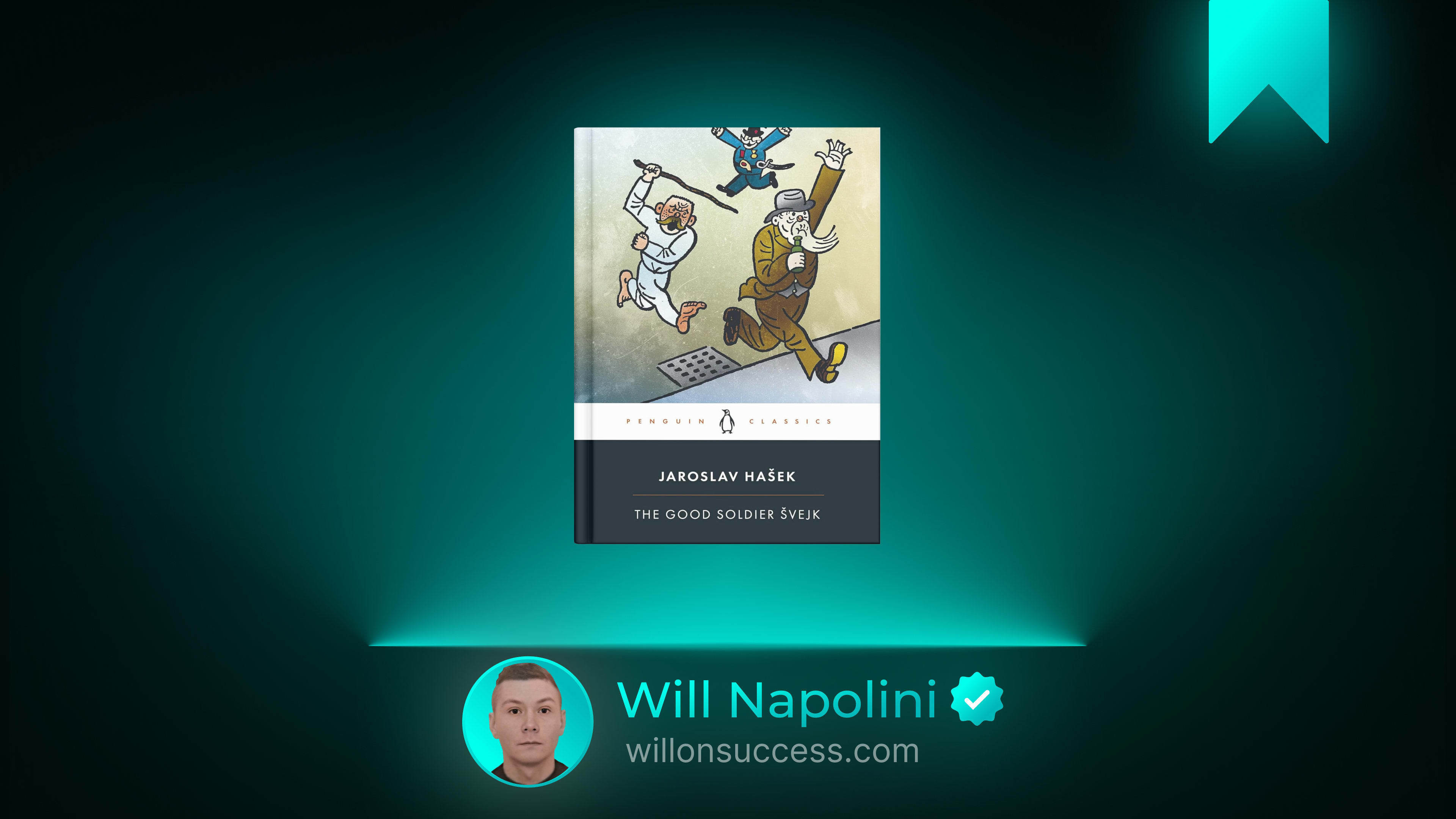
There is a question hiding inside Jaroslav Hašek’s great comic novel, and it is a question I think you have felt in your own life, probably more than once, though you may not have had words for it:
When the system around you has gone mad, what does sanity actually look like?
And its quieter companion: Can you survive inside an absurd machine without becoming part of it?
The Good Soldier Švejk—formally titled something like The Fateful Adventures of the Good Soldier Švejk During the World War—was published in Prague between 1921 and 1923. Hašek, a journalist, humorist, and itinerant troublemaker, died before finishing the fourth volume. What he left behind is unfinished, sprawling, often chaotic, and arguably the funniest anti-war novel ever written.
It is also, beneath the laughter, one of the most serious books I have encountered about what it costs to remain a human being inside an institution that has stopped being interested in human beings.
If you have ever sat in a meeting where everyone nodded at something that made no sense, or followed a procedure that clearly served no purpose, or watched someone be punished for telling the truth while the people who created the mess were promoted—if you have lived any of that—this book will feel uncomfortably, beautifully familiar.
The Big Idea: The Only Sane Response to an Insane System Might Look Like Idiocy
The novel’s central device is Josef Švejk, a Czech dog-catcher and former soldier who is called up to serve in the Austro-Hungarian army during World War I. Švejk has been officially declared an idiot by a medical commission. He talks too much. He agrees with everyone enthusiastically. He tells long, wandering stories at the worst possible moments. He follows orders with such literal, cheerful precision that they collapse into absurdity.
And here is the question the book never fully resolves, the question that gives it its strange, enduring power: Is Švejk actually an idiot? Or is he the only person in the entire army who sees the situation clearly?
Hašek never answers. That is the point. In a world where generals send millions of men to die for a few meters of mud, where officers demand loyalty to an empire that treats them as disposable, where the entire apparatus of authority runs on the assumption that you will not think—maybe the distinction between genuine foolishness and radical clarity stops mattering. Maybe they look the same from the outside. Maybe that is the joke, and maybe the joke is on everyone except Švejk.
The book’s deepest argument, if I can put it plainly, is this: a system that punishes honesty, rewards blind compliance, and treats individual thought as a threat will eventually make sanity indistinguishable from madness. And the person who appears to fit most perfectly inside such a system may be the one who is most completely free within it.
The Story: A Man Walks Through a War and Never Stops Talking
The plot, such as it is, follows Švejk from the moment the Archduke Franz Ferdinand is assassinated—Švejk hears the news in a Prague pub and offers a cheerfully confused commentary—through his arrest, his brief stay in an asylum, his re-enlistment, his service as an orderly to the army chaplain Katz (a drunk who loses Švejk in a card game), his transfer to Lieutenant Lukáš, and his long, wandering journey toward the front, during which he is arrested, lost, and repeatedly mistaken for a spy, a deserter, or an imbecile.
Nothing Švejk experiences seems to trouble him deeply. He is arrested. He is released. He is yelled at. He agrees. He is sent somewhere. He walks. He tells a story about his cousin’s neighbor’s brother-in-law who once had a similar experience. People scream at him. He smiles. He keeps walking.
The people around him—officers, bureaucrats, doctors, chaplains—are the ones who are unraveling. They are the ones who drink too much, rage, scheme, and collapse under the weight of the system they serve. Švejk simply flows through it all like water through a broken pipe, shapeless, unstoppable, somehow intact.
Hašek himself lived something like this. He was a wanderer, a journalist, a drunk, a political activist, a man who was imprisoned, conscripted, captured, and who switched sides during the war. He wrote parts of Švejk in taverns, sometimes dictating to friends. The book’s shaggy, digressive, never-quite-coherent structure is not a flaw. It mirrors the world it describes. It mirrors the experience of being a small person inside a vast, indifferent machinery that does not care whether you understand it.
The Wisdom of Not Arguing with a Wall
One of the things I have learned in my own life—and the thing Švejk embodies without ever seeming to try—is that you cannot always reason your way out of an unreasonable situation. Sometimes the system is not interested in your logic. Sometimes the authority figure does not want your explanation. Sometimes the procedure exists not to solve a problem but to perpetuate itself.
In those moments, the instinct to argue, to prove you are right, to make them see—to demand that the wall acknowledge it is a wall—can cost you everything. Your energy. Your position. Your peace. Sometimes your safety.
Švejk’s method is different. He does not fight the wall. He does not pretend the wall is not there. He simply does not give the wall the satisfaction of being resisted. He agrees. He complies. He tells a story. He becomes so thoroughly, cheerfully compliant that the machinery has nothing to grip. You cannot crush someone who offers no resistance, because there is nothing to push against.
Now, I want to be careful. I am not telling you to become a doormat. I am not saying that every unjust situation should be met with a smile and a shrug. There are moments that demand confrontation, that demand you say no clearly and bear the consequences. Courage is real, and sometimes it is necessary.
But there is another kind of courage that is quieter and harder to recognize. The courage of preserving your inner freedom without announcing it. The courage of not letting the system define your self-worth. The courage of remaining kind, observant, and intact in a place that is actively trying to grind those qualities out of you.
Švejk’s genius is that he never lets the army tell him who he is. They call him an idiot. He smiles. They give him absurd orders. He follows them so literally they become farce. They try to make him small, and he becomes so small he slips through their fingers.
You do not have to be in a war to need this. You need it in the office where a manager takes credit for your work. You need it in the family gathering where the same old argument recurs every December. You need it in any institution that asks you to sacrifice your clarity in exchange for your belonging.
Storytelling as an Act of Freedom
There is something else Švejk does that I find genuinely profound, and it is this: he never stops telling stories. In every situation—arrest, interrogation, train journey, being yelled at by a colonel—he produces a long, winding anecdote about someone he once knew. The stories are often irrelevant. They go nowhere. They exasperate everyone around him.
But they are also, I think, an assertion of self. In a system that wants to reduce you to a number, a rank, a function, a body that moves when told to move—telling a story is an act of saying, I am a person. I have a memory. I have a perspective. I am not merely the thing you need me to be right now.
You can see this in your own life. The colleague who keeps a sense of humor during a brutal restructuring. The parent who tells a ridiculous story at the dinner table after a day of bureaucratic nonsense. The friend who sends you a voice message that rambles for four minutes about nothing in particular but makes you laugh until your ribs ache.
These are not trivial things. In a world that increasingly wants to treat you as a unit of production, a data point, a consumer profile, a task to be completed—maintaining your narrative, your humor, your weirdness, your specificity—is a form of resistance. A gentle one. But real.
What you repeat in your private hours eventually shapes how you meet the world. And if what you repeat is laughter, story, connection, the small insistence on being a full human being rather than a function—then the system has not fully won. Even if it looks like it has.
The Cost of Taking the Machinery Seriously
Hašek’s novel is full of officers, bureaucrats, and authority figures who are destroying themselves. They drink. They rage. They scheme for promotions that will never come. They enforce rules they know are pointless because not enforcing them would mean admitting the whole structure is hollow. They are trapped not by the system but by their investment in the system’s legitimacy.
This is the part of the book that I find most relevant to modern work life, to institutional life, to any structure that asks you to treat its internal logic as sacred.
You have seen these people. Maybe you have been one of them. The manager who enforces a policy he privately thinks is stupid because his identity is built on being the person who enforces policies. The professional who cannot leave a career that makes them miserable because leaving would mean admitting they spent ten years on something that did not matter. The person who defends an institution’s failures because questioning them would unravel the story they have told themselves about their own choices.
Švejk is free because he never made that bargain. He never staked his identity on the army’s approval. He never needed the system to make sense in order for his life to make sense. And so when the system is absurd, he simply notes it, in his roundabout way, and continues being himself.
You do not have to quit your job to do this. You do not have to burn the institution down. But you can quietly, privately, stop asking the system to validate your worth. You can do good work and release your grip on whether the work is recognized. You can participate without worshiping. You can be in the machine without being of it.
That separation—being in without being of—is one of the hardest things a person learns. And one of the most liberating.
Laughter Is Not Frivolity. It Is Survival.
I want to say something about the fact that this book is funny. Genuinely, deeply, sometimes painfully funny. Hašek wrote it as comedy. The episodes are absurd. The dialogue is ridiculous. Švejk’s cheerfulness in the face of catastrophe is comic.
But the laughter is not decoration. It is the book’s argument. Hašek is saying that in the face of a world that has lost its mind, that sends young men to die for the pride of emperors, that grinds individuals into paste and calls it duty—the most honest response might be to laugh. Not because the suffering is not real. But because the alternative—taking the machinery’s own self-importance seriously—means accepting its premise. And its premise is a lie.
You are allowed to laugh at the thing that is trying to make you small. You are allowed to find the absurdity in the meeting that could have been an email, in the form that asks you to confirm your existence, in the rule that exists only to justify the position of the person who enforces it. You are allowed to see it clearly and smile, even while you comply, even while you navigate, even while you do what is necessary to survive the day.
Laughter does not solve the problem. But it keeps you from becoming the problem. It keeps a small space inside you that the system cannot reach. And that space is where your actual life lives.
Who Should Read This Book
The Good Soldier Švejk is for you if you have ever felt ground down by bureaucracy, by institutional absurdity, by the sense that you are living inside a script written by someone who has never met you. If you appreciate humor that has teeth. If you like novels that wander, digress, and refuse to be tidy.
It is especially resonant if you work in a large organization, if you have navigated military or government structures, if you have ever been told to follow a procedure that obviously makes no sense and felt your soul quietly leave your body.
It may be less suited for readers who want tight plotting, clear narrative momentum, or a neat resolution. The book is episodic, unfinished, and deliberately shaggy. It does not build toward a climax. It accumulates. It rambles. It mirrors the experience it describes.
It is also worth noting that the book is deeply rooted in Czech and Austro-Hungarian culture, in the specific humor and history of that place and time. Some of the references will pass you by. That is fine. The emotional truth translates. The absurdity translates. Švejk translates.
And a word of honesty: the novel can be slow in stretches. Hašek’s digressions are part of the method, but they also require patience. Give it a chapter. If Švejk’s voice hooks you, stay. If it does not, set it down and try again in a different season. Some books meet you at a specific moment.
One Small Step
Here is what I would invite you to do today.
Think about one small absurdity in your current routine. A rule, a procedure, a recurring interaction that you have been treating with a seriousness it does not deserve. Something you have been white-knuckling through as if your survival depended on it, when in truth it is just the machinery doing what machinery does.
And instead of tensing up, instead of rehearsing your frustration, instead of letting it occupy an hour of your inner life—give yourself permission to see it clearly. To notice the absurdity. To let a small, private smile cross your face. To say to yourself, Yes. This is what this is. And I will do what I need to do, and then I will go home and be a person.
You do not have to fix the system. You do not have to file a complaint or stage a revolution. You just have to stop letting the system’s self-importance become your self-importance.
You are not the procedure. You are not the org chart. You are not the email chain that could have been a sentence. You are the person who notices the absurdity, who tells the story at dinner, who laughs, who walks home, who remains stubbornly, quietly, irrevocably yourself.
And that stubbornness—that gentle, smiling refusal to be reduced—is the oldest and most human form of freedom there is.
Švejk knew it. You can learn it.
The door is not locked. It never was. You just have to stop pretending the wall is something more than a wall, walk around it, and keep telling your stories on the other side.