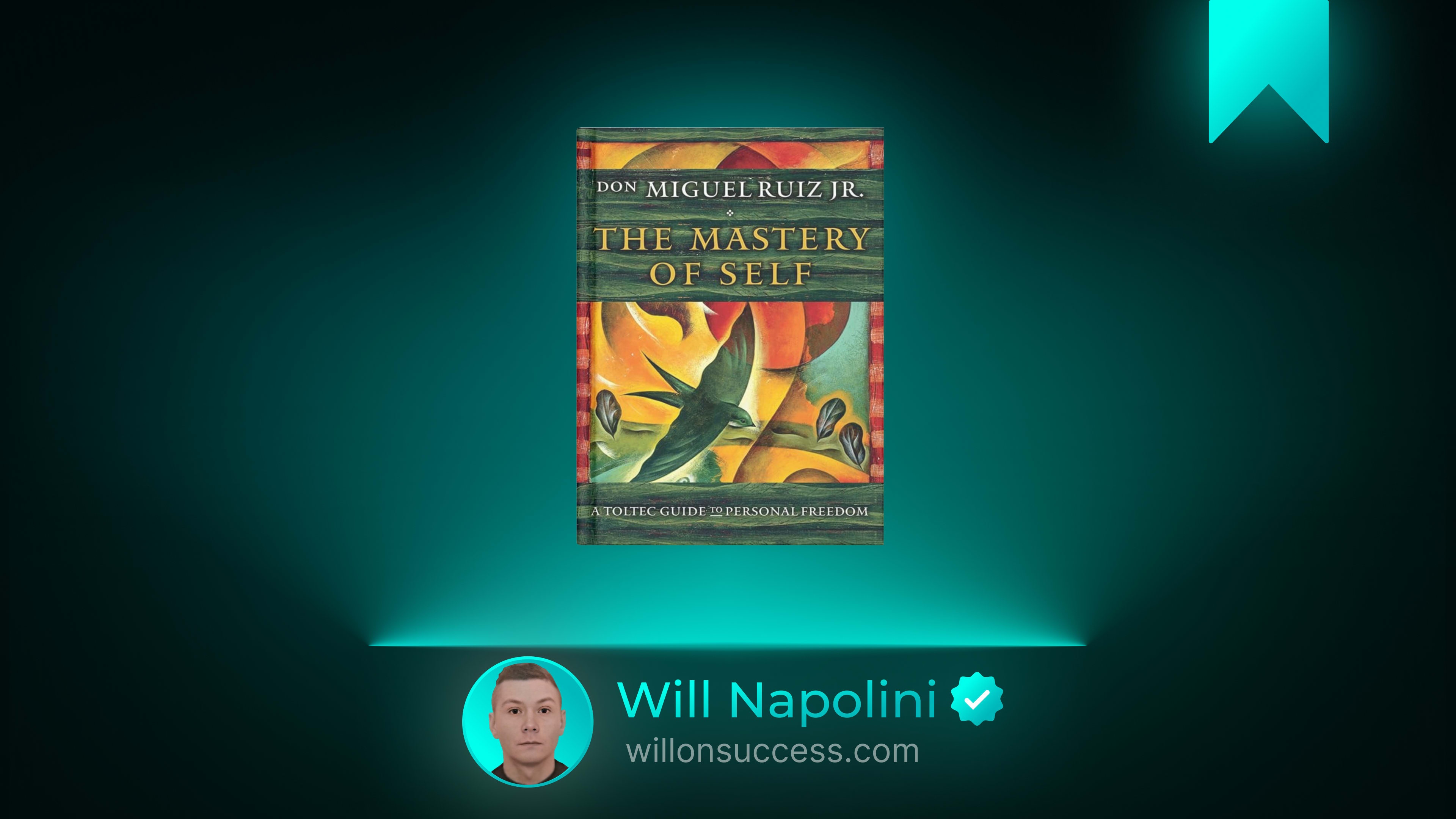
The Mastery of Self by Don Miguel Ruiz Jr. – The Person You Perform Is Not the Person You Are
You have been performing yourself for so long that you have forgotten it is a performance.
Not in a theatrical way. Not in a dishonest way. But somewhere, early on, you assembled a character. You gave it a name, a personality, a set of acceptable reactions, a list of things it could and could not want. You built this character to earn love, to avoid punishment, to fit inside the narrow space that the adults around you had available. And then you stepped inside it, pulled the seams closed, and said, This is who I am.
Decades later, the character is still running the show. And you are exhausted in a way you cannot fully explain, because maintaining a performance never stops costing energy, even when the audience left the room years ago.
The Mastery of Self by Don Miguel Ruiz Jr. is a book about that exhaustion. More precisely, it is a book about what lives underneath it. Writing from the Toltec wisdom tradition his family has carried for generations, Ruiz Jr. asks a question that sounds simple and is anything but: Who are you when you are not performing for anyone?
I have sat with this question for a long time. I do not think I have finished sitting with it. But what I can tell you is that the asking changes the ground under your feet. And this book is one of the clearest, most compassionate guides I have found for that particular asking.
The Character You Built to Survive
The central teaching of The Mastery of Self is this: the identity most of us walk around inside is not our true self. It is a construction. A carefully assembled image, built in childhood, reinforced by culture, maintained by fear, and protected by an inner judge that punishes us every time we step outside its boundaries.
Ruiz Jr. describes this construction with clarity. As children, we needed love, safety, and belonging. We did not yet have the capacity to evaluate the conditions attached to those things. So when a parent rewarded compliance and punished curiosity, we learned: Curiosity is dangerous. Compliance is safe. When a teacher praised stillness and corrected loudness, we learned: My natural energy is wrong. I must shrink to be acceptable. When a culture told us what success looked like, what a good person looked like, what a man or woman should be, we absorbed those images as though they were laws of nature.
Over time, thousands of these small lessons consolidated into what Ruiz Jr. calls a kind of internal rulebook—a set of agreements about who you are permitted to be. You did not write this rulebook. It was written for you, by people who were themselves operating from their own unexamined rulebooks. But you adopted it completely, because the alternative—being rejected, abandoned, unseen—felt like death to a small child. And in a very real sense, for a small child, it was.
The result is that most adults walk through life governed by a character they did not consciously design, defending a self-image they did not choose, and punishing themselves through an inner voice they mistake for their own conscience. Ruiz Jr. does not say this to shame you. He says it so you can see the mechanism. Because you cannot dismantle what you cannot see.
The Inner Judge and the Endless Trial
One of the most piercing ideas in the book is the figure Ruiz Jr. calls the inner judge. This is not a metaphor stretched thin. If you pay attention to your own mind for even a few honest minutes, you will find the judge sitting there. It narrates. It compares. It condemns. It rehearses old failures as though they happened this morning. It measures you against a standard you never agreed to and finds you wanting, daily, without appeal.
The judge works in tandem with what Ruiz Jr. describes as the victim—the part of you that accepts the judge’s verdict, that believes the punishment is deserved, that whispers you are not enough and calls it truth. Together, the judge and the victim form a closed loop. The judge sentences. The victim accepts. You live inside the courtroom, and the trial never adjourns.
Here is what I have learned, and what I think Ruiz Jr. is pointing toward with great care: you are not the judge. You are not the victim. You are the awareness that can notice both. That distinction is not a philosophical nicety. It is the hinge on which self-mastery turns. The moment you can observe the judge speaking—You should have done better. You are falling behind. They will see through you—and recognize it as a voice rather than as the truth, the courtroom loses some of its authority. You do not have to silence the judge today. You just have to stop mistaking it for yourself.
This is not easy. I want to be honest about that. The judge has been speaking in your ear for decades. It knows your particular wounds. It knows exactly which sentence will make you flinch. Disentangling yourself from it is not a single afternoon’s work. It is a practice, revisited again and again, each time with a little more distance, a little more compassion, a little less automatic belief.
The Warrior’s Path Is Inward
The Toltec tradition speaks of the warrior, and Ruiz Jr. carries that language into this book. But the warrior he describes is not conquering the world. The warrior is conquering the illusions inside their own mind. The battle is not against other people, not against circumstances, not against bad luck. The battle is against the agreements that keep you small, the fears that keep you performing, the stories that keep you imprisoned in a character that no longer fits.
This reframing matters. Most of us spend enormous energy trying to change our external circumstances—the job, the relationship, the bank account, the body—while the internal architecture that generates our experience remains untouched. We rearrange furniture in a house whose foundation is cracked. Ruiz Jr. is interested in the foundation.
The warrior’s discipline, in this context, is the discipline of attention. It is choosing, repeatedly, to look at what is true rather than what is comfortable. It is asking, Do I actually believe this, or am I repeating it because it was handed to me? It is being willing to feel the discomfort of uncertainty rather than retreating into the familiar story, even when the familiar story hurts.
I think of it like clearing a field that has been overgrown for years. You do not set fire to the whole thing in one afternoon. You pull one weed. Then another. You work a small section. You come back the next day and work another. Some roots go deep and resist. You do not yank them violently; you loosen the soil around them first. Slowly, patiently, the ground opens. And what was hidden underneath—good soil, living soil, soil that can grow something true—begins to appear.
That is the warrior’s work. It is not glamorous. It is not fast. But it is real.
Self-Love as Foundation, Not Reward
A principle that runs through The Mastery of Self like a river through a valley is this: you cannot master a self you despise. You cannot build freedom on a foundation of self-rejection. And yet most of us attempt exactly that. We try to improve, optimize, discipline, and transform ourselves from a starting position of I am not good enough as I am, so I will become acceptable through effort.
Ruiz Jr. challenges this sequence. In the Toltec framework as he presents it, self-love is not the reward you earn after you have fixed yourself. It is the ground from which honest seeing becomes possible. You cannot look clearly at your own patterns, your own fears, your own inherited agreements, if the act of looking is accompanied by a constant verdict of guilt. You will flinch away from the truth every time, because the truth will be used as ammunition by the inner judge.
Self-love, here, does not mean complacency. It does not mean pretending everything is fine. It means extending to yourself the same basic dignity you would extend to a friend who came to you confused and hurting. It means saying, I see what is here. I do not look away. And I do not condemn myself for what I find.
I have seen this shift change everything in a person’s inner life. When the relationship with yourself moves from prosecution to companionship, the work of growth stops being an act of violence and becomes an act of care. You change not because you hate what you are but because you are curious about what you might become. That is a different fuel. It burns longer. It burns cleaner.
Releasing the Need to Be Seen a Certain Way
Another thread woven through the book is the cost of living for an audience. Ruiz Jr. explores how much of our constructed self exists to manage other people’s perceptions. We shape our words, our ambitions, our emotions, even our bodies, around an imagined gallery of observers whose approval we need to feel real.
The exhaustion I mentioned at the beginning often comes from here. Not from the work itself. Not from the difficulty of the task. From the constant, low-level labor of maintaining the image. What will they think if I say this? What will they think if I fail? What will they think if I want something different from what they expect? The performance never ends, because the audience is imagined, and an imagined audience is always present, always watching, always about to withdraw its approval.
Ruiz Jr. invites you to notice what would happen if you set the audience down. Not if you became reckless or cruel. Not if you stopped caring about other people entirely. But if you released the need to be seen a certain way in order to feel that your existence is justified. What would you choose if no one were keeping score? What would you say if the gallery were empty?
That question is not rhetorical. It is diagnostic. The gap between your answer and your current life is the gap the book is asking you to close.
What This Looks Like on a Difficult Thursday
Let me bring this down to the ground, because I know how easy it is to read ideas like these and nod along and then return to the same Thursday you left.
It looks like this. You are in a meeting and you have an idea, but the old character whispers, If you speak, you will sound foolish. Stay quiet. Stay safe. You notice the whisper. You recognize it as the voice of a ten-year-old who was corrected in front of a class. You speak anyway. Your voice shakes. That is fine. You spoke.
It looks like catching yourself apologizing for taking up space, for having a need, for existing in a room. And pausing. And asking, Whose rule says I must be smaller? And then, gently, not shrinking.
It looks like a quiet evening where you sit with the discomfort of not knowing who you are when you are not performing, and you do not reach for your phone to fill the silence. You let the not-knowing be there. You let it be strange. You let it be the first honest moment of the day.
None of this is dramatic. None of it will be applauded. But it is the actual work of dismantling a character that was never yours to carry. And I promise you, the weight you set down, even a small portion of it, changes the way you walk through the rest of your week.
Who Will Benefit Most from This Book
The Mastery of Self will resonate most deeply with readers who feel a persistent sense of inauthenticity—who sense they are living a life shaped more by obligation and expectation than by genuine desire. If you have achieved things that look good from the outside but feel hollow from the inside, this book speaks to that specific ache.
It will also serve anyone who struggles with a harsh inner critic. The book’s treatment of the inner judge and the cycle of self-punishment is among its most practically useful contributions. If you are your own worst enemy and you know it but cannot seem to stop, Ruiz Jr. offers a framework for understanding why, and a path toward loosening the pattern.
Readers who prefer highly structured, step-by-step programs may find the book’s contemplative pace challenging. This is not a workbook. It is a mirror. It asks you to look, to reflect, to sit with discomfort, and to make changes from the inside out. If you need external scaffolding to stay engaged, you may want to pair it with a more structured practice or journaling system.
What makes the book genuinely valuable, beyond the ideas themselves, is the tone. Ruiz Jr. writes with the patience of someone who has walked this path and knows how long it takes. He does not rush you. He does not shame you. He walks beside you and points at things and says, Look. Do you see? That gentleness, in a genre that often shouts, is itself a kind of teaching.
One Practice to Begin Tonight
I am going to give you one exercise. Not five. Not ten. One. Because the point is not to accumulate tasks. The point is to begin.
Tonight, find ten minutes where you will not be interrupted. Sit comfortably. Close your eyes if that helps. And ask yourself this single question:
What am I performing right now that I would stop if I were not afraid of being seen?
Do not rush the answer. Let it surface. It might be a relationship you maintain out of guilt. A career path you chose to impress someone. A personality trait you exaggerate because it gets approval. A dream you have buried because the character you built has no room for it.
Whatever arises, do not judge it. Do not fix it tonight. Just look at it. Just say, Ah. There you are. I see you.
Then open your eyes. Go make tea. Go wash the dishes. Go sleep.
But carry the seeing with you. Because the character loses power in the exact proportion that you can look at it without flinching. And you just looked. That is the first step of the warrior’s path. Not a conquest. A glance. An honest, quiet, unhurried glance at what is true.
You Were Never the Mask
Ruiz Jr. is pointing, in the end, toward something that is both very simple and very difficult to accept: you were never the mask. You were never the character. You were never the performance, the image, the carefully managed impression. All of that was built to protect something tender and real underneath, and it did protect it, for a while. You do not owe it your resentment. It served its purpose.
But you are not a child anymore. You do not need the armor to be so thick. You do not need the script to be so rigid. You do not need to earn the right to exist by performing a version of yourself that was designed by committee, decades ago, in a world you have outgrown.
The self underneath all that construction is not something you have to create. It is something you have to uncover. And uncovering is not addition. It is subtraction. It is setting down what was never yours. It is releasing the agreements that have expired. It is letting the performance end, not with a dramatic exit, but with a quiet exhale and the simple, radical decision to stop acting.
You do not have to figure out who you are tonight. You do not have to have the whole new life mapped. You just have to be willing to let the old one be seen for what it is. A construction. A draft. A set of clothes you outgrew years ago but kept wearing because changing felt too exposed.
Take off one layer. Just one. See what the air feels like against skin that has not breathed in a long time.
That breath is yours. It always was. You just forgot to take it.
Take it now.