The Lovely Bones by Alice Sebold: What a Dead Girl Teaches Us About Living
There is a question most of us never ask until we are forced to ask it: What do you do with the space where someone used to be?
Not the practical question. Not the logistics of funerals, of paperwork, of telling relatives. I mean the deeper question. The one that arrives at two in the morning when the house is quiet and the absence has a weight to it, almost a texture. What do you do with that space? Do you seal it off? Do you build a shrine around it? Do you pretend it is not there and keep walking?
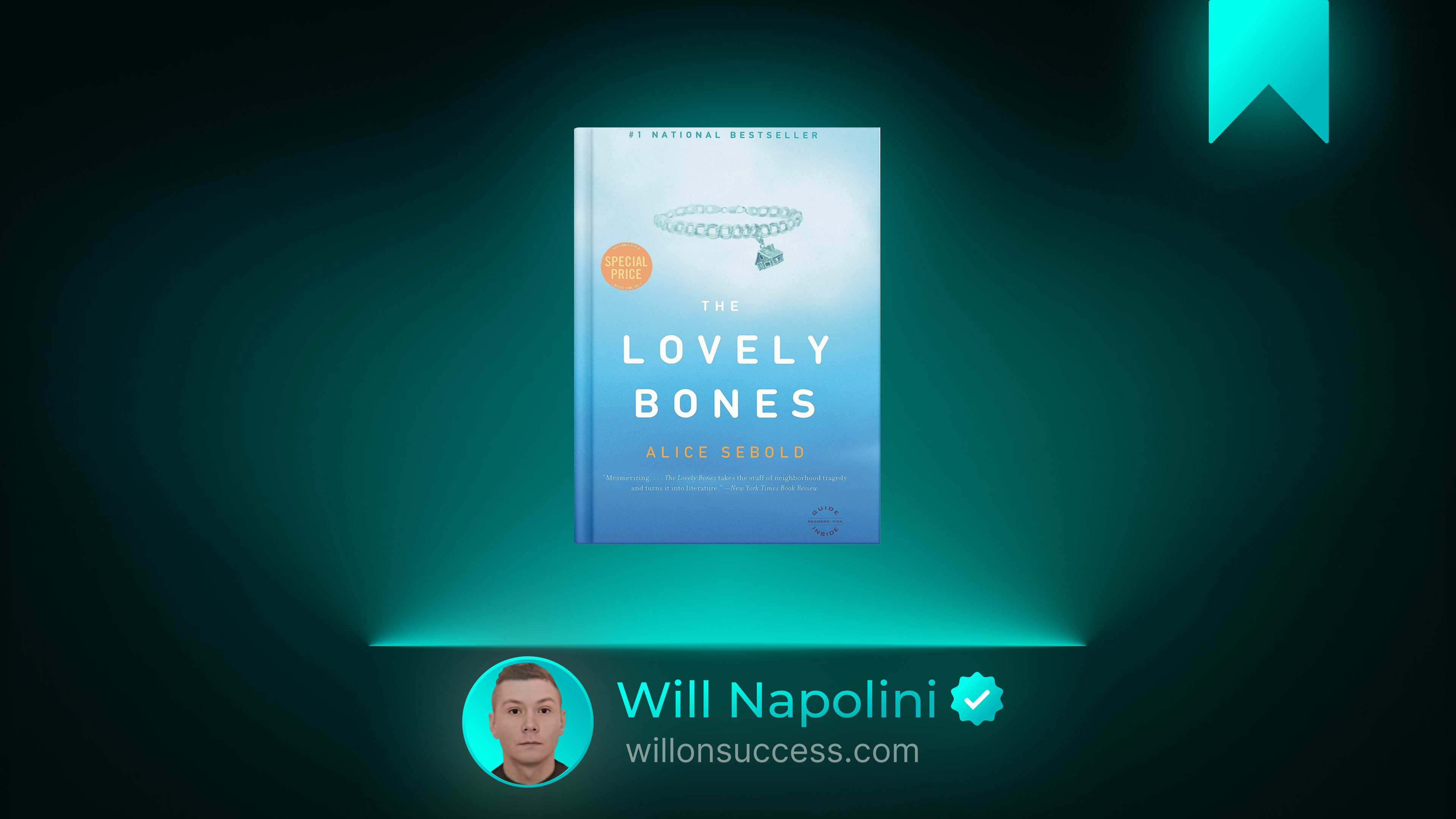
Alice Sebold’s 2002 novel The Lovely Bones sits inside that question for three hundred pages. And what it offers is not an answer, exactly. It is something more useful than an answer. It offers a way of seeing.
The narrator is fourteen-year-old Susie Salmon. She has been murdered in the opening pages. She tells her story from a personal heaven tailored to her adolescent longings—popsicles that never melt, a gazebo, a sky the color she wishes it could be. From there, she watches. She watches her family shatter. She watches her father obsess over finding her killer. She watches her mother pull away, suffocating under the weight of staying in a house shaped like a wound. She watches her younger sister grow up in the shadow of a ghost. She watches her friends try to continue being teenagers in a world that no longer makes sense.
And slowly, painfully, she watches them begin to live again.
This is not a comfortable book. I want to be honest with you about that. If you have lost someone—especially suddenly, especially violently—some passages will land like a hand pressed against a bruise. Sebold does not sanitize grief. She does not tidy it into a five-stage process with a resolution at the end. What she does, though, is something I have found rare and precious in any story about loss: she shows you that the living are allowed to keep living. That this is not betrayal. That it is, in fact, the only honest tribute available to us.
The Central Idea: Life Grows Around the Absence
The title is the thesis. “The lovely bones” are not Susie’s physical remains. They are the structures of connection, memory, and new life that gradually build up around the void her death creates. Sebold suggests that loss does not simply subtract from a life. It reshapes it. New rooms appear. New doors open that would never have existed otherwise. Not because the loss was good. Not because suffering is a gift. But because human beings are, stubbornly and beautifully, creatures who continue.
I think this is one of the hardest ideas to accept when you are inside grief. When you are in the first weeks, the first months, the idea that anything could “grow around” the absence feels like an insult. You want the person back. You do not want a garden where they stood. You want them.
And that is valid. That anger, that refusal, is part of the process. Sebold does not skip it. Susie rages from her heaven. She wants intervention. She wants someone to fix what was done. She watches her father’s obsession with justice and she understands it, because she wants it too.
But the novel’s arc bends, slowly, toward something else. Toward the recognition that the dead cannot be restored, but the living can be rebuilt. Not to what they were. To something new. Something that carries the absence honestly without being consumed by it.
If I could sit across the table from you right now, and if you are carrying a loss you have not yet made peace with, I would tell you this: you do not have to resolve it today. You do not have to “move on” on anyone’s schedule. But I would also tell you that moving forward is not the same as moving away. You can walk into your future and still carry them with you. The two are not opposites.
Grief Is Not a Shared Language—It Is a Private Dialect
One of the most quietly devastating things Sebold does is show how differently each member of the Salmon family grieves. There is no unified household mourning. There is no family meeting where everyone cries together and then heals in unison.
The father, Jack, channels his grief into pursuit. He becomes an investigator. He watches the neighbor he suspects. He builds a case in his mind. His grief looks like anger, like purpose, like a man trying to solve an unsolvable problem because the alternative—sitting still with the fact that his daughter is gone—would destroy him.
The mother, Abigail, grieves by withdrawing. She cannot bear the house. She cannot bear the room that still looks like Susie’s. She leaves. Not because she does not love her children. Because staying means confronting a reality she does not yet have the architecture to hold.
The younger sister, Lindsey, grieves by growing up too fast. By becoming watchful, tough, protective. By carrying responsibilities no child should carry.
And the grandmother, Lynn, arrives with wine and irreverence and a refusal to perform grief in the expected way, which infuriates everyone and saves the family in ways they cannot yet see.
What Sebold understands—and what I wish more people understood about loss—is that there is no correct shape for grief. Your partner may need to talk while you need silence. Your friend may need to return to routine immediately while you cannot get out of bed for a week. Your sibling may laugh at a memory while you are still crying, and that does not mean they loved the person less.
Grief is not a shared language. It is a private dialect. Each person speaks it differently, and the attempt to force everyone into the same grammar only adds guilt to the existing pain.
If you are supporting someone through loss, here is what I have learned matters most: do not correct their grief. Do not tell them they should be further along. Do not tell them they should be feeling something other than what they are feeling. Make space for their particular dialect, even if it is not yours.
The In-Between: Why We Need a Place That Is Not Yet Resolution
Susie’s heaven is not the traditional afterlife. It is personal, incomplete, a little adolescent. She does not have infinite wisdom. She still wants things. She still feels jealousy, frustration, longing. She is not at peace. She is in an in-between.
I find this profoundly honest. We talk about grief as though it has a destination. “You’ll get to the other side.” “Time heals all wounds.” “You’ll find closure.” And sometimes those things are partially true. But the reality I have seen, in my own life and in the lives of people I care about, is that there is a long in-between. A season where you are no longer in the acute shock but not yet in whatever comes after. A season where the loss is no longer the only thing you can see, but it is still the thing you see most clearly.
Susie’s heaven represents that in-between. It is not denial. It is not resolution. It is a space where the dead person can still watch, still care, still be present in some form while the living world continues its slow reconstruction below.
You may be in that in-between right now. You may have lost someone two years ago, five years ago, and you are not where you thought you would be by now. You expected to feel finished with it. Instead, a song plays in a grocery store and your chest tightens. Instead, a holiday arrives and the empty chair is still the loudest thing in the room.
You are not failing at grief. You are in the in-between. And the in-between is not a waiting room for some final answer. It is where the lovely bones grow. Slowly. Quietly. Without your permission and without your control.
Justice and Peace Are Not the Same Thing
A significant thread in the novel concerns Susie’s killer and whether he will be caught. Her father wants justice. Susie, watching from above, wants justice. The reader wants justice.
And I will not spoil the specific resolution for you, but I will tell you what the novel ultimately suggests: justice, in the human sense, is not always delivered. The legal system does not always close the loop. The person who caused the harm does not always face the consequence you need them to face.
And this is where the book asks something very difficult of its reader. It asks: Can you find peace even if justice never fully arrives?
I know how that sounds. I know it can feel like being asked to accept the unacceptable. And I am not asking you to forgive what should not be forgiven. I am not asking you to minimize what was done. But I have seen people spend twenty years building their entire emotional life around a wrong that was never righted, and what I have seen is that the wrong eventually becomes a second prison. The first prison was the event. The second prison is the refusal to live fully until the universe balances the ledger.
Sebold does not resolve this neatly. She lets the tension exist. But the family’s healing begins not when the killer is caught, but when they begin, tentatively, to build something beside the grief rather than only inside it.
What the Living Owe the Dead (And What They Do Not)
There is a moment in the novel’s trajectory—again, I will keep it general—that gestures toward a question every person who has lost someone eventually faces: How much of my life do I owe to the person who is gone?
Do I owe them my continued sadness? Do I owe them a refusal to be happy, because happiness would mean they are truly gone? Do I owe them a frozen life, a preserved room, an unchanged routine that keeps their absence as the central fact of my existence?
What Sebold suggests, gently and without sentimentality, is that the dead do not want our lives as tribute. Susie, watching her family, does not want them to stop. She wants them to live. She wants her sister to grow up. She wants her parents to find their way back to each other, or to whatever comes next. She wants the world to continue, even though she has been removed from it.
This is the hardest permission to grant yourself. The permission to be okay. The permission to laugh again, to love again, to build a Tuesday that is not organized around the loss. It feels, in the early days, like betrayal. Like you are saying the person did not matter enough.
They mattered. They matter still. And your living is not an erasure of that mattering. Your living is the only continuation available. The lovely bones grow because you let them grow. Because you water the soil beside the absence instead of staring only at the hole.
What This Looks Like on an Ordinary Tuesday
Let me bring this down from the philosophical to the practical, because I believe wisdom that cannot survive a Tuesday morning is not wisdom yet.
If you are in grief, or supporting someone in grief, here is what Sebold’s novel illuminated for me in practical terms:
Name the absence without letting it narrate your entire day. You can acknowledge the empty chair at breakfast and still eat breakfast. You can say their name out loud, feel the sting of it, and then wash the dishes. Both things are true simultaneously. The grief is real. The dishes still need washing. Neither cancels the other.
Let people grieve in their own dialect. If your partner needs to run every morning to process, let them run. If your friend needs to talk about the person for the fortieth time, let them talk. If your child draws pictures instead of speaking, let them draw. Do not manage other people’s grief. Witness it.
Build one small new thing beside the loss. Not instead of it. Beside it. Plant something in the garden. Start a small project. Accept one invitation you would normally decline. You are not replacing what was lost. You are letting the lovely bones form. One tiny calcification of new life around the old wound.
Release the timeline. There is no “should be over it by now.” There is only where you are. And where you are is acceptable, even if it is messy, even if it is slower than you expected, even if you thought you would be further along by August.
Distinguish between honoring and haunting. Honoring someone means carrying their memory forward into your living. Haunting yourself means refusing to live because they cannot. The first is love. The second is a slow surrender to the same darkness that took them. You owe them the first. You do not owe them the second.
Who Should Read This Book
The Lovely Bones will resonate most with anyone who has faced sudden loss, who is navigating the long middle of grief, or who is trying to understand why a family member is processing loss so differently from them. It is also powerful for anyone who has felt frozen by a past injustice and is wondering whether it is possible to set the weight down without pretending it never existed.
It is a novel, not a guidebook. It will not give you bullet points or a structured program. What it gives you is a mirror held up to the emotional landscape of loss, rendered with a specificity that makes you feel less alone inside your own experience.
I will say honestly: if you are in the very earliest, most acute phase of losing someone, this book may be too close to the wound. Give yourself time. It will be here when you are ready. And if the subject of violence against a young person is something you cannot currently bear, there is no obligation to read it. Protect your own tender places. That is not avoidance. That is wisdom.
The book is less useful if you are looking for a neat resolution, a tidy moral, or a story where everything is put right. Sebold does not offer that. She offers something harder and more honest: the slow, imperfect, asymmetrical process by which broken people find their way back to a life worth living. Not the same life. A different one. Still theirs.
One Small Step
Here is what I would ask you to do today. Just one thing.
If you are carrying a loss you have not fully let yourself feel, set a timer for ten minutes. Sit somewhere quiet. Say the person’s name out loud, or write it down, or simply hold their memory in your mind without pushing it away and without trying to solve it. Let yourself feel whatever comes. Sadness. Anger. Numbness. Love. All of it is welcome.
When the ten minutes are over, do one small act of living. Make a cup of tea. Step outside. Text a friend. Open a window. Not because the grief is finished. Because you are still here, and being still here is not a betrayal of anyone.
You start small. You stay gentle with yourself. You let time do what time does.
The lovely bones are already growing, whether you can see them yet or not. Your only task today is not to finish healing. Your only task is to not abandon yourself in the middle of it.
And that, I promise you, is enough.