The Mastery of Life by Don Miguel Ruiz Jr. – Why the Story You Believe About Yourself Is the Only Thing Holding You Back
There is a version of you that was assembled before you were old enough to consent.
Think about that for a moment. Before you could reason clearly, before you could question, before you had any real say in the matter, a set of instructions was handed to you. This is what you are. This is what you deserve. This is how the world works. This is what people like you do and do not do. You absorbed those instructions the way a dry field absorbs rain—completely, without resistance, without awareness that anything was being poured in at all.
And then you built a life on top of those instructions and called it yours.
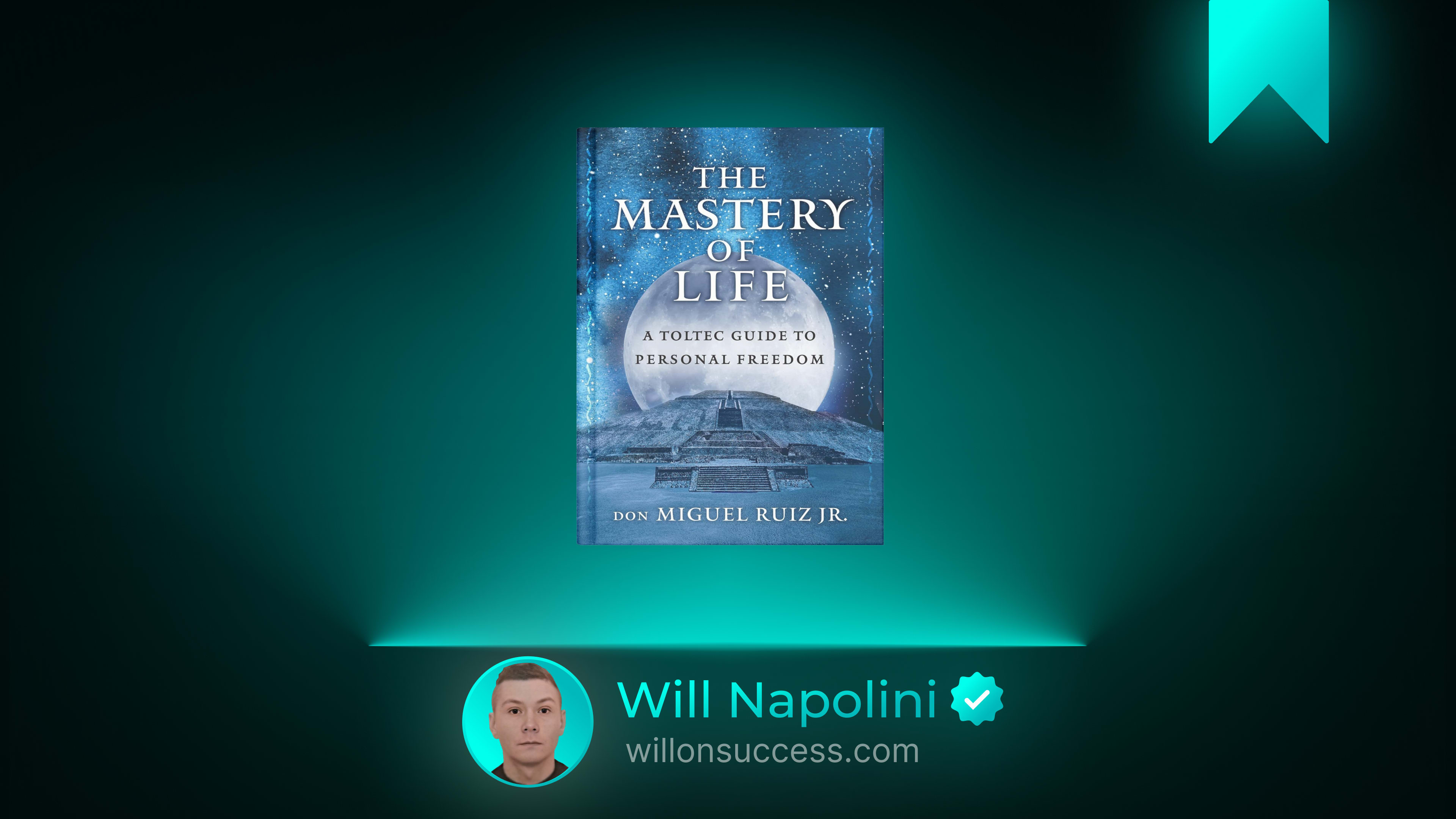
If you have ever felt a quiet, persistent mismatch between the life you are living and the life you sense you were meant to live, I want to introduce you to a book that speaks directly to that feeling. The Mastery of Life by Don Miguel Ruiz Jr. carries forward the Toltec wisdom tradition of his family—his father, Don Miguel Ruiz, wrote The Four Agreements—and turns its attention to a question most of us never think to ask: Who decided what I believe about myself, and do I still agree?
What I have come to appreciate about this book is that it does not hand you a list of habits to optimize or a ten-step plan to hustle your way into a better life. It asks you to do something far more unsettling and far more liberating. It asks you to look at the architecture of your own mind and notice which walls you actually chose to build.
The Dream You Are Living Inside
The central idea running through The Mastery of Life is one the Ruiz family has carried for generations, rooted in a Toltec tradition of awareness and transformation: each of us lives inside what they call a “dream.” Not a fantasy. Not a delusion. A constructed reality, assembled from every belief, agreement, assumption, and story we have absorbed since birth.
Your name, your identity, your sense of what is possible for you, your definition of success, your fears, your quiet sense of what you deserve—all of it was stitched together from thousands of small agreements made with parents, teachers, culture, religion, peers, and pain. Most of those agreements were made when you were too young to evaluate them. You simply accepted them because survival, for a child, means agreement.
Ruiz Jr. invites you to see this clearly, not to blame anyone, but to recognize something essential: if the dream was constructed, it can be reconstructed. If the agreements were made, they can be examined, questioned, and, where necessary, released.
Mastery, in this framework, is not about achieving perfection. It is about awareness. It is the practice of waking up inside your own life and choosing consciously rather than reacting from a script you never wrote.
I find this framing powerful because it removes the shame from the conversation. You are not broken. You are not lazy. You are not fundamentally flawed. You are running a set of programs that were installed before you had the capacity to review them. And now, as an adult, you have the capacity. That changes everything.
The Weight of Inherited Agreements
One of the most important things Ruiz Jr. explores is how deeply our inherited beliefs shape our daily behavior without our noticing. He speaks of the way we carry the voices of authority figures—parents, teachers, religious leaders, early critics—and mistake those voices for our own inner truth.
Consider a simple example. Imagine someone who grew up being told, directly or indirectly, that wanting more was selfish, that standing out was dangerous, that quiet compliance was the same as goodness. That person may now be thirty-five, forty, fifty years old, capable and intelligent, and still feel a knot of guilt every time they ask for a raise, set a boundary, or pursue something ambitious. The original voice belongs to someone else. The reaction belongs to a child who needed to stay safe. But the agreement is still running.
Ruiz Jr. does not ask you to rage against your past. He asks you to notice it. There is a profound difference. Rage keeps you chained to the story. Awareness gives you the space to say, I see you. I understand why you were installed. But I do not agree with you anymore.
This is where the book earns its place on a shelf next to more tactical self-help titles. Tactics without awareness often fail because the invisible agreement underneath sabotages the new behavior. You build the habit, and something inside you quietly dismantles it, because the deeper story says you do not deserve the result. Ruiz Jr. is interested in the deeper story.
Awareness as the Beginning of Freedom
If there is one word that holds this book together, it is awareness. Not positive thinking. Not visualization. Not affirmations pasted on a bathroom mirror. Awareness. The simple, difficult, sometimes uncomfortable act of seeing what is actually true in your mind before you try to change it.
Ruiz Jr. draws on the Toltec tradition’s emphasis on seeing clearly—what is sometimes described as seeing without the filter of the old dream. In practice, this means catching yourself in the middle of a familiar emotional reaction and pausing long enough to ask: Is this mine? Is this true? Or is this an old agreement speaking?
I have seen this kind of pause change the trajectory of a conversation, a career decision, a marriage. Not because the pause is dramatic. Because the pause creates a gap between stimulus and response, and in that gap, choice lives. Without the gap, you are on autopilot, replaying a script written by a frightened child. With the gap, you are an adult with options.
The book makes clear that this is not a one-time event. You do not have a single insight and walk into permanent freedom. Awareness is a practice. You will fall back into old patterns. You will catch the old agreement running again three months from now and think, I thought I was past this. You are not failing. You are deepening. Each time you notice the pattern, it loses a little more of its automatic power.
Think of it like this: a river that has carved its channel over decades will not redirect in a single afternoon. But every small diversion, every conscious choice that runs against the old groove, shifts the water a little. Given enough time, the river finds a new path. You are both the river and the landscape. That is the strange, beautiful work of self-mastery.
The Difference Between the Story and the Truth
A recurring theme in The Mastery of Life is the distinction between the story you tell about your life and the actual truth of your life. Ruiz Jr. encourages the reader to notice how much suffering comes not from events themselves but from the narrative layered on top of them.
You lose a job. The event is painful. But the story—I am a failure, I will never recover, this proves I was never good enough—that story multiplies the pain and extends it far beyond the actual circumstance. The event happened. The story is optional.
This is not about pretending difficulty does not exist. I want to be clear about that. Grief is real. Loss is real. Injustice is real. The book does not ask you to smile through suffering. It asks you to separate the clean pain of an experience from the layered suffering of the story you build around it. The first is inevitable. The second is, at least in part, a choice.
When you begin to disentangle the story from the truth, something remarkable happens. You stop arguing with reality. You stop spending enormous energy defending a version of yourself that was constructed to protect a child. You get to meet the actual present moment, with its actual possibilities, instead of the rehearsed past.
Freedom Is Not the Absence of Structure
One idea in the book that I think many readers will find surprising is this: mastery does not mean living without structure, discipline, or commitment. Sometimes people hear the language of freedom and dream release and imagine that the goal is a life with no obligations, no routines, no responsibilities.
Ruiz Jr. is not pointing in that direction. The Toltec tradition, as he presents it, values conscious commitment. The difference is between a commitment you chose with open eyes and a commitment you inherited and never questioned. One gives you energy. The other drains it. Both may look identical from the outside.
You can love your work, your family, your community, your daily discipline—and still examine whether the reasons you hold them are truly yours or whether you are performing someone else’s dream out of fear. Mastery is choosing your commitments again, deliberately, with full awareness. It is saying yes when you could say no, and meaning it.
That kind of yes is stronger than any yes born from obligation.
Why This Matters on an Ordinary Wednesday
You might be thinking, This sounds meaningful in theory, but what does it look like on a regular Wednesday afternoon when I am tired, the kids need something, my inbox is full, and I still have not done the thing I promised myself I would do?
Here is what it looks like.
It looks like catching the thought I should be further along by now and asking, According to whom? Who set that timeline? Do I actually agree with it?
It looks like noticing that you said yes to a request you did not want to fulfill, and recognizing the old agreement underneath: If I say no, they will think I am selfish. Then choosing, gently, to say no anyway, and sitting with the discomfort without calling it evidence that you are a bad person.
It looks like catching yourself rehearsing an old wound for the fortieth time and asking, Is this reflection, or is this repetition? And then, without judgment, setting the thought down.
None of this is dramatic. None of it will make a headline. But it is the actual texture of a life changing from the inside. And I have learned, through my own stumbling and recovering, that the undramatic shifts are the ones that last.
Who Will Find This Book Most Useful
The Mastery of Life will speak most clearly to readers who sense that their external efforts are not producing the internal change they want. You may be reading the right books, following the right routines, and still feeling as though you are performing a life rather than living one. This book addresses that gap.
It will also resonate with anyone who has done some personal-development work but feels stuck at a deeper level—someone who has changed behaviors but not the beliefs underneath them. Ruiz Jr. is working at the belief level, the agreement level, the story level. If that is where your stagnation lives, this is a good place to start.
Readers looking for highly structured, step-by-step tactical systems may find the book less immediately actionable than they want. The book is more contemplative than procedural. It gives you a lens, not a checklist. That is its strength, but it means the reader must be willing to sit with ideas and do the internal work of applying them. If you need external structure to get moving, you may want to pair this book with a more tactical resource.
What makes the book genuinely worth reading is its lineage. The Ruiz family has carried this tradition across generations, and there is a groundedness in the writing that comes from lived practice rather than theoretical knowledge. It does not feel like someone guessing about transformation. It feels like someone describing a path they have actually walked.
A Practice You Can Start Before You Finish This Article
I do not want you to close this page with a pleasant nod and a vague intention to “be more aware.” That is how good ideas go to die. So here is something concrete.
Tonight, before you sleep, take five minutes. Sit quietly. Bring to mind one recurring frustration in your life—something that keeps bothering you, a pattern that keeps repeating, a reaction that keeps catching you off guard.
Now ask yourself three questions:
When did I first learn to react this way? Whose voice is in this reaction? If I could renegotiate that old agreement today, what would I choose instead?
You do not need to solve it tonight. You do not need to have a clean answer. The act of asking is the act of loosening the agreement’s grip. You are turning on a light in a room that has been dark for a long time. You do not need to redecorate the room tonight. You just need to see what is in it.
Write your answers down, even if they are rough, even if they are incomplete. Putting a thought into words on paper strips it of some of its automatic power. It moves from being the water you swim in to being an object you can look at, pick up, and, eventually, set down.
Do this for five minutes. That is all. Five minutes of honest looking. Then sleep. And tomorrow, notice whether the frustration has the same absolute grip it had yesterday. It probably will. But the grip will be a little less invisible. And that is where mastery begins. Not with a grand transformation. With one honest question asked in a quiet room.
The Door Is Already Open
Ruiz Jr. writes about mastery not as a summit you reach but as a direction you walk. You do not master your life and then stop. You practice. You notice. You question. You choose again. Some days the old dream pulls you back so completely that you forget you were ever awake. That is part of the practice. That is not evidence of failure. That is evidence that you are human, and that the agreements were deep, and that undoing them takes more than one good afternoon.
But here is what I want you to carry with you: the version of you that was assembled without your consent is not a prison. It is a draft. And you, right now, in this moment, with whatever confusion and fatigue and longing you brought to these words, you hold the pen.
You do not need to tear up the whole draft tonight. You do not need to have the next chapter figured out. You just need to read the page you are on with honest eyes and ask, Is this still true? Is this still mine?
That question, asked sincerely, is the beginning of everything.
The life you are living was built from agreements. The life you want is waiting on the other side of the ones you are ready to release. You do not need permission. You never did. You just needed to notice the door was already unlocked.
Now turn the handle. Step through. And see what is actually there.