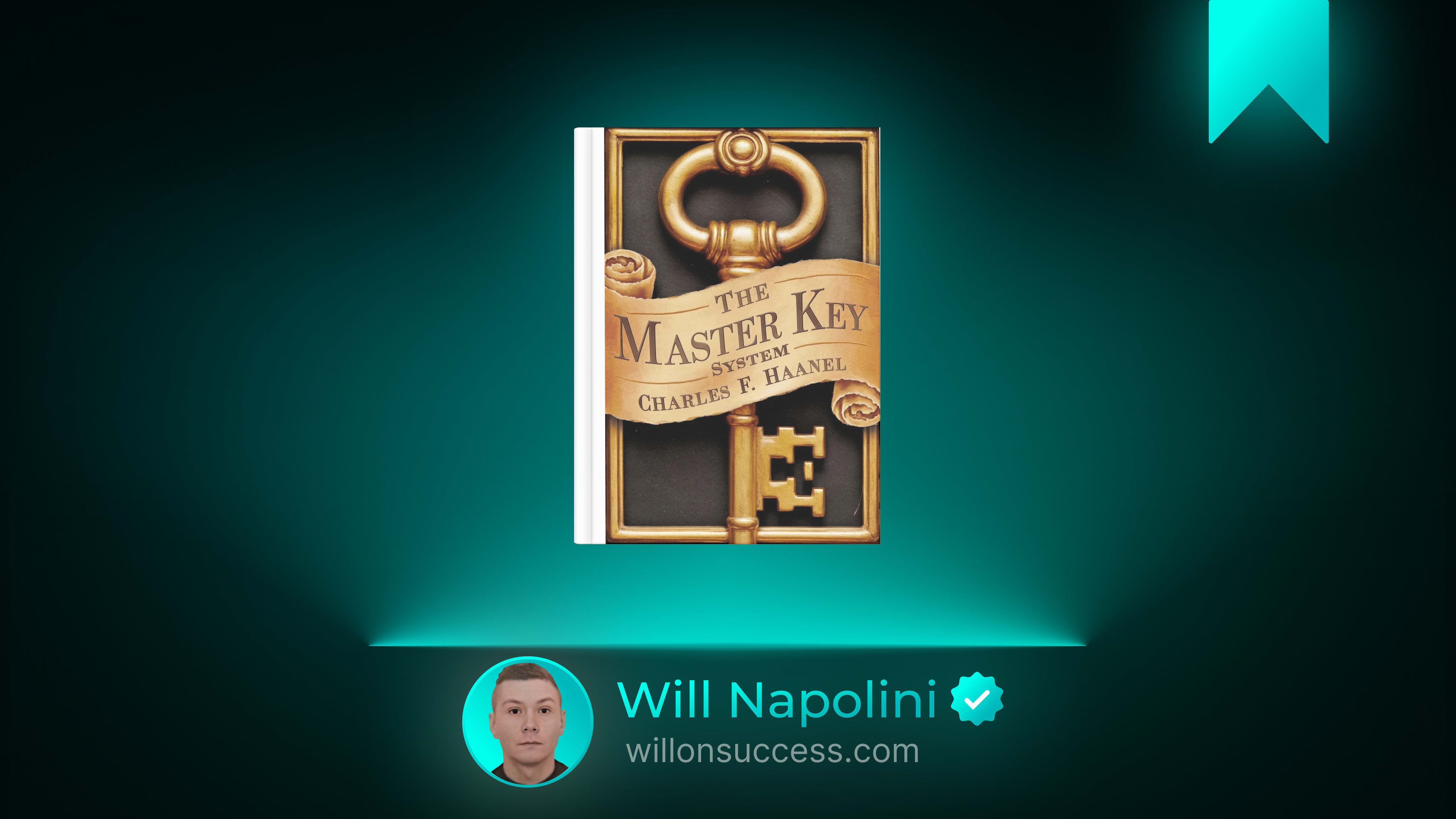
The Master Key System by Charles F. Haanel: The Quiet Discipline Behind the Life You Want
We live in an era that has turned the power of thought into a parlor trick.
Scroll through your feeds, and you will find endless promises that if you simply “vibrate at the right frequency” or “manifest hard enough,” the universe will hand you a better career, a fitter body, or a heavier bank account. It is an alluring message. It is also, for the most part, entirely hollow. It reduces the profound architecture of the human mind to a cosmic vending machine.
But more than a century ago, a man named Charles F. Haanel wrote a book that approached the power of thought from a completely different angle. He did not offer a parlor trick. He offered a forge.
The Master Key System, originally distributed as a 24-week correspondence course starting in 1912, is not a book about wishing for a better life. It is a rigorous, uncompromising manual on how to build the mental discipline required to sustain one. Haanel understood something that modern culture has largely forgotten: you cannot change the external structure of your life until you have mastered the internal machinery of your mind.
I want to walk you through what Haanel actually taught, because beneath the early 20th-century language lies a psychological framework that remains startlingly relevant. If you have ever felt like you are working hard but running in place, or if you suspect that your own unexamized thoughts are quietly sabotaging your best intentions, this is the conversation we need to have.
The World Within and the World Without
The entire foundation of The Master Key System rests on a single, unshakeable premise: the external world is a direct reflection of the internal world.
Haanel called these the “World Without” and the “World Within.” The World Without is your physical reality—your bank account, your relationships, your health, your career. It is the harvest. The World Within is your consciousness, your beliefs, your dominant thoughts, and your emotional patterns. It is the soil, the seed, and the root.
Most of us spend our entire lives trying to manipulate the World Without. We try to force better outcomes through sheer exhaustion. We work longer hours, we argue harder, we scramble for better tactics. But Haanel argued that trying to change the World Without without first changing the World Within is like standing in front of a mirror, frowning, and trying to force the reflection to smile.
The reflection will only smile when you do.
What I have learned from studying Haanel’s work is that this is not meant to be a mystical platitude. It is a practical mechanism. Your external circumstances are largely the result of your past decisions. Your past decisions were driven by your past thoughts. Therefore, if you want to alter the trajectory of your future circumstances, you must intercept and redirect the thoughts that are generating your current decisions.
The “Master Key” is simply this: the conscious, deliberate direction of your thought.
The Watchman at the Gate
To understand how to use the key, you have to understand the lock. Haanel divided the mind into two primary functions: the conscious mind and the subconscious mind.
Think of your conscious mind as the watchman at the gate. It is the reasoning, analytical, choosing part of you. It is the part reading these words right now. It has the power of discernment. It can look at an idea and say, “Yes, this is true,” or “No, this is false.”
Your subconscious mind, on the other hand, is the vast, powerful engine beneath the surface. It controls your autonomic functions, your habits, your emotional reactions, and your deep-seated beliefs. But here is the critical flaw in the machinery: the subconscious mind cannot reason. It cannot argue. It cannot tell the difference between a constructive thought and a destructive one. It simply accepts whatever the watchman lets through the gate, and it goes to work executing it with relentless, unquestioning efficiency.
If your conscious mind dwells on scarcity, fear, and resentment, the watchman is letting poison through the gate. The subconscious does not say, “Wait, this will ruin our life.” It simply says, “Understood. We are focusing on scarcity. I will now heighten your anxiety, narrow your perception, and prompt you to make fearful decisions that will guarantee we experience more scarcity.”
The subconscious is a faithful servant, but a terrible master.
Haanel’s work is essentially a training program for the watchman. He teaches that you must stand guard at the gates of your mind with fierce intentionality. You must stop letting every stray anxiety, every news headline, and every insecure thought wander unchallenged into the engine room. You must choose the seeds you plant, because the subconscious will grow whatever you hand it, and it will not stop growing until the harvest is complete.
The Muscle of Concentration
If there is one element of The Master Key System that separates it from almost every other personal development book of its era, it is Haanel’s absolute obsession with concentration.
At the end of every single chapter in the book, Haanel provides a practical exercise. And the first several exercises have nothing to do with visualization, affirmations, or goal-setting. They have to do with sitting in a chair and not moving.
Haanel instructed his students to sit in an upright chair, place their feet flat on the floor, and remain absolutely, perfectly still for fifteen minutes. No shifting weight. No scratching an itch. No crossing and uncrossing legs. Just stillness.
When I first read this, I thought it was trivial. But as I have practiced it, and as I have watched others try to practice it, I realized it is one of the most difficult things a modern human can do.
Within three minutes, your body will scream at you to move. Your mind will generate a dozen urgent reasons to get up. You will suddenly remember an email you forgot to send. You will feel a phantom tickle on your neck.
Why did Haanel start here? Because he understood a foundational principle of human behavior: you cannot command a kingdom if you cannot command your own hands to stay still.
Concentration is not a gift; it is a muscle. And in a world of constant notifications, infinite scrolling, and fractured attention, that muscle has atrophied in almost all of us. Haanel knew that if you cannot control your physical body, you have no hope of controlling your mental body. The physical stillness is the prerequisite for mental stillness. And mental stillness is the prerequisite for directed, creative thought.
You must build the capacity to hold your attention on a single point without wavering. Only when you have mastered the muscle of concentration can you begin to use your mind to actually build the life you want, rather than just daydreaming about it.
Tapping the Universal Mind
As you move deeper into the book, Haanel introduces a concept that often makes modern, secular readers uncomfortable: the “Universal Mind.”
Haanel was writing during the height of the New Thought movement, and his language reflects a belief in a singular, infinite intelligence that permeates all of creation. He argued that the individual mind is not isolated; it is a localized center of this Universal Mind.
If you are resistant to spiritual language, I invite you to translate this into a more practical framework. Think of the Universal Mind as the underlying network of reality—the sum total of all natural laws, human knowledge, creative potential, and systemic cause-and-effect.
When you are operating from a place of fear, ego, and scarcity, you are disconnected from that network. You are trying to push a boulder up a hill using only your own limited strength. You are operating in isolation.
But when you quiet your mind, master your concentration, and align your thoughts with constructive, creative, and service-oriented principles, you tap into a much larger current. You stop trying to force outcomes and start recognizing opportunities. You begin to see connections you missed before. Ideas arrive that seem to come from nowhere.
Haanel’s argument is that you do not need to generate all the power required to change your life. The power already exists. Your job is simply to build a clear, unobstructed conduit for it to flow through. And the only way to clear the conduit is through the rigorous discipline of your own thought life.
What This Looks Like on an Ordinary Tuesday
Let’s bring this out of the abstract and into the friction of a normal week.
Imagine it is Tuesday afternoon. A project you have been leading at work just hit a massive roadblock. A key client is unhappy. A deadline is slipping.
The untrained mind—the mind that has not done the work of the World Within—immediately reacts. The watchman falls asleep at the gate. Fear, defensiveness, and blame rush into the subconscious. The subconscious immediately floods your body with cortisol. Your vision narrows. You send a reactive, slightly aggressive email. You snap at your spouse when you get home. You sleep poorly. The external world (the World Without) reflects this internal chaos, and the situation worsens.
Now, imagine the mind that has practiced Haanel’s discipline.
The roadblock hits. The initial spike of stress occurs—that is simply biology. But the trained watchman steps up to the gate. You recognize the fear, but you do not let it take the wheel. You pause. You take five minutes to physically and mentally center yourself, returning to that baseline of stillness you practiced in the quiet of your morning.
You consciously choose a different thought: This is a problem to be solved, not a threat to my survival. I am capable of navigating this. You feed that thought to the subconscious. The subconscious responds by lowering your heart rate, widening your perception, and allowing your prefrontal cortex to come back online. You draft a calm, strategic response. You ask for help. You navigate the crisis with grace.
The external circumstance (the roadblock) was the same in both scenarios. But the internal architecture dictated two entirely different outcomes.
This is the magic of the system. It is not magic because it defies the laws of nature. It is magic because it utilizes the laws of nature that most people are entirely unaware of.
The Honest Reality of the Work
I want to be very straightforward with you, because a mentor who only highlights the summit and ignores the steepness of the climb is doing you a disservice.
The Master Key System is not an easy read. It is dense. It is repetitive. The language is formal and sometimes archaic. It does not offer the quick dopamine hits of modern self-help books. There are no “five hacks to double your income” in these pages.
Furthermore, if you are someone who requires peer-reviewed, double-blind neuroscience studies to validate a concept, this book will frustrate you. Haanel writes with the absolute conviction of a philosopher and a mystic, not an academic. He states his premises as self-evident laws of the universe.
And the exercises? They are boring. Sitting in a chair staring at a wall, or trying to hold a single mental image of a geometric shape for fifteen minutes without your mind wandering, is profoundly unglamorous. You will feel foolish. You will feel like you are failing. Your mind will rebel.
This is exactly why the book is so valuable.
We have built a culture that worships intensity and ignores consistency. We want the transformation without the tedium. But Haanel understood that profound internal shifts require boring, repetitive, unglamorous practice. The musician does not master the concerto by playing it perfectly once; they master it by playing the scales ten thousand times when no one is watching.
If you are looking for a quick motivational boost to get you through the weekend, do not read this book. But if you are ready to commit to a fundamental restructuring of your mental habits, and you are willing to endure the discomfort of actual discipline, this book is a masterclass.
Who This Book Serves Best
The Master Key System is best suited for the person who has hit a ceiling that no amount of external strategy can break.
If you have read all the books on productivity, if you have optimized your schedule, if you know exactly what you should be doing, but you still find yourself paralyzed by procrastination, self-sabotage, or quiet despair, Haanel is speaking directly to you. He addresses the root, not the symptom.
It is also profoundly useful for leaders, creators, and entrepreneurs. The higher you climb, the more your external results depend on your internal clarity. When you are responsible for the livelihoods of others, or the vision of a company, you cannot afford the luxury of an undisciplined mind. The ability to sit in a quiet room, shut out the noise, and hold a clear, constructive vision until it materializes into a plan is the ultimate competitive advantage.
However, if you are currently in the midst of an acute mental health crisis, severe trauma, or deep clinical depression, this is not the right tool for this specific season. Haanel’s work requires a baseline of cognitive stability to engage with the rigorous mental exercises. Heal first. Build the foundation. Then come to the forge.
One Small Step to Take Today
I am not going to ask you to commit to a 24-week correspondence course today. I am going to ask you to do the very first thing Haanel asked his students to do. It will take ten minutes, and it requires nothing but a chair and a clock.
Sometime today, find a quiet room. Sit in a chair with your feet flat on the floor and your hands resting in your lap. Set a timer on your phone for ten minutes, and place the phone out of reach.
Your only task is to sit perfectly still.
Do not move a muscle. When your nose itches, do not scratch it. When your leg wants to bounce, force it to be still. When your mind screams at you that this is a waste of time, observe the thought, and let it pass without acting on it.
You are not trying to empty your mind. You are simply asserting dominance over your physical vessel. You are teaching your nervous system that you are in charge, not your impulses.
When the timer goes off, notice how you feel. Notice the quiet hum of self-respect that comes from making a small promise to yourself and keeping it.
That feeling is the first turn of the key.
You have spent years searching the world for the right opportunity, the right connection, the right break that will finally unlock the life you know you are meant for. But the master key is not hidden in the world. It is forged in the quiet, one disciplined thought at a time.
Sit down. Be still. And begin the work of mastering yourself.