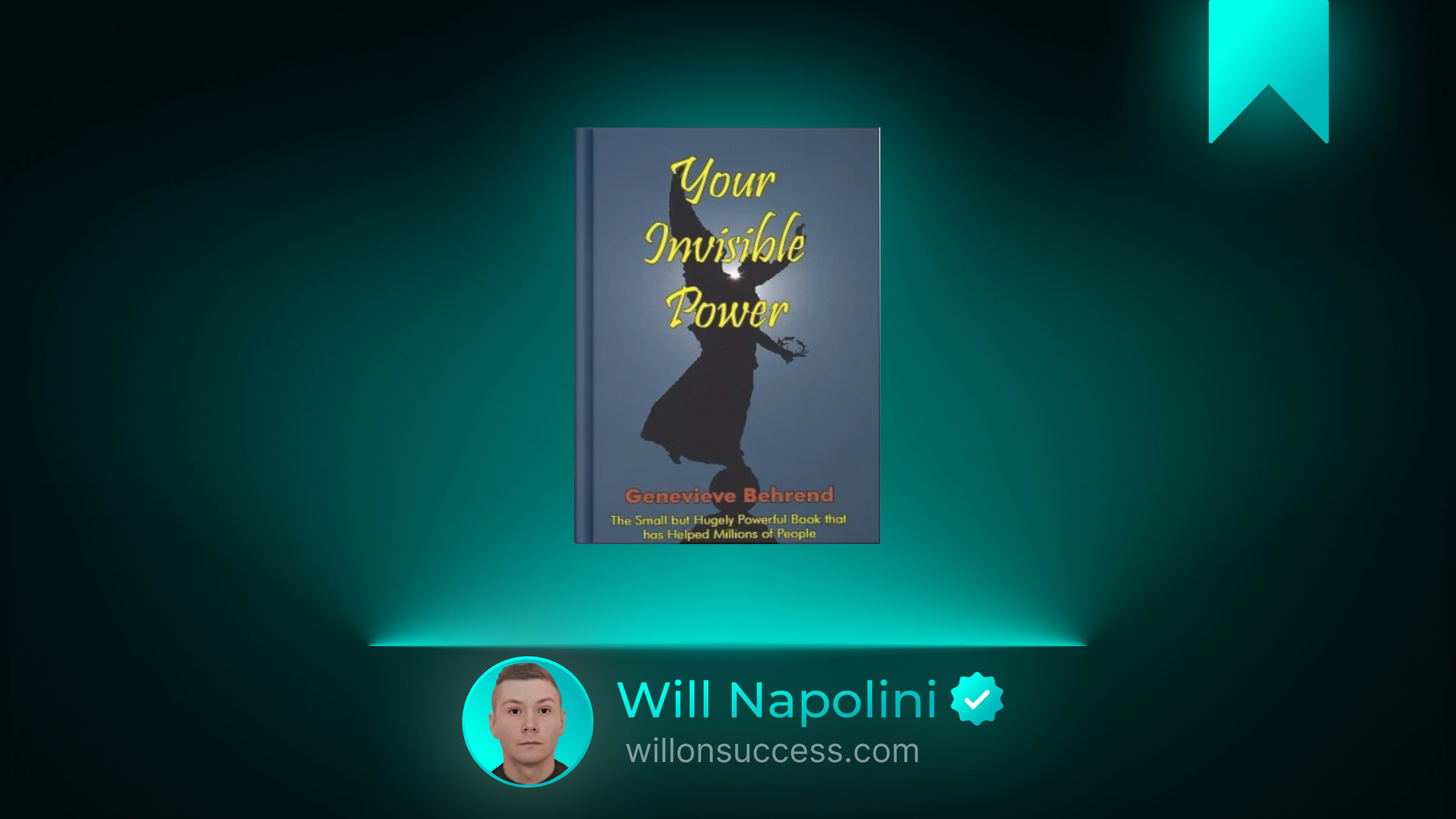
Your Invisible Power by Genevieve Behrend: How to Build the Life You Can Only See in Your Mind
Look around the room you are sitting in right now. Look at the chair you are resting on, the device you are reading this on, the walls that shelter you.
Before any of those things existed in the physical world, they existed in a single, invisible place: a human mind.
Every physical object, every institution, every piece of art, and every transformed life began as a silent, invisible image. The physical world is not the starting point of reality. It is the finishing point. It is the frozen residue of thoughts that were held with enough clarity, conviction, and persistence to eventually pull themselves into form.
Yet, when we want to change our own lives, we almost always start at the wrong end. We look at our bank accounts, our relationships, our careers, and our physical health—the visible evidence of our past thinking—and we try to force them to change through sheer, grinding effort. We push against the physical world, exhausted and frustrated, wondering why the needle will not move.
In 1921, a woman named Genevieve Behrend published a small, unassuming book called Your Invisible Power. Behrend was the only personal student of Thomas Troward, one of the most brilliant philosophical minds of the early New Thought movement. What she produced was not a mystical text for ascetics on a mountaintop. It was a highly practical, deeply systematic manual on the mechanics of human creation.
Her premise was as radical then as it is now: You cannot permanently change the visible conditions of your life until you first change the invisible pictures in your mind.
I have spent years watching incredibly hardworking people burn out because they are trying to build a house by rearranging the furniture, rather than looking at the blueprint. If you are tired of working hard but finding that your external reality keeps snapping back to the same old baseline, it is time to look at the blueprint. It is time to understand the mechanics of your invisible power.
The Big Idea: The Universe Does Not Respond to Your Wishes. It Responds to Your Blueprints.
There is a profound difference between a wish and a mental image, and Behrend’s entire philosophy rests on this distinction.
A wish is vague. A wish is a feeling of lack combined with a hope for relief. I wish I had more money. I wish I were in a better relationship. I wish I felt healthier. Wishes are essentially complaints directed at the universe. They reinforce the very absence you are trying to escape, because the underlying emotion of a wish is, I do not have this.
A mental image, in Behrend’s framework, is entirely different. It is a blueprint. It is specific, detailed, and held with the quiet certainty of an architect who knows that once the plans are drawn, the building is inevitable.
Behrend argued that the subconscious mind—which she often referred to as the Universal Mind or the creative power within you—cannot tell the difference between a vividly imagined experience and a physically real one. It does not argue with your blueprints. It simply goes to work gathering the materials to build them.
If your mental image is blurry, your physical results will be chaotic. If your mental image is rooted in lack, your physical results will reflect scarcity. But if you can learn to construct a clear, sensory-rich, emotionally resonant picture of what you are trying to build, the invisible power of your mind will begin to orchestrate the physical steps required to get you there.
You are not a victim of your circumstances. You are the architect of them. You just forgot that you are holding the pencil.
The Trap of the “How” Is Where Dreams Go to Die
If there is one chapter in Behrend’s book that I would urge you to read, reread, and tape to your mirror, it is her instruction on the trap of the “how.”
When most of us set a goal, we immediately demand to know the exact sequence of events that will get us there. We look at where we are (Point A) and where we want to be (Point Z), and we try to map out every single step from B to Y. When we cannot see the bridge, we assume the destination is impossible. We abandon the vision because we cannot figure out the logistics.
Behrend’s advice is blunt and liberating: The “how” is not your job.
Your job is the what and the why. Your job is to define the destination with absolute clarity and to hold the feeling of having already arrived. The mechanics of how it arrives—the coincidences, the introductions, the sudden ideas, the shifting circumstances—are the domain of the deeper intelligence that runs the universe.
Think of planting a seed. You do not dig it up every morning to inspect the roots. You do not yell at the soil to explain the chemical process of germination. You provide the environment, you plant the seed, and you trust the invisible mechanics of nature to do the work.
When you obsess over the “how,” you introduce anxiety into the system. You restrict the infinite possibilities of the universe down to the very limited, very narrow pathways your conscious mind can currently perceive.
I have seen this play out in my own life and in the lives of countless others. The moments of greatest breakthrough rarely came through the exact door I was staring at. They came through a side window I hadn’t noticed, introduced by a stranger I hadn’t planned to meet, sparked by an idea that arrived while I was washing the dishes.
Define the end result. Feel the reality of it. Then, get out of the way and let the invisible power handle the logistics.
Fear Is Just Faith Working in the Wrong Direction
One of the most striking observations in Your Invisible Power is Behrend’s treatment of fear.
We tend to think of fear and faith as opposites. We think of faith as a positive force and fear as a negative void. But Behrend points out a mechanical truth: fear and faith are the exact same energy. They both require you to project your mind into the future, visualize an event that has not yet happened, and generate intense emotional and physical responses to it.
When you have faith, you visualize a positive outcome and your body responds with hope, energy, and aligned action. When you have fear, you visualize a negative outcome and your body responds with cortisol, tension, and avoidance.
Fear is simply faith working in the wrong direction. It is the misuse of your invisible power.
Think about how much of your mental energy is spent visualizing worst-case scenarios. You rehearse arguments that haven’t happened. You picture the business failing. You imagine the medical test coming back with bad news. You are using the exact same creative machinery that could build your dream life to construct a detailed, high-definition nightmare. And because your subconscious mind builds whatever blueprint you hand it, you are inadvertently laying the foundation for the very things you are terrified of.
Behrend does not tell you to simply “stop worrying.” That is impossible. The mind must have a picture to hold. Instead, she teaches you to deliberately redirect the machinery. When you catch yourself visualizing disaster, you must consciously interrupt the pattern and replace it with the image of the solution. You must use your faith to picture the resolution, the recovery, the success.
You are going to use your imagination anyway. You might as well use it to build a house you actually want to live in.
The Feeling of the Wish Fulfilled
It is not enough to just see the picture. A dry, emotionless mental image is like a blueprint drawn in fading ink. It lacks the power to command the materials of reality.
Behrend emphasizes that the secret to activating your invisible power is the feeling of the wish fulfilled.
What would it actually feel like, in your body, if the problem were already solved? If the debt were paid, if the relationship were healed, if the creative project were launched and celebrated?
You cannot wait for the physical evidence to arrive before you allow yourself to feel the emotion of the outcome. The emotion is the magnet. The feeling of relief, of gratitude, of quiet satisfaction—that is the signal you are broadcasting to the deeper layers of your mind.
This is where many people fail. They try to visualize wealth while their stomach is tied in knots of financial panic. They try to visualize love while their chest is tight with the grief of loneliness. The conscious mind is saying one thing, but the body is screaming another. The subconscious always believes the body.
The practice, then, is to cultivate the feeling first. You sit in the quiet. You bring up the image of your goal. And you deliberately breathe into the physical sensation of it already being done. You let your shoulders drop. You let the tension leave your jaw. You practice the emotional state of the finish line while you are still at the starting block.
When your internal feeling matches your external desire, the friction disappears. The invisible power engages.
What This Looks Like on an Ordinary Thursday
Let’s bring this out of the realm of philosophy and into the grit of a normal week.
It is Thursday. You are an entrepreneur, and a major client just canceled a contract. The visible reality is a loss of revenue. The immediate, instinctual reaction is panic. The mind begins to visualize the cascade of negative events: I won’t make payroll. The team will lose faith. The business is failing. You are using your invisible power to build a disaster.
In the old pattern, you would spend the next three days operating from that panicked blueprint. You would send desperate emails. You would make short-sighted financial decisions. You would radiate an energy of scarcity that repels new opportunities.
In the new pattern—the one Behrend teaches—you feel the initial sting of the loss. You do not suppress the human emotion of disappointment. But then, you go to work on the blueprint.
You sit in your office for ten minutes. You close your eyes. You do not just think, I need more money. You visualize the specific feeling of looking at your bank account at the end of the month and seeing a healthy surplus. You picture the face of your lead developer when you tell them their bonus is secure. You feel the physical sensation of relief in your chest. You hold that image until it feels more real than the canceled contract.
You do not know how the money will come. You do not have a new client lined up. But you have drawn the blueprint. You have set the coordinates.
Because you are operating from a state of solved problems rather than active panic, your next actions are different. You make a calm, strategic phone call to a dormant contact. You write a clear, confident proposal for a new prospect. You are moving, but you are moving from a foundation of invisible certainty.
The invisible power does not mean you sit on the couch and wait for a check to fall through the ceiling. It means that when you do act, your actions are guided by the quiet confidence of the finish line, rather than the frantic scrambling of the starting line.
Who Should Read This Book
If you are a builder, a creator, an entrepreneur, or an artist, this book is foundational. If you have ever felt that there is a massive gap between your internal potential and your external results, Behrend will hand you the bridge. It is essential reading for anyone who wants to understand the mechanics of focus, belief, and the architecture of reality.
I do want to offer a fair warning about the text itself. It was written in 1921. The prose is beautiful, but it is undeniably of its time. It uses the language of early 20th-century “Mental Science” and occasionally leans into the formal, slightly archaic phrasing of that era. If you are looking for a fast-paced, modern, neuro-hacking manual filled with bullet points and clinical studies, the original text might require some patience.
Furthermore, if you are deeply uncomfortable with spiritual or metaphysical language, some of her references to the “Universal Mind” or “Infinite Intelligence” might cause you to bristle. I encourage you to read past the terminology and look at the mechanics. Whether you call it the Universal Mind, the subconscious, or the reticular activating system, the underlying principle of how focused imagery drives human behavior remains entirely intact.
One Small Step
Here is what I want you to do today to prove this principle to yourself.
Choose one small, specific friction point in your life. Not your entire life’s purpose. Just one thing. A difficult conversation you are avoiding. A cluttered room you need to organize. A single task you have been procrastinating on.
Tonight, before you go to sleep, spend exactly three minutes visualizing the end of that task.
Do not visualize doing the work. Visualize the moment it is finished. See the clean desk. See the smile on the other person’s face after the conversation. See the checkmark on the list.
Crucially, capture the feeling of the completion. Feel the physical lightness in your chest. Feel the quiet satisfaction of a closed loop. Hold that feeling as you drift off to sleep.
Tomorrow, observe what happens. Notice how the resistance has dropped. Notice how your body naturally moves toward the task, not out of forced discipline, but because the invisible blueprint has already been completed, and the physical world is simply catching up.
You have spent your whole life thinking that seeing is believing. It is time to learn the deeper truth of the craftsman.
Believing is seeing. And what you hold in the quiet, invisible dark of your mind will inevitably become the house you live in. Pick up the pencil. Draw it clearly. The builder is already waiting for your command.