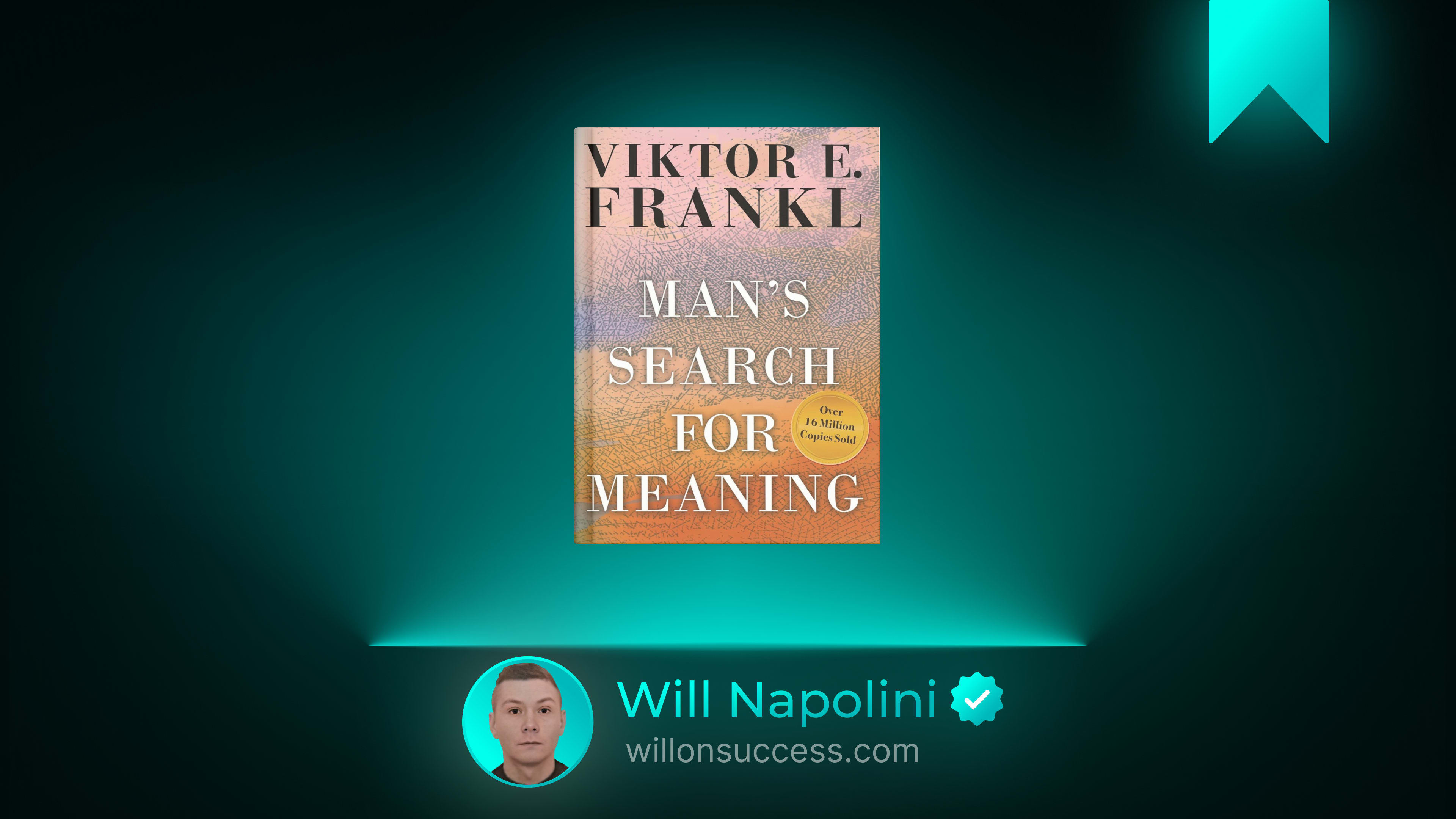
Man's Search for Meaning by Viktor Frankl: The One Freedom They Could Never Take Away
I want to ask you a question, and I want you to sit with it before you answer.
If everything were stripped from you tomorrow—your home, your work, your name, your dignity, your relationships, your comfort, your future—what would remain? Not what you own. Not what you do. Not what others call you. If all of that were taken, and you were left standing in the most brutal, dehumanizing circumstances imaginable, what would be left that no one could reach?
In 1942, a thirty-seven-year-old Austrian psychiatrist named Viktor Frankl was arrested by the Nazis. Over the next three years, he was imprisoned in several concentration camps, including a sub-camp of Dachau. His wife, his parents, his brother—all were murdered. He lost every single person he loved. He lost his manuscript, his career, his identity. He was reduced to a number stitched onto a uniform.
And in that absolute extremity, stripped of everything that normally constitutes a life, Frankl made a discovery. Not a theory developed in a comfortable office. Not a hypothesis tested in a laboratory. A discovery forged in starvation, in cold, in the daily sight of death, in the slow grinding annihilation of everything human.
He discovered that the last thing they could take from him—the one freedom that remained even when every other freedom had been annihilated—was the ability to choose his response. To choose what his suffering meant. To choose whether he would remain a human being inside, even as they tried to reduce him to an animal outside.
Man’s Search for Meaning, written in nine days after his liberation in 1945, is the record of that discovery. It is not a self-help book. It is not a motivational text. It is a witness statement from the deepest pit of the twentieth century, and it carries a message that I believe is the most important idea any person can encounter: you cannot always control what happens to you, but you can always, always choose what it means.
The Big Idea: Meaning Is Not a Luxury. It Is a Survival Mechanism.
Before the war, Frankl was already a psychiatrist. He had studied under the great Viennese schools. He knew Freud. He knew Adler. But the camps taught him something that no textbook could.
He watched, over three years, which prisoners survived and which did not. And what he observed contradicted every assumption about physical fitness or biological resilience. The men who endured were not always the strongest. They were not always the healthiest. They were, in many cases, the ones who carried a why—a reason to keep breathing, a task unfinished, a person waiting for them on the other side of the suffering.
Frankl remembered a line from Nietzsche and let it become his compass in the camps: He who has a why to live for can bear almost any how.
This was not abstract philosophy. It was observation. He saw men with strong bodies give up and walk toward the electrified fences because they had lost their reason for enduring. And he saw frail, exhausted men survive another day because somewhere in their minds, a purpose still burned. A book to write. A child to find. A testimony to deliver.
The central thesis of the book is this: the primary drive in human life is not pleasure, as Freud believed. It is not power, as Adler believed. It is meaning. The will to meaning. And when that will is frustrated—when a person cannot find or create meaning in their circumstances—they do not merely become unhappy. They become capable of destruction, of despair, of spiritual death.
But when meaning is present, even in the most horrific conditions, a person can endure. Not because suffering is good. Frankl is absolutely clear: suffering is not good, and it is not necessary for meaning. But when suffering is unavoidable, meaning can be found within it. And that meaning can sustain a life that would otherwise collapse.
The Last of the Human Freedoms
Let me tell you what Frankl observed in the camps, because it is the foundation of everything else in the book.
The Nazi system was designed to strip a person of every shred of autonomy. They took your name and gave you a number. They shaved your head. They starved you. They worked you until your body was a skeleton held together by rags. They killed people beside you for no reason, at random, to teach you that your life had no value. They controlled when you ate, when you slept, when you worked, when you died.
Everything external was controlled. Everything.
And yet. Frankl noticed that in the camps, there were men who walked through the barracks comforting others, giving away their last piece of bread. There were men who, in the midst of a death march, looked up at the sky and felt a moment of beauty. There were men who, facing the gas chamber, walked in with dignity rather than with animal terror.
These men were not superhuman. They were not saints. But they had accessed something that the guards, with all their absolute power, could not reach. Frankl called it the last of the human freedoms: the ability to choose one’s attitude in any given set of circumstances.
They can control your body. They can control your environment. They can control whether you live or die. But they cannot reach inside your skull and force you to assign a particular meaning to your experience. They cannot make you believe your suffering is pointless if you have decided it is not. They cannot make you hate if you have decided not to. They cannot take your inner dignity unless you hand it over.
This is not a platitude. This is not “positive thinking.” Frankl watched people die every day. He endured beatings, starvation, typhus, and the constant, grinding terror of arbitrary execution. What he is saying is not that you can smile your way through hell. What he is saying is that even in hell, you retain the freedom to decide who you are in relation to the flames.
And that freedom is yours. In every circumstance. Not just in the camps. In the hospital room. In the divorce. In the layoff. In the diagnosis. In the grief. In the ordinary Tuesday when everything feels pointless and gray. The circumstance may be imposed. The meaning is chosen.
Three Paths to Meaning
In the second part of the book, Frankl introduces logotherapy—his school of psychotherapy, built on the foundation of what he witnessed in the camps. The word logos is Greek for meaning. Logotherapy is, literally, healing through meaning.
Frankl identifies three primary ways a person discovers meaning in life. They are not ranked. They are not sequential. They are three doors into the same room.
The First Path: What You Create and Contribute
The first way to find meaning is through work, through action, through making something that did not exist before. This is not about career prestige or wealth. It is about the act of bringing something into the world. Writing the book. Building the garden. Teaching the child. Solving the problem. Creating the thing that carries your fingerprint and your care.
In the camps, Frankl survived in part because he had a manuscript he wanted to reconstruct. He had been stripped of his life’s work, but the intention to create again gave him a future to walk toward. The work was not yet done. The contribution was not yet made. And that unfinished task anchored him to life when everything else had been torn away.
The Second Path: Who You Love and How You Connect
The second way to find meaning is through love. Through genuine encounter with another person. Through seeing someone fully and being seen in return.
Frankl writes about thinking of his wife during a death march, his feet bleeding in the cold, a guard shouting at the column of prisoners. And in that moment of absolute physical misery, he felt a surge of love so powerful that it made the suffering bearable. Not because she could save him. Not because the thought was practical. But because the love itself was a form of meaning that transcended the physical conditions.
He did not know, at that moment, that she was already dead. But the love remained. The connection, even to a memory, even to an absence, was enough to sustain the human spirit.
The Third Path: The Attitude You Take Toward Unavoidable Suffering
This is the hardest path. And Frankl is careful to say: suffering is not necessary for meaning. If you can avoid suffering, avoid it. If you can change the circumstance, change it. There is no virtue in needless pain.
But when suffering is unavoidable—when the diagnosis is terminal, when the loss is permanent, when the past cannot be rewritten—then the final path to meaning opens. You can choose the attitude you take toward what has happened to you. You can decide that your suffering will not be wasted. That it will be transformed into testimony, into compassion, into a deeper understanding of what it means to be human.
This is not masochism. It is alchemy. It is the refusal to let the worst thing that ever happened to you have the final word on who you are.
The Existential Vacuum: Why Comfortable People Still Feel Empty
Frankl wrote Man’s Search for Meaning in 1945, but he saw a problem coming that has only deepened in the decades since. He called it the existential vacuum—the feeling of inner emptiness that settles over a person when they have comfort, security, and routine, but no meaning.
He noticed that many of his patients in post-war Vienna were not suffering from trauma or deprivation. They were suffering from boredom. From a sense that their lives, while comfortable, were hollow. They had the how. They did not have the why.
Frankl called the modern version of this the “Sunday neurosis”—the depression that descends when the busyness of the week stops and the silence reveals the void underneath. You work hard Monday through Friday. You are occupied. You are needed. But on Sunday, when the noise stops, you feel it. The quiet question. What is all of this for? What am I building? Why am I here?
I have seen this in so many people who appear, from the outside, to have everything. The good job. The stable relationship. The comfortable home. And yet they feel a persistent, low-grade grief they cannot name. They are not depressed in the clinical sense. They are meaning-deprived. They are living a life that looks correct but feels empty.
Frankl’s answer is not to judge them. It is to say: you are not broken. You are hungry. And the food you need is not more comfort, more distraction, more achievement. It is meaning. A reason. A purpose that is larger than your own comfort and asks something of you.
What This Looks Like on an Ordinary Day
Let me bring this down from the camps and the philosophy into the texture of a normal life. Because Frankl’s ideas are not meant to be admired from a distance. They are meant to be lived.
It is Wednesday morning. You are tired. The work feels repetitive. The inbox is full. You have a meeting that could have been an email. You feel the familiar gray settling over everything, the quiet voice that says, This is all there is. This is the rest of your life.
In that moment, you have a choice. Not a dramatic, heroic choice. A small, quiet one.
You can ask yourself: What is this day asking of me? Not what do I want from this day. Not what do I deserve from this day. What is it asking of me? What small act of creation, of service, of attention, of love is available to me right now?
Maybe it is doing the work well, even the tedious parts, because someone downstream depends on your care. Maybe it is calling your mother, not because you feel obligated, but because the conversation is a form of love and you are the only one who can offer her that specific attention. Maybe it is sitting with your own grief or frustration and deciding, quietly, that this pain will teach you something rather than merely punish you.
You do not need to find the meaning of your entire life before breakfast. Frankl insists that meaning changes from moment to moment. It is not a fixed destination. It is a question that life asks you every single day, and you answer it with your actions, your attention, and your attitude.
You answer it by what you create. By who you love. By how you carry what you cannot change.
Who Should Read This Book
If you are in a season of suffering—if you are grieving, if you are facing an illness, if your life has been disrupted in a way you did not choose and cannot reverse—this book will meet you where you are. Frankl does not minimize your pain. He does not tell you to look on the bright side. He says something far more powerful: Your suffering can be transformed. Not erased. Transformed. And you are the one who chooses the shape of that transformation.
If you are comfortable but restless—if you have built a life that looks good from the outside but feels hollow from the inside—this book will name the emptiness you have been unable to articulate. And it will point you toward the three paths that fill it.
If you are a student of psychology, philosophy, or history, this is an essential primary text. It bridges the personal and the theoretical in a way that few books manage.
A word of honesty: this is a short book, but it is not an easy one. The first half is a firsthand account of the Holocaust, and Frankl does not spare the reader the horror. If you are in a place where you cannot bear to read about extreme suffering, give yourself permission to wait. The book will be here when you are ready.
And if you are looking for a step-by-step program with worksheets and exercises, this is not that book. It is a meditation. A testimony. A philosophical argument delivered in the language of lived experience. You will not find a checklist here. You will find a mirror.
One Small Step
Here is what I would ask you to do today.
Take five minutes. Sit quietly. And ask yourself one question—not What do I want from life? but What is life asking of me right now?
Write down the answer. It might be small. It might be: To finish the project I have been avoiding. To forgive the person I have been carrying. To rest without guilt. To show up fully for my child this evening. To stop running from the grief I have been outrunning.
Whatever it is, write it down. And then do one small thing in the direction of that answer before the day ends. One email. One conversation. One honest sentence in a journal. One act of attention.
You do not need to find the meaning of your entire life today. You need to find the meaning of this hour. And then the next. And then the next. Meaning is not a monument you build once. It is a fire you tend, one small log at a time.
Frankl survived the worst that human beings have ever done to one another. And what he carried out of those camps was not bitterness. It was not nihilism. It was a conviction so deep, so tested, so forged in fire that nothing in the comfortable world can shake it: that life has meaning under any conditions. That you are not defined by what is done to you. That the space between what happens to you and how you respond is the space where your entire life is decided.
They can take your name. They can take your comfort. They can take everything you thought made you who you are. But they cannot reach into that quiet, sovereign space behind your eyes and tell you what your suffering means. That belongs to you. It has always belonged to you.
The question is not whether life has meaning. The question is whether you will answer it. And the answering is not a thought. It is a life, lived deliberately, one choice at a time.
Pick up the pen. The page is waiting. And you are not writing for an audience. You are writing for yourself.