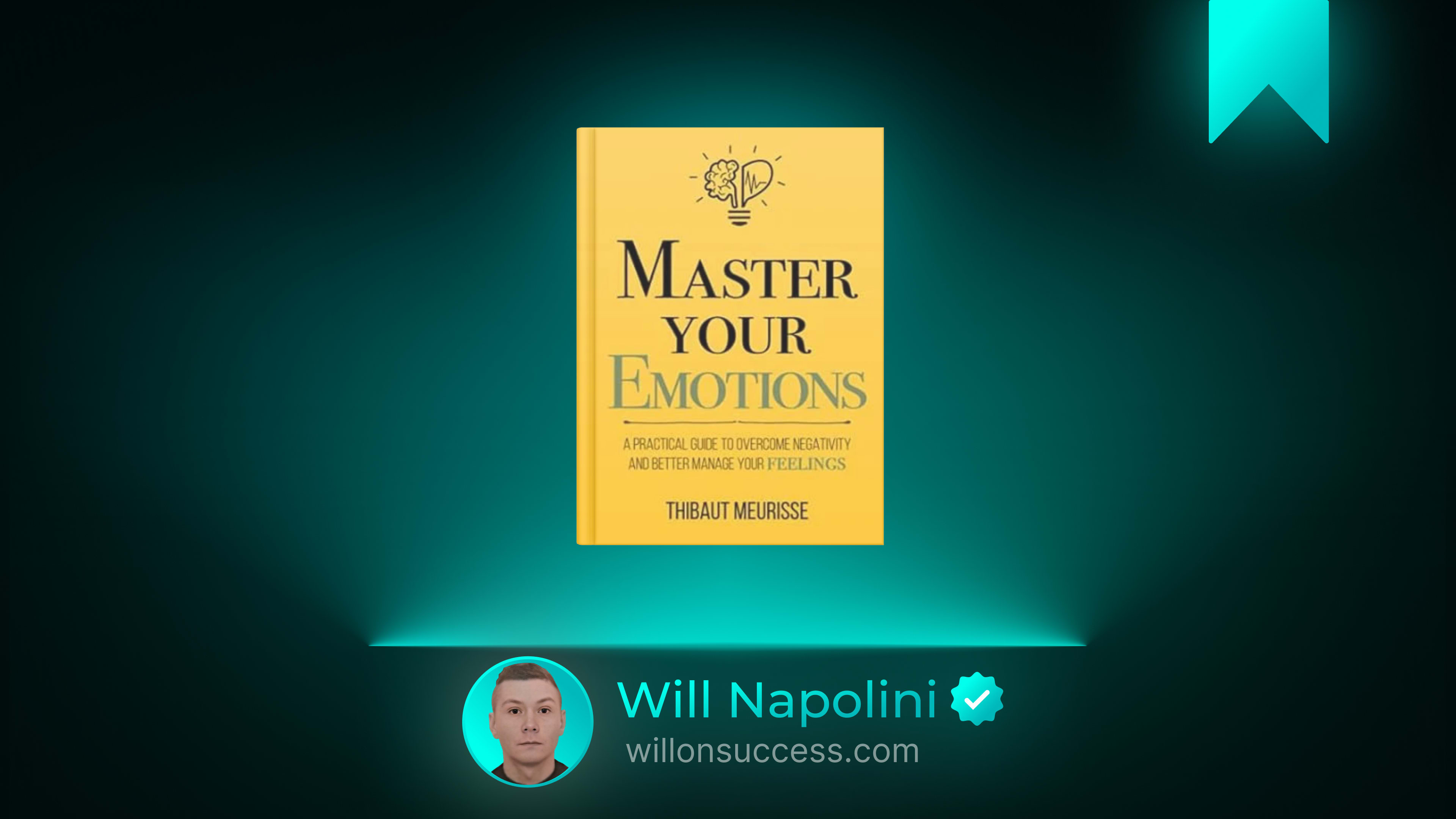
Master Your Emotions by Thibaut Meurisse: How to Break Free from the Negativity Loop
You know the exact moment it happens. Your chest tightens. Your breathing grows shallow. A sudden wave of anger, anxiety, or profound inadequacy washes over you, and in that fraction of a second, a dangerous assumption takes root in your mind: Because I feel this so intensely, it must be true.
I have sat across from countless brilliant, capable people who were entirely hijacked by this single illusion. They believed their frustration was proof of their circumstances. They believed their anxiety was a prophecy of their future. They treated their emotions as if they were objective facts handed down from the universe, rather than internal weather systems generated by their own minds.
If you have ever felt trapped in a loop of negativity—working hard, trying to stay positive, yet constantly dragged back down by heavy, unyielding feelings—I want to offer you a different perspective. You do not need to fight your emotions. You need to understand the machinery that creates them.
The Big Idea
In his book Master Your Emotions, Thibaut Meurisse dismantles the way we typically relate to our feelings. The central thesis is both liberating and deeply challenging: your emotions are not reality; they are signals generated by a complex system of mental habits, evolutionary survival mechanisms, and a constructed identity known as the ego.
Most of us move through life reacting to our emotional states as if they are external forces acting upon us. We say things like, “He made me so angry,” or “This situation is depressing.” We outsource our emotional authority to the world around us. But Meurisse argues that while we cannot always control what happens to us, we have far more influence over our emotional landscape than we realize.
The goal of mastering your emotions is not to become a stoic robot, devoid of feeling. It is to stop being a passive victim of your internal chemistry. It is about developing the awareness to recognize a negative emotion as it arises, understanding the story your mind is telling to create it, and choosing a different response. When you understand the mechanism, the emotion loses its absolute power over you.
The Story of the Survival Brain and the Constructed Identity
To understand how this machinery works, we have to look at the two primary engines driving your emotional state: the survival brain and the ego.
Let’s start with the survival brain. Human beings are not evolved to be perpetually happy; we are evolved to survive. Your inherent survival mechanisms naturally contribute to a negativity bias. Thousands of years ago, the ancestors who assumed the rustling in the bushes was a predator lived to pass on their genes. The ancestors who assumed it was just the wind often did not. Today, there are no predators in the bushes, but your brain still scans the environment for threats. It magnifies a critical email from your boss, a strange look from a friend, or a minor financial setback, treating them as existential dangers. Your ego and survival brain keep you stuck in negativity because, to your primitive neurology, hyper-vigilance feels like safety.
Then, there is the ego. When most people hear the word “ego,” they think of arrogance or pride. But Meurisse defines the ego differently. He describes it as a mind-constructed identity. It is a collage of your past experiences, your beliefs, your labels, and your grievances. The ego’s primary job is to protect this constructed identity at all costs.
When reality contradicts the story your ego tells about who you are, it perceives a threat. If your ego is built on being the “smart one,” and you make a foolish mistake, the ego feels attacked. To defend itself, it generates negative emotions. It might project anger outward to blame someone else, or it might turn inward, generating shame to reinforce the narrative that you are fundamentally flawed. The ego similarly cultivates a sense of superiority over others through judgment, or a sense of victimhood through resentment, just to maintain its boundaries.
You are not always fighting the world. Very often, you are fighting the ego’s desperate need to defend a story it wrote years ago.
The Major Principles
Thoughts Are the Architects of Feeling
There is a sequence that dictates your emotional life, and it happens so fast you rarely notice it. An event occurs. A thought arises. An emotion follows.
The critical mistake we make is skipping the middle step. We believe the event caused the emotion. But your thoughts play a central role in shaping your emotional state. The event is neutral until your mind interprets it.
Imagine you send a text message to a close friend, and hours pass without a reply. The event is simply a lack of digital response. But the thoughts you generate will determine your emotional reality.
- If your thought is, They are ignoring me because I annoyed them yesterday, your emotion will be anxiety or rejection.
- If your thought is, They must be incredibly busy at work, your emotion will be empathy or neutrality.
- If your thought is, They are probably distracted and forgot, your emotion might be mild amusement.
The event never changed. The feeling changed entirely based on the narrative your mind constructed. What you repeat in private eventually becomes visible in your life. If you habitually interpret ambiguous events through a lens of threat or inadequacy, you will live in a state of chronic emotional distress. Mastering your emotions begins with catching the thought before it hardens into a feeling.
The Trap of Emotional Reasoning
When a negative emotion takes hold, it creates a powerful physiological response. Your heart rate changes. Your muscles tense. Because the physical sensation is so intense, your brain assumes the thought that caused it must be undeniably true. This is called emotional reasoning.
You feel like a failure, therefore you must be a failure. You feel terrified of the future, therefore the future must be doomed.
I have learned that treating an emotion as a fact is one of the most destructive habits a person can develop. An emotion is a weather system, not the climate. It is a temporary atmospheric condition passing through the vast sky of your consciousness. It may be storming fiercely right now, but the storm is not the sky. The sky remains untouched, vast, and capable of holding the weather without being destroyed by it.
When you stop identifying with the weather, you gain the ability to observe it. You can say, “I am experiencing a feeling of deep frustration right now,” instead of, “I am a frustrated, angry person.” This subtle shift in language creates a gap between you and the emotion. In that gap lies your freedom to choose how to respond.
Action Precedes Motivation
When we are trapped in a negative emotional spiral, we usually wait to feel better before we take action. We tell ourselves, “Once I feel more motivated, I will tackle that project.” “Once I feel less anxious, I will have that difficult conversation.” “Once I feel happier, I will start taking care of my health.”
This is a fundamental misunderstanding of human psychology. Motivation is rarely the precursor to action; it is the result of action.
Meurisse provides 31 simple coping strategies to deal with negative feelings, many of which rely on shifting your physical state to shift your mental state. You cannot easily think your way out of a feeling you thought your way into. The intellect is a poor tool for prying open the jaws of the survival brain.
Instead, you must use the body. Change your physiology. Stand up. Walk outside. Change your breathing. Engage in a task that requires your full, undivided attention. When you alter your physical state and direct your focus outward, you interrupt the neural loop that is feeding the negative emotion. Action creates momentum, and momentum generates a new emotional baseline. You do not need more motivation to change your life. You need a system that makes the right action easier, even when your feelings are telling you to stay in bed.
Why It Matters
Why does this level of emotional mastery matter on an ordinary Tuesday?
Because the quality of your life is inextricably linked to the quality of your emotional regulation. In your career, the inability to manage the ego’s reaction to criticism will stall your leadership potential. The person who can receive harsh feedback without their ego collapsing into defensiveness or shame will always outpace the person who requires constant validation.
In your relationships, unmastered emotions act as a wrecking ball. When your partner says something thoughtless, your survival brain perceives an attack. If you react from that primal place, you will say things designed to wound, not to resolve. Mastering your emotions allows you to feel the sting of the moment, recognize it as a trigger, and choose a response that builds the relationship rather than tearing it down.
Ultimately, this work is about reclaiming your time. Every hour you spend ruminating on a perceived slight, worrying about a hypothetical disaster, or nursing a grievance is an hour stolen from your actual life. The ego demands your attention to sustain its stories. When you stop feeding it, you get your life back.
Practical Application
Understanding these concepts is valuable, but understanding without action changes nothing. How do we translate this into daily behavior?
Meurisse’s framework is highly tactical. Instead of trying to memorize dozens of abstract theories, I want you to implement a simple, three-step protocol the next time a heavy, negative emotion threatens to pull you under.
1. Name the Weather The moment you feel the physical shift—the tight chest, the heat in your face—pause. Silently name the emotion. “This is anxiety.” “This is resentment.” Naming it engages the prefrontal cortex, the logical part of your brain, and begins to dampen the amygdala’s alarm bells.
2. Interrogate the Architect Ask yourself: What story is my ego telling right now to make me feel this way? Look for the hidden narrative. Are you feeling like a victim? Are you trying to prove you are right? Are you assuming a threat where there is only a neutral event? Write the story down on a piece of paper. Seeing it outside of your head strips it of its power.
3. Shift the Physiology Do not try to argue with the emotion using logic alone. Move. Splash cold water on your face. Do ten push-ups. Step outside and look at the horizon. Force your brain to process new sensory input. Once your physical state has shifted, return to the problem with a clearer mind.
Small decisions repeated over time build emotional resilience. You start small. You stay consistent. You let time do its work.
Who Should Read This Book
Master Your Emotions is a highly pragmatic, action-oriented manual. It will be immensely valuable for overthinkers, people who struggle with daily emotional spirals, and anyone who feels like a passive victim of their own moods. If you are looking for clear, actionable strategies to break the loop of everyday negativity, this book is a powerful tool.
However, it is important to be honest about its limitations. This book is not a substitute for clinical psychology or deep trauma therapy. If your emotional struggles stem from severe, unprocessed trauma, deep psychological wounds, or clinical disorders, the tactical strategies in this book, while helpful, will not replace the need for professional therapeutic support. It is a guide for managing the everyday mechanics of feelings, not a clinical treatment plan.
One Small Step
If I could sit across the table from you right now, I would ask you to look at the area of your life where you feel the most stuck, frustrated, or anxious.
Here is your one small step for today: Identify one recurring negative emotion you have felt this week. Take out a blank sheet of paper and draw a line down the middle. On the left side, write down the objective, undeniable facts of the situation—the things a camera could record. On the right side, write down the story your ego has attached to those facts.
Look at the difference between the two columns. The gap between them is where your suffering lives.
You cannot control the wind, and you cannot stop the storms from rolling in. But you can learn to build a shelter. You can learn to watch the clouds pass without believing you are the rain. The moment you realize your feelings are just visitors, you finally become the master of the house.