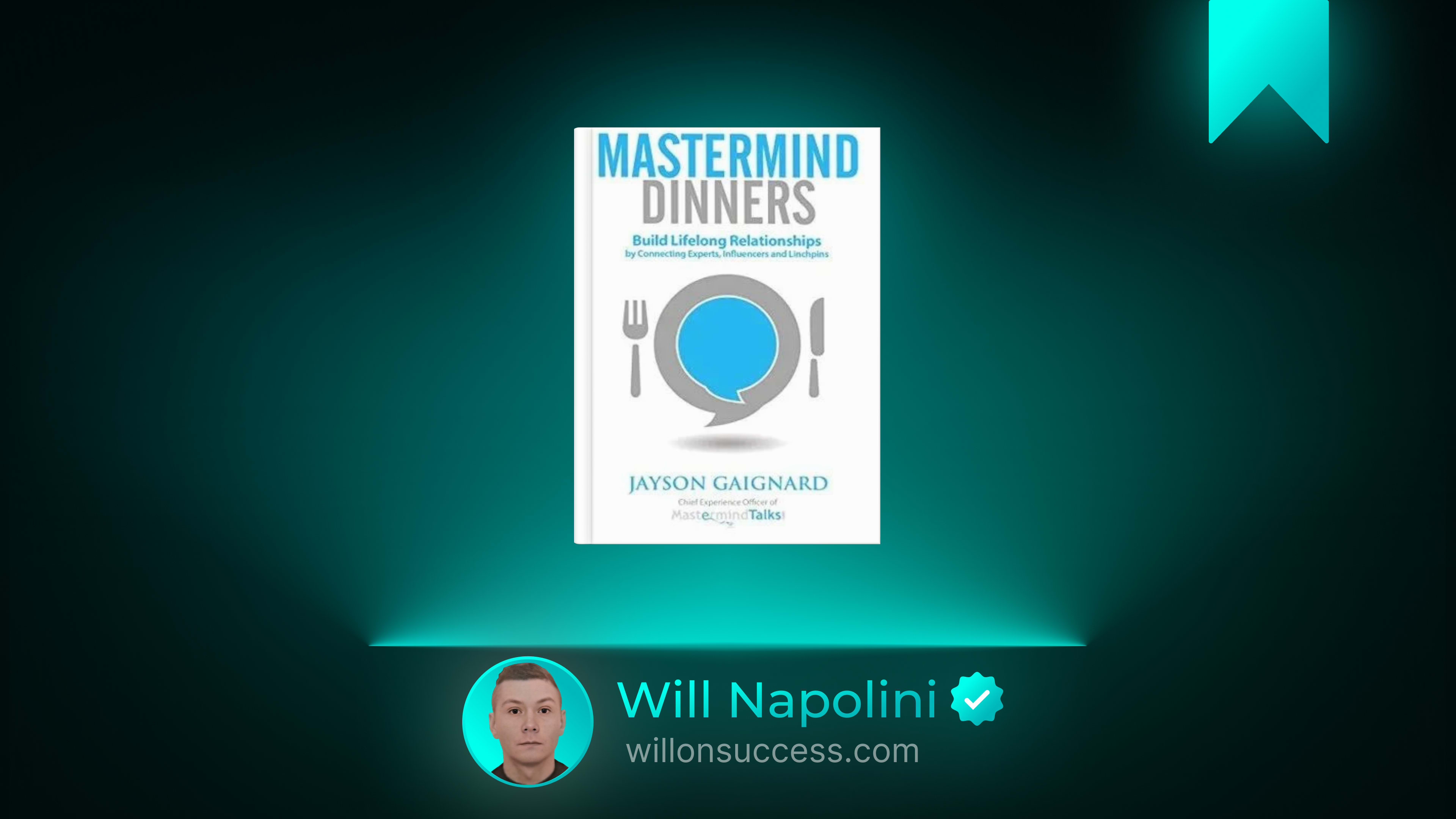
Mastermind Dinners by Jayson Gaignard: The Architecture of Deep Connection
Imagine the last networking event you attended. The loud room. The name tags peeling off your shirt. The forced smiles. The exchange of pleasantries that meant nothing, with people you would never speak to again. You left with a pocket full of business cards and a profound sense of exhaustion.
I have been in those rooms. I have handed out the cards. And I have learned the hard way that a wide network is entirely useless if it lacks depth. We are drowning in digital connections, yet starving for genuine, high-trust relationships. When the market turns, when a deal falls through, or when life simply breaks your heart, a LinkedIn connection cannot help you. You need people who know your character, not just your job title.
There is a dangerous assumption hiding inside the way most of us think about professional success: the belief that if we just meet more people, the right doors will eventually open. But what if the secret isn’t in the volume of people you meet, but in the environment you create for them?
The Big Idea
In Mastermind Dinners, entrepreneur and master connector Jayson Gaignard dismantles the traditional concept of networking and replaces it with something far more powerful: curation. The central thesis of the book is that the most profound personal and professional breakthroughs do not happen in crowded conference halls or over rushed coffee meetings. They happen around a dinner table.
Gaignard argues that human connections, not cash, are what give true value to your life. But these connections do not happen by accident. They require intention, architecture, and a willingness to move from being a passive participant in your network to an active “catalyst.” By hosting intimate, highly curated dinners for four to eight people, you can bypass the superficial ego and foster the kind of deep, lifelong trust that transforms careers and lives.
You do not build a network by collecting business cards; you build it by collecting shared experiences.
The Story of the Table
To understand why this works, we have to look at the fundamental flaw in modern networking. When you meet someone at a mixer, the immediate, unspoken question is: What can you do for me? The ego is on high alert. People lead with their resumes. They pitch. They posture. They guard their insecurities behind a wall of professional jargon.
A dinner table changes the physics of the room.
When you invite someone to break bread, you are invoking one of the oldest human rituals of trust. Gaignard built a multi-million-dollar business and community by recognizing this simple truth. He didn’t chase influencers; he invited them to dinner. He brought together experts, creators, and linchpins from entirely different industries and placed them in an environment designed for vulnerability.
But a Mastermind Dinner is not just a casual dinner party with old friends. It is a carefully engineered experience. It relies on a specific format, a curated guest list, and a set of ground rules that signal to the brain: You are safe here. You can drop the armor. A dinner table is not just a place to eat; it is a stage for human alchemy.
The Major Principles
The Alchemy of the Guest List
The magic of a Mastermind Dinner does not come from inviting the most famous or successful people you can find. It comes from the alchemy of the mix.
If you invite six real estate investors to a dinner, you get an echo chamber. They will talk about cap rates and market trends, and they will leave having learned nothing new. But if you invite two real estate investors, one philosopher, one artist, one software engineer, and one chef, something remarkable happens. They begin to see their own challenges through entirely new lenses.
Your job as the host is to be the architect of this collision. You are looking for high-character individuals who are curious, generous, and open-minded. You are not trying to build a room of people who can help each other immediately; you are building a room of people who can expand each other’s thinking. A small decision becomes a direction, and a direction repeated long enough becomes a life. The people you choose to surround yourself with dictate the direction of your life.
The Architecture of the Environment
Environment dictates behavior. If you want deep conversation, you cannot host a dinner in a loud, crowded sports bar where people have to shout over the music. Gaignard emphasizes the tactical details of the environment because they quietly shape the emotional baseline of the room.
Consider the mechanics of the meal. One of the most practical rules in the book is to have guests order their food immediately after introductions. Why? Because if you wait, the conversation will inevitably deepen, and an hour later, you will have eight hungry people who forgot to look at a menu.
Another rule is to order wine by the glass, rather than placing bottles on the table. This subtly controls the pace of consumption, keeping the cost manageable and ensuring the conversation remains sharp rather than sloppy. You set an explicit end time for the dinner, which gives people the psychological permission to leave gracefully if they need to, while allowing those who want to stay to continue. You enforce a strict policy of confidentiality—what is shared at the table stays at the table. And you ask for the phones to be put away.
These are not arbitrary rules. They are the scaffolding that holds the space. When people know the boundaries, they relax. When they relax, they open up.
The Currency of Depth
The most critical moment of any gathering is the introduction. Most introductions are painful recitations of job titles and company names. This feeds the ego and bores the room. Gaignard suggests entirely bypassing the resume. Instead, he uses a framework of questions designed to reveal the human being behind the title.
The centerpiece of this is what he calls “The Champagne Question.” Early in the evening, he asks every person at the table: “If we were to meet a year from now with a bottle of champagne, what are we celebrating?”
Think about the power of that question. It forces the person to articulate their deepest aspirations. It reveals what they actually care about, not just what they are currently working on. It instantly aligns the room toward growth and possibility.
To deepen the connection further, Gaignard uses a physical stack of cards, each with a different question. He color-codes them from light to dark. Light questions might be, “What is the best advice you’ve ever received?” Dark questions might be, “What is a devastating event in your life that turned out to be a blessing?”
By drawing a card and answering it, the guests are given permission to be vulnerable. You cannot build a deep relationship with someone’s highlight reel. You build it by witnessing their struggles, their doubts, and their genuine reflections.
The Power of the Gatekeeper
As you begin to host these dinners and your network deepens, you will become a node of connection. People will start asking you for introductions. This is where many well-meaning people fail. They become a conduit for everyone else’s agendas, burning out their own social capital by making sloppy introductions. Gaignard teaches that you must become fiercely protective of your network. You must become the gatekeeper.
When someone asks you to connect them with a high-level contact, Gaignard recommends asking one simple, clarifying question: “What is your desired outcome with this connection?”
You would be shocked at how many people are stopped dead in their tracks by this question. They want the introduction, but they have no clarity on why. By forcing them to articulate the mutual value of the connection, you protect the time and energy of your friends, and you ensure that any introduction you do make is rooted in purpose, not just convenience.
Why It Matters
Why does this level of intentionality matter on an ordinary Tuesday?
Because trust is the only currency that scales. In a world increasingly mediated by algorithms, artificial intelligence, and digital transactions, high-trust, face-to-face human connection is becoming the rarest and most valuable asset you can possess.
When you are the person who brings brilliant, generous people together, you do not just get a seat at the table; you become the table. Opportunities, partnerships, and deep friendships will flow to you naturally, not because you chased them, but because you cultivated the soil where they could grow.
Furthermore, this work changes you. The loneliness of the modern professional is a silent epidemic. We sit in our offices or our home studios, managing crises in isolation. When you regularly sit across from people who are wrestling with profound questions, who are honest about their failures, and who are dreaming out loud about their future, your own baseline for what is possible expands. You stop playing small games. You realize that everyone you admire is just a person, figuring it out one day at a time.
What you repeat in private eventually becomes visible in your life. If you repeat the act of bringing good people together, you will inevitably become a person of deep influence and quiet confidence.
Practical Application
Understanding the philosophy is the first step. But to experience the power of the Mastermind Dinner, you must become the host. Here is how you can engineer your first gathering without feeling overwhelmed.
1. The Curated List Identify four to six people. They do not need to be famous or wealthy. They just need to be interesting, kind, and open. Aim for a mix of industries and backgrounds. Do not invite people who already know each other well; the magic is in the introduction.
2. The Personal Invitation Do not send a mass email or create a Facebook group. Reach out individually. Tell them why you are specifically inviting them. Frame it not as a networking event, but as an intimate gathering of curious minds. Be entirely clear about the financial expectation (e.g., “We will be splitting the bill evenly” or “I am hosting this as my treat”). Clarity prevents awkwardness and builds immediate trust.
3. The Table Mechanics Choose a restaurant with a quiet corner and good lighting. Arrive thirty minutes early to secure the table and greet the first arrivals. Establish the ground rules early: confidentiality, phones away, and ordering food immediately.
4. The Facilitation You are the host, which means you are the conductor. Start with the Champagne Question. Let it breathe. If the conversation stalls, pull out your stack of questions. Your job is not to be the most interesting person in the room; your job is to make everyone else feel like the most interesting person in the room. Listen more than you speak.
Who Should Read This Book
Mastermind Dinners is a masterclass in relational networking. It is essential reading for entrepreneurs, community builders, leaders, and anyone who feels isolated at the top of their profession. If you are tired of transactional relationships and want to build a resilient, supportive ecosystem around you, this book provides the exact blueprint.
However, if you are looking for a tactical guide to cold-emailing, sales funnels, or aggressive growth-hacking, this book will frustrate you. Gaignard is not teaching you how to manipulate people for short-term gain. He is teaching you how to invest in human beings for long-term compounding. It requires patience, generosity, and a genuine interest in others. If you lack those traits, the mechanics of the dinner will feel hollow, and the results will not follow.
One Small Step
You do not need to book a private room at a high-end restaurant to start practicing this today.
Here is your one small step: Look at your contacts and find one person you deeply respect, but whom you only interact with on a superficial, professional level. Send them a message today and invite them to a simple cup of coffee or a quiet lunch.
When you sit down, skip the resume. Skip the shop talk. Look them in the eye and ask them the Champagne Question: “If we were to sit down a year from now, what is the one thing you hope we are celebrating?”
Listen to their answer.
You will instantly realize that you have stopped networking, and you have finally started connecting. The doors you have been trying to kick down will quietly swing open the moment you learn how to set the table.