Charisma Is Not a Gift. It Is a Skill You Can Build From Scratch.
We have all watched them. The person who walks into a crowded room and seems to effortlessly glide from one conversation to the next. They know exactly when to speak, when to listen, and how to make the person they are talking to feel like the only one in the room. When they tell a story, people lean in. When they leave, people feel a little brighter than they did before.
We watch them from the corner, holding our own drink, and we tell ourselves a very specific, very comforting lie: They just have the gene. They are naturally charismatic. I am just wired differently.
I used to tell myself that lie, too. It is a comforting lie because it absolves us of responsibility. If charisma is a genetic lottery, then our social awkwardness, our lonely weekends, and our stalled careers aren’t our fault. We just didn’t win the draw.
But what if I told you that the person in the center of the room isn’t using magic? What if I told you they are simply running a highly optimized, deeply practiced system that you have never been taught?
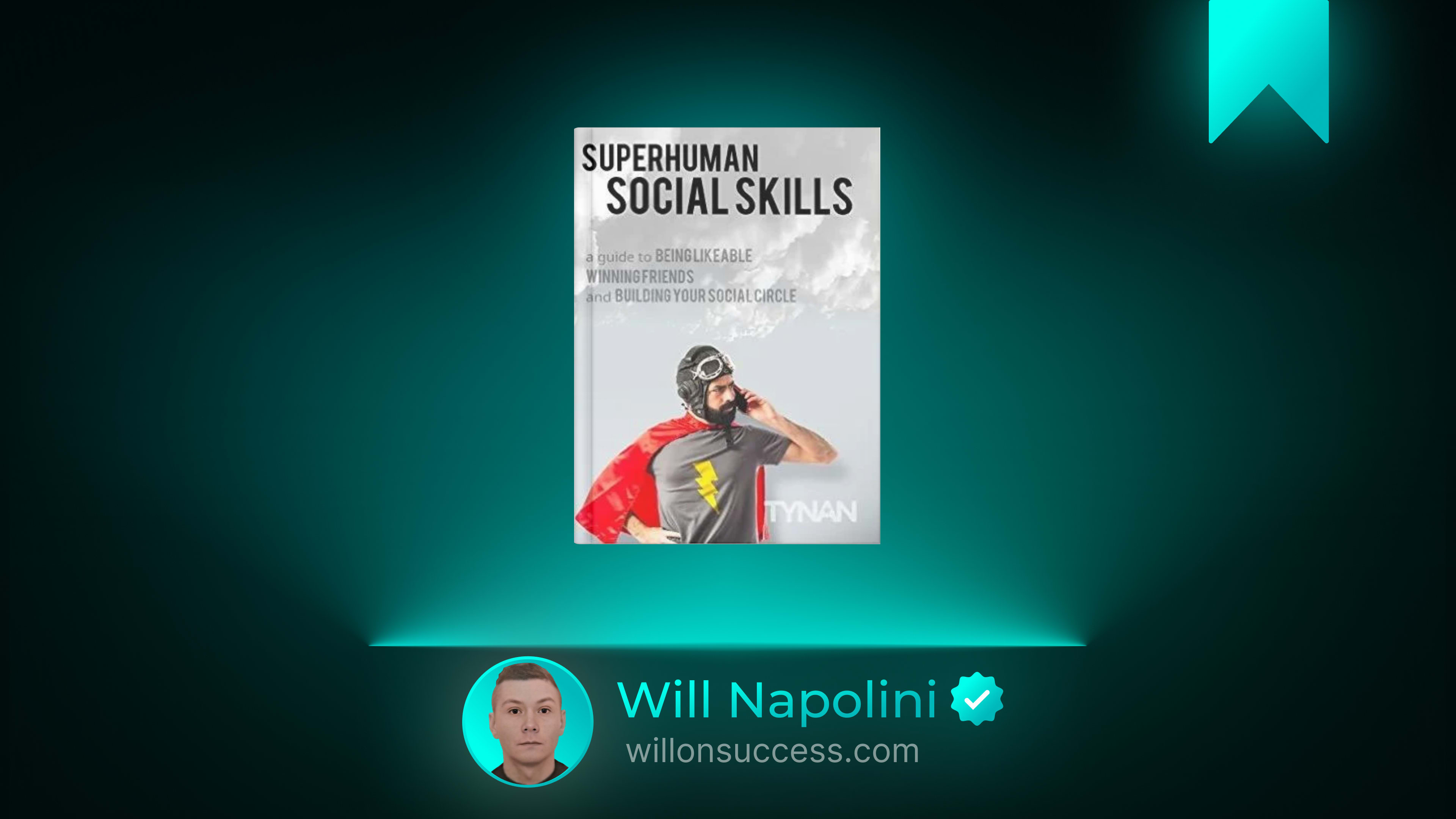
Tynan, a writer, traveler, and analytical thinker, wrote Superhuman Social Skills to dismantle the myth of the “natural.” His premise is as blunt as it is liberating: social skills are not innate personality traits. They are mechanical skills. They are exactly like typing, driving a car, or playing chess. They look like intuition from the outside, but from the inside, they are just a series of learned patterns, practiced until they become automatic.
If you want to build a rich, vibrant social life, you do not need to change who you are. You just need to learn how the machine works. Let me show you the blueprint.
The Big Idea: Charisma Is an Algorithm, Not an Aura
When we think of social skills, we usually think of them as an “aura” — a mysterious vibe that you either project or you don’t. Tynan approaches socializing the way an engineer approaches an engine. He breaks it down into bolts, gears, and levers.
The central thesis of the book is that “superhuman” social ability is simply the result of applying deliberate, mechanical practice to areas of life that most people leave to chance. Most people just walk into a room and hope a good conversation happens to them. The “superhuman” walks in with a toolkit, recognizes the patterns of human interaction, and actively builds the conversation.
But I want to be very clear about something right up front, because social skills books often get a bad reputation. This is not about manipulation. It is not about learning tricks to deceive people, or using psychological hacks to get what you want from them.
Tynan’s philosophy is rooted in a fundamental truth: Social skills are an amplifier for your character. If you are a selfish, uninteresting person, learning social skills will just make you a highly effective manipulator, and people will eventually see through you. But if you are kind, curious, and have value to offer, learning social skills removes the friction that keeps your good qualities hidden. It allows you to actually deliver your value to the people who would benefit from it.
You are not learning to be fake. You are learning to translate your genuine self into a language others can easily understand.
Conversational Threading: The Art of Never Running Out of Things to Say
If there is one mechanical skill in this book that will immediately change your daily life, it is the concept of Conversational Threading.
The greatest fear of the socially anxious person is the silence. The terrifying moment when the other person stops talking, the air goes dead, and your mind goes entirely blank. To avoid this, most people default to “interview mode.” They ask a question, the person answers, and then they ask another, unrelated question. It feels like an interrogation, and it exhausts everyone involved.
Tynan points out that every single sentence a human being speaks contains multiple “threads” — keywords or concepts that you can grab onto to pull the conversation forward.
Imagine someone says: “I just got back from a really exhausting trip to Chicago for my sister’s wedding.”
A socially unskilled person might just say, “Oh, cool,” and let the thread drop. Or they might immediately pivot to themselves: “I went to Chicago once, the pizza was great.”
But look at the threads available in that single sentence:
- Exhaustion / Travel fatigue
- Chicago / The city itself
- The sister / Family dynamics
- Weddings / The event
A skilled conversationalist simply picks one of those threads and follows it.
- Thread 1: “Travel can be so draining. Are you the kind of person who needs a day to recover, or do you bounce right back?”
- Thread 3: “That’s wonderful. Are you and your sister close, or was it stressful playing the family role for the weekend?”
When you understand threading, you realize you never actually run out of things to say. You just stop listening to respond, and start listening to identify the threads. You let the other person’s words build the bridge, and you just walk across it.
The Story Toolbox: Why You Must Pre-Pack Your Best Moments
We tend to believe that great storytellers are just spontaneously witty. We think they pull hilarious, engaging narratives out of thin air.
Tynan shatters this illusion. The best storytellers in the world do not make it up on the spot. They have a Story Toolbox. They have five to ten polished, reliable stories from their life that they know how to tell well, and they deploy them when the context is right.
Think about it. You have lived for years. You have traveled, worked, failed, and succeeded. Yet, when someone asks, “What’s the craziest thing that happened to you at your last job?” your mind goes blank. Not because nothing happened, but because you haven’t indexed your memories.
Tynan advises actively building your toolbox. Sit down and write out a few stories from your life. A time you failed spectacularly. A time you experienced a bizarre coincidence. A time you changed your mind about a deeply held belief.
Then, practice telling them. Out loud. To your dog, to the mirror, to a voice recorder. Notice where the story drags. Cut the unnecessary details about the weather or what you had for breakfast. Find the emotional core. Find the punchline or the lesson.
When you have a toolbox of pre-packed stories, you stop panicking in social situations. You know you have value in your back pocket. And here is the beautiful secret about storytelling: you are not telling stories to brag. You are telling stories to give the other person a gift. You are giving them a moment of entertainment, a spark of emotion, and a hook to connect with you.
The Baseline of Comfort: The Physicality of Presence
Before you open your mouth, your body has already introduced you. Tynan spends a significant portion of the book on the physical mechanics of comfort, particularly eye contact and body language.
Many people who struggle socially have a “darting” physical presence. Their eyes dart around the room while someone is talking to them. Their shoulders are hunched. They physically angle their body toward the exit. This signals to the other person’s primal brain: This person is unsafe, distracted, or wants to leave.
The baseline of social comfort is grounded physical presence. Tynan breaks down the mechanics of comfortable eye contact. It is not about staring unblinkingly into someone’s soul—that is aggressive and creepy. It is about resting your gaze softly on the triangle between their eyes and the bridge of their nose. When you break eye contact, you break it horizontally (looking to the side), not vertically (looking down at the floor). Looking down signals submission and shame. Looking to the side signals that you are simply processing a thought.
These micro-adjustments feel incredibly unnatural at first. You will feel like a robot manually operating a meat suit. But I promise you, the person across from you will not see a robot. They will just suddenly feel, Wow, this person is really present. I feel safe with them.
You are building the physical scaffolding that allows emotional intimacy to occur.
The Architecture of a Social Circle: Becoming the Hub
One of the most profound shifts in the book is moving from a “one-to-one” social mentality to a “hub” mentality.
Most people view their social life as a series of isolated, one-on-one connections. I know John from work. I know Sarah from college. But they never introduce John to Sarah. They wait for invitations to events, rather than creating the events themselves. They are spokes, waiting to be attached to a wheel.
Tynan encourages you to become the Hub. The hub is the person who connects others.
When you meet someone interesting, your first thought should not just be, How do I hang out with this person? It should be, Who else in my life would benefit from knowing this person?
If you meet a brilliant graphic designer, and you have a friend who is struggling to build a brand, introduce them. If you know two people who both love obscure 1970s sci-fi movies, put them in the same room.
When you become a connector, you stop having to generate all the social value yourself. You become a node of abundance. Furthermore, hosting low-stakes gatherings—a Sunday morning coffee walk, a casual Thursday night taco dinner—positions you as the architect of your social world. You don’t need to be the loudest person at the party if you are the person who invited everyone to the party.
Reframing the Awkward: Silence Is Not a Failure
I want to address the elephant in the room: the awkwardness.
Even if you master threading, storytelling, and eye contact, you will still experience awkward silences. You will still tell a joke that falls flat. You will still accidentally interrupt someone.
The unskilled person panics when this happens. They rush to fill the silence with nervous chatter. They apologize profusely. They internalize the stumble as proof that they are fundamentally flawed.
Tynan offers a vital reframe: Awkwardness is only fatal if you treat it as a fatality.
A silence is not a failure of conversation; it is a resting place. It is a moment for both people to digest what was just said. If a joke falls flat, the skilled person doesn’t spiral; they just smile, acknowledge it, and move on. “Well, that sounded much funnier in my head.”
When you stop being terrified of awkwardness, you strip it of its power. You realize that human connection is a messy, stumbling, imperfect dance. The goal is not a flawless performance. The goal is to keep dancing, even when you step on each other’s toes.
Why This Matters on an Ordinary Tuesday
You might be reading this and thinking, This sounds like a lot of work. Why can’t I just be myself and let people like me for who I am?
You absolutely should be yourself. But if your “self” is currently trapped behind a wall of poor eye contact, an inability to ask follow-up questions, and a fear of hosting gatherings, then people aren’t rejecting you. They are rejecting the friction of trying to reach you.
Your career, your romantic life, your deepest friendships, and your wildest opportunities will not come from filling out online forms. They will come from the micro-interactions of daily life. They will come from the conversation you have with a stranger in an elevator, the story you tell at a dinner party, the introduction you make between two friends.
When you treat social skills as a mechanical practice, you stop taking rejection and social failure so personally. If you fail to connect with someone, it doesn’t mean you are unlovable. It just means you used the wrong tool for that specific lock. You adjust, you practice, and you try again.
Who Should Read This Book
If you are an analytical thinker, an engineer, a programmer, or an introvert who feels like they “missed the manual” on human interaction, this book will feel like a revelation. Tynan writes with a highly logical, systematic, and deeply pragmatic voice. He does not deal in vague platitudes like “just be confident.” He gives you the exact mechanics of how to stand, where to look, and what to say.
It is also a phenomenal book for expats, digital nomads, or anyone moving to a new city who needs to build a social circle from scratch and needs a tactical playbook to do it.
However, if you are dealing with deep, clinical social anxiety, trauma, or profound self-hatred, this book is not a substitute for therapy. Tynan provides the mechanics of the car, but if the engine is fundamentally damaged, you need a mechanic (a therapist) before you can take it on the highway. Furthermore, if you are looking for deep, philosophical explorations of human nature, this book might feel a bit too “tactical” for your taste. It is a how-to manual, unapologetically focused on results.
Practical Application: Building Your Social Muscle
Understanding the theory is easy. Rewiring your social habits requires repetition. Here is how you can start building your superhuman skills this week.
1. The “Thread” Drill with Strangers You do not need to practice threading at a high-stakes networking event. Practice it on people who are paid to be polite to you. When the barista says, “It’s so crazy busy in here today,” do not just say, “Yeah, thanks.” Grab the thread. “I bet. Do you prefer the rush because the day goes by faster, or do you wish for the quiet mornings?” Practice identifying and pulling threads in low-stakes environments until it becomes your default setting.
2. The Story Audit Take thirty minutes this weekend to write down three stories from your life.
- One time you failed at something and what you learned.
- One time you experienced something highly unusual or funny.
- One time you passionately defended an opinion and later realized you were wrong. Write them out. Cut the fluff. Find the emotional hook. Practice telling them out loud until you can deliver them smoothly in under two minutes. Put them in your toolbox.
3. The “Hub” Experiment Look at your contacts list. Find two people who do not know each other, but who share a specific interest, profession, or vibe. Send them both a message: “Hey, I was just talking to [Name] and realized you two both [shared interest]. I feel like you’d really hit it off. Would you be open to me introducing you over a quick email or coffee?” Stop hoarding your friends. Start connecting them.
One Small Step
I want to leave you with a challenge that you can execute the very next time you speak to another human being. It requires no preparation, only a shift in your attention.
In your next conversation, I want you to implement the “Two-Thread Rule.”
Before you are allowed to talk about yourself, or before you are allowed to change the subject, you must identify and pull two threads from what the other person just said.
If they tell you about their weekend, ask a follow-up about the first thread. When they answer, ask a follow-up about the second thread. Only after you have explored their world for two beats are you allowed to step back into your own.
Notice what happens to their face. Notice how their shoulders drop. Notice how they lean in. You will have given them the rarest gift in the modern world: the feeling of being thoroughly, genuinely heard.
We spend so much of our lives waiting to be chosen. We wait for the invitation, we wait for the icebreaker, we wait for the “natural” charismatics to adopt us into their circles.
But you do not have to wait anymore. The mechanics of human connection are not a secret guarded by the lucky few. They are a toolkit, sitting right here, waiting for you to pick it up.
You are not broken. You are just untrained. And training is something you can start today.
The room is waiting for you to walk in. And this time, you know exactly how to open the door.