Your Mind Is a Powerful Engine, But You Left It in Neutral: How to Break the Habit of Overthinking
I want you to think about the last time you exhausted yourself without moving a single muscle.
You know the feeling. It is 2:00 a.m., and you are staring at the ceiling, replaying a conversation from three years ago. Or you are sitting in your car in the driveway, mentally rehearsing a difficult email you need to send, drafting and redrafting the opening sentence until your chest feels tight and your shoulders ache. You have run through forty different scenarios, anticipated every possible objection, and prepared for every conceivable disaster.
And yet, when you finally stand up, nothing has changed. The email is still unwritten. The problem is still unsolved. You are just profoundly, deeply tired.
I have watched this pattern drain the life out of brilliant, capable people for years. We treat overthinking as if it were a sign of intelligence, or a necessary tax we pay for being thorough. We tell ourselves that if we just think about the problem a little longer, from a few more angles, the perfect solution will finally reveal itself.
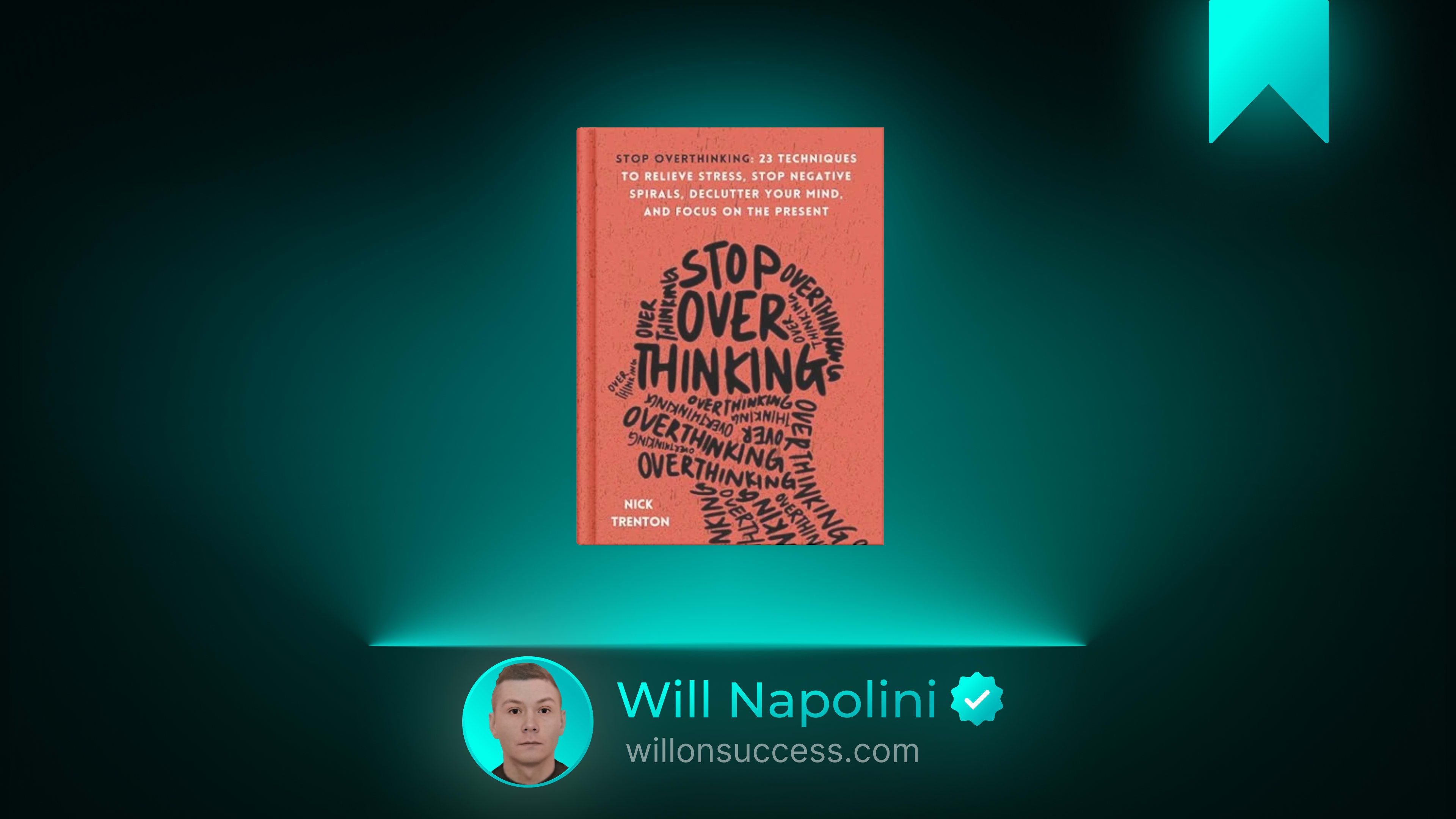
But Nick Trenton, in his highly practical book Stop Overthinking: 23 Techniques to Relieve Stress, Stop Negative Spirals, Clear Your Mind, & Focus on the Present, dismantles that illusion completely. His central message is both a relief and a challenge: Overthinking is not problem-solving. It is a defense mechanism masquerading as productivity. And because it is a habit, not a personality trait, it is a habit you can break.
Let us look at how to put down the heavy coat of rumination and finally start walking.
The Big Idea: The Illusion of Control
To stop overthinking, you first have to understand why your brain does it in the first place. Your brain is not trying to punish you. It is trying to protect you.
Thousands of years ago, when human beings faced physical threats, the brain’s job was to simulate outcomes to keep us alive. If I go into that cave, will there be a bear? If I eat that berry, will I get sick? Thinking was a survival tool.
But today, the “bears” are ambiguous text messages, performance reviews, financial uncertainties, and social judgments. These modern threats cannot be solved by physical preparation, so the brain does the only thing it knows how to do: it spins up the mental simulator. It tries to control the uncontrollable by predicting every possible future.
Trenton’s core thesis is that overthinking provides a false sense of control. It feels like you are doing something about the problem, but you are actually just rocking in a mental rocking chair. You are getting a lot of movement, but you are not going anywhere.
The moment you realize that your rumination is not a strategy, but a symptom of anxiety, the spell begins to break. You stop treating your thoughts as profound insights and start treating them as mere neurological weather.
Problem-Solving vs. Ruminating: Knowing the Difference
One of the most vital distinctions Trenton makes is the difference between productive problem-solving and toxic rumination. They feel similar in the moment, but their mechanics and outcomes are entirely different.
Problem-solving is linear. It has a beginning, a middle, and an end. You identify a problem, you brainstorm potential solutions, you choose one, and you take action. It is a process that moves outward into the world.
Rumination is circular. It asks “Why?” instead of “What now?” Why did I say that? Why do they think that about me? Why does this always happen to me? It digs into the past, or it spirals into a catastrophic future, but it never lands in the present moment with a concrete next step.
I have found that a simple litmus test can save you hours of mental agony. When you catch yourself deep in thought, ask yourself one question: Is this line of thinking leading to a specific, physical action I can take in the next ten minutes?
If the answer is yes, you are problem-solving. Keep going. If the answer is no, you are ruminating. You are burning fuel while parked in the driveway. And it is time to turn off the engine.
You Cannot Think Your Way Out of a Thinking Problem
Here is a mistake I see people make every single day: when they catch themselves overthinking, they try to use more thinking to stop it. They argue with their thoughts. They try to logically prove to themselves that their worries are irrational. They tell themselves, Stop worrying, it’s not a big deal, just relax.
But you cannot out-think a feeling. The brain does not respond to logical commands when the nervous system is flooded with anxiety. Trying to logic your way out of a mental spiral is like trying to put out a grease fire with a glass of water; it only makes it spread.
Trenton draws heavily on somatic and cognitive-behavioral techniques to show that the way out of the mind is through the body. You have to shift your physiological state to change your mental state.
One of the most effective tools he highlights for this is the 5-4-3-2-1 Grounding Technique. When the mental loop is spinning out of control, you forcefully pull your attention out of the hypothetical future and anchor it in the physical present. You look around and name:
- 5 things you can see.
- 4 things you can physically feel (the texture of your jeans, the chair against your back).
- 3 things you can hear.
- 2 things you can smell.
- 1 thing you can taste.
This is not a parlor trick. It is a neurological interrupt. It forces the prefrontal cortex to come online and process sensory data, which naturally dials down the amygdala’s panic response. You are not ignoring the problem; you are simply regulating your nervous system so that you can actually look at the problem clearly.
Containing the Fire: The Power of Scheduled Worry
When you tell an overthinker to “just stop worrying,” they will look at you as if you just told them to stop breathing. The worries feel too urgent, too loud, and too important to simply dismiss. If you try to push them away, they will only bounce back with more force.
Instead of fighting the thoughts, Trenton suggests a counterintuitive strategy: Schedule them.
This is often called a “Worry Window” or “Containment.” You designate a specific time—say, 4:30 p.m. to 4:45 p.m.—as your official worry time. When a catastrophic thought or a looping anxiety arises at 10:00 a.m., you do not engage with it. You write it down on a piece of paper and tell yourself, I am not ignoring this, but I am not dealing with it right now. I will worry about this at 4:30.
What I have discovered when applying this principle is that it changes your relationship with your own anxiety. During the day, you regain your focus because you have given your brain permission to postpone the panic. And here is the beautiful irony: when 4:30 p.m. finally arrives, and you sit down with your list of worries, you will often find that the urgency has evaporated. The things that felt like life-or-death emergencies at 10:00 a.m. look remarkably manageable, or even silly, in the light of the late afternoon.
You are not suppressing the thoughts. You are simply refusing to let them dictate the schedule of your life.
The Antidote to Paralysis is Imperfect Action
If overthinking is the disease, action is the cure. But not just any action. Imperfect action.
Overthinking thrives on the demand for certainty. It whispers that you must have all the information, foresee all the risks, and guarantee a positive outcome before you are allowed to move. But certainty is a myth. You will never have 100% of the data.
Trenton emphasizes that a bias toward action is the ultimate disruptor of the overthinking loop. When you take a physical step forward, you generate real-world feedback. And real-world feedback is infinitely more valuable than hypothetical simulation.
Imagine you are standing at the edge of a diving board, trying to calculate the exact angle of entry, the temperature of the water, and the wind resistance. You can stand there until you freeze. Or, you can jump. Once you are in the water, you no longer need to theorize about swimming; you simply swim.
A decision made and corrected is infinitely more powerful than a perfect decision never made. When you act, you give your brain actual data to process, rather than imagined fears to chew on. You trade the exhaustion of the simulator for the clarity of the real world.
Why This Matters on an Ordinary Tuesday
It is easy to read about these concepts and nod along, but the real test happens on an ordinary Tuesday when the stakes feel incredibly high to you.
It happens when your boss sends an email that just says, “We need to talk later,” and your mind immediately begins drafting your resignation letter. It happens when you want to start a business, write a book, or ask someone out, but you spend six months researching the “perfect” strategy instead of making a single phone call.
The cost of overthinking is not just lost time. It is lost life. It is the relationships you never enter, the art you never make, and the words you never say because you simulated the rejection forty times in your head and decided it wasn’t worth the risk.
When you learn to catch the loop, ground yourself in your body, and take one small, imperfect step, you reclaim your agency. You stop being a passive victim of your own neurology and become the active architect of your days. You realize that your mind is a brilliant servant, but a tyrannical master. It is time to put it back in its proper place.
Who Should Read This Book
If you are someone who lies awake at night replaying conversations, who struggles to make simple decisions because you are terrified of making the wrong one, or who feels a constant, low-grade hum of mental exhaustion, this book is a highly effective toolkit. Trenton writes in a clear, accessible, and deeply practical style. He does not get bogged down in dense academic theory; he gives you the tools and tells you exactly how to use them.
It is particularly useful for people who appreciate structured, cognitive-behavioral approaches to mental habits. If you like frameworks, checklists, and concrete exercises, you will find a lot to love here.
However, if you are looking for deep psychoanalysis, childhood trauma exploration, or a philosophical treatise on the nature of consciousness, this is not that book. It is a tactical manual for mental hygiene. Furthermore, if your overthinking is a symptom of severe, clinical anxiety or OCD, this book is a great supplementary tool, but it should not replace the guidance of a licensed mental health professional.
Practical Application: Building Your Mental Circuit Breakers
Understanding the mechanics of overthinking is only the first step. You need a system to catch yourself when the spiral starts. Here are three concrete practices you can implement this week.
1. The “Brain Dump” Protocol When your mind feels like a browser with 40 tabs open and you cannot find where the music is playing, stop trying to organize it in your head. Get a blank piece of paper and write down every single open loop, task, worry, and random thought. Do not organize it. Do not prioritize it. Just get it out of your head and onto the physical page. The brain is excellent at generating ideas, but it is terrible at storing them. Once the thoughts are on paper, your brain will stop spinning its wheels trying to remember them, and the mental noise will immediately drop.
2. The “Next Right Physical Step” Rule When you catch yourself paralyzed by a massive, overwhelming problem (e.g., “I need to figure out my entire career change”), shrink the frame. Ask yourself: What is the next right physical step I can take in the next five minutes? Not the next big strategic leap. The next physical step. It might be: “Open a new document and write three job titles I am curious about.” Or, “Find the email address of one person in that industry.” Do that one tiny thing. Action shrinks anxiety.
3. The Linguistic Shift Pay close attention to the words you use when talking to yourself. Overthinkers love the words should, must, always, and never. These words create rigid, inescapable boxes. Start catching them and replacing them with could, might, sometimes, and prefer. Change “I must figure this out today or I’m a failure” to “I would prefer to make progress on this today, but if I don’t, I can try again tomorrow.” It sounds small, but language shapes reality. Softening your internal vocabulary lowers the stakes and gives you room to breathe.
One Small Step
I want to leave you with a challenge that you can execute the moment you finish reading this sentence.
Think of one thing you have been overthinking lately. A decision you have been delaying, a conversation you have been rehearsing, a project you have been researching but not starting. You know exactly what it is.
I want you to identify the absolute smallest, most ridiculously easy physical action you could take toward that thing. Not the whole thing. Just the first inch.
If it is an email, the action is opening your inbox and typing the recipient’s name. If it is a workout, the action is putting your shoes on. If it is a difficult conversation, the action is writing down the very first sentence you want to say.
Do not think about step two. Do not worry about the outcome. Just do step one. Take the action, however clumsy or small it might be.
Because here is what I have learned after years of watching people fight their own minds: The future is not a puzzle to be solved in the quiet of your own head. It is a room you enter by taking a step.
Your mind will try to convince you that you need to map the entire room before you cross the threshold. It is lying to you. The map only draws itself as you walk.
Close the tab. Put down the phone. Take the step. The rest will follow.