Stop Fighting Yourself: What Leo Babauta’s Essential Zen Habits Teaches Us About the Gentle Art of Change
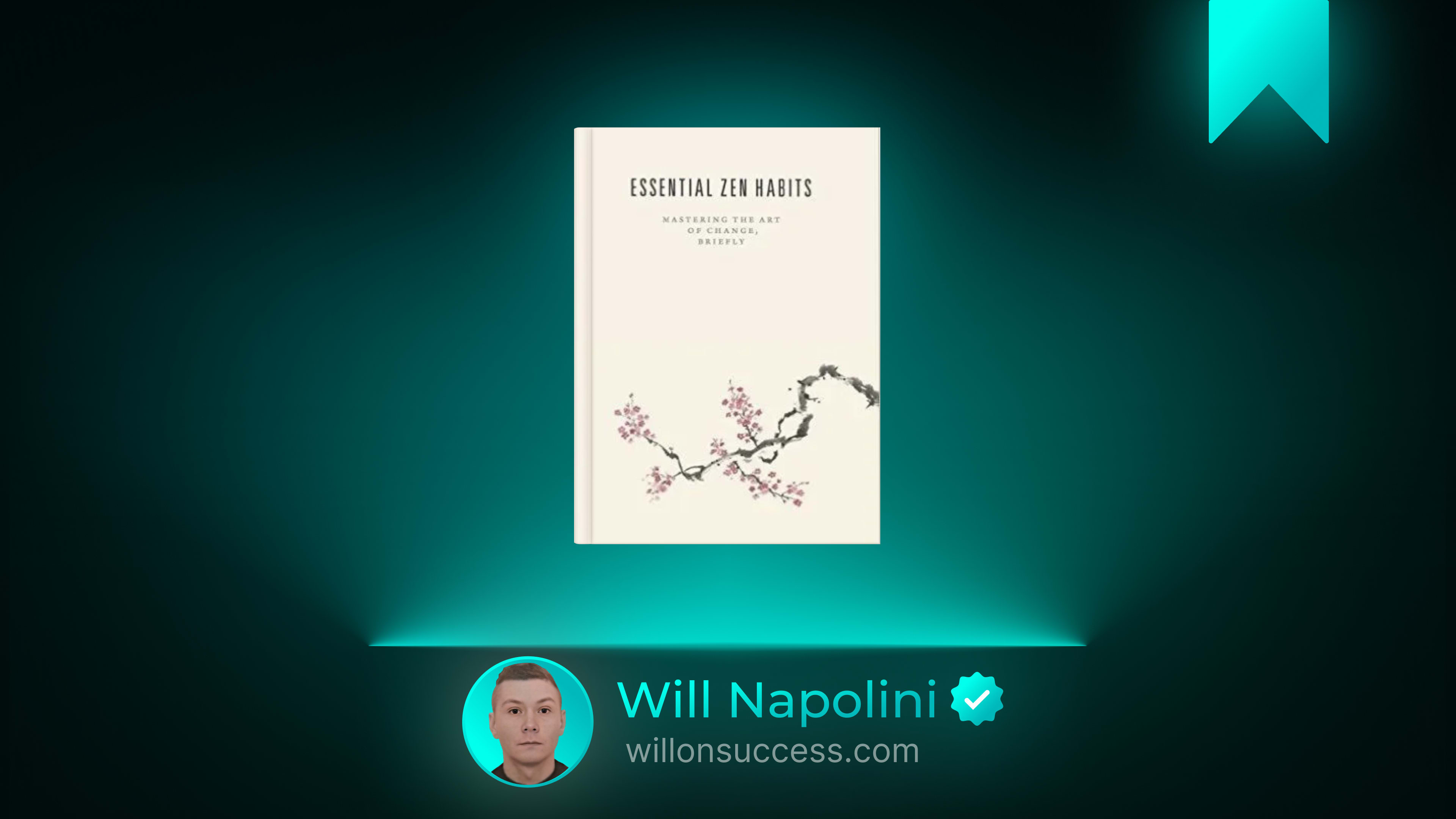
I want you to think about the exact moment you decide to break a promise to yourself. You planned to wake up early and write. You planned to go for a run. You planned to sit quietly for ten minutes instead of reaching for your phone. But the moment the time arrives, a strange, heavy resistance settles in your chest. Your mind suddenly becomes incredibly creative. It offers you brilliant, logical-sounding reasons why today is not the right day. *You didn't sleep well enough. You have too much on your plate. You'll do it twice as hard tomorrow.* If you have ever felt that specific, quiet rebellion inside your own mind, you already understand the core of Leo Babauta’s *Essential Zen Habits: Mastering the Art of Change, Briefly*. Most of us believe that failing to build a habit is a failure of willpower. We think we are simply lazy, or undisciplined, or broken. Babauta, the creator of the deeply influential Zen Habits blog, argues that this is entirely the wrong diagnosis. You do not lack discipline. You are fighting a fantasy. The central thesis of *Essential Zen Habits* is that our struggles with change do not come from the difficulty of the task itself. They come from the friction between reality and the idealized movie playing in our heads. When we stop trying to brute-force our way through that friction, and instead learn to observe it with gentleness and curiosity, change stops being a war and starts being a practice. ## The Projector and the Toddler To understand why we fail, Babauta introduces two brilliant, deeply human concepts: the **Mind Movie** and the **Childish Mind**. Imagine there is a projector in your head. Every time you decide to make a change, this projector plays a film about how beautiful and orderly your life will be once you succeed. You picture yourself effortlessly meditating at dawn, or joyfully eating a salad, or happily writing your novel. This is the Mind Movie. It is a fantasy. The problem is that reality never matches the movie. Reality is messy. Reality is tired. Reality is a cold morning and a stiff back and a mind that wants to scroll through social media. When reality fails to match the Mind Movie, the **Childish Mind** wakes up. Babauta describes this part of our psyche as a toddler. The toddler only wants comfort, pleasure, and control. When the habit feels uncomfortable, boring, or difficult, the toddler throws a tantrum. It screams in the form of procrastination, distraction, and sudden, overwhelming urges to quit. We spend our lives trying to discipline the toddler. We yell at ourselves. We make stricter rules. We download new apps and buy new planners. But you cannot bully a toddler into maturity. You can only parent it with patience, mindfulness, and self-compassion. ## Start So Small It Feels Ridiculous The Childish Mind rebels against massive, intimidating change. So, Babauta’s six-week process begins with a radical reduction of scale. In Week One, the focus is on a "Slow Start." You do not commit to an hour of exercise. You commit to one minute. You do not commit to writing a chapter. You commit to opening the document and writing one sentence. This is not about the output; it is about establishing the neural pathway of the trigger and the action. When the habit is incredibly small, the toddler does not feel threatened. The resistance stays low. You prove to yourself, day after day, that you are someone who shows up. Consistency before intensity. A single drop of water, repeated every day, will eventually carve a canyon. But if you try to pour a bucket of water over the rock once a month, you will only make a mess. ## Notice the Movie and Find the Joy Once the tiny habit is established, the work shifts from action to awareness. In Weeks Two and Four, Babauta asks you to practice "Mindful Enjoyment." This means turning your attention away from the Mind Movie and toward the actual, physical reality of the moment. When you sit down to do your one minute of meditation, do not judge it against the fantasy of perfect, Zen-like stillness. Notice the actual feeling of your breath. Find gratitude for the quiet. Notice the toddler complaining, and simply smile at it. By anchoring yourself in the sensory reality of the present moment, you starve the Mind Movie of the attention it needs to survive. You stop performing the habit for an imaginary audience, and start experiencing it for yourself. What you repeat in private eventually becomes visible in your life, but only if you are actually present while you are repeating it. ## Sit in the Groundlessness This is the deepest and most profound teaching in the book. Around Week Three, you will hit what Babauta calls "The Dip." The novelty has worn off. The habit feels tedious. The toddler is screaming. Babauta borrows a concept from Buddhist teacher Pema Chödrön: **Groundlessness**. When we step outside our comfort zone, the solid ground we thought we were standing on disappears. We feel uncertainty, fear, boredom, and resistance. This is groundlessness. Most people quit at this stage because they believe groundlessness means they are doing something wrong. They scramble to find solid ground again by retreating to their old, comfortable, bad habits. Babauta’s instruction is counter-intuitive: stay with the groundlessness. Do not run from the discomfort. Observe it. Be curious about it. Realize that the feeling of wanting to quit is just a sensation in the body, not a command from the universe. When you learn to sit comfortably in the groundlessness, you become unbreakable. You realize that the discomfort of growth is not a sign of failure; it is the feeling of the roots pushing deeper into the soil. ## Why This Matters on an Ordinary Tuesday You might think of this as a gentle philosophy for monks or minimalists. But the battle between the Mind Movie and reality is happening in your living room, your office, and your relationships every single day. When you snap at your partner because the house is messy, that is the Mind Movie colliding with reality, and the Childish Mind throwing a tantrum. When you abandon a creative project because the first draft is terrible, that is the toddler refusing to sit in the groundlessness of being a beginner. Babauta’s work matters because it replaces shame with curiosity. It teaches you that your resistance is not a moral failing. It is simply the toddler asking for comfort. And you, the adult, can gently acknowledge that fear, offer yourself a moment of compassion, and take the next small step anyway. ## Practical Application Understanding this will not change your life. Only doing it will. Here is how to apply the Zen Habits method today. **The One-Minute Vow** Choose one habit you have been struggling to build. Cut it down until it takes less than sixty seconds. If you want to read more, your habit is reading one single paragraph. If you want to floss, your habit is flossing one single tooth. Write this tiny vow down. Tie it to a specific trigger (e.g., "After I pour my morning coffee, I will read one paragraph"). Do not increase the time until you have done it every day for two weeks without fail. **Name the Toddler** The next time you feel that heavy, physical resistance to doing something you know is good for you, do not get angry at yourself. Pause. Close your eyes. Say out loud, "The toddler is throwing a tantrum." By naming it, you separate your core identity from the impulse to quit. You become the compassionate parent, rather than the screaming child. **Practice Groundlessness for Sixty Seconds** When the resistance hits, do not immediately reach for your phone to numb it. Do not get up to get a snack. Just sit there with the uncomfortable feeling for sixty seconds. Watch it. Where do you feel it in your body? Is it tight in the chest? Heavy in the stomach? Watch it rise and fall like a wave. You will discover a profound truth: the discomfort will not kill you. It will simply pass. ## Who Should Read This Book *Essential Zen Habits: Mastering the Art of Change, Briefly* is exactly what its subtitle promises: brief. It is a distillation of Babauta’s years of writing on simplicity and mindfulness, stripped of long anecdotes and fluff. It is a "just do this" manual. It is essential reading for **chronic quitters, perfectionists, and anyone who has read dozens of productivity books but still cannot seem to make a habit stick.** If you are tired of the aggressive, hustle-culture approach to self-improvement and want a method rooted in mindfulness and self-compassion, this book is a quiet revelation. It may be less useful for someone looking for complex behavioral architecture, gamification, or deep neurobiological explanations of habit loops. Babauta’s approach is deeply internal, psychological, and spiritual. It requires a willingness to sit quietly with your own mind. ## One Small Step You do not need to commit to a six-week program today. You just need to change your relationship with your own resistance. Think of one small, positive action you have been avoiding today because it feels uncomfortable. It might be making a difficult phone call. It might be putting on your running shoes. It might be sitting in silence. Do not force yourself to do it. Just set a timer for sixty seconds. For those sixty seconds, allow yourself to fully feel the resistance. Do not fight it. Just observe the "Childish Mind" complaining. When the timer goes off, take one tiny, microscopic step in the direction of the action. Just one. ## Final Thought We spend so much of our lives at war with ourselves. We treat our own minds like unruly dogs that need to be shouted into submission. We believe that change requires a brutal, unyielding force of will. But Leo Babauta’s deepest teaching is that you cannot hate yourself into a better life. The habits that actually last are not the ones forged in the fires of self-loathing. They are the ones planted gently, watered with mindfulness, and tended with profound self-compassion. The movie in your head will always be more perfect than the reality in front of you. But the movie is made of light and shadow. The reality is made of breath, and time, and your one, finite life. Turn off the projector. Step into the beautiful, messy, groundless reality. And take the first, smallest step.
This post is licensed under CC BY 4.0 by the author.