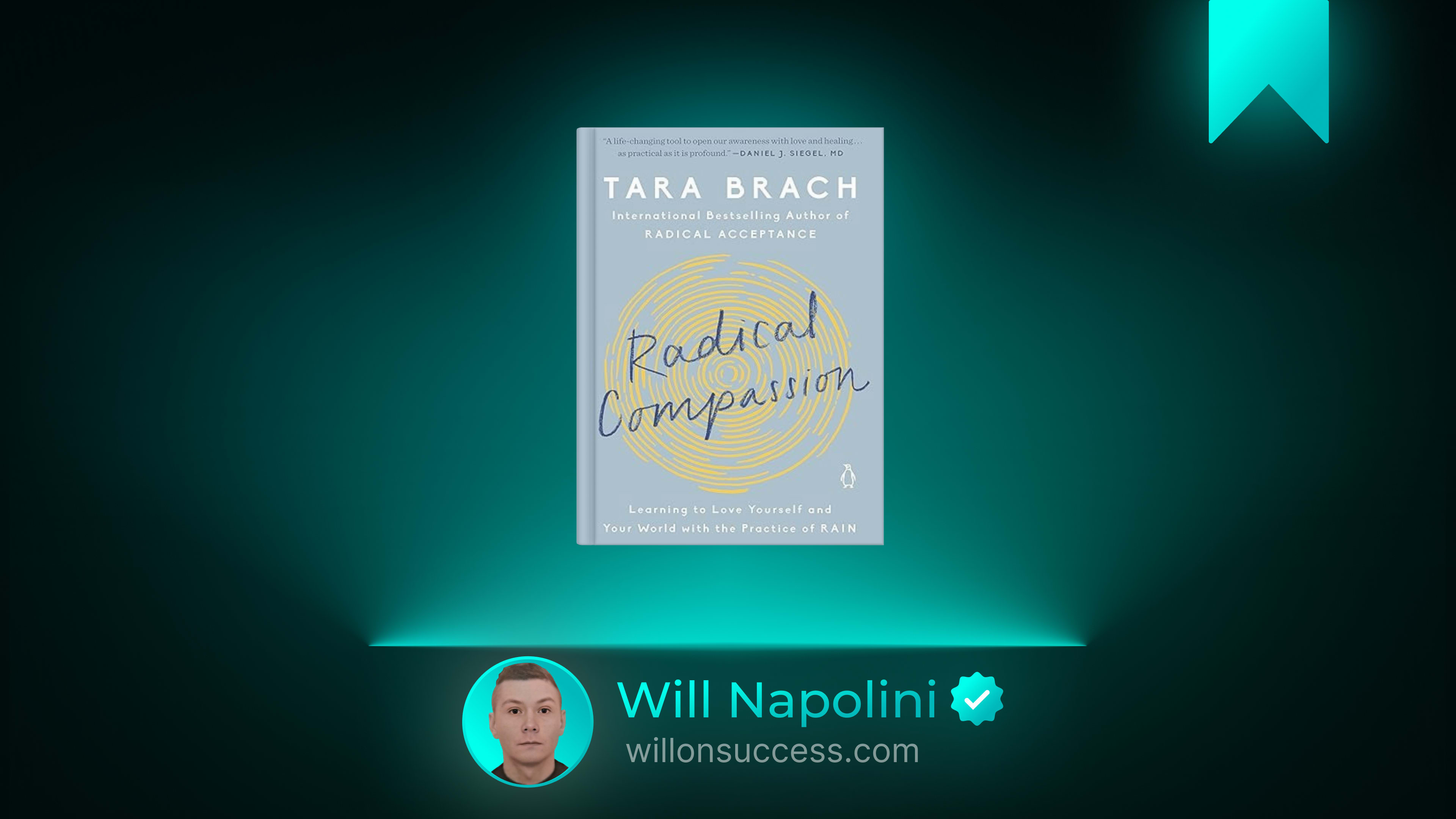
Radical Compassion by Tara Brach: How the RAIN Practice Helps You Meet Life with Courage and Kindness
What if the part of you that you keep trying to fix is the very part that most needs your kindness?
That question sits at the heart of Tara Brach’s Radical Compassion. And if you have ever been hard on yourself for being anxious, ashamed, angry, jealous, needy, distracted, or afraid, this book may feel less like a lecture and more like someone gently placing a hand on your shoulder.
Most of us learned how to push through pain. We learned how to perform, produce, achieve, explain, defend, distract, and keep going. But few of us learned how to turn toward our own suffering with steadiness and care.
So we live divided.
One part of us feels afraid, but another part scolds the fear. One part feels lonely, but another part says we should be stronger by now. One part longs for love, but another part calls that longing weakness.
I have learned that inner conflict rarely heals through force. You do not shame yourself into peace. You do not bully yourself into freedom. At some point, the parts of you that hurt must be met, not conquered.
That is the central invitation of Radical Compassion: stop abandoning yourself in the moments when you most need presence. Learn to pause. Learn to notice what is happening inside you. Learn to bring warmth to the places you usually judge.
Brach’s main teaching in the book is organized around a simple but profound mindfulness practice called RAIN:
- Recognize what is happening.
- Allow the experience to be there.
- Investigate it with gentle curiosity.
- Nurture yourself with compassion.
This is not a formula for becoming endlessly calm. It is not a way to decorate pain with spiritual language. It is a way of coming home to yourself when fear, shame, anger, or grief has carried you away.
Radical compassion does not mean life stops hurting. It means you stop leaving yourself alone in the hurt.
The Big Idea: Healing Begins When We Stop Fighting Ourselves
The central thesis of Radical Compassion is that suffering grows when we are caught in what Brach often describes as a trance of unworthiness, fear, or separation. We become identified with a painful emotion or belief, and then we start living from inside it.
You know this trance.
You make one mistake at work, and suddenly your mind says, I always mess things up.
Someone does not text back, and your body tightens with the old story: I am not important.
You speak harshly to someone you love, and shame rises: I am a terrible person.
In those moments, you are not simply having a thought or emotion. You are inside a small, painful world that feels completely true.
Brach’s message is that mindfulness and compassion help us wake up from that narrow world. We learn to see thoughts as thoughts, emotions as emotions, sensations as sensations. We learn to meet them with care instead of becoming them.
This matters because the way you relate to your inner life shapes the way you relate to everything else.
If you are at war with yourself, you will carry that war into your work, your relationships, your parenting, your leadership, and your decisions. You may call it ambition, discipline, realism, or high standards, but underneath it there may be a quiet belief that you are never enough.
Radical compassion interrupts that pattern.
It teaches you to ask a different question. Not, How do I get rid of this feeling? But, What is asking for attention right now?
That one shift can change the atmosphere of your entire life.
RAIN: A Practice for Returning to Yourself
RAIN is the heart of the book. Its power is in its simplicity.
When you are caught in a painful emotion, you do not need a perfect plan. You need a way to stop running from yourself.
RAIN gives you that way.
It is not meant to be used only during formal meditation. You can practice it in your car after an argument, at your desk after receiving criticism, in bed when anxiety is circling, or in the bathroom during a family gathering when you need two minutes to breathe.
Think of RAIN as a small shelter you can build in the middle of emotional weather.
The storm may still be there.
But now you have somewhere to stand.
Recognize: Name What Is Actually Happening
The first step is Recognize.
This means you pause and identify what is happening inside you. You might notice fear, anger, sadness, resentment, shame, tightness, numbness, or the urge to escape.
Recognition sounds simple, but it is powerful because most of us do not recognize our emotions early. We act them out before we understand them.
We snap at someone and later realize we were scared.
We overeat and later realize we were lonely.
We procrastinate and later realize we were overwhelmed.
We withdraw and later realize we felt rejected.
Recognition creates a little space between stimulus and reaction. It is like turning on a light in a room you have been stumbling through in the dark.
You might say quietly to yourself:
- “Fear is here.”
- “Shame is here.”
- “Anger is moving through me.”
- “There is tightness in my chest.”
- “I am caught in the belief that I am failing.”
Notice the language. You are not saying, “I am shame.” You are saying, “Shame is here.”
That small distance matters.
You are not the weather. You are the sky that can hold it.
In ordinary life, this step may be the difference between sending the defensive email and waiting ten minutes. It may be the difference between criticizing your partner and saying, “I’m feeling hurt right now.” It may be the difference between spiraling into self-blame and realizing, “I’m triggered.”
What you can name, you can begin to meet.
Allow: Stop Making the Moment Your Enemy
The second step is Allow.
This may be the hardest part for many of us.
Allowing does not mean approving of everything. It does not mean you accept injustice, tolerate mistreatment, or stop making changes. It means that, in this moment, you stop fighting the reality of what is already present inside you.
If grief is here, grief is here.
If fear is here, fear is here.
If jealousy is here, jealousy is here.
You do not have to like it. You do not have to act on it. But you stop pretending it is not there.
Many of us have spent years trying to edit our inner experience before anyone, including ourselves, can see it. We tell ourselves, I should not feel this way. I should be over this. I should be more spiritual. I should be stronger.
But the word “should” often becomes a locked door.
Allowing opens it.
One simple phrase Brach teaches in her work is the attitude of letting things be as they are. Not because they are ideal, but because resistance adds a second layer of suffering. First there is the pain. Then there is the shame about the pain. Then there is the fear that the pain means something is wrong with us.
Allowing softens that second layer.
On an ordinary Tuesday, allowing might look like sitting in your car before walking into work and saying, “Anxiety is here, and for this moment, I can let it be here.” It might look like noticing anger in your body without immediately justifying it or condemning it. It might look like letting tears come instead of swallowing them because you think you should be more composed.
Allowing is not passivity.
It is honesty.
And honesty is where healing starts.
Investigate: Listen Beneath the Surface
The third step is Investigate.
This is not harsh analysis. You are not cross-examining yourself like a prosecutor. You are approaching your inner life the way you might approach a frightened child or a wounded animal: slowly, respectfully, with genuine curiosity.
You might ask:
- “What is this feeling like in my body?”
- “What am I believing right now?”
- “What feels most vulnerable?”
- “What am I afraid would happen if I stopped controlling this?”
- “What does this part of me need?”
This step matters because emotions often carry messages from deeper places. Anger may be protecting hurt. Numbness may be protecting overwhelm. Perfectionism may be protecting shame. People-pleasing may be protecting fear of rejection.
If you only react to the surface emotion, you miss the root.
I think of this like working with a garden. You can keep cutting weeds at the surface, but if you never understand the root system, the same growth keeps returning. Investigation is how you gently place your hands in the soil.
Suppose you feel furious because a colleague criticized your work. Recognition says, “Anger is here.” Allowing says, “I can let this anger be present without immediately acting on it.” Investigation asks, “What is underneath this anger?”
You may discover fear: I’m afraid I’m not respected.
You may discover shame: I think this proves I’m not good enough.
You may discover old pain: This feels like being dismissed when I was younger.
Once you see what is underneath, your response changes. You no longer need to attack, defend, or collapse. You can care for the vulnerable place directly.
This is where responsibility and compassion meet.
You are not blaming your past for your behavior. You are understanding your inner world so you can choose a wiser response now.
Nurture: Offer the Kindness You Have Been Waiting For
The fourth step is Nurture.
This is where compassion becomes active.
After recognizing, allowing, and investigating, you ask: What does this hurting place need?
It may need reassurance.
It may need forgiveness.
It may need protection.
It may need rest.
It may need the reminder that you belong.
Nurturing yourself may feel awkward at first, especially if you learned to treat yourself like a project, a machine, or a problem to solve. But Brach’s work invites you to relate to yourself as a living being worthy of care.
You might place a hand on your heart. You might breathe slowly. You might speak inwardly with gentleness. You might imagine offering kindness to the younger part of you that first learned to be afraid. You might say, “I am here with you,” or “This is hard, and I can meet it with care.”
The exact words matter less than the quality of presence.
You are learning to become the person you needed.
That line is not sentimental. It is practical. Because when you can offer steadiness to yourself, you stop demanding that the world constantly regulate you. You become less reactive. Less desperate for approval. Less dependent on everything going perfectly before you can be okay.
Self-compassion is not self-indulgence. It is emotional responsibility.
A person who can meet their own pain with kindness is far less likely to throw that pain onto someone else.
Radical Compassion Is Not Weakness
Some people resist compassion because they think it will make them soft, passive, or unambitious.
I understand that fear. Many of us believe our inner critic is the only thing keeping us disciplined. We think if we stop shaming ourselves, we will stop growing.
But look honestly at the fruit of self-attack.
Does it create deep confidence? Does it create sustainable courage? Does it make you more loving? More creative? More resilient?
Sometimes self-criticism can produce short bursts of performance. But it usually leaves damage behind. It may get you moving, but it rarely helps you become whole.
Compassion works differently. It does not excuse harmful behavior. It gives you the strength to face it without collapsing into shame.
If you hurt someone, compassion does not say, “It doesn’t matter.” Compassion says, “You can tell the truth, make repair, and still remain connected to your basic worth.”
If you fail, compassion does not say, “Don’t improve.” It says, “You can learn without hating yourself.”
If you are afraid, compassion does not say, “Stay small forever.” It says, “Let us take one brave step while holding the frightened part with care.”
This is why radical compassion is radical. It challenges the old belief that growth requires violence against the self.
You can be accountable without being cruel.
You can be disciplined without being harsh.
You can change without declaring war on who you are.
The “Second Arrow” of Suffering
One of the most useful ideas connected to mindfulness teachings is the difference between pain and the extra suffering we add to pain.
Life sends the first arrow: loss, disappointment, criticism, illness, uncertainty, conflict.
Then the mind often sends the second arrow: This should not be happening. I cannot handle this. Something is wrong with me. My life is ruined. I am alone.
The first arrow hurts.
The second arrow deepens the wound.
RAIN helps you notice the second arrow before it becomes your entire reality. It helps you pause long enough to see the story your mind is building around the pain.
This matters in work, relationships, money, health, and personal growth.
You may not control the first arrow. You may not control whether someone rejects your proposal, whether your plans fall apart, whether a difficult memory gets stirred, or whether fear appears in your body.
But you can learn to meet the moment without adding self-blame, resistance, and isolation.
That is not a small thing.
That is the beginning of freedom.
Compassion for Others Begins with Seeing Clearly
Radical Compassion is not only about self-kindness. Brach also applies compassion to our relationships and our world.
When you practice RAIN with yourself, you begin to see that other people are also living from fear, wounds, longing, and unmet needs. This does not mean you excuse harmful behavior. Boundaries still matter. Justice still matters. Truth still matters.
But compassion allows you to see more than the surface.
The person who is controlling may be afraid.
The person who is defensive may feel ashamed.
The person who is distant may be protecting old hurt.
The person who is angry may feel powerless.
Again, this does not mean you let people mistreat you. Compassion without boundaries becomes self-abandonment. But boundaries without compassion can become cold and punishing.
The mature path holds both.
You can say no with a steady heart.
You can protect yourself without dehumanizing someone else.
You can stand for what is right without feeding hatred inside yourself.
This is especially important in a divided world. The easiest thing is to reduce people to their worst behavior or most offensive belief. The harder work is to oppose harm while still remembering the humanity beneath it.
Compassion is not agreement.
It is the refusal to let someone else’s fear turn you into a smaller version of yourself.
What This Looks Like in Real Life
Let’s bring this down to an ordinary day.
You wake up already behind. Your phone is full of messages. Your mind starts racing. Before breakfast, you feel like you are failing.
Without awareness, you might spend the whole day inside that trance. You rush, snap, compare, criticize yourself, and go to bed exhausted.
With RAIN, you pause.
Recognize: “Anxiety is here.”
Allow: “For now, this is what’s happening. I do not have to fight it.”
Investigate: “Where do I feel this? What am I believing? I’m believing I have to do everything perfectly or I’ll disappoint everyone.”
Nurture: “This is a lot. I can take one step at a time. I do not have to earn my worth by finishing everything today.”
Nothing magical happens.
The inbox is still there.
The responsibilities remain.
But your relationship to the moment changes. You are no longer trying to outrun yourself. You are present, and from presence you can choose the next right action.
That is how a life changes.
Not always through dramatic breakthroughs, but through small moments of returning.
You return once.
Then again.
Then again.
Over time, you become less afraid of your own inner weather.
Practical Ways to Apply Radical Compassion
Understanding RAIN is helpful. Practicing it is what changes you.
Here are a few grounded ways to begin.
Practice the 90-Second RAIN Pause
Choose one moment today when you feel emotionally activated. Maybe you are irritated, ashamed, anxious, or discouraged.
Pause for 90 seconds.
Ask:
- Recognize: What is happening in me right now?
- Allow: Can I let this be here for just this moment?
- Investigate: Where do I feel this in my body? What does this part of me need?
- Nurture: What kind words or gesture of care can I offer myself?
Do not try to do it perfectly. The goal is not to achieve instant peace. The goal is to stop abandoning yourself.
Put a Hand Where the Pain Lives
When a difficult emotion comes up, notice where it shows up in the body. The throat. Chest. Belly. Face. Shoulders.
Place a hand there gently if that feels right.
This simple gesture can help shift your nervous system from threat to care. It reminds the body that you are not only thinking about compassion; you are embodying it.
Replace Self-Attack with a Useful Question
When you catch yourself saying, “What is wrong with me?” pause and ask instead:
“What part of me is hurting right now?”
That question changes the whole direction of your attention.
The first question turns you into a problem.
The second turns you into someone worthy of understanding.
Use RAIN Before Repairing a Relationship
If you are upset with someone, practice RAIN before you respond.
Not to avoid the conversation.
To enter it cleanly.
Recognize your anger. Allow it. Investigate the fear or hurt underneath. Nurture that vulnerable place.
Then speak.
You may still need to be firm. You may still need to set a boundary. But you will be less likely to speak from the raw edge of an unexamined wound.
Build a Daily Compassion Ritual
Once a day, take two minutes and ask:
- “What has been hardest for me today?”
- “Can I meet that with kindness?”
- “What is one caring action I can take now?”
The action may be small: drink water, send the honest message, step outside, apologize, rest, or do the next task without self-judgment.
Small acts of care repeated over time become a new inner climate.
Who Should Read This Book
Radical Compassion is especially helpful for readers who struggle with self-criticism, anxiety, shame, emotional reactivity, perfectionism, or the feeling of being fundamentally “not enough.”
It will also serve people who already practice meditation but want a more heart-centered way to work with difficult emotions. If you are a therapist, coach, leader, parent, or caregiver, the RAIN framework can deepen the way you support others without losing yourself.
This book may be less useful for someone looking for a highly tactical productivity system or a quick motivational push. Brach is not offering hacks. She is offering a practice. And practice takes patience.
What makes the book worth reading is its combination of spiritual depth and emotional practicality. It does not ask you to float above your pain. It teaches you how to sit beside it with courage.
One Small Step
Today, choose one emotion you usually avoid.
Not the biggest one. Not the deepest wound. Start gently.
When it appears, pause and say, “This is here.”
Then breathe.
Let it be present for a few moments without fixing it, explaining it, or judging it. Ask what it needs. Offer