The Weight of Witness: Finding Humanity in the Darkest Valley
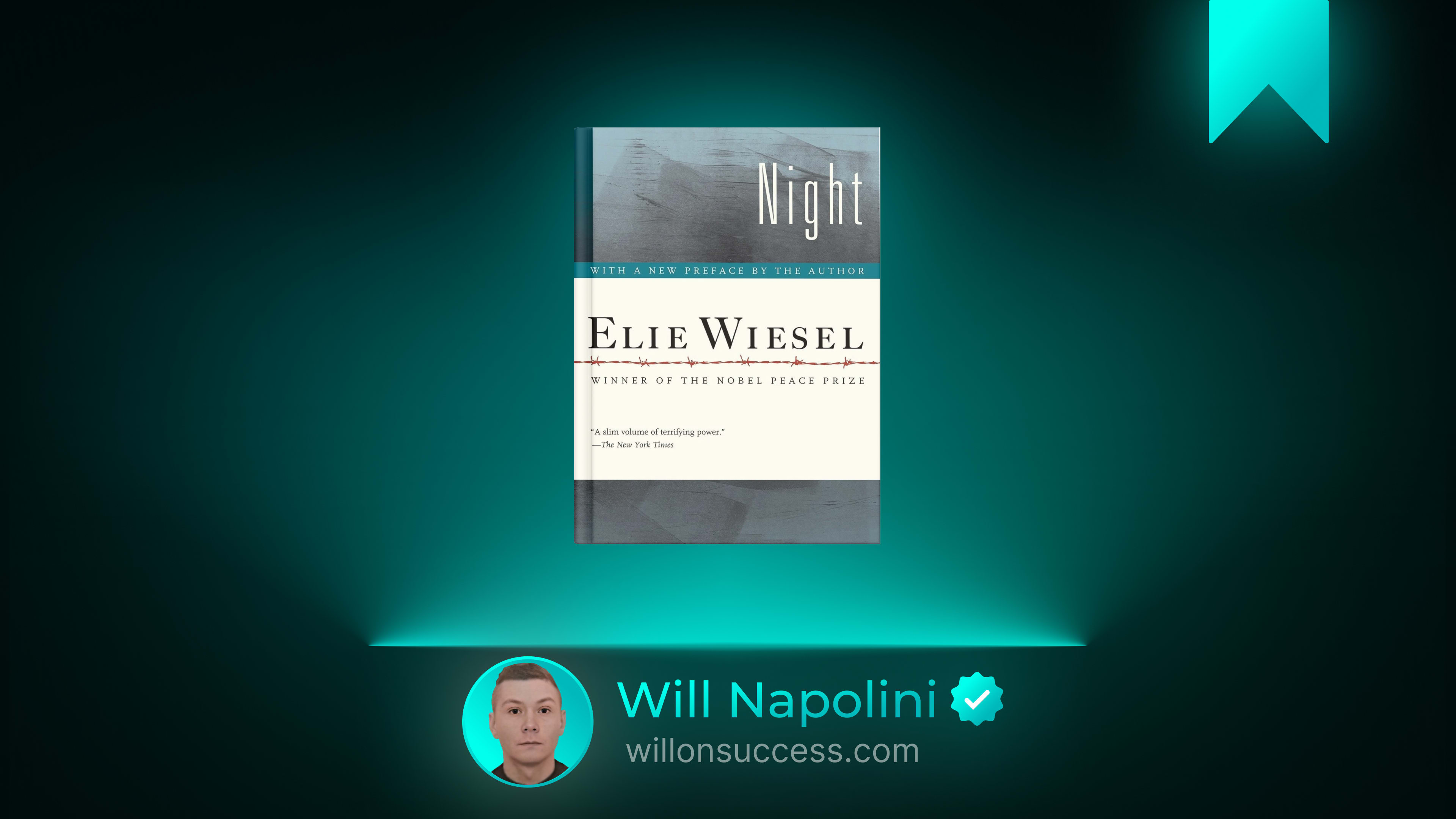
There is a moment near the end of Elie Wiesel’s Night that I have never been able to forget.
Liberated from the concentration camps, Eliezer looks into a mirror for the first time in months. He does not see a survivor. He does not see a hero. He writes: “From the depths of the mirror, a corpse gazed back at me. The look in his eyes, as they stared into mine, has never left me.”
If I could sit across the table from you right now, I would not tell you that this book will help you optimize your morning routine or build a better habit tracker. Night is not a manual for success. It is a testament to survival. It is a record of what happens when the world loses its mind, and a quiet, fierce argument for what it takes to keep your soul when everything around you is designed to strip it away.
You may be reading this and wondering how a book about the Holocaust fits into a conversation about personal growth. I understand that hesitation. But I have learned that true personal development is not just about achieving more. It is about becoming someone who can carry the weight of being human. It is about developing the moral clarity to recognize darkness, and the courage to remain soft in a world that constantly tries to make you hard.
Here is what I want to show you about Night, and why its lessons are more urgent for your life today than you might realize.
The Central Thesis: The Fragility of Humanity and the Duty to Remember
The central idea of Night is not simply that evil exists. We know evil exists. The profound realization Wiesel forces us to confront is how quickly civilization can collapse, how easily human beings can be reduced to numbers, and how fragile our own humanity truly is.
But the book is not a surrender to despair. Its underlying thesis is that our humanity is a flame that must be fiercely protected, and when the world descends into absolute silence, our highest, most sacred calling is simply to bear witness. We survive the unendurable not by becoming stone, but by refusing to let the darkness have the final word.
The Hanging of the Pipel: When the Universe Fractures
To understand the depth of this book, we must look at one of its most harrowing concepts.
The prisoners are forced to watch the hanging of a young boy, a pipel, whom the others affectionately called the “sad-eyed angel.” Because of his light weight, he does not die immediately when the rope is pulled. He struggles on the gallows for more than half an hour.
Behind Wiesel, a man asks, “Where is God? Where is He?”
And Wiesel hears a voice inside him answer: “Where is He? Here He is—He is hanging here on this gallows…”
This is the moment the universe fractures for Eliezer. It is the ultimate crisis of meaning. How do you maintain faith, or purpose, or even the will to live, when the world is so profoundly absurd and cruel? Wiesel does not offer a neat theological answer. Instead, he offers something much more valuable: an honest, unflinching look at what it means to wrestle with the absolute worst of reality without losing your moral compass entirely.
The Architecture of Dehumanization
Before we can understand how to protect our humanity, we must understand how it is taken away.
The brilliance and horror of Night is how meticulously it documents the process of dehumanization. The Nazis did not just kill people; they systematically dismantled their identities. First, they took their homes. Then their possessions. Then their names, replacing them with numbers. Then their hair, their clothes, and finally, their dignity. They turned human beings into a mass of flesh, making it psychologically easier for the oppressors to commit atrocities, and psychologically devastating for the victims to resist.
Why this matters to you: You will never face a concentration camp. But you live in a world that is constantly trying to dehumanize you and others. Algorithms reduce your attention to data points. Political discourse reduces your neighbors to caricatures. The modern economy often treats you as a unit of production rather than a living soul.
We do not lose our humanity in a single, dramatic moment. We lose it in a thousand tiny surrenders to numbness. We lose it when we stop seeing the person in front of us and only see their utility, their tribe, or their inconvenience. Wiesel’s account is a stark warning: if you do not actively protect your own dignity and the dignity of others, the systems around you will gladly strip it away.
The Anchor of Connection in the Void
If dehumanization is the disease, connection is the antidote.
Throughout Night, the central emotional tether is the bond between Eliezer and his father, Shlomo. In an environment designed to make every man care only for himself, their devotion to one another is a quiet rebellion. Eliezer writes that his only remaining purpose is his father’s survival. “If I lost him, I would be nothing.”
Contrast this with another heartbreaking scene in the book: an old man is beaten for hoarding a piece of bread, and his own adult son jumps on him to get it, only to be killed himself shortly after. The contrast is devastating.
Why this matters to you: When the body fails and the mind fractures, the spirit survives on connection. In your own life, when you face your personal valleys of darkness—grief, failure, illness, or profound disappointment—your survival will not depend on your sheer willpower. It will depend on the tethers you have built to other people.
Character before circumstances. The circumstances of the camps were designed to sever human bonds. The prisoners who held onto their love for a father, a son, a friend, or even a memory of home, had an anchor in the storm. Your relationships are not a distraction from your personal growth; they are the very foundation of it.
The Crucible of Faith and Meaning
Wiesel’s struggle with God is the philosophical spine of the book. He arrives at Auschwitz as a devout student of Jewish mysticism. He leaves questioning the very existence of a just universe.
Many readers mistake his anger for a loss of faith. But I would argue that his relentless questioning is the very proof that his spirit was not broken. A truly broken spirit does not argue with God; it simply accepts the darkness. Wiesel’s anger was a refusal to accept that cruelty was the ultimate truth of the universe.
Why this matters to you: You will face moments where life makes no sense. You will experience suffering that feels entirely undeserved. In those moments, it is tempting to become cynical. It is tempting to decide that the universe is random and meaningless.
But Night teaches us that meaning is not found in the absence of suffering. It is found in how we carry it. True faith, or a true sense of purpose, is not the absence of doubt. It is the stubborn, quiet refusal to let the darkness dictate your actions. You can be angry at the world and still choose to be kind. You can question everything and still choose to do good.
The Sacred Duty of the Witness
The final, and perhaps most important, principle of the book is the transition from survivor to witness.
Wiesel made a vow on the first night in the camp never to remain silent, no matter how long it took. He realized that forgetting the dead is akin to killing them a second time. The ultimate triumph of the oppressor is not just the destruction of life, but the erasure of memory.
Wiesel writes that apathy is not neutrality; it is the silent accomplice of the oppressor. To bear witness is to look at the horror, to name it, and to say, “This happened. This must never happen again.”
Why this matters to you: We live in an age of unprecedented information, yet we are also living in an age of unprecedented apathy. We scroll past tragedies on our phones without breaking our stride. We look away from injustice because it is uncomfortable.
Memory is not just looking backward. It is the armor we forge to protect the future. Bearing witness in your daily life means refusing to look away from suffering. It means speaking up when a colleague is demeaned. It means acknowledging the pain of someone you disagree with. It means recognizing that your silence is a choice, and it has consequences.
Practical Application: Living as a Witness
Understanding Night is not enough. As with all true wisdom, understanding without action changes nothing. How do we translate the weight of this book into an ordinary Tuesday?
1. Audit your numbness. Pay attention to the moments you unconsciously choose apathy. When you see a news story about human suffering, do you immediately scroll past? When a stranger asks for help, do you harden your heart? Notice when you are protecting your own comfort at the expense of your empathy. Choose to feel the discomfort.
2. Strengthen your tethers. Identify the people who anchor you. In the rush of daily life, we often take our deepest relationships for granted. Reach out to someone who has been a steady presence in your life. Tell them what they mean to you. When the world feels chaotic, your love for others is the ground you stand on.
3. Speak the truth in your sphere. You cannot fix the whole world, but you can govern your immediate environment. When you witness a small injustice—a cruel joke, an unfair exclusion, a moment of dehumanization in your workplace or community—do not stay silent. You do not need to be a hero. You just need to be a witness who refuses to validate the cruelty by ignoring it.
Who Should Read This Book
Night is a short book, barely over a hundred pages, but it is incredibly heavy. It is not a light read, and it should not be consumed quickly.
This book is essential for anyone who has begun to take the peace and freedom of their daily life for granted. It is vital for those who are wrestling with their faith, or who feel that the world is too dark to care about. It is a necessary read for anyone who wants to understand the absolute limits of human endurance, and the indestructible nature of the moral conscience.
If you are looking for a book that will make you feel good about yourself, this is not it. But if you are looking for a book that will make you want to be better, that will strip away your petty grievances and remind you of the profound privilege of being alive, read it.
One Small Step
I want to leave you with a single, actionable step you can take today.
We often think of bearing witness as a grand, historical act. But it begins in the micro-moments of our daily lives.
Today, I want you to identify one area where you have been choosing numbness over empathy. Perhaps it is ignoring a difficult conversation with a loved one. Perhaps it is turning a blind eye to someone who is marginalized in your community. Perhaps it is simply refusing to listen to a perspective that challenges you.
Find that one area. And today, choose to look directly at it. Do not look away. Have the difficult conversation. Acknowledge the person you usually ignore. Listen to the truth, even when it is uncomfortable.
Elie Wiesel survived the darkest valley humanity has ever known, and he emerged with a single, burning conviction: that we must never let the darkness win.
Your life is a testament to the fact that the darkness did not win. Now, it is your turn to carry the light.