You're Not Lazy — You're Avoiding a Feeling: What Procrastination Research Actually Reveals
I want you to think about the last thing you put off. Not something dramatic. Something small. An email you drafted in your head three times but never sent. A form that sat in your bag for two weeks. A conversation you rehearsed in the shower and then talked yourself out of having, again, over dinner.
Now notice what happened in the moment you decided — and I mean decided, even if it felt like drifting — to postpone it. There was a feeling. Maybe a tightness in your chest. A low hum of dread. A whisper that said not yet, I’m not ready, I’ll handle it when I feel more like it.
And then you felt better. Immediately. The relief was real. The tension dropped. You opened your phone, or went to make tea, or tidied a shelf, and the discomfort lifted.
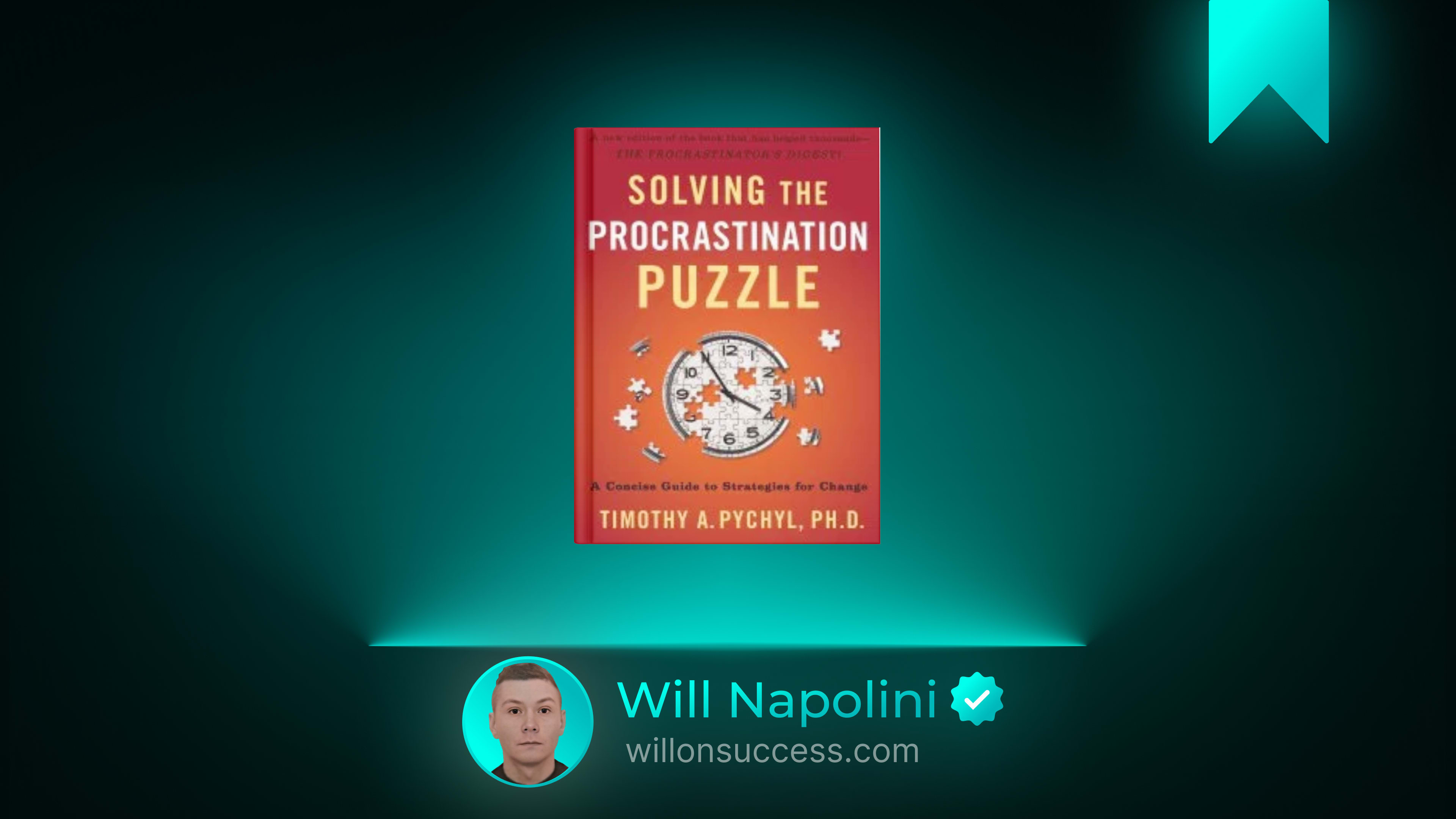
That relief is the whole puzzle. And Timothy Pychyl, a psychology researcher at Carleton University who has spent the better part of three decades studying procrastination, built an entire book around explaining why that relief is not a sign of laziness. It is a sign that you just made an emotional trade: short-term comfort for long-term cost.
Solving the Procrastination Puzzle is a short book. You can read it in an afternoon. But the idea at its center, once you truly absorb it, rearranges how you understand yourself. And I think that rearrangement is where real change begins.
The Big Idea: You Are Not Managing Time. You Are Managing Feelings.
Here is the reframe that everything in this book rests on, and I want you to let it land before moving forward:
Procrastination is not a time-management problem. It is not a discipline problem. It is not a character flaw or evidence that you are fundamentally lazier than the people around you.
It is an emotion-regulation problem.
You do not avoid the task because you cannot find the hours. You avoid the task because the task makes you feel something you do not want to feel. Boredom. Anxiety. Frustration. The quiet sting of fearing you will do it poorly. Resentment at being obligated. Confusion about where to start. The discomfort is the trigger. The avoidance is the coping mechanism. And the relief you feel when you postpone is the reward that keeps the loop running.
Pychyl’s research draws on this understanding: we procrastinate to repair our mood in the present moment. We are not optimizing for the deadline. We are optimizing for feeling okay right now. And the brain, left to its own devices, will almost always choose immediate emotional relief over future benefit.
That is not weakness. That is neurology. But understanding the mechanism gives you a point of intervention that “just try harder” never could.
“I’ll Feel Like It Tomorrow” — The Lie That Keeps the Loop Running
One of the most quietly devastating patterns Pychyl identifies is what he calls the assumption that your future emotional state will be different from your present one.
You tell yourself: I’ll do it Thursday. I’ll be more rested. More focused. More in the mood.
And Thursday arrives, and you are the same person, with the same resistance, staring at the same task, feeling the same low-grade dread. Because the task did not change. And you did not change. Only the calendar did.
I have watched this pattern operate in my own life more times than I can count. The version of me who will “feel like it” is a fictional character. A convenient stranger I keep assigning unpleasant work to, as if next Tuesday’s version of me will wake up with a fundamentally different relationship to discomfort.
Pychyl’s research points to something important here: we treat our future selves as though they are other people. We offload the emotional cost onto someone we imagine will be better equipped to handle it. But that someone is you. Always you. And the feeling you are avoiding today is the same feeling you will be avoiding tomorrow, only now it is compounded by guilt for having waited.
The relief of postponing is real, but it is borrowed. And the interest rate is high.
The Task Is Rarely as Bad as the Anticipation
There is a consistent finding running through the research Pychyl discusses: the emotional discomfort of thinking about starting a task is almost always worse than the discomfort of actually doing it.
Think about that for a moment. The dread you feel at 9 p.m. when you remember the report is due Friday is not the report. It is the idea of the report, filtered through fatigue and avoidance and a mind that has had all day to amplify the unpleasantness. The actual act of opening the document, typing the first clumsy sentence, reading the first paragraph of source material — that act is almost always less painful than the story you built around it.
Anticipation is a magnifying glass. It takes a manageable task and inflates it into a threat. And the longer you avoid, the larger the magnified image becomes, because now the avoidance itself adds a layer of shame on top of the original discomfort. The task is no longer just boring or difficult. It is also the thing you have been running from, and that makes starting feel like an admission of how long you have been running.
Pychyl’s practical conclusion from this is straightforward: the single most important step is to begin. Not to finish. Not to do it well. Just to cross the threshold from thinking about doing into doing. Because once you are inside the task, the emotional landscape shifts. The anticipation collapses. You are no longer imagining the discomfort. You are simply working. And working, even imperfectly, is almost always easier than dreading.
You do not need to feel ready. You need to begin before you feel ready. Those are not the same thing, and waiting for the first one guarantees you will never reach the second.
Self-Criticism Makes It Worse — And the Research Is Clear on This
This is the part of the book I think most people need and few expect.
The instinct, when you catch yourself procrastinating, is to turn on yourself. What is wrong with you. You’re wasting time again. Everyone else manages to do this. You’re going to ruin everything. You think the harshness will motivate you. You think if you make yourself feel bad enough, you will finally act.
Pychyl’s research, conducted with colleagues, points in the opposite direction. Self-forgiveness for past procrastination is associated with less future procrastination. Self-criticism is associated with more.
Why? Because the cycle is emotional. You procrastinate to escape a negative feeling. Then you criticize yourself, which creates another negative feeling. And now the task is associated not only with its original discomfort but also with shame, guilt, and the memory of your own harshness. The emotional weight of starting just got heavier. So you avoid again. And criticize again. And the loop tightens.
Forgiving yourself does not mean excusing the pattern. It means refusing to add a second wound on top of the first. It means saying, Yes, I avoided that. That is what happened. I am not going to spend the next three days punishing myself for it. I am going to start now, gently, without the extra layer of self-contempt.
That gentleness is not softness. It is strategy. You cannot shame yourself into sustained change. You can only build a relationship with the work that is honest enough to survive a bad Tuesday.
Make the Next Step So Small It Feels Almost Ridiculous
One of the most practical threads in the book concerns how we structure the task itself. Pychyl draws on research showing that tasks feel most aversive when they are vague, large, unstructured, or lack a clear starting point. “Work on the project” is a sentence that invites avoidance. “Open the file and write one paragraph about the methodology section” is a sentence you can act on.
The difference is not trivial. A vague task forces your brain to make dozens of micro-decisions before you can begin: Where do I start? What does “done” look like? Am I doing this right? Each micro-decision is a small point of friction, and friction is where avoidance lives.
A concrete, specific next action removes the friction. You do not have to decide anything. You just execute the one small step you already decided on. And once that step is done, the next one usually reveals itself.
Pychyl also discusses the value of what researchers call implementation intentions — “if-then” plans that link a specific situation to a specific behavior. If it is 8 a.m. and I have finished my coffee, then I will open the document and write for fifteen minutes. The structure removes the moment of negotiation. You are no longer asking yourself whether to start. You are simply following the plan you made when your mind was clearer.
This is not a hack. It is a way of respecting the fact that your willpower is not infinite, and that the moment of decision is the moment of greatest vulnerability. Remove the decision, and you protect the action.
The Identity Trap: “I’m Just a Procrastinator”
There is a quiet danger Pychyl touches on that I think deserves more attention than it usually gets. When you procrastinate long enough, the behavior stops being something you do and starts being something you are. You begin to say, “I’m a procrastinator,” the way someone might say, “I’m left-handed,” as if it were a fixed trait, a neurological given, a permanent category of person.
And once it becomes identity, change feels like self-betrayal. Because now stopping the procrastination is not just changing a habit. It is dismantling a story you have told about yourself for years. And the mind resists that dismantling, even when the story causes pain, because a familiar pain feels safer than an unfamiliar freedom.
I would gently challenge that identity, if you carry it. You are not a procrastinator. You are a person who has learned a pattern of avoiding discomfort, and that pattern was probably useful once, in some earlier context where avoidance kept you safe from judgment or failure. You do not owe that pattern your loyalty. You can thank it for trying to protect you and then choose a different response.
The behavior is not the person. And a behavior can be changed without changing who you are at the core. You are allowed to outgrow a strategy that no longer serves you.
What This Looks Like on an Ordinary Thursday
Let me bring this down from principle to practice, because I think the distance between understanding procrastination and actually doing something differently is where most people get stuck.
Say it is Thursday morning. You have a task you have been putting off since Monday. It is not enormous, but it is uncomfortable. Maybe it is a difficult conversation with a colleague. Maybe it is the first draft of something you are afraid will be mediocre. Maybe it is a financial task that makes you feel vaguely incompetent.
Here is what the old pattern looks like: you feel the resistance, you tell yourself you will do it after lunch, you scroll your phone, you feel guilty, you tell yourself you will do it tomorrow, you feel more guilty, the task grows larger in your mind, Thursday becomes Friday, and by the time you finally do it, you are exhausted and self-critical and the whole experience confirms your belief that you cannot be trusted to follow through.
Here is what the new pattern looks like, informed by what Pychyl teaches:
You notice the resistance. You name it. I am avoiding this because it makes me feel anxious. You do not judge yourself for the anxiety. You do not narrate a story about your character. You simply acknowledge the feeling the way you would acknowledge weather. There is the dread. It is here. It will pass once I start.
Then you make the next step absurdly small. Not “finish the project.” Not “have the whole conversation figured out.” Just: Open the email. Type the subject line. Or: Walk to their office. Knock. Or: Open the spreadsheet. Read one column.
You do not wait to feel motivated. You do not negotiate. You set a timer for ten minutes if that helps, and you commit only to those ten minutes. And you begin.
And here is what will likely happen, based on everything the research suggests: the task will be less terrible than the anticipation. You will not feel inspired. You will not feel graceful. But you will feel less than you feared. And that small reduction in suffering, that quiet proof that you can sit with discomfort and survive it, is the foundation everything else is built on.
Who Should Read This Book
If you have spent years believing your procrastination is a moral failing — evidence that you lack the discipline, intelligence, or seriousness that other people seem to have — this book will be a relief. Pychyl writes with the clarity of a researcher and the compassion of someone who has sat with thousands of people struggling with exactly this. The book is short, direct, and free of jargon. It does not overwhelm you with a forty-step system. It gives you a framework and a handful of concrete strategies, and then trusts you to adapt them.
It is especially useful for people whose procrastination is tangled up with perfectionism, anxiety, or a harsh inner critic. If you avoid tasks not because you are lazy but because you are afraid of doing them badly, this book speaks directly to that fear.
It will be less useful if you are looking for a detailed productivity system, app recommendations, or a structured twelve-week program. Pychyl’s goal is to change your understanding of the problem so that the solutions make sense. He is giving you the why so that the how stops feeling arbitrary.
And I think it is worth saying honestly: if your procrastination is severe, chronic, and intertwined with deeper anxiety or depression, a book is a starting point, not a complete solution. There is no shame in bringing a professional alongside the reading. Pychyl would, I believe, agree.
One Small Step — Before You Close This Page
I am going to ask you to do one thing. Not tomorrow. Not after you finish your coffee. Right now, or as close to right now as you can manage.
Think of the one task you have been avoiding the longest. The one that has been sitting in the back of your mind, quietly generating guilt every time you remember it. You know which one it is. You felt it the moment I said “the one task.”
Now do not think about finishing it. Do not think about doing it well. Do not think about what it will look like when it is done.
Just identify the very first physical action. The one your hands or fingers would perform. Open the laptop. Pick up the phone. Walk to the desk. Click the icon. Lift the pen.
And then do that one action. Not the whole task. Just the first motion. Ten seconds. Maybe thirty.
That is all. You do not owe yourself a transformation today. You owe yourself ten seconds of starting.
Because here is what I have come to believe after years of watching people struggle with this and, honestly, after years of struggling with it myself: the distance between the life you want and the life you have is almost never a canyon. It is a single step that you keep deciding to take tomorrow instead of today. And tomorrow never comes with better feelings. Tomorrow comes with the same resistance, plus the weight of another day spent waiting.
You do not need to feel ready. You never will. You just need to be willing to feel unready and begin anyway.
The task is on the other side of a feeling. And the feeling is smaller than you think.
Go take the ten seconds. The rest will follow. It always does.