Stop Climbing the Wrong Ladder: What *Smartcuts* Teaches Us About the Hidden Architecture of Success
We are given a piece of advice so early in life, and so often, that it eventually stops sounding like advice and starts sounding like a law of physics.
Keep your head down. Work hard. Pay your dues. Climb the ladder one rung at a time.
If I could sit across the table from you right now, I would ask you to look closely at the ladder you are climbing. Because I have watched too many brilliant, exhausted people reach the top of their respective ladders, look out over the edge, and realize with a sinking heart that the ladder was leaning against the wrong wall.
They did everything right. They put in the hours. They sacrificed their weekends. They followed the rules. And yet, they were passed by people who seemed to bend the rules of time itself—people who achieved in three years what took the grinders fifteen.
We look at those people and we feel a mix of awe and quiet resentment. We call them lucky. We call them connected. Or, if we are feeling cynical, we assume they cut corners.
But what if they didn’t cut corners on their character? What if they simply found a better route through the woods?
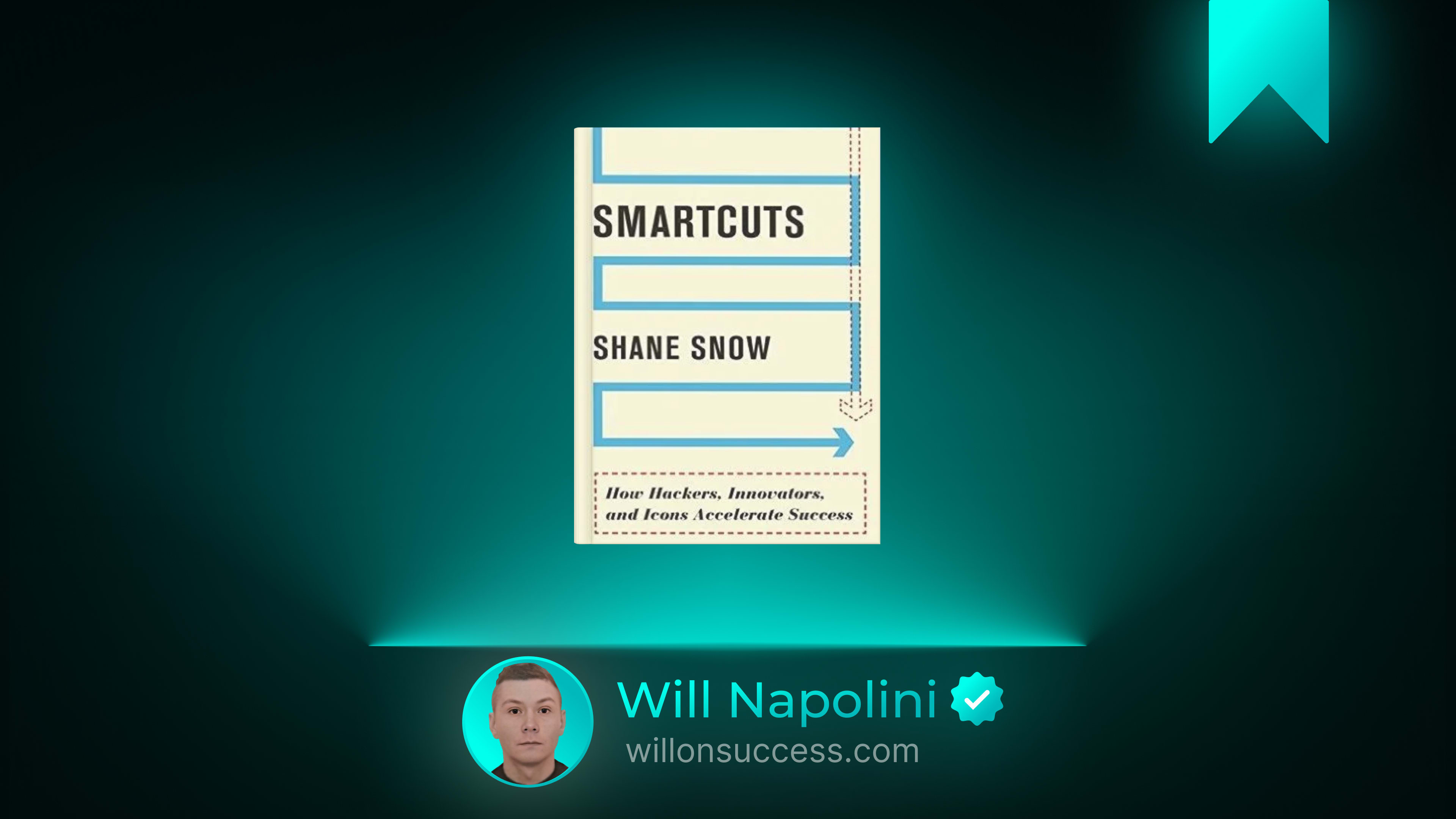
Shane Snow’s book Smartcuts: How Hackers, Innovators, and Icons Accelerate Success is built around a premise that makes traditionalists very uncomfortable: the “long, hard grind” is not a moral virtue. It is often just a failure of imagination.
Snow argues that the most successful people in history did not get there by blindly following the established path. They got there by finding “smartcuts”—ethical, strategic, and highly deliberate ways to bypass unnecessary suffering, collapse timelines, and leverage the systems around them.
Let me show you what a smartcut actually looks like, why it is not the same thing as cheating, and how you can start redesigning the architecture of your own journey today.
The Big Idea: A Shortcut in Character Is a Lie; A Shortcut in Strategy Is Wisdom
Before we go further, we have to clear up a linguistic trap. The word “shortcut” has a bad reputation. We associate it with cheapness, with skipping the hard work, with building a house on a foundation of sand.
And let me be entirely clear: There are no smartcuts when it comes to character. You cannot hack your way to integrity. You cannot find a shortcut to trust. You cannot optimize your way out of doing the right thing when no one is watching. If you try to take a shortcut on your values, you will eventually pay the toll with interest.
But when it comes to strategy, the rules change.
A smartcut is not about avoiding work. It is about avoiding waste. It is the refusal to suffer unnecessarily just because your predecessors suffered. It is the recognition that the “traditional path” was often built by people who didn’t have the tools, the technology, or the hindsight that you have right now.
Snow’s central thesis is that success is rarely a straight, vertical line. It is a grid. And the people who accelerate their success are the ones who realize they can move laterally, borrow momentum, and shrink their feedback loops, rather than just putting their heads down and walking in a straight line into the dark.
The Story of the Ladder and the Jungle Gym
To understand the mechanics of a smartcut, we have to look at how we are taught to navigate our careers and our crafts.
We are taught the “Ladder” model. You start at the bottom. You wait for the person above you to retire or get promoted. You do your time. You master the specific, narrow skills required for your current rung, and you ignore everything else.
Snow points out that the ladder model is incredibly fragile. If the industry changes, if the company restructures, or if the person above you refuses to leave, you are stuck. You are entirely dependent on the permission of the system to move forward.
The alternative is what we might call the “Jungle Gym” or the “Grid.”
Snow uses the career trajectory of Jimmy Fallon as a brilliant, real-world illustration of hacking the ladder. Fallon started on Saturday Night Live. The traditional ladder would dictate that he stay there, slowly work his way up to head writer, and eventually become the senior anchor.
Instead, Fallon stepped off the ladder. He left SNL to pursue a career in Hollywood movies. By traditional metrics, it was a failure. The movies were not massive hits. He was struggling.
But here is where the smartcut happens: instead of retreating in shame, he moved laterally. He returned to SNL, but he brought a new set of skills with him. He started experimenting with digital media, creating viral music parodies and “Thank You Note” segments that bypassed the traditional television hierarchy and connected him directly with a massive online audience. When the opportunity to host The Tonight Show arose, he didn’t get it because he had waited his turn in the traditional late-night lineup. He got it because he had built a unique, lateral stack of skills—traditional comedy, musicality, and digital virality—that made him the only logical choice for the modern era.
He didn’t climb the ladder. He stepped sideways, gathered new tools, and stepped back onto a much higher rung.
The Myth of the 10,000 Hours and the Power of the Tight Loop
If you have spent any time in the personal development space, you have heard of the “10,000 Hour Rule”—the idea popularized by Malcolm Gladwell that it takes roughly ten thousand hours of deliberate practice to achieve mastery in any field.
Snow dismantles the way most people apply this rule. The problem is not the number of hours. The problem is the feedback loop.
Imagine two people learning to play the piano. Person A practices in a soundproof room for an hour every day. Once a year, a master teacher comes in, listens to them play, and gives them an hour of corrections. Person B practices for an hour every day in a busy public square. Every single time they hit a wrong note, the crowd winces, or someone tosses a coin, or they simply hear the dissonance ring out in the open air.
After a year, Person B will be vastly superior to Person A, even if they practiced the exact same number of hours. Why? Because Person B has a tight feedback loop.
Snow highlights research showing that the fastest way to accelerate skill acquisition is to shrink the time between the action and the consequence. This is why surgeons who play fast-paced video games often make fewer errors in the operating room; the game provides immediate, unforgiving feedback that trains their nervous system to adapt in milliseconds.
If you are working on a project for six months before you show it to anyone, you are not getting six months of practice. You are getting one day of practice, repeated for six months, followed by a devastating realization that you went in the wrong direction.
A smartcut is the deliberate engineering of a tight feedback loop. It is the courage to show your work early, to fail fast, to get the data, and to adjust. You do not need ten thousand hours of blind repetition. You need one hundred hours of immediate, painful, honest feedback.
Borrowing the Momentum of Others
There is a profound arrogance in the “self-made” myth. It assumes that to be authentic, you must invent everything from scratch. It assumes that asking for help, using a template, or standing on the shoulders of those who came before you is somehow a dilution of your own genius.
Snow calls this out for what it is: a waste of time.
One of the most powerful smartcuts is the concept of platforms and leverage. Throughout history, the greatest accelerators of success were people who figured out how to plug their unique talents into an existing, powerful system.
Think of a surfer. A surfer does not try to generate the wave. They do not paddle out into the ocean and try to push the water upward with their bare hands. That would be exhausting and impossible. Instead, they study the ocean. They wait for the swell. And when the massive, unseen energy of the wave arrives, they position themselves to borrow its momentum.
In your life, the “wave” might be an existing audience, a proven business model, a mentor who has already made the mistakes you are about to make, or a piece of software that automates the tedious parts of your work.
When you refuse to use leverage out of a misguided sense of pride, you are not being noble. You are just being slow. The master craftsman does not insist on forging their own hammer from raw iron ore before they build the house. They buy the best hammer they can find, and they get to work.
Why This Matters on an Ordinary Wednesday
It is easy to read about comedians and surfers and feel that these concepts belong to the extraordinary. But the architecture of a smartcut applies to the quiet, ordinary moments of your life.
It applies when you are trying to get a promotion. The traditional path is to work longer hours, hoping the boss notices your exhaustion and rewards it with a title. The smartcut is to look laterally: What problem is my boss’s boss losing sleep over? If I can solve that specific problem, I bypass my immediate manager’s limited budget and create undeniable, cross-departmental value.
It applies to your relationships. The traditional path to resolving a recurring argument is to keep having the same fight, louder and louder, hoping the other person finally yields. The smartcut is to shrink the feedback loop. You step out of the argument, you go to a couples counselor, or you read a book on attachment styles together, bringing an external, immediate feedback mechanism into a closed system that is failing.
It applies to your health. The traditional path is to rely on sheer willpower to resist the junk food in your pantry until your willpower inevitably breaks at 9:00 PM. The smartcut is to change the environment. You throw the junk food away. You use the leverage of a meal-prep service. You stop fighting the battle and start redesigning the battlefield.
You stop asking, How can I work harder at this? You start asking, How can I redesign this so the hard work actually moves the needle?
Who Should Read This Book — and Who Might Need to Look Elsewhere
I want to be honest about the limits of this book, because no single framework solves every problem.
Who it is for: If you are an entrepreneur, a creative, a mid-career professional feeling stuck in the “grind,” or anyone who suspects that the rules they were taught are outdated, Smartcuts will feel like permission to breathe. It is highly analytical, deeply researched, and filled with fascinating historical and modern case studies. It is for the person who wants to work with intense focus, but who refuses to work blindly.
Who might find it less useful: If you are in a season of life that requires deep, slow, unglamorous foundational building—such as recovering from severe burnout, healing from deep trauma, or raising a newborn—this is not the book for you right now. Smartcuts are about acceleration. But you cannot accelerate a vehicle that is currently broken down in the ditch. Fix the engine first. Heal the foundation. Then, look for the smartcuts. Furthermore, if you are looking for a book that tells you how to get rich without doing any work at all, you will be disappointed. Snow’s smartcuts still require immense effort; they just direct that effort more intelligently.
Practical Application: Engineering Your Own Smartcuts
Philosophy is useless if it does not change how you move through the world. If you want to stop climbing the wrong ladder, you need to start auditing your current path. Here are three concrete ways to apply this today.
1. The Lateral Audit
Look at your current goal. Are you trying to move straight up? Now, ask yourself: What adjacent skill, if I mastered it, would make my current goal irrelevant or easily achievable? If you are a graphic designer trying to become a senior designer, the vertical path is to just design better. The lateral smartcut might be to learn the basics of behavioral psychology or copywriting. Suddenly, you aren’t just a designer; you are a conversion strategist. You have stepped off the crowded ladder and onto a much less crowded one. Identify one lateral skill you can learn in the next ninety days.
2. Shrink the Feedback Loop
Identify one project you are currently working on in secret. You are polishing it, hiding it, waiting until it is “perfect.” Stop. Find a way to get feedback on it in the next forty-eight hours. Show it to a trusted colleague. Post a rough draft to a small audience. Run a tiny, cheap ad to test the headline. It will be uncomfortable. The feedback might sting. But that sting is the feeling of you saving yourself six months of wasted effort.
3. The Leverage Question
Look at the most tedious, time-consuming part of your week. Now ask the leverage question: Who has already solved this? Is there a software tool you are refusing to pay for out of stubborn frugality? Is there a freelancer you could hire for fifty dollars to do the thing that takes you four hours? Is there a mentor you could buy a coffee for to save yourself a year of trial and error? Stop trying to invent the wheel. Buy the wheel, and start driving.
One Small Step
You do not need to overhaul your entire career trajectory today. You just need to break one arbitrary rule that is slowing you down.
Here is your one small step for today:
Identify one “rule” of your industry, your family, or your routine that you are following simply because “that’s how it’s always been done.” It might be the rule that you have to sit at your desk until 5:00 PM. It might be the rule that you have to read every email the second it arrives. It might be the rule that you have to cook dinner from scratch every single night to be a “good” parent or partner.
Take that rule, and deliberately break it or bypass it today. Use a template. Delegate a task. Say no to an obligation that doesn’t serve your core mission.
Notice that the sky does not fall. Notice that you just bought yourself an hour of your life back. That is the feeling of a smartcut.
The Door Is Already Open
We are so deeply conditioned to equate suffering with virtue. We believe that if we are not exhausted, we are not trying hard enough. We believe that the long way around is the only honorable way to travel.
But the universe does not give you bonus points for unnecessary suffering. The people you are trying to serve, the art you are trying to make, the family you are trying to provide for—they do not care how many hours you bled on the traditional path. They only care about the value, the love, and the wisdom you bring to them when you finally arrive.
Shane Snow’s work is ultimately not about “hacking” the system. It is about respecting your own time. It is the profound realization that your life is finite, and therefore, your strategy must be brilliant.
You do not have to wait your turn. You do not have to climb the rungs in order. You do not have to suffer just because those who came before you suffered.
Look at the grid. Find the leverage. And take the shorter, smarter, braver path home.