Stop Waiting to Be Perfect: Why the World Needs Your Messy, Unfinished Process
Imagine a locked room.
Inside, there is a person working furiously. They have brilliant ideas. They are practicing their craft, refining their skills, and building something that could genuinely help, move, or inspire others. But the door is locked from the inside. They have convinced themselves that they cannot unlock it, step out into the light, and show anyone what they have made until it is absolutely, undeniably perfect.
And so, the work stays in the dark. The world never sees it. And the creator quietly starves, wondering why no one is knocking on the door.
If I could sit across the table from you right now, I would ask you a question that might make your chest tighten: Where are you hiding your work?
Maybe it is a business idea you are endlessly tweaking but never launching. Maybe it is a manuscript you refuse to let anyone read. Maybe it is a career pivot you are afraid to announce because you are not yet an “expert.”
We have been sold a very dangerous, very romantic myth. We have been taught that true greatness is forged in absolute secrecy. We believe the genius is a solitary figure who disappears into a cabin, emerges ten years later with a flawless masterpiece, and shocks the world.
But that is a fantasy. And for most of us, that fantasy is not a standard of excellence; it is a very clever disguise for fear.
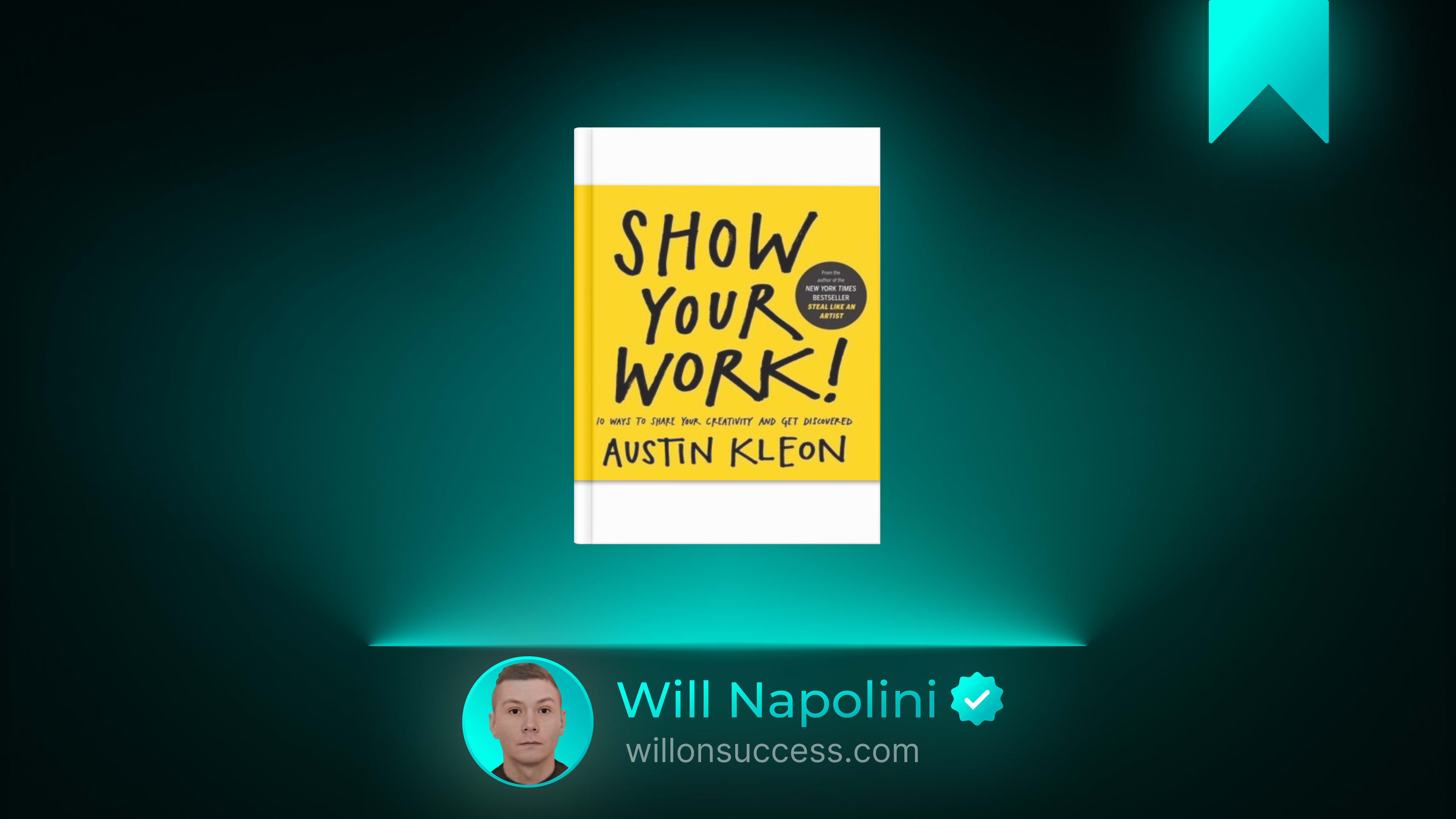
Austin Kleon’s Show Your Work! is a short, vital book that dismantles that myth entirely. It is not a book about marketing, and it is certainly not a book about becoming a loud, self-obsessed influencer. It is a profound, practical guide to the courage of visibility. It argues that your process—your messy, unfinished, stumbling journey—is actually more valuable, more interesting, and more connective than the polished final product you are waiting to unveil.
Let me show you why stepping out of the locked room is the single most important thing you can do for your growth, and how to do it without losing your mind.
The Big Idea: You Do Not Have to Be a Genius
The central thesis of Kleon’s work is beautifully liberating: You do not need to be an expert to share your life and your work. You just need to be open.
Kleon argues that the concept of the “lone genius” is a relatively modern invention. For most of human history, creativity was a communal, open process. Ideas were shared, borrowed, remixed, and passed along. The pressure to be a solitary, flawless authority is a modern burden that is crushing your potential.
Instead of trying to be a genius, Kleon invites you to embrace the mindset of the amateur.
We usually use the word “amateur” as an insult. We use it to mean unskilled, clumsy, or not serious. But look at the root of the word. It comes from the Latin amatorem, which means a lover. An amateur is simply someone who loves what they do so much that they cannot stop doing it, regardless of whether they are getting paid or praised.
The expert is often paralyzed. The expert has a reputation to protect. The expert is terrified of making a mistake, looking foolish, or stepping outside their narrow lane.
The amateur has no such burden. The amateur is free to ask questions, to try new things, to fail publicly, and to learn out loud. The amateur is not someone who knows less; the amateur is someone who fears less.
When you realize that you do not need a PhD, a decade of experience, or flawless execution to share your perspective, the locked door clicks open. You are allowed to simply say, “Look at this. I am learning this. Come learn it with me.”
Document the Process, Don’t Just Polish the Product
One of the most practical shifts Kleon suggests is changing how we view the act of sharing. Most of us think sharing means creating content. We think we have to stop our actual work, put on a performance, and produce something brand-new just to show people we exist. That is exhausting, and it usually leads to burnout.
Kleon offers a much more sustainable alternative: Don’t create. Document.
Think about the difference. Creating for an audience means trying to guess what they want to see and performing it. Documenting means simply turning the camera around and showing them what you are already doing.
It is the difference between painting a masterpiece, hiding it in the attic for five years, and then demanding applause. It is the difference between leaving your sketchbook open on the table and letting someone watch you erase, redraw, smudge the graphite, and finally get the line right.
People do not just want the finished product. They want the proof of life. They want to see the struggle. They want to know that the thing they are admiring was built by human hands that shook a little bit along the way.
When you document your process, you are not asking for applause. You are simply saying, This is what I did today. This is what I am thinking about. This is where I am stuck.
This aligns perfectly with the principle of consistency over intensity. You do not need a massive, dramatic reveal once a year. You need one small, honest update today. And another one tomorrow. Over time, those small documents become a body of work, and they attract the exact right people to your corner.
Teaching Is the Ultimate Form of Connection
There is a fear that plagues almost everyone who considers sharing their work: If I give away my secrets, I will lose my advantage. If I teach people how I do what I do, they will realize I don’t know that much, or worse, they will surpass me.
Kleon dismantles this scarcity mindset entirely. He points out a simple, beautiful truth: Teaching does not steal your thunder. Teaching builds your community.
When you share what you know, you are not handing someone a weapon to defeat you. You are extending a hand. You are saying, I walked this path, and here are the stones I tripped over so you don’t have to.
And here is the secret about teaching that the “expert” mindset hides from you: You do not need to be at the top of the mountain to help someone climb. You only need to be one step ahead of the person behind you.
If you learned a new software program yesterday, you are qualified to teach the person who is trying to learn it today. If you just figured out how to manage your anxiety during a job interview, you are qualified to help the person whose interview is tomorrow.
Generosity is the most powerful signal you can send into the world. When you teach freely, without hoarding your knowledge, you build deep, unshakeable trust. You stop being a competitor in a crowded market, and you become a guide in a shared journey.
The Art of Taking a Punch
I want to be honest with you about what happens when you unlock that door and step outside.
When you show your work, you will get hit.
You will face criticism. You will face indifference, which is sometimes harder than criticism. You will face people who misunderstand your intentions, who mock your enthusiasm, or who are simply cruel because they are fighting a battle of their own.
Kleon does not pretend this is easy. He calls it “learning to take a punch.”
If you are a sensitive person—and if you are a creator, you probably are—the first time someone criticizes you publicly, it will feel like a physical blow. Your instinct will be to retreat back into the locked room and never come out again.
But you must learn to separate the signal from the noise.
Not all criticism is equal. If a master of your craft gives you a critique, you sit down, you listen, and you use it to get better. That is a gift. But if a stranger on the internet, who has built nothing, is simply trying to drain your energy, you do not owe them a response. You do not owe them your peace.
You must learn to protect your vulnerability. You can be open with your work without being open to abuse. You can share your process without handing strangers the keys to your self-worth.
The goal is not to build a skin of armor so thick that nothing can touch you. The goal is to build a foundation of character so deep that their noise does not move your ground. You take the punch, you check your footing, and you get back to work.
Why This Matters on an Ordinary Tuesday
It is easy to read about the “amateur mindset” and feel inspired. It is much harder to apply it when you are sitting at your desk on a Tuesday afternoon, staring at a half-finished project, feeling like a fraud.
What does showing your work actually look like in the messy reality of your life?
It looks like sending the email to your team and saying, “This is a rough draft, and I am struggling with the middle section. Can you look at it?” instead of hiding it until it is perfect.
It looks like the baker who posts a picture of the loaf of bread that collapsed in the oven, and writes, “The humidity got the best of me today. Trying again tomorrow.”
It looks like the entrepreneur who shares the story of the client who said no, not to complain, but to document the reality of building something from scratch.
When you do this, something magical happens. You stop competing on perfection, which is an exhausting, unwinnable game. You start connecting on humanity, which is an infinite resource. People do not connect with your perfection. They connect with your struggle, your curiosity, and your willingness to keep going despite the struggle.
Your process becomes your proof of life. It tells the world that you are here, you are trying, and you are not afraid to be seen.
Who Should Read This Book — and Who Might Not Need It
I want to be very clear about who this book is for, because it is not for everyone.
Who it is for: If you are paralyzed by imposter syndrome, if you are waiting for permission to start, or if you are exhausted by the pressure to appear flawless, this book is a lifeline. It is for the introvert who wants to share their work without having to dance for the camera. It is for the freelancer, the artist, the writer, the parent, and the student who needs to be reminded that their journey has value before it reaches the destination.
Who might find it less useful: If you are looking for a deep, technical manual on how to improve your specific craft—how to paint better, how to write cleaner code, how to structure a novel—this is not it. Kleon is not teaching you how to do the work; he is teaching you how to be seen doing the work. Furthermore, if you are already highly visible, completely comfortable with public sharing, and have a strong handle on your boundaries, you may already know most of what is here.
Practical Application: Building the Habit of Visibility
Understanding this is beautiful, but implementing it requires a system. You cannot rely on a sudden burst of courage to finally share your work. Courage is a finite resource. You need a gentle, repeatable practice.
Here is how you can start documenting your life without overwhelming yourself.
1. The Daily Log
Choose one platform. It can be a public social media account, a private blog, or even a notebook you share with one trusted friend. Every single day, share one small thing from your process. It does not need to be profound. It can be a photo of your workspace. It can be a single sentence: “Today I spent three hours trying to fix this one paragraph, and I finally figured it out.” The goal is not to go viral. The goal is to build the muscle of saying, I am here, and I am working.
2. The “One Step Ahead” Teaching Moment
Think of one thing you learned this week. It could be a keyboard shortcut, a new way to chop onions, or a mental trick you used to calm down before a hard conversation. Write it down and share it with someone who is just one step behind you. Do not frame it as a lecture. Frame it as a gift. “I just figured this out, and it saved me an hour. I thought you might find it useful.”
3. The Boundary Practice
Because visibility invites noise, you must build a boundary before you need it. Decide right now what you will and will not engage with. For example: I will read constructive feedback from people I trust. I will not argue with strangers in comment sections. I will not check my metrics before noon. Write that boundary down. Protect your energy so you have enough left to actually do the work.
One Small Step
You do not need to overhaul your entire life today. You do not need to launch a website or write a manifesto. You just need to crack the door of the locked room just an inch.
Here is your one small step for today:
Take out your phone. Find the thing you are currently working on—the messy, unfinished, imperfect thing. Take one clear photo of it.
Post it, send it to a friend, or email it to a colleague. Add one honest sentence. Say, “This is what I am working on today. It is not finished, but I am trying to get it right.”
Do not wait for the applause. Just hit send, and let yourself be seen in the middle of the process.
The Door Is Already Open
We spend so much of our lives trying to build a flawless version of ourselves to present to the world. We think that if we can just polish the edges, hide the doubts, and perfect the performance, people will finally love us, respect us, and welcome us in.
But the world does not need your perfection. The world is already drowning in polished, empty performances.
The world needs your curiosity. It needs your messy sketchbook. It needs to hear about the things you love, the things you are struggling with, and the small, quiet ways you are trying to figure it out.
You are not a lone genius waiting to be discovered. You are a human being, learning out loud, inviting others to learn with you.
The locked room was never protecting you. It was only keeping you from the very people who were meant to walk beside you.
Drop the need to be an expert. Share the rough draft. And step out into the light.