The Art of the Yield: What a 17th-Century Epic Teaches Us About Power, Patience, and Letting Go
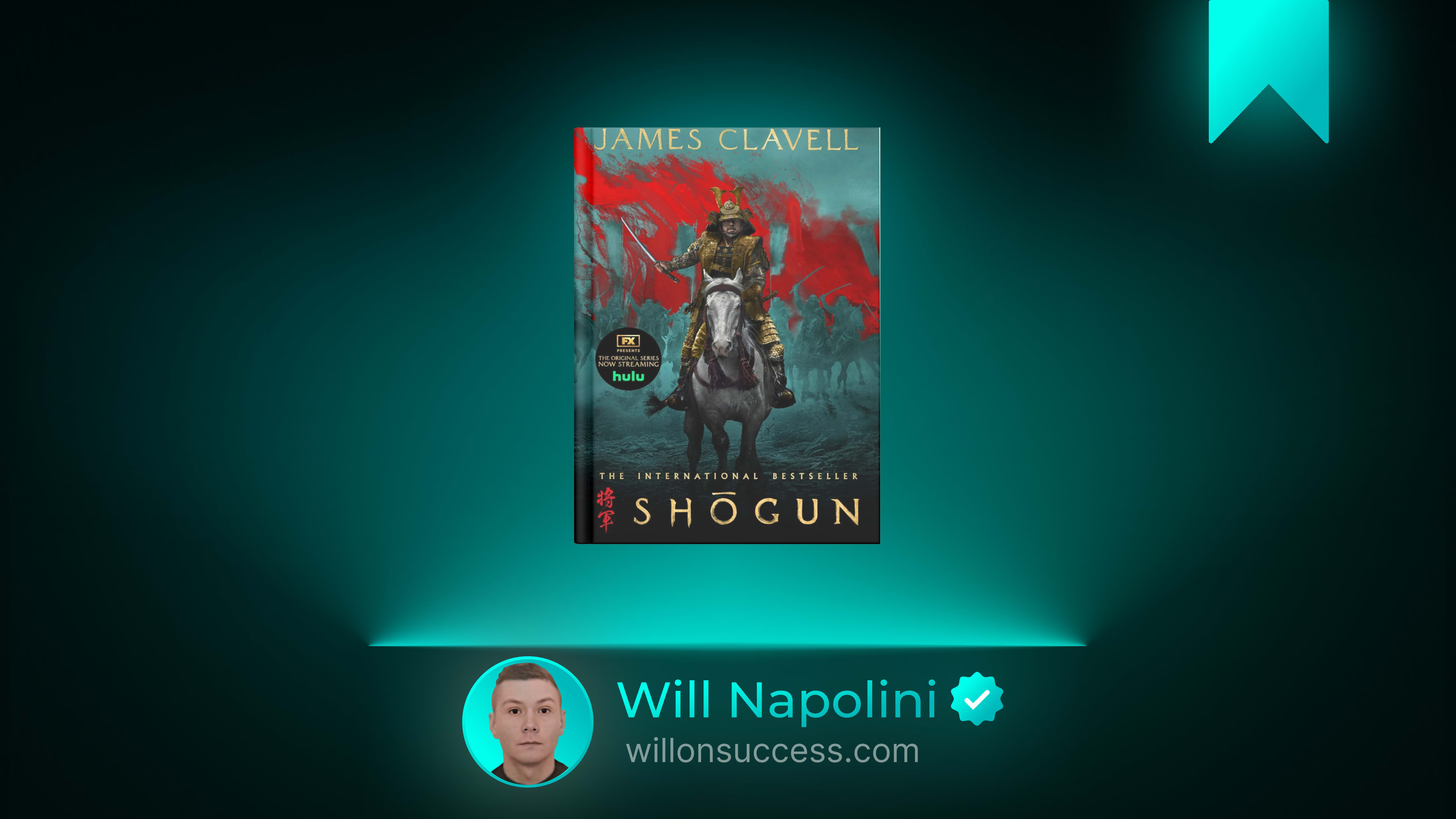
Imagine, for a moment, being dropped into a world where everything you know about power, communication, and survival is suddenly, violently wrong.
You shout, and they ignore you. You push, and they push back harder. You try to use the exact same tools, habits, and attitudes that made you successful yesterday, and they fail completely today. You are entirely out of your depth, surrounded by people who operate on a frequency you cannot even hear, let alone understand.
If you have ever gone through a devastating divorce, navigated a radical career pivot, stepped into a leadership role you felt unprepared for, or simply woken up one day to realize that the life you built no longer fits the person you have become, you know exactly what this feels like.
We call it a crisis. We call it being lost.
But in 1600, an English navigator named John Blackthorne called it Tuesday.
When Blackthorne’s ship wrecks on the shores of feudal Japan in James Clavell’s monumental epic Shōgun, he is thrust into a society so complex, so rigid, and so fundamentally alien to his Western mind that his very survival seems impossible. He is a man of brute force, loud commands, and absolute certainty. And in Japan, those traits are not just useless; they are a death sentence.
Most of us, when faced with a massive shift in our environment, do exactly what Blackthorne does at first: we push harder. We demand that the new world bend to our old rules. And when it doesn’t, we break.
But Shōgun is not just a story about a shipwreck. It is a profound, sprawling masterclass in the psychology of adaptation, the illusion of control, and the quiet, devastating power of patience. If you are willing to look past the swords and the political intrigue, Clavell has left behind a blueprint for how to navigate the moments in your life when the ground completely shifts beneath your feet.
Let me show you what it teaches, and how you can use it to stop fighting the current and finally learn to steer.
The Big Idea: Surrender Is Not Defeat; It Is the Beginning of Strategy
The central, counter-intuitive thesis running through the thousands of pages of Shōgun is this: True power does not come from forcing your will upon the world. It comes from understanding the current and aligning yourself with it.
We are culturally conditioned to believe that when we meet resistance, we must attack it. If a door is locked, we kick it down. If a market shifts, we outspend the competition. If a relationship fractures, we argue our case louder. We treat life like a fortress to be besieged.
But Clavell illustrates, through the brutal education of his protagonist, that when you are in an environment you do not control, brute force is just a fast track to exhaustion.
Blackthorne only begins to survive—and eventually thrive—when he stops trying to make Japan act like England. He stops shouting. He stops demanding. He begins to observe. He learns the language. He learns the intricate, unspoken rules of bowing, of silence, of wa (harmony). He realizes that to gain influence in this new world, he must first submit to its reality.
Surrender, in this context, does not mean giving up your soul or your goals. It means surrendering your friction with reality. It means accepting the board exactly as it is laid out in front of you, rather than throwing a tantrum because you wish the pieces were arranged differently. You cannot navigate a new world using an old map. You have to draw a new one.
The Story of the Falcon and the Waiting Mind
To understand the deepest mechanics of power in the book, you have to look past the English navigator and look at the man who actually holds the keys to the empire: Lord Toranaga.
Toranaga is the brilliant, besieged warlord who is slowly being trapped by his political rivals. On the surface, Toranaga appears to be losing. His enemies are mobilizing armies, issuing decrees, and rushing to corner him. His allies are panicking, urging him to act, to strike first, to do something.
But Toranaga does nothing. He practices the art of the waiting mind.
There is a recurring motif in the book involving falconry. A master falconer does not chase the bird. He does not run through the fields waving his arms, trying to force the falcon to land on his glove. That would be exhausting, and it would fail. Instead, the falconer stands perfectly still. He creates the conditions. He holds the glove. He waits. And the bird, following its own nature, returns to him.
Toranaga understands a principle that most ambitious people never grasp: Action is often just impatience wearing a mask of productivity.
His rivals are exhausting their resources, making mistakes, and overextending themselves because they are terrified of the silence. They think that if they are not moving, they are losing. Toranaga knows that by waiting, he allows his enemies to defeat themselves. He practices what he calls the “Crimson Sky” strategy—a long-term vision that requires immense, almost agonizing patience in the short term.
What I have learned from watching leaders, entrepreneurs, and parents is that our greatest mistakes rarely come from a lack of effort. They come from a lack of patience. We intervene too early. We send the angry email before the emotion has cooled. We pivot the business strategy before the data has fully materialized. We try to force the falcon to the glove.
Toranaga teaches us that sometimes, the most powerful move you can make is to sit perfectly still, keep your hand open, and let the world exhaust itself against your patience.
Freedom Is Found Inside the Boundaries of Duty
One of the most challenging concepts for a modern Western reader to digest in Shōgun is the Samurai ethos of Giri (duty, obligation, and social responsibility) versus Ninjo (human emotion, personal desire, and passion).
In our modern culture, we idolize Ninjo. We are told to “follow our hearts,” to “speak our truth,” and to cast off any obligation that does not serve our personal happiness. We view duty as a chain and personal desire as freedom.
But the characters in Shōgun—particularly the brilliant, tragic translator Lady Mariko—operate on a different paradigm. They understand that a life driven entirely by passing emotions is chaotic, fragile, and ultimately selfish. They find a profound, almost transcendent freedom inside the strict boundaries of their duty.
When you accept what you must do—when you embrace your obligations to your family, your team, your word, and your community without constant, whining resistance—you stop wasting energy fighting your own life.
This is not about staying in abusive situations or accepting toxic environments. It is about the mature recognition that life requires carrying weight. The petty person constantly drops the weight, complains about the weight, and tries to pass the weight to someone else. The noble person picks up the weight, adjusts their grip, and walks.
When you stop asking, What do I feel like doing today? and start asking, What is required of me today? a strange peace settles over your mind. The endless, exhausting debate inside your head about whether you “feel” like doing the hard thing simply vanishes. You do it because it is your duty. And in that doing, you build a character that can weather any storm.
Make Peace with the End to Master the Present
There is a psychological armor that the Samurai in the book wear, and it is perhaps the most practical tool for navigating high-stakes anxiety in your own life.
Before going into battle, or before making a decision that could cost them their lives, the warriors in Shōgun engage in a mental ritual: they accept that they are already dead. They visualize the worst-case scenario, they grieve it, they make peace with it, and they let it go.
Because they have already accepted the end, the fear of the end loses its grip on them. And without the paralyzing fear of death, they can act in the present moment with absolute, terrifying clarity.
Think about how much of your daily anxiety is driven by the fear of a hypothetical future. What if I launch this project and it fails? What if I have this difficult conversation and they leave me? What if I take this job and I hate it?
We spend so much of our present energy trying to insure ourselves against future pain that we become paralyzed in the present. We hedge, we delay, we soften our words, we play it safe.
The lesson of the Samurai is not to be reckless. It is to do the risk assessment, accept the worst-case outcome as a possibility you can survive, and then step onto the field with your mind entirely focused on the swing of the sword. When you stop trying to guarantee a perfect outcome, you free yourself to execute a perfect process.
Why This Matters on an Ordinary Thursday
It is easy to read about warlords and navigators and feel that the lessons belong to a different century. But the architecture of Shōgun plays out in your life every single week.
It plays out when you join a new company. The old you wants to come in on day one and tell everyone how things were done at your last job. The wise you—the Blackthorne who has learned the way of wa—spends the first ninety days just listening, learning the unspoken culture, and understanding where the actual power lies before you ever suggest a change.
It plays out in your marriage. When an argument starts, the old you wants to win, to deploy the best arguments, to force your partner to see your logic. The wise you practices Toranaga’s waiting mind. You pause. You let the emotional heat dissipate. You realize that winning the argument might cost you the harmony of the home, and you choose the longer, quieter strategy of connection over the short-term victory of being “right.”
It plays out when you face a medical diagnosis, a financial setback, or a sudden loss. The old you panics, fights the reality, and asks Why me? The wise you accepts the new terrain. You look at the board as it is currently arranged, you make peace with the difficulty of the road ahead, and you ask, What is the best next move?
You stop fighting the earthquake, and you start building a house that can sway.
Who Should Read This Book — and Who Might Want to Skip It
I must be honest with you about the commitment this book requires. Shōgun is not a quick read. It is a massive, dense, intricately plotted epic that demands your full attention.
Who it is for: If you are in a season of massive transition, if you are a leader trying to understand the deep mechanics of power and patience, or if you simply love being entirely submerged in a meticulously researched world, this book will change you. It is for the person who wants to understand how to maintain their internal center when the external world is chaotic. It is a profound study in cultural intelligence and strategic restraint.
Who might want to skip it: If you are looking for a light, fast-paced thriller to read on the beach, this will feel like homework. The pacing is deliberate, the political maneuvering is complex, and the cultural details are exhaustive. Furthermore, it is a product of its time (written in the 1970s about the 1600s), and while Clavell’s research was immense, some of the gender dynamics and cultural generalizations reflect the era in which it was written. You must be willing to read it as a historical artifact as much as a personal development tool.
Practical Application: The Architecture of Patience
Philosophy is useless if it does not change how you move through the world. If you want to integrate the wisdom of Shōgun into your life, you must build systems that force you to slow down and observe. Here are three ways to begin.
1. The “Language of the Room” Audit
Think of a specific environment where you are currently experiencing friction—a new team at work, your partner’s family, a new social circle. Stop trying to impose your way of doing things. Instead, become an anthropologist. Write down three unspoken rules of this “culture.” How do they handle conflict? What do they value? How do they show respect? Once you understand the actual rules of the room, you can navigate it without constantly tripping the alarms.
2. The Toranaga Pause (Strategic Inaction)
The next time you feel a surge of urgency to “fix” a problem, send a defensive email, or make a reactive decision, enforce a mandatory waiting period. Tell yourself: I am allowed to take action, but not for twenty-four hours. Use that time to observe. Watch how the situation evolves when you do not interfere. You will be shocked at how many problems solve themselves, or reveal their true nature, when you simply refuse to rush.
3. The “Already Dead” Release
Identify one fear that is currently paralyzing you from taking a necessary risk. Write down the absolute worst-case scenario. Describe it in detail. What happens if you fail? What happens if they say no? Now, write down how you would survive it. How would you recover? Who would still love you? Once you have made peace with the worst-case scenario, the fear loses its teeth. You can finally take the step.
One Small Step
You do not need to master the art of the warlord today. You just need to practice the art of the yield in one small, specific way.
Here is your step for today:
Identify one conversation or situation today where your instinct is to push, to argue, or to force your will. It might be a disagreement with your spouse, a frustrating interaction with customer service, or a child who refuses to put on their shoes.
When the moment comes, do not push. Physically step back. Drop your shoulders. Unclench your jaw. Take one deep breath and choose silence for just five seconds. Let the other person’s energy hit the empty space where your resistance used to be. Watch how the dynamic instantly shifts when you refuse to be the wall they are pushing against.
The Door Is Already Open
We spend so much of our lives trying to build ships that are unsinkable. We gather our credentials, we build our savings, we curate our reputations, and we hope that if we just construct a sturdy enough vessel, the ocean will never be able to touch us.
But the ocean always wins. The storm always comes. The ship, eventually, wrecks.
The profound gift of Shōgun is the realization that the shipwreck is not the end of your story. It is the beginning of your education. When you are stripped of your old titles, your old certainties, and your old ways of doing things, you are finally forced to meet the person you actually are beneath the armor.
You learn that you do not need to shout to be heard. You learn that waiting is not weakness. You learn that true power is not the ability to force the world to bend to your will, but the quiet, unshakeable ability to remain entirely yourself, no matter what world you are dropped into.
The ground will shift again. It always does. But you do not need to fear the earthquake anymore. You have learned how to build a house that sways.
Drop the heavy need to control. Open your hand to the current. And let the waiting mind do its work.