The Question You Stopped Asking at Twelve — and Why It Still Matters
When is the last time you looked at the sky — really looked, not glanced while checking the weather on your phone — and felt genuinely startled that it was there? That you were there, beneath it, conscious, temporary, inexplicable?
I am not asking to be poetic. I am asking because I think most of us lost something around the age of eleven or twelve, and we did not notice it leave. A quality of attention. A rawness of looking. The sense that existence itself was strange and worth asking about, not because a teacher assigned it, but because the strangeness pressed against you and demanded a response.
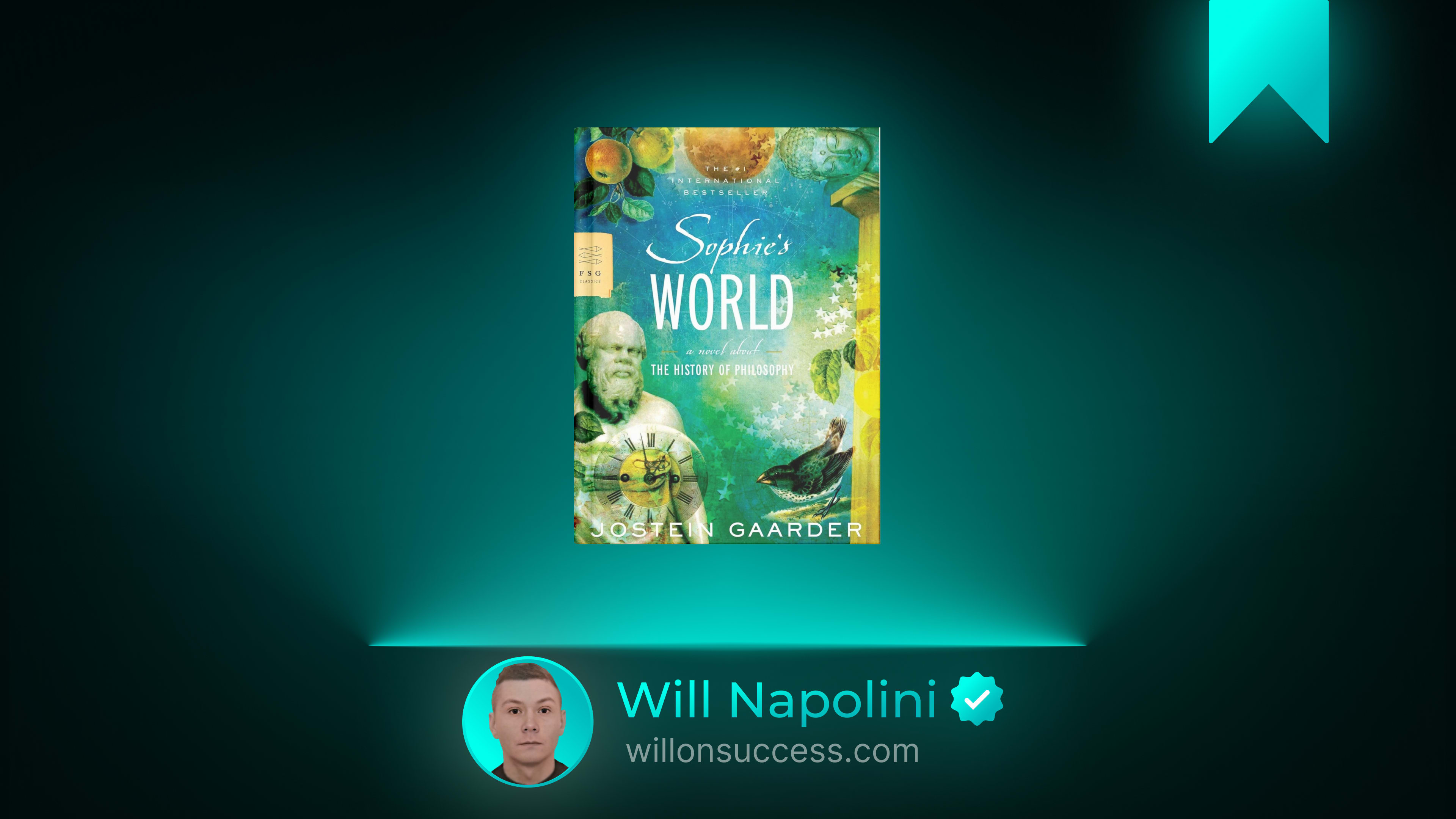
Jostein Gaarder wrote a novel about getting that quality back. It is called Sophie’s World, and it is, on the surface, a book about a fourteen-year-old girl in Norway who starts receiving mysterious philosophy lessons in her mailbox. But underneath that surface, it is something more urgent. It is an argument — made not through lectures but through story, surprise, and a slowly unfolding mystery — that the most important question a human being can ask is the one most of us stopped asking decades ago:
Who are you? And where does the world come from?
Let me tell you why I think that question still belongs to you, even if you put it down a long time ago.
The Big Idea: Philosophy Is Not a Subject. It Is a Way of Being Awake.
Gaarder was a philosophy teacher in Norway before he became a novelist, and Sophie’s World was originally written to make the history of Western thought accessible to young readers. But the book became an international phenomenon — translated into dozens of languages, read by millions of adults — because it does something no textbook can do. It makes you feel the questions before it explains them.
The central idea is this: philosophy is not a collection of dead men’s opinions to be memorized for an exam. It is the living, ongoing act of refusing to take existence for granted. It is the decision to remain astonished. And that decision is available to everyone, at any age, regardless of education or training. You do not need a degree to wonder. You only need to stop letting familiarity anaesthetize you.
The book traces the history of Western philosophy from the pre-Socratic Greeks through Socrates, Plato, Aristotle, the medieval thinkers, Descartes, Spinoza, Locke, Hume, Kant, Hegel, Marx, Darwin, Freud, and into the twentieth century. But it does not present these thinkers as museum exhibits. It presents them as people who were bothered by something. Who could not let a question go. Who looked at what everyone else accepted and said, Wait. That doesn’t make sense. Tell me more.
That impulse — the inability to let strangeness pass without interrogating it — is what Gaarder wants to hand back to you.
The White Rabbit: A Metaphor You Will Not Forget
Early in the novel, Gaarder offers an image that I have carried with me since I first read it, and I think it is worth sharing here because it captures the book’s entire philosophy in a single picture.
Imagine the universe as a white rabbit being pulled from a magician’s top hat. Most of us, as we grow up, crawl deep into the soft fur of the rabbit. We get comfortable there. We build routines, careers, opinions, certainties. We stop looking up. We stop wondering about the magician, about the hat, about why there is a rabbit at all. We become, in Gaarder’s quiet phrase, people who have settled so far into the fur that they no longer notice they are inside a trick.
But philosophers — and here Gaarder means not just professional academics but anyone who retains the habit of questioning — are the ones who keep climbing up the fine hairs toward the top of the rabbit, toward the rim of the hat, trying to look into the magician’s eyes. The climb is uncomfortable. The view is disorienting. You cannot settle there easily. But you can see something that the people deep in the fur cannot.
I think about this image often. I think about how easy it is, in the middle of a life full of obligations and noise, to burrow deeper into the fur and call it maturity. And I think about how much is lost when we do. Not productivity. Not achievement. Something quieter and more essential: the sense that your life is occurring inside a mystery worth attending to.
You do not have to live at the top of the rabbit’s fur. No one can. But you can climb up occasionally. You can look around. You can let the strangeness back in before you burrow down again.
The Mystery Inside the Mystery: What Happens When You Discover You Are a Story
I want to talk about the novel’s structure without ruining it entirely, because the discovery at the heart of Sophie’s World is one of the most effective philosophical thought experiments I have encountered in fiction.
Sophie begins receiving lessons from a mysterious philosopher named Alberto Knox. He guides her through the history of thought. She learns. She questions. She grows. And then, gradually, she begins to notice something wrong. Small intrusions. References that do not belong. A sense that her world is being written rather than lived.
What Sophie discovers is that she is a character in a book. A man named Albert Knag is composing her existence as a birthday gift for his daughter, Hilde. Sophie’s thoughts, her conversations with Alberto, the very ground she walks on — all of it is being generated by someone else’s pen.
And once she knows this, she cannot unknow it. The question becomes: If I am written, am I real? If my choices are chosen for me, do I have will? And if there is an author, can I speak to him? Can I step outside the page?
Gaarder uses this meta-fictional twist not as a clever gimmick but as a philosophical engine. It forces Sophie — and the reader — to confront questions about consciousness, free will, the nature of reality, and the relationship between creator and creation. These are the same questions that have occupied thinkers from Augustine to Berkeley to Sartre. But here, you feel them in your body, because you are inside a character who is feeling them for the first time.
I will not tell you how the book resolves this tension. But I will say that the resolution asks something of you as a reader. It asks you to consider whether your own sense of being a fixed, solid, self-evident “I” is as certain as you assume. Whether the ground you stand on is as firm as it feels. Whether the story you tell yourself about who you are is the only story available.
That is not meant to unsettle you for its own sake. It is meant to loosen the grip of certainty so that wonder can re-enter. Because wonder requires a gap. A space between what you assumed and what might actually be true. And that space is where philosophy lives.
The Examined Life Is Not a Luxury
One of the threads running through Sophie’s lessons, from Socrates onward, is the idea that an unexamined life is not merely less interesting than an examined one. It is less lived. That the act of questioning your assumptions, your values, your reasons for believing what you believe, is not an intellectual exercise reserved for people with leisure time. It is the basic work of being a conscious creature.
I want to be careful here, because I do not want to make this sound like a moral obligation. You are not a bad person for not reading Kant on a Saturday afternoon. But I do think there is a quiet cost to never pausing, never asking, Why do I believe what I believe? Why do I want what I want? Is the life I am building actually mine, or is it a set of inherited scripts I never questioned?
Gaarder’s novel suggests that the cost is not dramatic. It is not tragedy. It is a slow dimming. A gradual acceptance that things are as they are because they have always been as they are. A settling into the fur. And then one day you are fifty, or sixty, or seventy, and you realize you cannot quite remember the last time you were genuinely surprised by your own existence.
The examined life is not about becoming a philosopher. It is about remaining a participant in your own experience rather than a passenger. It is the difference between watching your life happen and inhabiting it.
What the Philosophers Actually Offer You (Beyond the History Lesson)
The novel moves through roughly twenty-five centuries of thought, and I will not attempt to summarize each thinker here. But I want to name a few of the ideas that Gaarder presents with particular force, because they have practical weight beyond their historical context.
Socrates and the admission of not knowing. The beginning of wisdom is not accumulating answers. It is honestly saying, I do not know. In a world that rewards certainty and punishes hesitation, the willingness to say “I am not sure” is quietly radical. It keeps the mind open. It prevents the calcification of belief into ideology.
The empiricists and the limits of what you can verify. Hume, in particular, teaches Sophie that much of what we call knowledge is really habit. We expect the sun to rise because it always has. We expect cause to follow effect because we have never seen it fail. But expectation is not proof. And recognizing that humbles the mind in a useful way. You are more uncertain than you pretend. And that uncertainty, held honestly, makes you more careful, more curious, more willing to be wrong.
Existentialism and the weight of freedom. Sartre’s insistence that you are condemned to be free — that there is no fixed human essence, no predetermined script, that you must choose and that the choosing is yours alone — runs through the novel’s later sections with real force. Gaarder does not present this as liberating in a simple, feel-good way. He presents it as terrifying and dignifying simultaneously. You are not handed a meaning. You must make one. And the making is the work of a lifetime.
You do not need to agree with any of these thinkers to benefit from encountering them. The benefit is in the friction. In having your comfortable assumptions bumped against a mind that saw things differently. That friction keeps you awake.
Who Should Read This Book — and How to Read It
If you have never read a philosophy book and the word “philosophy” makes you think of impenetrable prose and irrelevant abstractions, this is the book to start with. Gaarder writes clearly, warmly, and with genuine delight in his subject. Sophie is a believable, curious, sometimes frustrated teenager, and her voice keeps the philosophical content grounded. You learn alongside her. You are confused when she is confused. You feel the excitement when an idea clicks.
If you already have a strong background in philosophy, the historical content will not surprise you. But the novel’s structure — the meta-fictional layer, the way Gaarder makes you feel the questions rather than merely understand them — still has power. And the book works beautifully as something to share with a young person in your life. A teenager. A student. Someone who is beginning to ask the big questions and needs to know those questions are not naive.
One honest caveat: the middle sections, where the philosophical content becomes dense and the plot slows, require some patience. The book asks you to sit with ideas for stretches at a time. If you are looking for pure narrative momentum throughout, you may find the pace uneven. But I would encourage you to stay with it. The ideas earn their space. And the novel’s final act rewards that patience with genuine surprise.
Read it slowly. One or two chapters at a time. Let the ideas settle before moving on. This is not a book to race through. It is a book to inhabit.
What to Do With This — Starting Today
Philosophy, as Gaarder presents it, is not something you consume. It is something you do. So let me offer you a few small practices that grow directly from the book’s spirit.
One question to carry this week: What is one thing I have accepted as simply “the way things are” that I have never actually examined? It might be a belief about your career, a assumption about what a good life requires, a story about your own limitations that you inherited at fifteen and never revised. You do not have to resolve it. Just hold it up. Look at it. Ask it why it is there.
A daily practice, small and honest: Once a day — on a walk, while washing dishes, in the two minutes before sleep — look at something ordinary. A tree. A building. Your own hand. And try, for five seconds, to see it as if you have never seen it before. To recover the strangeness. The thereness of it. You will not sustain it. You are not meant to. But the five seconds of genuine looking will remind you that the world is not as familiar as your routines have convinced you it is.
A conversation to have: If there is someone in your life — a friend, a child, a student, a colleague — who has recently asked a question you dismissed as impractical or naive, go back to them. Take the question seriously. Ask them more. You do not have to solve it. You just have to signal that the asking matters. That wonder is not childish. That climbing toward the top of the rabbit is not a waste of time.
A reading practice: If this book sparks something in you, do not let it end there. Follow one thread. Pick one philosopher whose section made you pause. Find a short, accessible introduction to their work. Give yourself permission to be a beginner. You do not need to master them. You need to let one mind disagree with yours, gently, over the course of an evening.
The Door That Never Fully Closes
Here is what I keep returning to, long after I finished this book and set it down.
We are given one life. One brief, improbable stretch of consciousness in a universe that owes us no explanation. And most of that life is spent in routines so familiar they become invisible. We stop asking. We stop noticing. We burrow into the fur and call it home.
But the questions never leave. They wait patiently beneath the noise. Who are you? Why is there something rather than nothing? What does it mean to live well? Is the story you are telling yourself the only story? You can ignore them for years. Decades. But they do not go away. They simply wait for a quiet evening, a loss, a disruption, a book that falls open in your hands at the right moment, to surface again.
Gaarder wrote this novel as a reminder that the questions belong to everyone. Not just to specialists. Not just to people with time and training. To you. To the fourteen-year-old you were, who once lay awake wondering whether the stars were real. To the adult you are now, who is allowed to wonder again without needing to justify it.
You do not need permission to be astonished by your own existence.
You never did.
Climb up one hair of the rabbit tonight. Just one. Look at the world as if you have just arrived in it. And then, tomorrow, burrow back down if you need to. The fur will still be there. The routines will resume.
But you will carry the view with you. And that changes everything, even if no one else can see it.
The magician is still pulling the rabbit from the hat. The trick is still in progress. And you — you are still here, watching, conscious, brief, and full of questions you do not have to answer to be allowed to ask.
Go ask one. Tonight. Before the fur gets too comfortable again.