Mastery by Robert Greene: The Hidden Architecture of True Genius
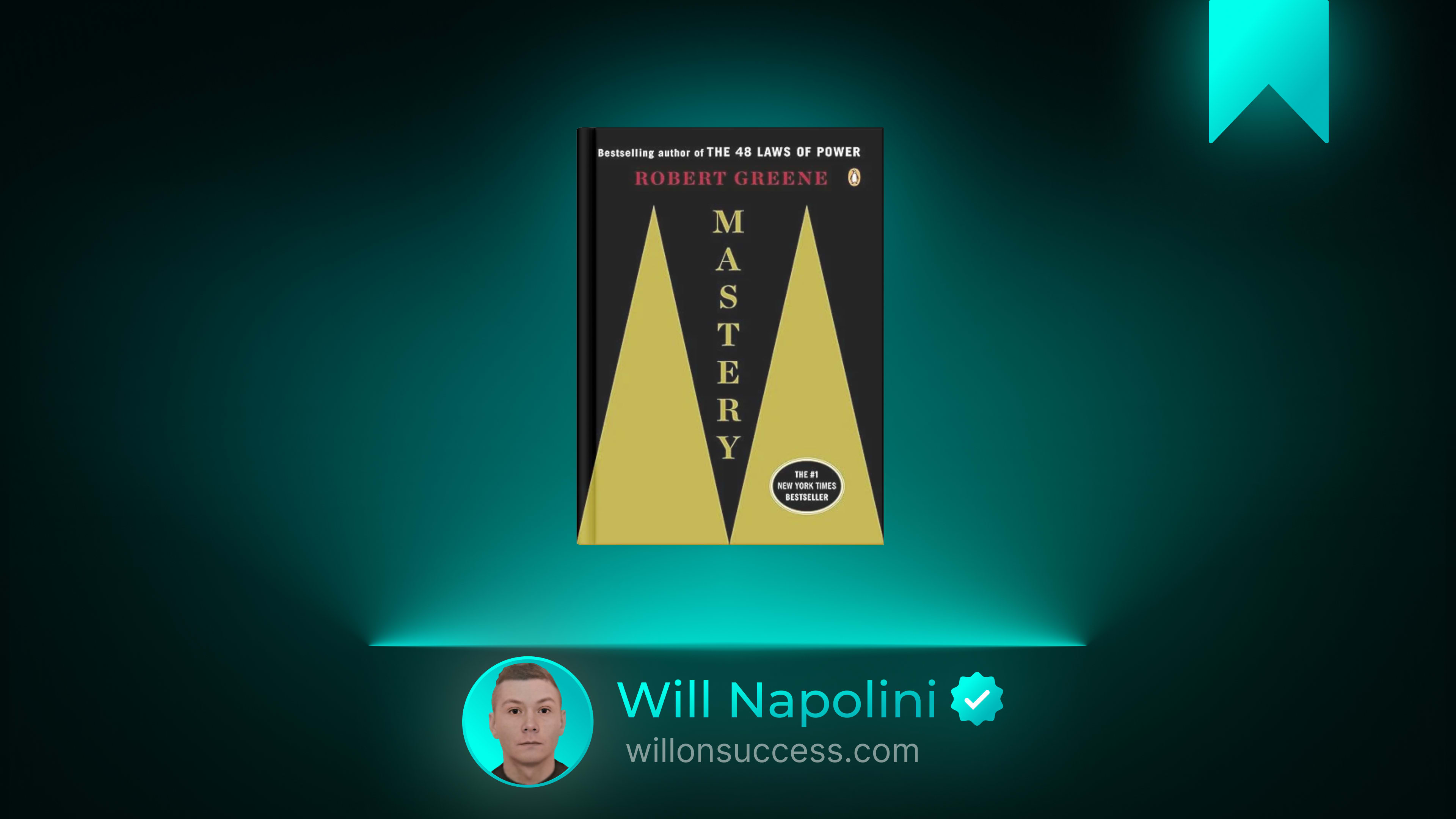
There is a comforting lie we tell ourselves when we watch someone operate at the absolute peak of their potential.
We watch a grandmaster play chess without looking at the board, or a musician improvise a melody that brings a crowd to tears, or a founder navigate a complex crisis with effortless grace. And we whisper a single, dangerous word to ourselves: Genius.
We use the word “genius” as a shield to protect our own mediocrity. We tell ourselves that they were born with a magical gift, and we were not. It is a comforting lie because it absolves us of responsibility. If greatness is a genetic lottery, then our lack of greatness is not our fault.
But I have spent years studying people who have reached the highest levels of their fields, and I have learned a humbling truth: greatness is rarely a gift. It is an architecture. It is a rigorous, often painful, deeply unglamorous process of psychological and technical development.
If you have ever felt stuck in your career, if you have ever felt like you are working hard but spinning your wheels, or if you suspect you are pursuing a path that belongs to your parents rather than yourself, I want to show you a different way.
The Big Idea
In his masterwork Mastery, Robert Greene dismantles the myth of the natural prodigy. By examining the lives of historical figures like Leonardo da Vinci, Charles Darwin, and Albert Einstein, alongside contemporary masters like Temple Grandin and Freddie Roach, Greene reveals a universal trajectory.
The central thesis of the book is that mastery is not a function of innate talent; it is the result of submitting to a specific, sequential process. It begins with discovering your “Life’s Task,” moves through a grueling “Apprenticeship Phase,” enters a “Creative-Active Phase,” and finally culminates in Mastery itself—a state where the conscious and unconscious mind fuse.
Greene argues that we are all born with a primal inclination, a seed of potential. But society, education, and our own egos constantly pull us away from it. To achieve mastery, you must stop chasing shortcuts, money, and superficial status. You must instead value deep learning above all else, and you must be willing to endure the boredom of the apprenticeship.
Mastery is not about being the smartest person in the room. It is about having the deepest relationship with reality.
The Story of the Seed and the Soil
To understand how this process begins, we have to look at Charles Darwin. We often think of him as a towering intellectual giant, but as a young man, he was entirely unremarkable. He was a mediocre student, easily distracted, and deeply disappointing to his father, who wanted him to become a doctor or a clergyman.
Darwin’s only true obsession was collecting beetles, observing birds, and wandering through nature. This was his primal inclination. It was the thing he was drawn to before the world told him what he should care about.
When he was offered a spot on the HMS Beagle, he didn’t go as a celebrated scientist. He went as an amateur. But during that voyage, and in the decades that followed, Darwin did something extraordinary. He didn’t just look; he observed. He submitted himself to the slow, agonizing process of gathering data, questioning his own assumptions, and letting the reality of the natural world dictate his theories. He spent over twenty years refining his ideas before publishing On the Origin of Species.
Darwin did not have a magical brain. He had a profound alignment with his Life’s Task, and he possessed the patience to let his apprenticeship mature into mastery. He let the soil dictate the shape of the root.
The Major Principles
Discovering Your Life’s Task (The Primal Inclination)
Before you can master a skill, you must know what you are trying to master. Greene argues that inside every person is a unique “Life’s Task.” It usually reveals itself in childhood, before the ego and societal expectations take over. It is the activity that makes you lose track of time. It is the subject you are naturally drawn to, whether it is organizing systems, understanding human behavior, building things with your hands, or analyzing patterns.
The problem is that as we grow up, we lose the signal. We choose college majors because our parents approve of them. We take jobs because they pay well or sound impressive. We drift.
I have seen incredibly intelligent people spend decades climbing a ladder, only to reach the top and realize it is leaning against the wrong wall. You cannot achieve mastery in a field you secretly despise. The cognitive load is too high, and the inevitable boredom of practice will break you.
Your first responsibility is to excavate your past. You must look for the clues of your primal inclination and find a way to align your daily work with your deepest natural curiosity.
The Apprenticeship Phase (Value Learning Over Money)
Once you have identified your field, you enter the Apprenticeship Phase. This is where most people fail, because the ego hates this phase. The ego wants the title, the salary, and the applause immediately.
Greene outlines that a true apprenticeship lasts roughly five to ten years and consists of three distinct steps: Deep Observation, Skills Acquisition, and Experimentation.
Deep Observation: When you enter a new environment, keep your mouth shut and your eyes open. Observe the rules, the power dynamics, the culture, and the unspoken realities of the field. Do not judge; just absorb. Skills Acquisition: This is the grinding phase. You must practice the foundational skills until they become automatic. This requires submitting to repetition. You must embrace the boredom. What you repeat in private eventually becomes visible in your life. If you skip the foundational repetition, your future work will be brittle. Experimentation: Once the skills are internalized, you begin to take small risks, testing your knowledge in the real world and gathering feedback.
The golden rule of the apprenticeship phase is this: Value learning over earning. If you are offered a job that pays more but teaches you nothing, and a job that pays less but places you at the feet of brilliant mentors, you must take the latter. The knowledge you acquire in your twenties and thirties will compound into wealth and influence in your forties and fifties. If you chase the money too early, you cap your ultimate potential.
The Dynamics of Mentorship (Absorbing the Master’s Mind)
You do not have time to make every mistake yourself. A mentor acts as a compressor of time. They allow you to absorb decades of hard-won wisdom in a fraction of the time.
But Greene warns against viewing mentors as mere cheerleaders. A true mentor relationship is an intense, sometimes difficult transfer of knowledge. You must find someone whose mastery you respect, submit to their way of thinking, and internalize their standards.
However, there is a danger. If you stay under a mentor’s shadow for too long, you will never develop your own voice. You will become a perfect replica of them, rather than a master in your own right. Eventually, the apprentice must rebel, step away, and forge their own path. You submit to the mentor to learn the rules; you leave the mentor to learn how to break them.
Social Intelligence (Seeing People as They Are)
One of the most profound insights in Mastery is that technical skill is useless if you are destroyed by human nature. Many brilliant people fail because they operate from what Greene calls the “Naive Perspective.” They assume that if they just do good work, people will be fair, rational, and supportive.
This is a fatal error. The workplace is a complex web of human egos, insecurities, and hidden agendas. Social intelligence is the ability to step outside your own emotional reactions and observe people objectively.
You must accept human nature as it is, not as you wish it to be. Learn to read the subtle cues of power. Learn to manage your own ego so you do not trigger the insecurities of those above you. Learn to build alliances. You cannot master your environment if you are constantly blindsided by the people in it.
The Creative-Active Phase and the Dimensional Mind
After years of rigorous apprenticeship, you graduate into the Creative-Active Phase. Because you have internalized the foundational rules of your discipline, you no longer have to think about them consciously. Your mind is now free to make connections that others cannot see.
Greene calls this the “Dimensional Mind.” While most people think in linear, rigid ways, the master can see the entire system. They can fuse the intuitive with the rational. They can look at a problem in biology and apply a principle from architecture.
This is where true innovation happens. But this creativity is not magic. It is the direct result of the thousands of hours of deep, structured observation that preceded it. You earn the right to be creative only after you have mastered the fundamentals.
Why It Matters
Why does this rigorous philosophy matter on an ordinary Tuesday?
Because we live in an era that is deeply hostile to mastery. We are surrounded by the illusion of the overnight success. We are sold software, supplements, and systems that promise to hack our way to the top. We are encouraged to build personal brands before we have built any actual competence.
This creates a society of anxious, fragile people who know a little bit about everything, but have mastered nothing. When the market shifts, when the trend dies, when the algorithm changes, they are left with nothing.
Mastery provides a fortress against the chaos of life. It gives you a profound sense of internal security that no boss, no economy, and no critic can take away. When you know, deep in your bones, that you have submitted to the process and forged genuine competence, your posture in the world changes. You stop begging for validation. You start creating value.
Furthermore, mastery is the ultimate antidote to the existential dread of modern life. Meaning is not found in leisure; it is found in the deep, absorbing engagement with a challenging task. The master does not work to live; they live to push the boundaries of their craft.
Practical Application
Understanding the trajectory of mastery is inspiring, but you need to know where you currently stand on the map. Here is how you can audit your life today.
1. The Childhood Audit Take an hour this weekend with a blank notebook. Write down the ages of 5 to 12. What did you do when no one was watching? What subjects made you ask a hundred questions? What did you build, draw, or organize? Look for the common thread. That thread is your primal inclination. Compare it to your current daily work. How far have you drifted? What is one small pivot you can make this year to bring them closer together?
2. The Learning vs. Earning Audit Look at your current job or business. Ask yourself honestly: Am I still in the apprenticeship phase, or have I stopped learning? If you are just executing the same skills you learned three years ago for a paycheck, you are stagnating. You need to find a new challenge, a new skill to acquire, or a new mentor to push you into the discomfort of growth.
3. The Naive Perspective Check Think of the most difficult person in your professional life. Stop asking, Why are they so unfair? Instead, ask, What are their insecurities? What do they value? What are they afraid of losing? Shift from emotional reaction to objective observation.
Who Should Read This Book
Mastery is a dense, rich, and deeply philosophical book. It is essential reading for anyone who feels a deep calling but lacks the roadmap to achieve it. It is a lifeline for mid-career professionals who feel trapped in the “success trap,” and for young people who are trying to decide where to invest the next decade of their lives. If you are a creator, an entrepreneur, an artist, or a dedicated professional, this book will recalibrate your entire relationship with time and effort.
However, this book is not for everyone. If you are looking for a quick, 150-page book with “10 Hacks to 10x Your Income by Friday,” you will be frustrated. Greene’s writing is historical, detailed, and demands your full attention. He does not offer shortcuts; he offers a profound paradigm shift. If you are not willing to embrace the long game, the concept of the apprenticeship will feel like a burden rather than a liberation.
One Small Step
I want you to stop treating your current struggles as a sign that you lack talent, and start seeing them as a sign that you are in the forge.
Here is your one small step for today: Identify one foundational skill in your field that you have been avoiding because it is tedious, boring, or difficult. Maybe it is learning the underlying code, maybe it is memorizing the historical case studies, maybe it is practicing the basic scales.
Commit to spending just thirty minutes on that foundational skill today, before you check your email, before you open social media, before you try to be “creative.”
Submit to the boredom. Submit to the repetition.
Genius is not a gift you are handed; it is a fire you must build, stick by stick, in the dark. The world is waiting for what only you can build, but it will only arrive when you finally decide to lay the foundation.