Matilda by Roald Dahl: The Quiet Rebellion of a Brilliant Mind
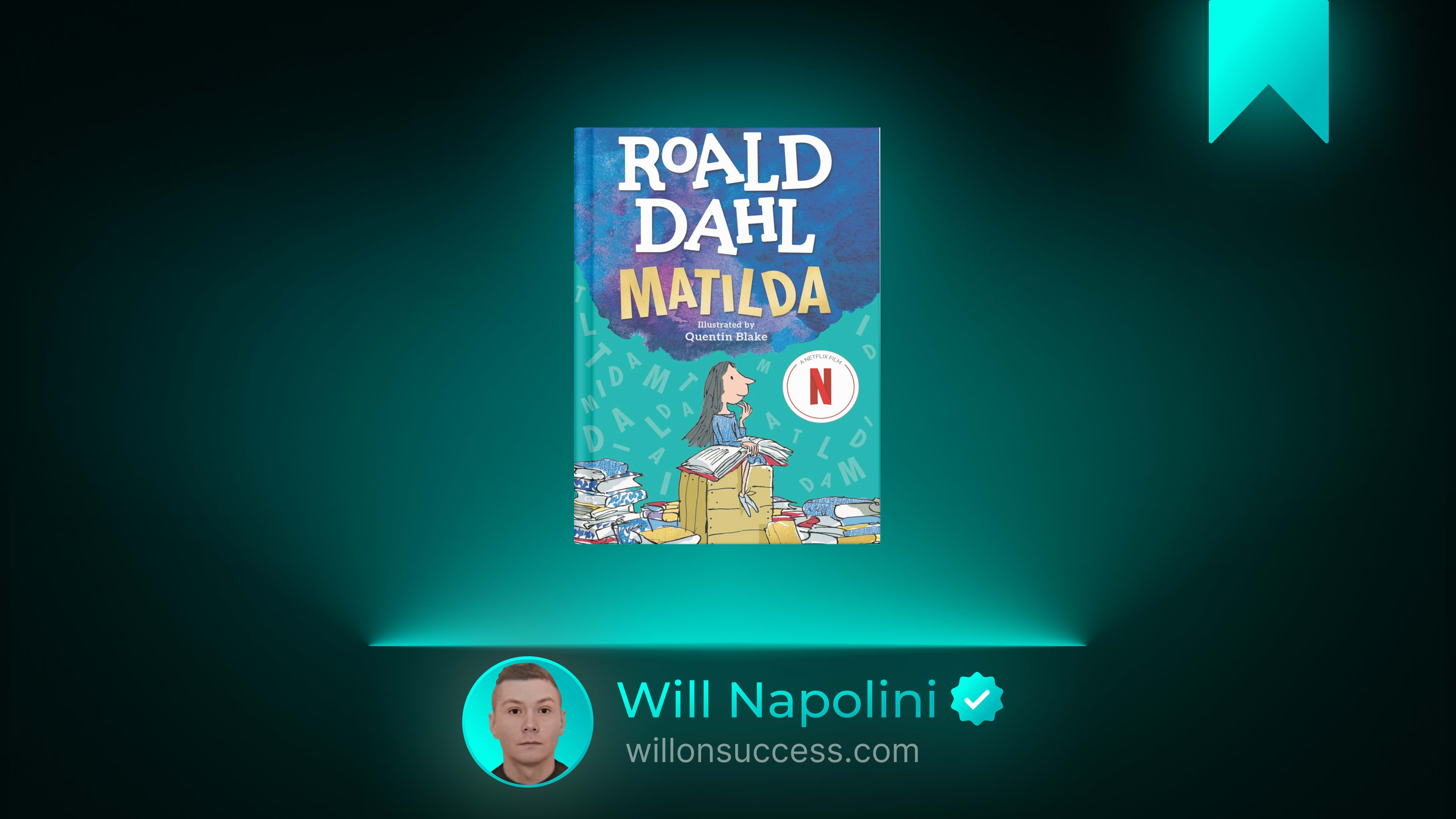
There is a particular kind of loneliness that no one warns you about. It is not the loneliness of being physically alone. It is the loneliness of being surrounded by people who look at you and see nothing. Who look at your curiosity and call it a nuisance. Who look at your questions and call them impertinent. Who look at the person you are becoming and wish you would become someone else entirely.
If you have ever felt that you were born into the wrong family, the wrong classroom, or the wrong life—if you have ever been told, quietly or loudly, that your mind was too sharp, your dreams too large, your questions too inconvenient—then I want to tell you about a small girl who refused to disappear.
Her name is Matilda. And her story is not really a children’s story at all. It is a blueprint for anyone who has ever had to build their own life from scratch, in secret, against the wishes of the people who were supposed to love them.
The Big Idea
Roald Dahl published Matilda in 1988, and on the surface it is a tale of a five-year-old genius with telekinetic powers who outwits a tyrannical headmistress. But beneath the mischief and the magic, the book carries a single, radiant conviction: your circumstances of birth do not get to write your ending.
Matilda Wormwood is born into a family that despises everything she is. Her father is a dishonest used-car salesman who believes television is superior to books. Her mother is obsessed with bingo and sees no value in a daughter who asks questions. They do not merely ignore Matilda’s brilliance. They punish it. They tell her she is wrong for being who she is.
And yet. Matilda does not wither. She goes to the public library alone at four years old. She reads Dickens, Hemingway, Steinbeck. She teaches herself to multiply large numbers in her head. She builds an inner world so vast and rich that the smallness of her parents cannot contain it.
What Dahl understood—and what I have come to believe through years of watching people rebuild their lives—is that the mind is the one door no one can lock from the outside. They can lock the room. They can take away your privileges. They can mock you and diminish you. But if you can still think, still read, still imagine, you are not truly imprisoned. You are simply waiting for the moment to walk out.
The Story
The Wormwood household is a place of noise and neglect. Matilda’s brother watches television endlessly. Her father brags about cheating customers. Her mother dismisses reading as a waste of time. When Matilda dares to point out that her father’s business practices are dishonest, she is told to be quiet. When she tries to share what she has learned, she is told she knows nothing.
So Matilda begins a quiet rebellion. Small acts. A parrot hidden in the chimney to simulate a ghost. Superglue poured into her father’s hat. Hair dye swapped for bleach. These are not the actions of a malicious child. They are the actions of a child who has been denied every form of justice and must manufacture her own.
When Matilda finally enters school, she meets Miss Honey—a gentle, underpaid teacher who recognizes immediately that Matilda is extraordinary. Miss Honey sees what the Wormwoods never could: a child who deserves to be challenged, nurtured, and believed in. For the first time in Matilda’s life, an adult looks at her and says, without irony, You matter.
But the school is ruled by Miss Trunchbull, a monstrous headmistress who governs through terror. She hurls children by their pigtails. She locks them in a closet called the Chokey, lined with broken glass and nails. She forces a boy named Bruce Bogtrotter to eat an entire enormous chocolate cake in front of the whole school as punishment for stealing a slice. She is authority stripped of all compassion, power wielded as pure cruelty.
And here is where the story turns. Matilda discovers that her mind can move objects. With focused thought, she tips a water jug. She writes a message on a blackboard with a piece of chalk, making Miss Trunchbull believe she is being haunted by the spirit of Miss Honey’s dead father. The message is simple: Give Miss Honey back her house. Leave this school.
Miss Trunchbull flees. Miss Honey gets her home back. And in the end, Matilda’s parents—fleeing the law for her father’s crimes—leave town. They leave Matilda behind. Miss Honey adopts her.
The girl who was told she was nothing finds her people. She finds her home. Not the one she was born into, but the one she earned.
The Major Principles
Your Mind Is the One Room They Cannot Enter
The most radical act in Matilda’s story is not the telekinesis. It is the library.
A four-year-old girl walks alone to the public library, sits down with a book, and enters a world her parents cannot touch. They cannot confiscate the sentences. They cannot punish the ideas. They cannot reach inside her skull and dim the light.
I have seen this pattern in countless lives. The person who grew up in a household that mocked education, but who read in secret. The person who was told their ambitions were foolish, but who quietly built a skill in the margins of their day. The person who was surrounded by cynicism but refused to let it become their own vocabulary.
You do not need permission to grow. You do not need someone to validate your curiosity before you are allowed to learn. A small decision becomes a direction, and a direction repeated long enough becomes a life. Matilda chose one book. Then another. Then another. And those choices built a world her parents could not reach.
What are you reading? What are you learning in the quiet hours, when no one is watching? That is where your real education lives. Not in the credentials others approve of, but in the questions you refuse to stop asking.
Cruel Authority Only Holds Power Through Your Belief
Miss Trunchbull is terrifying. But look closely at what gives her power. It is not her physical strength. It is the absolute conviction of every child and teacher in that school that she is untouchable. That her rules are the rules. That resistance is futile.
The moment Matilda refuses to believe that—to accept that Trunchbull’s version of reality is the only reality—the tyrant’s power begins to crack.
I have seen this in workplaces. I have seen it in families. I have seen it in the internal dialogue of people who were told, as children, that they were stupid, or lazy, or not enough. The voice of the Trunchbull lives on long after the actual person is gone. It sits in the back of your mind and says, You cannot. You should not. You are not permitted.
But here is what I have learned: the voice is only as powerful as your willingness to obey it. The moment you say, No. That is not true. That is not mine to carry, the spell weakens. Not all at once. But it weakens.
Miss Trunchbull does not die. She does not go to prison. She simply runs away. Because she was never as powerful as everyone believed. She was only as powerful as their fear allowed her to be.
One Person Who Sees You Can Change the Trajectory of a Life
Miss Honey does not give Matilda superpowers. She does not rescue her from her parents. She does not defeat the Trunchbull.
She does something simpler and more profound. She sees Matilda. She says, I see you. You are brilliant. You deserve more than what you are being given.
If I could sit across the table from you and tell you one thing I have learned about human transformation, it would be this: one person who genuinely sees you—who names your potential before you can see it yourself—can alter the entire trajectory of your life. Not because they fix you. Not because they save you. But because they give you permission to believe in what you already suspected about yourself.
Miss Honey is not a superhero. She is poor, frightened, and powerless against Trunchbull. But she is kind. And in a world that had offered Matilda nothing but contempt, kindness was revolutionary.
Who is your Miss Honey? Who looked at you, perhaps years ago, and said something that made you believe you might amount to something? Hold that person in your memory. And more importantly—be that person for someone else.
Small Courage Compounds Into Transformation
Matilda does not overthrow Trunchbull in a single dramatic battle. She begins with parlor tricks. A parrot. Superglue. A newt in a water jug. Each act is small. Each act says, I will not be erased. I will not be silent. I exist, and I will make myself known.
This is how courage actually works. It does not arrive fully formed. It is not a lightning bolt. It is a muscle. You exercise it with small, imperfect acts. You speak up in the meeting when you would normally stay silent. You send the email you have been drafting for three weeks. You set the boundary you have been avoiding for years.
You start small. You stay consistent. You let time do its work.
By the time Matilda moves the chalk across the blackboard with her mind, she has already practiced a hundred smaller rebellions. The telekinesis is not magic. It is the external manifestation of an internal decision that was made long ago: I will not be small anymore.
Why It Matters
You may be thinking, This is a children’s book. I am an adult with responsibilities. And you would be right. But the dynamics of Matilda’s world do not disappear when we turn eighteen. They simply change shape.
The parent who told you your interests were worthless becomes the manager who dismisses your ideas in meetings. The Trunchbull becomes the toxic workplace culture where fear is the primary management tool. The loneliness of being unseen as a child becomes the quiet isolation of adulthood, where no one is obligated to notice your struggle.
And Miss Honey? She becomes the mentor who pulls you aside and says, I think you are capable of more than you are allowing yourself to be. She becomes the friend who listens without fixing. She becomes the book you read at the right moment that makes you feel, for the first time, that someone has written the sentence you could not speak.
Matilda matters because it reminds us that the child who was told she was wrong does not have to become the adult who believes it. The story does not end where the cruelty was. It ends where the courage was.
Practical Application
You cannot change the family you were born into. You cannot undo the years you were told you were too much or not enough. But you can do what Matilda did: build your own world, one deliberate choice at a time.
Here are three practices drawn from the spirit of this story:
The Library Practice Choose one area of your life where you have been told you are not qualified, not smart enough, or not the right kind of person. This week, spend thirty minutes learning about it. Not for a credential. Not for anyone’s approval. Just for you. Walk into the library of your curiosity and sit down.
The Miss Honey Practice Think of one person in your life—a colleague, a younger family member, a friend—who is quietly struggling with self-belief. This week, tell them one specific thing you see in them that they may not see in themselves. Do not be vague. Name the quality. Name the moment. Give them the gift of being seen.
The Small Rebellion Practice Identify one small act of courage you have been postponing. A conversation. A boundary. A creative project. A decision to stop apologizing for taking up space. Do it this week. Not perfectly. Not dramatically. Just do it. Superglue in the hat. A parrot in the chimney. Start where you are.
Who Should Read This Book
Matilda is a children’s novel, yes. But it is also a story for every adult who still carries the wound of being dismissed. If you grew up in a household that did not celebrate your mind, this book will feel like a hand on your shoulder. If you have ever worked under a leader who ruled through fear, Trunchbull will feel painfully familiar. If you have ever been saved by a single kind teacher or mentor, Miss Honey will make you weep.
It is less useful if you are looking for complex literary prose or moral ambiguity. Dahl writes with clarity, humor, and a child’s sense of justice. The villains are villains. The heroes are heroes. The ending is earned and warm. It is not subtle. But it is true in the ways that matter most.
Read it for yourself first. Then read it aloud to a child. Watch their face when Matilda stands up. Watch them understand, perhaps for the first time, that they are allowed to be exactly who they are.
One Small Step
Here is your one small step for today.
Think of the thing you loved as a child—the thing you did before anyone told you it was impractical, or strange, or not serious enough. Drawing. Building things. Reading stories aloud. Asking endless questions about how the world works.
Do that thing for twenty minutes today. Not for productivity. Not for content. Not for anyone. Just for the child in you who was told to stop.
Sit down. Open the book. Pick up the pencil. Ask the question.
The door was never locked from the outside. You only needed to remember that you were allowed to walk through it. And the moment you do, you will find that the room on the other side has been waiting for you all along.