The Art of the Unseen Advantage: A Mentor’s Guide to 'Never Split the Difference'
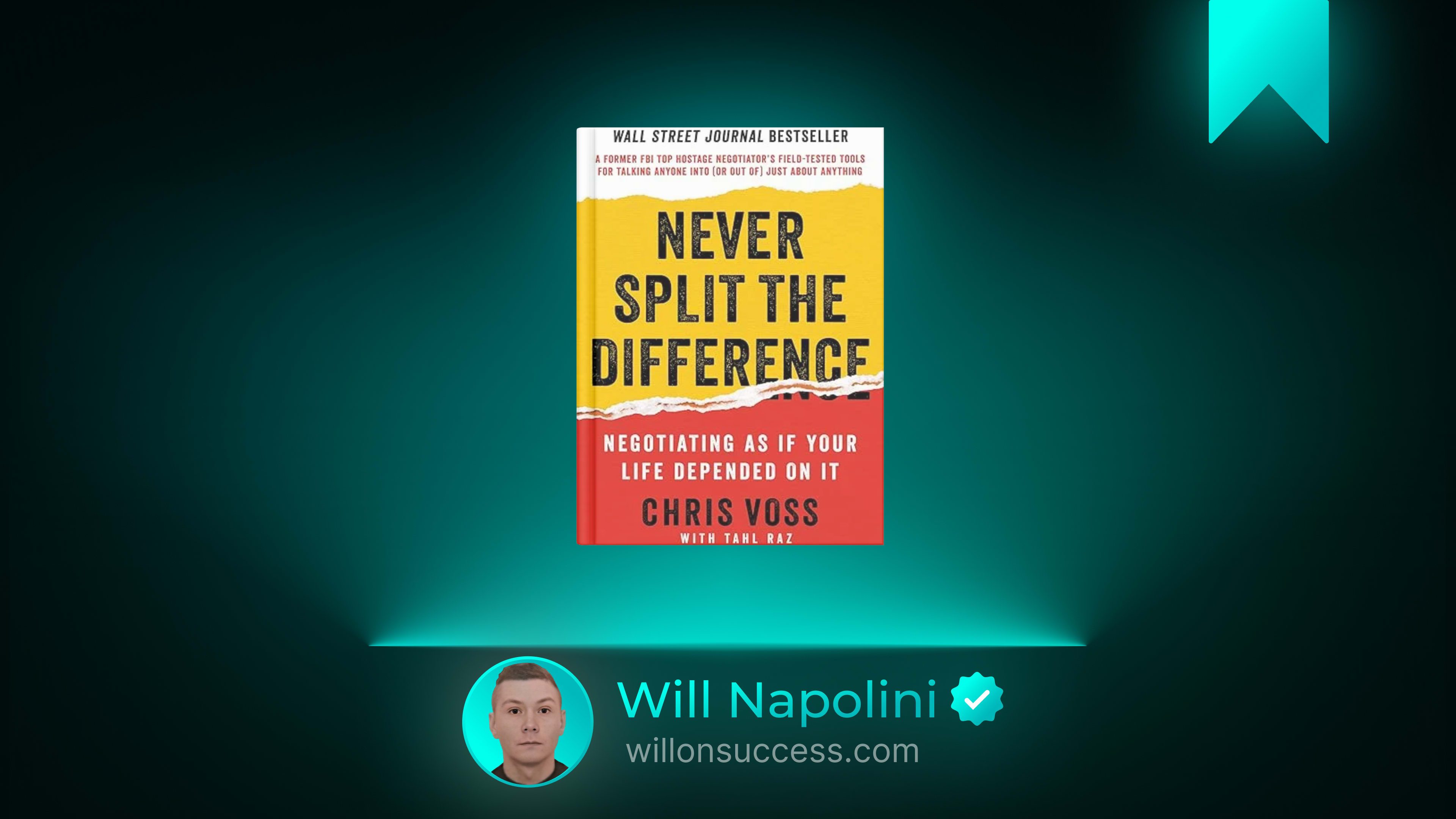
If I could sit across the table from you, I would ask you a simple question: When was the last time you walked away from a difficult conversation feeling truly heard, rather than just defeated or exhausted?
We are often taught that negotiation is a battle of wills. We are told to anchor high, hold our ground, and never show weakness. We treat every disagreement like a tug-of-war, believing that if we just pull hard enough, the other side will finally let go of the rope.
But what if the reason you keep hitting a wall in your conversations has less to do with your logic and more to do with the emotions you are ignoring?
In Never Split the Difference, former FBI hostage negotiator Chris Voss dismantles the myth of the purely rational negotiator. He shows us that true influence does not come from overpowering someone. It comes from understanding them so deeply that they willingly help you solve your problem.
I am not here to teach you how to manipulate people. Manipulation is a short-term hack that destroys long-term trust. My goal is to help you extract the practical, deeply human wisdom from Voss’s experience and apply it to your work, your relationships, and your daily routines.
Let us look at what it truly means to negotiate as if your life depends on it, and why that mindset will actually make your life much more peaceful.

The Big Idea: The Illusion of Compromise
The central thesis of this book is both counterintuitive and profoundly liberating: Negotiation is not about winning an argument; it is a process of collaborative discovery.
The title itself is a warning. Voss uses the analogy of shoe color. If you and your counterpart decide to “split the difference” on what shoes to wear, you both end up with one black shoe and one brown shoe. You both look ridiculous. Compromise is often just a lazy way to avoid the hard work of finng a solution that actually satisfies both parties’ underlying needs.
Instead of compromising, Voss teaches us to seek a “That’s Right” moment—a breakthrough of genuine understanding that disarms defensiveness and opens the door to creative solutions. This requires shifting your focus from what you want to say, to what the other person needs to feel.
You do not defeat resistance by pushing harder against it. You dissolve it by inviting the other person to help you navigate the constraints.
The Story: Shifting the Burden
To understand how this works in practice, consider a high-stakes scenario Voss faced early in his career. He was negotiating with a bank robber who had taken hostages and was demanding a getaway car.
The traditional negotiation playbook would dictate that Voss firmly say “No,” explain why giving a criminal a car is a bad idea, and offer a lesser alternative. That approach usually leads to escalation.
Instead, Voss used a calibrated question. He leaned into the microphone and asked, “How am I supposed to do that?”
He did not yell it. He did not say it with sarcasm. He said it with genuine, calm curiosity.
This simple question shifted the entire dynamic. It forced the hostage-taker to step into Voss’s shoes and confront the reality of the situation. The robber could no longer just make demands; he now had to solve the problem of how the FBI could possibly meet his demand without violating their own rules and getting him caught. The burden of the solution shifted from the negotiator to the person making the unreasonable demand.
This is the mechanism of the book in action. When you stop fighting the current and start asking the other person to help you steer the boat, the resistance evaporates.
The Major Principles
To bring this into your own life, we must break down the book into its most useful, actionable ideas.
The Illusion of Rationality
We like to believe that people make decisions based on cold, hard facts. Voss, drawing on decades of behavioral psychology and field experience, proves otherwise. Humans are emotional creatures who use logic to justify the decisions their emotions have already made.
If you try to argue someone out of their feelings, you will only make them dig in deeper. You cannot reason with a flooded nervous system. You must calm the waters before you can navigate the ship. The first step in any meaningful conversation is to acknowledge the emotional reality of the room.
Tactical Empathy and the “That’s Right” Breakthrough
Empathy, in this context, is not about agreeing with someone. It is about demonstrating that you understand their perspective so completely that they feel safe. Voss calls this “tactical empathy.”
The ultimate goal of tactical empathy is to hear the other person say, “That’s right.”
Notice the distinction between “That’s right” and “You’re right.” When someone says “You’re right,” they are often just trying to get you to shut up. It is a dismissal. “That’s right,” however, is a moment of profound recognition. It means you have accurately summarized their worldview, their fears, and their desires. When you hear “That’s right,” the defensive walls come down, and real problem-solving can begin.
The Gentle Art of Mirroring and Labeling
How do you reach that “That’s right” moment? You use two simple, highly effective tools.
Mirroring is the practice of repeating the last one to three words of what someone just said, phrased as a question. If a colleague says, “I’m just overwhelmed by the timeline on this project,” you respond, “The timeline?”
This does three things: it shows you are listening, it encourages them to elaborate, and it buys you time to think. It is an invitation for them to reveal more, without you having to interrogate them.
Labeling involves identifying and vocalizing the other person’s emotions. You use phrases like, “It seems like you’re frustrated by the lack of clarity,” or “It sounds like you’re worried about the budget.”
Crucially, you must avoid the word “I” (“I think you’re frustrated”). The focus must remain entirely on them. When you accurately label a negative emotion, you diminish its power. When you label a positive emotion, you reinforce it.
Calibrated Questions: “How Am I Supposed to Do That?”
When you face an unreasonable demand or a rigid boundary, do not say “No.” Instead, ask a calibrated question.
Calibrated questions are open-ended inquiries that typically begin with “What” or “How.” They are designed to stop the other person in their tracks and invite them to collaborate on a solution.
- Instead of: “We can’t lower the price.”
Try: “How am I supposed to accept that price given our current budget constraints?”
- Instead of: “You’re being unfair.”
- Try: “What about this arrangement feels fair to you?”
These questions are not attacks. They are gentle probes that force the other party to look at the problem from your perspective. You are handing them the puzzle and asking them to help you put the pieces together.
Hunting for Black Swans
In negotiation, a “Black Swan” is an unknown unknown. It is a hidden piece of information that, if discovered, would completely change the outcome of the discussion.
Voss recounts negotiations where the entire dynamic shifted because he uncovered a seemingly minor detail—like a kidnapper’s desire to look good in the eyes of his community, or a business client’s hidden fear of looking incompetent to their board.
You cannot find Black Swans by talking. You find them by listening deeply, asking calibrated questions, and paying attention to the subtle shifts in tone and body language. The answers you need are almost always hiding in the room; you just have to create enough safety for them to be spoken aloud.
Why It Matters to You
You might be thinking, “I am not negotiating with bank robbers. I am just trying to get a raise, or get my toddler to eat vegetables, or resolve a disagreement with my partner.”
That is exactly why this matters. The stakes may be different, but the human psychology is identical.
- In your career: When asking for a promotion, do not just list your achievements. Use labeling to acknowledge your manager’s pressures (“It seems like the department is under a lot of scrutiny right now”), and then use calibrated questions (“How can I take on more responsibility to help alleviate that pressure while growing my role?”).
- In your relationships: When a disagreement escalates, stop defending your position. Mirror your partner’s core concern. “So, it sounds like you feel unsupported when I work late.” Watch how quickly the tension dissipates when they feel truly heard.
- In your daily routines: When you catch yourself feeling resistant to a task, label your own emotion. “It seems like I am avoiding this because I am afraid I won’t do it perfectly.” Acknowledging the fear often strips it of its control over you.
This framework helps you avoid the trap of ego-driven conflict. It shifts your goal from “winning the argument” to “solving the problem together.”
Practical Application: Turning Concepts into Behavior
Understanding these ideas is valuable, but understanding without action changes nothing. Here is how you can translate Voss’s philosophy into observable behavior starting this week.
1. The Three-Second Mirror In your next three conversations, consciously practice mirroring. When the other person finishes a sentence, pause for three seconds, then repeat the last two or three words with an upward, inquisitive inflection. Do not add your own opinion. Just mirror. Observe how much more they share with you.
2. The Accusation Audit Before you make a request or deliver difficult news, preemptively label the negative thoughts the other person might have about you. “You’re probably going to think I’m being unreasonable, and you might feel like I’m not respecting your time.” By voicing their fears first, you disarm them. You take the poison out of the room before it can spread.
3. The “How” Question Challenge For one week, ban the word “No” from your vocabulary in professional or high-stakes personal conversations. When you cannot agree to a request, replace “No” with a calibrated question: “How am I supposed to do that given my current commitments?” Let the other person help you define the boundary.
4. The Evening Summary At the end of a significant discussion, summarize the other person’s position back to them. Start with, “Let me make sure I understand…” and lay out their perspective as fairly and accurately as possible. Do not move forward with your own agenda until they say, “That’s right.”
Who Should Read This Book
Never Split the Difference is an essential manual for a specific type of reader.
You will benefit most from this book if:
- You frequently find yourself in conflicts where logic fails to move the needle.
- You want to improve your communication skills in leadership, sales, parenting, or relationships.
- You are tired of superficial “win-win” platitudes and want a realistic, psychologically grounded framework for handling difficult people.
- You are willing to check your ego at the door and prioritize understanding over being understood.
You may find this book less useful if:
- You are looking for manipulative “tricks” to force people into giving you what you want. (Voss explicitly warns that faking empathy is easily detected and destroys trust).
- You believe that every interaction is a zero-sum game where someone must lose for you to win.
- You are unwilling to do the emotional labor of truly listening to someone you disagree with.
This book is worth reading because it treats communication as a learnable craft, not an innate talent. It gives you a flashlight for the dark, emotional corners of human interaction.
One Small Step
We have covered a lot of ground, from the illusion of rationality to the power of calibrated questions. But all of this remains abstract until you test it in the real world.
Here is your one small step for today. It requires no preparation, no special authority, and no risk.
The next time someone expresses frustration, complaint, or resistance to you, do not offer a solution. Do not defend yourself. Do not tell them to calm down.
Instead, take a breath, soften your voice, and offer a simple label:
“It sounds like you’re really frustrated by this.”
Then, stop talking. Give them the space to respond.
You will be amazed at what happens when you stop trying to fix the problem, and simply start honoring the person. True influence does not begin when you speak your truth. It begins the moment you make the other person feel safe enough to reveal theirs.