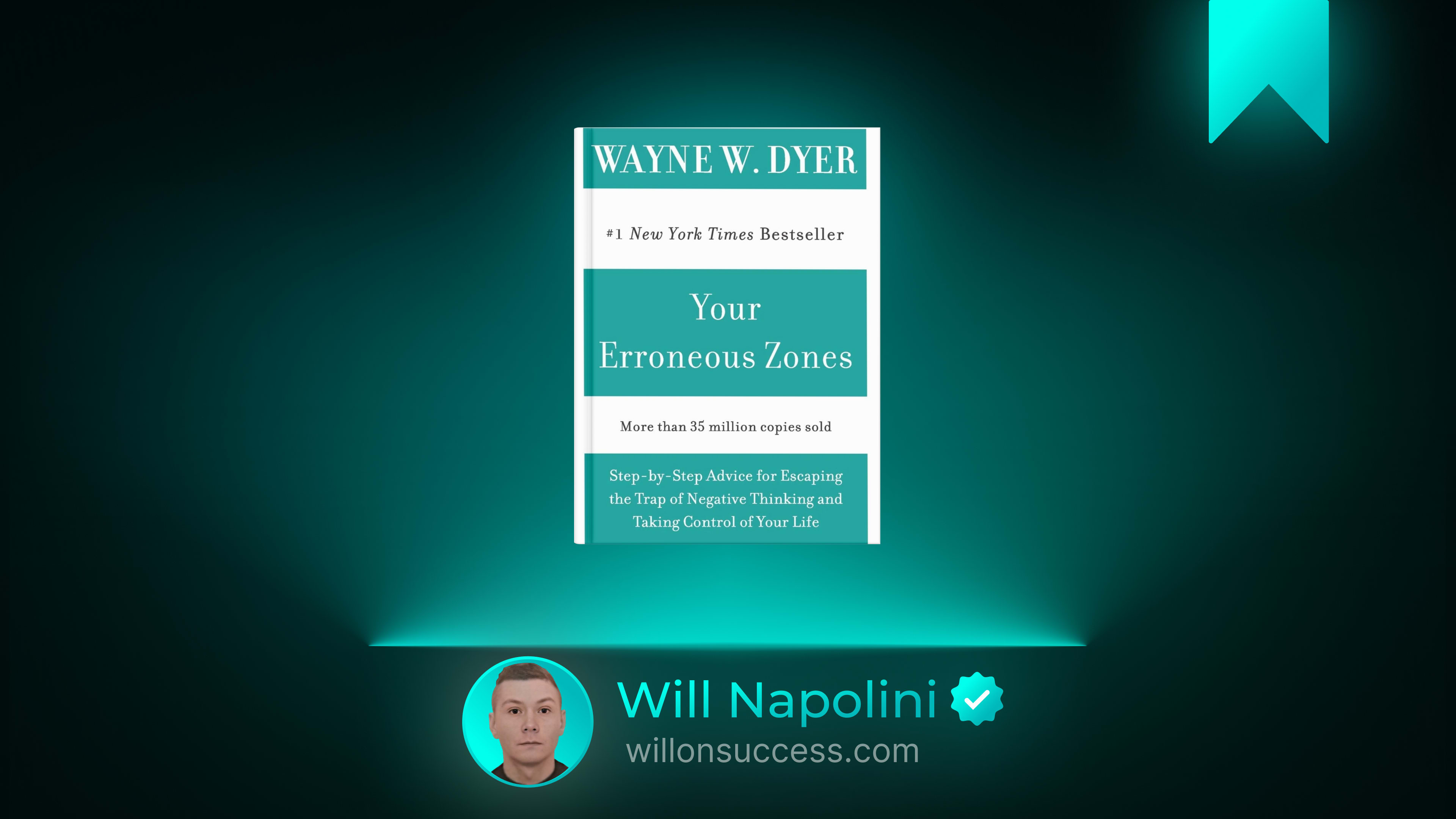
Your Erroneous Zones by Wayne Dyer: How to Take Back the Wheel of Your Own Mind
Think about the last time you were genuinely angry. Maybe someone cut you off in traffic, or a colleague took credit for your work, or a family member made a thoughtless comment at dinner.
In the moment, the story you told yourself was incredibly clear: They made me feel this way. Their action was the cause. Your anger was the unavoidable effect. You were the victim of their behavior, and your emotional reaction was simply the natural consequence of what they did.
Now, imagine someone sitting across from you, looking you in the eye, and saying with absolute calm: No one can make you feel anything without your permission. You are doing this to yourself.
If that sounds offensive, or at least deeply counterintuitive, you are exactly where you need to be. That quiet, radical provocation is the beating heart of Wayne Dyer’s 1976 classic, Your Erroneous Zones.
Dyer was not interested in offering temporary relief or gentle coping mechanisms. He was interested in a complete overhaul of how you understand your own mind. He argued that the vast majority of our suffering does not come from the events of our lives, but from the “erroneous zones”—the mental blind spots where we surrender our agency, blame the outside world for our internal weather, and trap ourselves in cycles of guilt, worry, and the need for approval.
I have spent years watching highly intelligent, deeply capable people remain stuck in lives they resent, entirely because they believe their emotions are happening to them rather than being generated by them. If you have ever felt held hostage by your own reactions, this book is the key to the cell. The door is not locked. It never was. You just have to realize you are the one holding it shut.
The Big Idea: You Are Not Your Emotions. You Are the One Watching Them.
Here is the central thesis of Dyer’s work, stripped of all psychological jargon: You are responsible for what you feel, because you are responsible for what you think.
We are culturally conditioned to use language that strips us of our power. We say, “You make me so mad.” We say, “That news depressed me.” We say, “He broke my heart.” This language assumes that emotions are external forces, like rain or gravity, that strike us from the outside.
Dyer dismantles this illusion by introducing a simple, unbreakable equation: Event + Thought = Emotion.
An event happens. Someone forgets to call you. The event itself is neutral. It is just a fact of the universe, like a rock sitting on the ground. But then, your mind interprets the event. You think, They don’t respect my time. I am not important to them. That thought generates the emotion of anger or sadness.
If, instead, your thought was, They must be incredibly overwhelmed at work today, the exact same event generates the emotion of empathy or concern.
The event did not change. The other person did not change. The only variable that altered your emotional reality was the thought you chose to entertain.
This is not about suppressing your feelings or pretending that bad things do not hurt. It is about recognizing the gap between the stimulus and your response. In that gap lives your freedom. When you realize that your emotions are the downstream result of your own internal dialogue, you stop trying to control the world to feel better, and you start taking responsibility for the only thing you can actually control: your own mind.
The Two Great Thieves: Guilt and Worry
If you want to understand why you feel stuck, Dyer suggests you look at how you spend your mental energy. He identifies guilt and worry as the two most useless, immobilizing emotions in the human repertoire.
They are the thieves of the present moment, and they operate by pulling you out of the only place where life actually happens: right now.
Guilt: The Toll You Pay for a Road You Are No Longer Traveling
Guilt is an emotion directed entirely at the past. It is the belief that you should have done something differently, and that by punishing yourself now, you somehow balance the cosmic scales.
But Dyer points out a harsh truth: guilt changes absolutely nothing. It does not rewrite history. It does not heal the person you hurt. It does not make you a better person today. It simply paralyzes you in the present with the ghosts of yesterday.
Much of our guilt, Dyer argues, is not even our own. It is inherited. It is the internalized voice of parents, teachers, and cultural norms telling us what we “should” feel bad about. We carry guilt for wanting more money, for setting boundaries, for resting, or for disappointing someone else’s expectations.
The work is not to become remorseless. Remorse is healthy; it says, I made a mistake, I will learn from it, and I will act differently next time. Guilt is a trap; it says, I am bad, and I must suffer for it. You must learn to look at your guilt and ask: Is this feeling helping me grow, or is it just keeping me small?
Worry: The Tax You Pay on a Future That Hasn’t Arrived
If guilt anchors you to the past, worry anchors you to a future that does not yet exist.
We treat worry as if it were a form of problem-solving. We tell ourselves that if we just think about the worst-case scenario enough times, we will somehow be prepared for it. We mistake the physical anxiety of worry for the productive action of preparation.
But worry is a rocking chair. It gives your mind something to do, but it does not move you an inch forward.
Dyer asks the reader to look at their track record. How many of the things you worried about five years ago actually happened the way you feared? And for the ones that did, did your worrying actually help you handle them? The answer is almost always no. Worry does not empty tomorrow of its sorrow; it empties today of its strength.
When you catch yourself worrying, the antidote is not to force yourself to relax. The antidote is to bring your attention violently back to the present moment and ask: What is the actual problem in front of me right now, and what is one small action I can take to address it?
The Tyranny of “Should” and the Courage to Disappoint
One of the most liberating chapters in the book deals with the need for approval and the tyranny of the word “should.”
From the time you are very small, you are trained to seek the nod of approval from authority figures. You learn that being “good” means doing what others want, and being “bad” means disappointing them. As adults, we carry this programming into our careers, our marriages, and our friendships. We make decisions based on what our parents would think, what the neighbors would say, or what society dictates we “should” do by a certain age.
Dyer argues that the need for approval is an erroneous zone because it places your self-worth in the hands of other people. If you require someone else’s validation to feel okay, you are essentially handing them the remote control to your emotional life.
Breaking free from this requires developing a very specific, highly uncomfortable skill: the courage to disappoint people.
You cannot live an authentic life without occasionally disappointing someone. If you choose the career you love, you may disappoint the parent who wanted you to take over the family business. If you set a boundary with a toxic friend, you will disappoint them. If you choose to rest instead of hustling, you will disappoint the culture that demands your constant productivity.
Dyer’s message is not to become cruel or selfish. It is to realize that someone else’s disappointment is not an indictment of your character. It is simply the friction that occurs when your authenticity bumps up against their expectations. You can love someone deeply and still refuse to shrink yourself to make them comfortable.
What This Looks Like on an Ordinary Tuesday
Ideas like “emotional responsibility” sound profound in a book, but they are forged in the mundane, irritating moments of daily life.
Let’s say it is Tuesday afternoon. You are busy, and your manager sends you a terse, one-line email: We need to talk about this report later.
In the old pattern—the erroneous zone—your stomach drops. Your mind races. They hated it. I’m going to be fired. I knew I shouldn’t have taken that shortcut. You spend the next three hours in a state of low-grade panic. When you finally meet, you are defensive, exhausted, and irritable. You blame the manager for ruining your afternoon.
In the new pattern, the email arrives. You feel the initial spike of anxiety—that is just biology, the nervous system doing its job. But then you pause. You observe your thought: I am telling myself a story that I am in trouble.
You recognize that the email is just text on a screen. You choose to generate a different thought: They are probably just rushed and want to give me quick feedback. I won’t know until we speak. You return to your work. Your afternoon is intact.
You did not suppress your fear. You simply refused to let an unverified thought hijack your nervous system. You stayed in the driver’s seat. This is what mastery looks like. It is not the absence of triggers. It is the shortening of the recovery time.
Who Should Read This Book
If you frequently feel victimized by your circumstances, if you spend a lot of time explaining why you are unhappy by pointing to what other people have done to you, this book will be a profound shock to your system. It is the ultimate manual for developing an internal locus of control. It is highly recommended for anyone who feels stuck in cycles of people-pleasing, chronic worrying, or lingering, unproductive guilt.
However, I want to offer a necessary caveat. Dyer’s approach is fiercely individualistic. It places the entirety of emotional responsibility on the shoulders of the individual. If you are dealing with acute trauma, systemic oppression, or a genuinely abusive environment, the directive to simply “change your thoughts” can feel dismissive of very real, external harm.
This book is a masterpiece of cognitive self-management, but it is not a substitute for trauma therapy, nor does it address the very real need for systemic change in the world. Read it to master your internal world, but do not use it to gaslight yourself into tolerating external situations that are genuinely unsafe or unjust.
One Small Step
Here is what I want you to do today to begin reclaiming your agency.
I want you to go on a “Blame Fast” for the next twenty-four hours.
During this time, you are not allowed to use any language that attributes your emotional state to an external source. You cannot say, “You made me mad.” You cannot say, “The traffic frustrated me.” You cannot say, “The news depressed me.”
Every time you feel a strong emotion, you must rephrase it using this exact formula: I am feeling [emotion] because I am telling myself [thought] about [event].
- “I am feeling angry because I am telling myself that my partner’s lateness means they don’t respect me.”
- “I am feeling anxious because I am telling myself that this presentation will define my entire career.”
You do not have to fix the thought. You do not have to change the outcome. You just have to take ownership of the mechanism.
When you stop blaming the world for your feelings, you stop waiting for the world to change before you can be at peace. You realize that the power to alter your internal state has been in your hands the entire time.
You are not a leaf blown by the wind of other people’s behavior. You are the tree. The leaves may shake when the storm comes, but the roots hold.
The erroneous zones are simply the places where you forgot you had roots. Step out of the illusion. Take back the wheel. The road ahead belongs to you.