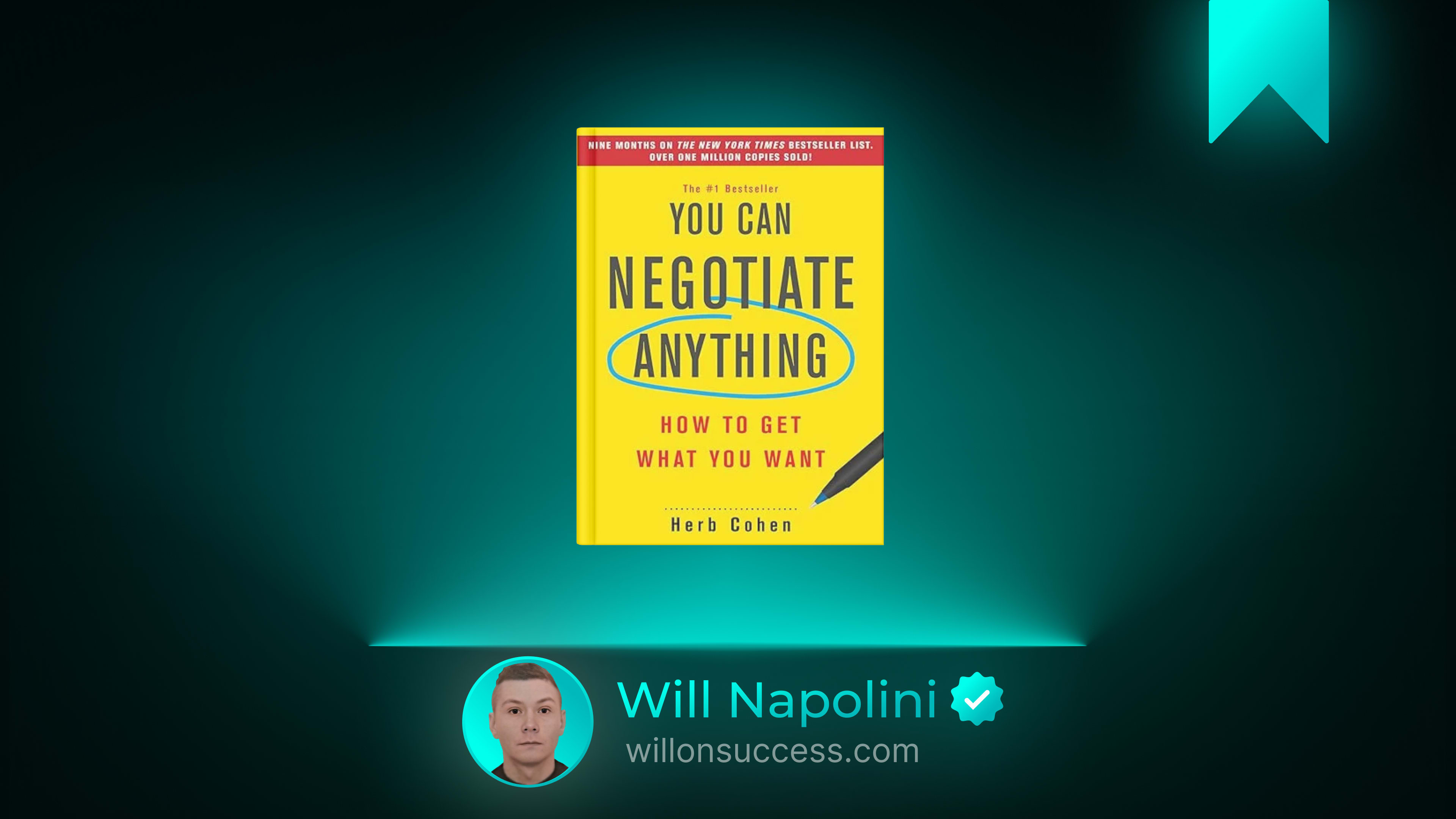
You Can Negotiate Anything by Herb Cohen: How to Stop Giving Your Power Away at the Table
There is a specific kind of quiet regret that has nothing to do with failure. It is the feeling you get in the car on the way home, or lying in bed at night, when you realize you just agreed to something you did not actually want to do.
You said yes to the extra project because you could not find the words to say no. You accepted the first salary offer because asking for more felt greedy. You paid the full price, accepted the unfavorable terms, or let the boundary slide, all to avoid a few seconds of awkward friction. You walked away with the deal, but you left your power in the room.
If that feeling is familiar to you, I want to introduce you to a perspective that can change the trajectory of your career, your finances, and your daily life.
Herb Cohen spent decades as one of the most sought-after negotiators in the world. He advised presidents, navigated hostage crises, and closed massive corporate deals. But in his classic book, You Can Negotiate Anything, he does not write for the elite dealmaker. He writes for the rest of us. He writes for the person who feels a tightness in their chest when the word “negotiation” comes up.
Cohen’s central message is not about becoming a ruthless shark. It is about waking up to a fundamental reality that most of us walk past every day: almost everything in your life is negotiable, and the power you think the other person holds is almost entirely an illusion.
I have seen brilliant, capable people give away millions of dollars in lifetime earnings, accept unbearable working conditions, and settle for lives that are slightly too small for them, simply because they did not understand the mechanics of the table. They thought negotiation was a personality trait. They thought it required aggression, charm, or a willingness to lie.
It requires none of those things. It requires observation, patience, and the willingness to sit in the silence.
The Big Idea: Power Is Not What You Have. It Is What They Think You Have.
If you take only one concept from Cohen’s work, let it be this: power in a negotiation is not a physical object. It is not the size of your bank account, your job title, or your physical stature.
Power is a perception.
Cohen breaks this down into a brilliantly simple formula. Your power at the table is determined by three things: what you think of yourself, what the other person thinks of you, and what you think the other person thinks of you.
Think about how often you walk into a room—a bank, a dealership, a manager’s office—and immediately hand over your power before a single word is spoken. You see the mahogany desk. You see the uniform. You see the title. And your subconscious mind whispers, They are in charge. I am lucky to be here.
Because you believe they have the power, you act accordingly. You concede early. You justify your requests. You apologize for taking up their time. And because you act that way, they begin to believe they have the power, too. The illusion becomes real.
Cohen flips this dynamic on its head. He points out that the person across the table is often just as anxious, just as constrained by their own bosses, and just as desperate to close the deal as you are. The salesperson needs their commission. The manager needs to fill the role. The contractor needs the job to pay their crew.
When you realize that they need you just as much as you need them, the geometry of the table changes. You stop asking for permission. You start making proposals. You do not lose power when the other person says no. You lose power when you decide their no is final.
The Person Who Cares the Least Holds the Most Leverage
This is perhaps the most counterintuitive and liberating principle in the book. We are taught to believe that passion wins. We think that if we want something badly enough, if we show how much it means to us, the other person will be moved to give it to us.
In negotiation, the opposite is almost always true. The person who cares the least about the outcome holds the most leverage.
I am not talking about apathy. I am talking about emotional detachment from the result. If you walk into a car dealership absolutely convinced that you must drive home in that specific car today, the salesperson can sense it. They can smell the urgency on you. And they will hold firm on the price, because they know you have no alternative.
But if you walk in genuinely prepared to walk out—if you are perfectly fine with keeping your current car for another year, or going to the dealership across town—your posture changes. Your voice changes. You are willing to ask the hard questions because you are not afraid of the answer.
Cohen calls this the power of “walk away.” It is the ultimate trump card. You cannot be manipulated, pressured, or rushed if you are entirely willing to leave the table.
This is why doing your internal work before a negotiation is just as important as doing your research. You have to find the place inside yourself where you can say, I want this, but I do not need this to survive. When you detach your self-worth from the outcome, you become incredibly dangerous to anyone trying to take advantage of you.
Information Is the Currency. Silence Is the Vault.
When most people get nervous at a table, they talk. They fill the silence. They explain their reasoning, they reveal their budget, they offer concessions before they have even been asked. They think they are being cooperative, but they are actually handing over their ammunition.
Cohen is adamant: information is the most valuable currency in any negotiation, and the side that gathers the most information usually wins.
How do you get information? By asking questions. And more importantly, by shutting up after you ask them.
There is a profound power in silence. When you ask a question—“Is that the best you can do?” or “How did you arrive at that number?”—and then close your mouth, you create a vacuum. Human beings are deeply uncomfortable with conversational vacuums. The other person will almost always speak to fill it. And in filling it, they will often reveal the very information you need: their deadline, their flexibility, or their underlying motivation.
I have watched people negotiate against themselves simply because they could not tolerate three seconds of silence. They make an offer. The other person pauses. The negotiator gets anxious and says, “But I could probably go a little lower.”
Learn to love the pause. Let the silence do the heavy lifting. You do not need to justify your position. State it clearly, and then let the quiet hang in the air.
Time Is the Pressure You Apply to Yourself
We live under the tyranny of the deadline. The end of the month. The close of business on Friday. The lease expiring at midnight.
Cohen points out a truth that will save you an immense amount of stress: most deadlines are entirely arbitrary. They are fabricated to create urgency. They are designed to make you panic and sign the paper without reading the fine print.
When you understand this, time shifts from being your enemy to being your tool.
Think about the classic car dealership scenario. You have been there for six hours. It is 8:30 PM. You are exhausted. You just want to go home. The salesperson knows this. They know that your resistance drops with every passing minute. They are using time to wear you down.
But what if you realize that the salesperson wants to go home, too? What if you realize that the “end of the month” quota is just a number on a spreadsheet that will reset in forty-eight hours?
When you refuse to be rushed, you reclaim the leverage. You say, “I understand you need an answer today, but I don’t make decisions this late. I’ll sleep on it and call you tomorrow.” Suddenly, the pressure shifts. They have to decide if they are willing to risk losing the deal over a few more hours.
Patience is not just a virtue in negotiation. It is a weapon. The person who is in a hurry pays the premium. The person who can wait dictates the terms.
The Toolkit: Tactics That Actually Work
Cohen provides a toolkit of specific, observable tactics. I want to be clear: you learn these tactics not to become a manipulator, but so you can recognize when someone is trying to use them on you. And, when used with integrity, they are simply effective ways to protect your own boundaries.
Here are three of the most practical tools from the book.
The Flinch
When the other person makes their first offer, you must visibly react. A sharp intake of breath. A widening of the eyes. A slight physical leaning back.
Why? Because the first offer is almost always a test. They are throwing a number at the wall to see if it sticks. If you accept it calmly, or even if you just nod and say, “Let me think about it,” they instantly know they asked for too little (or offered too much). The flinch signals, without words, We are not even in the same ballpark. It immediately lowers their expectations and forces them to justify their position.
The Higher Authority
Never, if you can avoid it, be the final decision-maker.
Even if you are buying a house for yourself, or negotiating your own salary, you need a “higher authority.” It can be your spouse, your financial advisor, your business partner, or even a personal rule you have set.
When the other person pushes you for a final yes or no, you say, “This looks good, but I need to run it by my partner before I can commit.”
This does two things. First, it buys you time. Second, it removes you as the obstacle. You become the ally trying to help them get the deal approved by the “boss.” It takes the personal friction out of the rejection and forces them to give you a better offer to take back to your higher authority.
The Nibble
This is Cohen’s most famous tactic, and it requires a bit of nerve.
The nibble happens at the very end of the negotiation. The major terms are agreed upon. The contracts are being drawn up. The psychological tension has dropped. Everyone is smiling, feeling good about the deal.
Right at that moment, you ask for one small, reasonable extra. “Oh, and you’ll include the floor mats, right?” or “Since we’re doing this today, you can waive the delivery fee, correct?”
Because the other person has already mentally closed the deal, because they are experiencing the relief of the finish line, they will almost always say yes to the nibble just to keep the peace. It is a highly effective way to capture the final 5% of value that most people leave on the table out of sheer politeness.
Why This Matters in Real Life
It is easy to think of negotiation as something that only happens in boardrooms or at car dealerships. But if you look closely, you are negotiating every single day.
You are negotiating with your children about bedtime. You are negotiating with your partner about where to spend the holidays. You are negotiating with your boss about your workload. You are negotiating with yourself about whether to get out of bed and go to the gym.
Every time you fail to negotiate, you are letting someone else—or your own unexamined fears—design your life.
When you learn to ask for what you need, you are not being difficult. You are being an adult. You are signaling to the world that your time, your energy, and your contributions have value. And remarkably, the world usually agrees. People respect those who respect themselves.
I have seen relationships improve dramatically when one partner finally learns to negotiate boundaries instead of quietly resenting the other. I have seen careers accelerate the moment a professional stops waiting to be “discovered” and starts negotiating for the resources they need to do their job well.
Negotiation is not about defeating the other person. It is about discovering what is actually possible when you refuse to accept the first draft of reality.
Who Should Read This Book
If you are someone who avoids conflict at all costs, who feels physically ill at the thought of asking for a discount, or who assumes that “no” is a permanent wall rather than a temporary hurdle, this book is essential medicine. Cohen’s straightforward, street-smart style will demystify the process and give you the armor you need to step into the arena.
It is also highly recommended for anyone entering the business world, freelancing, or starting a company. The tactical advice on pricing, contracts, and leverage is timeless and immediately applicable.
However, I want to be honest about its limitations. The book was written in the 1980s, and some of the examples and cultural references feel dated. More importantly, Cohen’s approach is highly tactical and leverage-based. If you are looking for a deeply empathetic, emotionally resonant approach to conflict resolution—something focused on healing relationships and finding profound mutual understanding—you might find his style a bit transactional. (For that, you would look to books like Chris Voss’s Never Split the Difference or the classic Getting to Yes).
Cohen teaches you how to play the game and win it. He does not spend much time asking if it’s the right game to play. You will need to supply your own moral compass.
One Small Step
Here is what I want you to do this week to break the seal.
I want you to practice the “Pause and Nibble” on something entirely trivial, where the stakes are so low that your fear cannot possibly be justified.
Go to a coffee shop, a local market, or call a service provider. When they tell you the final price or the final terms, I want you to look at them, pause for two full seconds, and ask one simple question:
“Is that the best price you can do for me today?”
And then, and this is the most critical part, close your mouth. Do not smile. Do not apologize. Do not say, “It’s okay if not.” Just wait in the silence.
Ninety percent of the time, they will either give you a discount, throw in something extra, or explain exactly why they can’t. Ten percent of the time, they will say no. And you will realize that the world did not end. The sky did not fall. You simply asked a question.
You have spent a lifetime assuming that the first offer is the final offer. It is time to test that assumption.
The table is not a place where you go to be judged. It is a place where you go to discover what is possible. The person sitting across from you is just a person. The power in the room belongs to whoever is willing to ask the next question.
Pull up your chair. Take a breath. And begin.