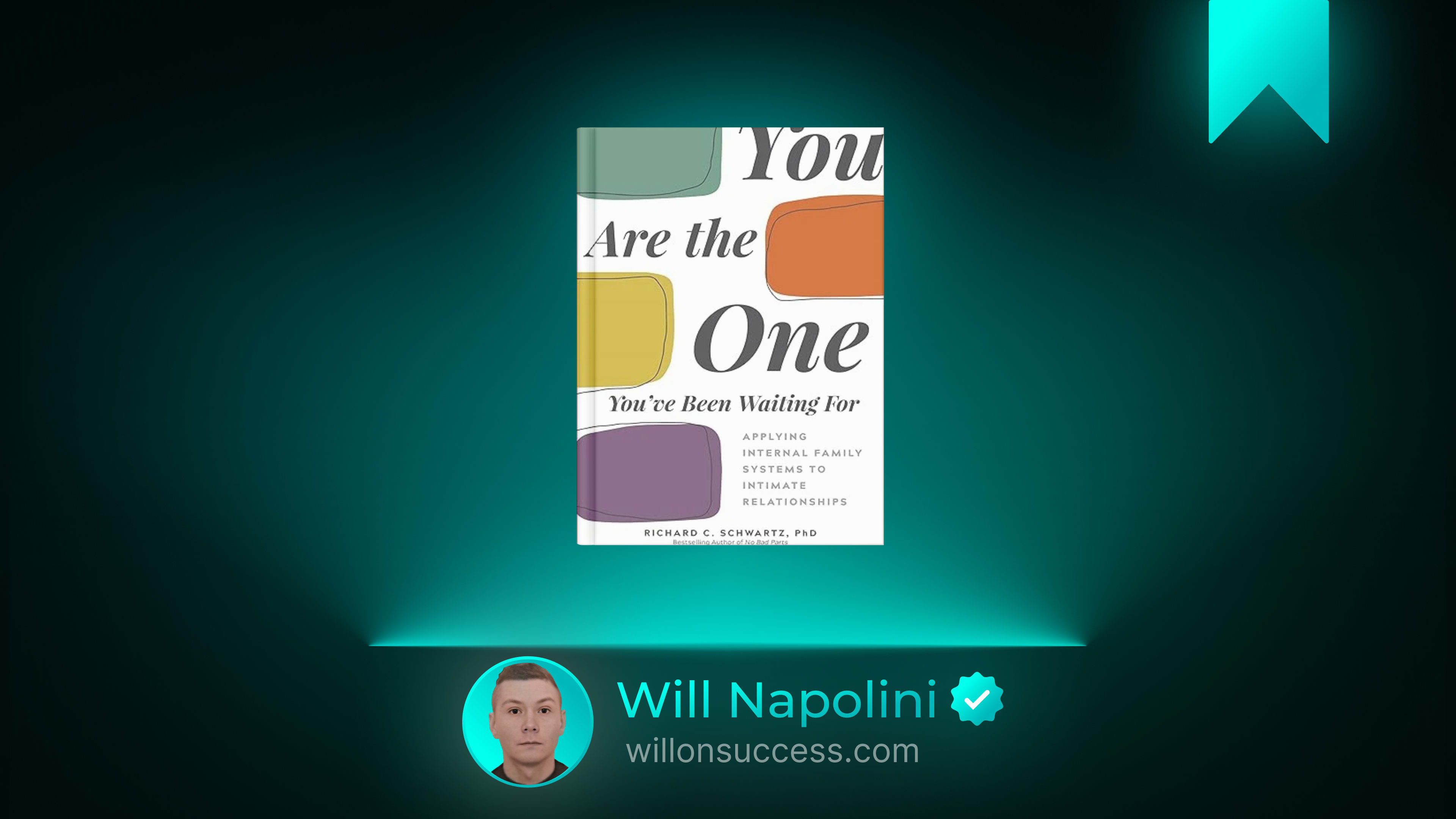
You Are the One You've Been Waiting For by Richard C. Schwartz: Why Healing Yourself Is the Real Love Story
Think about the last time someone you loved said something that made you react far more strongly than the moment warranted. A small comment. A tone of voice. A look across the kitchen table. And suddenly you were not a grown adult in a kitchen. You were eight years old, or fourteen, or twenty-two, standing in some older wound, feeling the exact same helplessness you felt back then. And the person you love most in the world became, for a few burning minutes, the person who was hurting you again.
Then the moment passed. You felt embarrassed. You apologized, or they did. Life resumed. But something in you wondered, quietly, Why does that still have power over me? Why can’t I just be steady?
Richard C. Schwartz has spent decades answering that question. As the founder of Internal Family Systems therapy, he developed a model of the human mind that is, in my view, one of the most compassionate and useful frameworks ever offered to ordinary people trying to understand themselves. And in You Are the One You’ve Been Waiting For, he turns that framework toward the place where our wounds are most visible, most tender, and most consequential: our intimate relationships.
The book’s title is not a greeting-card sentiment. It is a diagnosis. Schwartz is telling you that the completion you have been seeking in another person—the safety, the validation, the feeling of finally being seen and chosen—cannot be permanently delivered by a partner. Not because your partner does not love you. But because the longing you bring into the relationship was formed long before they arrived. And no external person can reach back into your childhood and give you what you needed then.
Only you can do that. And the way you do it is by turning toward the wounded parts of yourself with the same compassion you would offer a frightened child. That turning is the real love story. Everything else follows from it.
The Big Idea: Your Mind Is a Family, and Your Partner Is Meeting All of Them
Here is the foundation of Schwartz’s model, stated as simply as I can.
You are not a single, unified voice inside your head. You are a family of parts. This is not pathology. This is how human minds work. You have parts that plan and protect. Parts that react quickly when they sense danger. Parts that carry old pain you have not yet faced. And underneath all of them, there is a core Self—a quality of awareness in you that is calm, curious, compassionate, and clear.
Schwartz identifies three broad categories of parts. The first he calls managers. These are the parts that try to keep you safe by controlling your environment, your image, your performance. They are the inner critic that says, You should have said something smarter. They are the perfectionist who will not let you rest. They learned their job early: if they keep everything orderly, no one will get hurt.
The second category he calls firefighters. These parts activate when pain breaks through the managers’ defenses. They are impulsive, urgent, sometimes destructive. They are the part that reaches for the drink, the scroll, the affair, the rage, the shutdown—anything to douse the fire of feeling that has suddenly become unbearable. They are not trying to harm you. They are trying to save you from a pain they believe will destroy you.
The third category is the most vulnerable: the exiles. These are the parts that carry the original wounds. The child who was ignored. The teenager who was humiliated. The young adult who was abandoned. They hold the grief, the shame, the terror, the belief that something is fundamentally wrong with them. The managers and firefighters exist, largely, to keep you from having to feel what the exiles feel.
And then there is the Self. Schwartz describes it not as another part but as the space underneath all the parts. It is characterized by what he calls the eight C’s: curiosity, compassion, calm, clarity, courage, confidence, creativity, and connectedness. You do not need to build the Self. It is already there. It has been there the whole time, buried under layers of protection. The work is not construction. It is excavation.
Now bring your partner into this picture. When your partner says something that triggers you, it is rarely your Self that responds. It is a protector. A manager who needs to be right. A firefighter who needs to escape. And underneath the reaction, an exile is crying out, asking for the very thing your partner cannot give: the experience of being loved exactly as you are, the way you needed to be loved when you were small and no one came.
Schwartz calls this the central tragedy of intimate relationships. We choose our partners, in part, because they feel like the people who might finally heal our oldest wounds. And then we spend years resenting them for not doing it.
You Cannot Be Loved Fully Until You Can Sit With Your Own Pain
One of the hardest truths in this book is also one of the most liberating: your partner cannot heal you. Not because they are selfish or incapable. Because the wound is not theirs to reach.
Schwartz describes a pattern he observed repeatedly in couples. One partner carries an exile that holds a core belief—I am not enough. I will be abandoned. I am a burden. The other partner, without knowing it, steps into the role of the person who is supposed to disprove that belief. They become the parent who finally shows up. The witness who finally sees. The source of the reassurance that was missing.
For a while, this works. The early intensity of new love provides a flood of validation. You feel chosen. You feel held. You feel, for the first time, that the old story might be wrong.
But the need is bottomless, because it was formed in a child who needed consistent love over years, not a single partner offering reassurance on a Tuesday evening after a long workday. The exile asks for more than any adult relationship can sustainably provide. And eventually, the partner buckles. They pull back. They get tired. They have their own exiles asking for attention. And the moment they cannot meet the need, the old wound reopens with its full original force.
This is not a failure of love. It is a misplacement of responsibility. The healing your exile needs cannot come from outside. It must come from the one person who can actually reach the wounded child within you. And that person is you.
Schwartz is not saying you should not need your partner. Interdependence is healthy. Connection is essential. But there is a difference between bringing your whole, mostly-tended-to inner life into a partnership and bringing an untreated wound and asking another person to perform surgery on it every night after dinner.
Blending: The Moment You Lose Yourself in the Reaction
One of the most practically useful concepts in the book is what Schwartz calls blending. Blending is the state in which a part takes over your awareness so completely that you become it. You are no longer a person noticing anger. You are the anger. You are no longer observing the defensive voice. You are speaking from it, through it, as it.
In blended states, your partner is not your partner. They are the threat. They are the person who wronged you, who does not understand, who is doing it on purpose. Your field of vision narrows. Your options collapse to fight or flee. You say things you will regret. Or you go silent in a way that communicates punishment rather than peace.
Schwartz’s insight is that blending is not a character flaw. It is a protective mechanism that was once necessary. The part that hijacks you in an argument learned to do so in a context where you were genuinely powerless. It is still running the old program. It has not been updated.
The work, then, is not to eliminate the reactive part. It is to create a small space between you and it. To notice the blending happening. To say, internally, I see you. I know you are trying to protect me. But I am the adult now. Let me handle this. And then, from that slightly widened space, to respond rather than react.
This is not easy. In the heat of a fight with the person you love most, it is extraordinarily hard to pause, breathe, and locate the part that has grabbed the wheel. But Schwartz insists it is possible, and that every time you do it—even imperfectly, even after you have already said the sharp thing—you weaken the old pattern by one small degree.
The Shift from Parts-Love to Self-Love
Schwartz draws a distinction that I find deeply important. He describes two modes of loving.
The first is what you might call parts-love. This is love filtered through need. I love you because you make me feel safe. I love you because you validate me. I love you because without you I would have to face the parts of myself I cannot bear. Parts-love is conditional, even when it does not realize it. It is transactional underneath the romance. It says, I will love you as long as you continue to meet the need my exile carries. And the moment the need goes unmet, the love turns to resentment, withdrawal, or rage.
The second mode is what Schwartz calls Self-love. This is love that arises from the calm, curious, compassionate center within you. It does not need the other person to perform a function. It can tolerate their bad days, their distance, their imperfect humanity, because its security does not depend on their constant reassurance. Self-love can say, I see you. I am curious about your experience. I can hold space for your pain without needing you to fix mine.
The movement from parts-love to Self-love is not a switch you flip. It is a long, slow reorientation. It happens as you do the internal work—meeting your own exiles, thanking your protectors, unburdening the old beliefs. As you take responsibility for your own healing, the desperate edge comes off your need for your partner. You can love them more freely because you are not secretly asking them to save your life.
And here is what Schwartz observes: when both people in a relationship are doing this work, even imperfectly, the relationship itself transforms. It stops being a negotiation between two sets of unmet needs. It becomes a meeting between two people who are mostly whole, choosing each other not out of desperation but out of genuine delight.
What This Looks Like on a Thursday Evening When You Are Tired
Let me ground this, because IFS can sound abstract if it stays in the language of parts and Self and exiles.
It is Thursday. You and your partner are both tired. The day was long. Something small happens—a dish left in the sink, a comment that lands wrong, a plan that was changed without asking. And you feel the heat rise. The old familiar tightening. The voice that says, You never consider me. You always do this. I am invisible here.
In the old pattern, you would speak from that voice. You would say something sharp. Or you would go cold. You would retreat into silence that is not peace but punishment. And your partner, triggered by your withdrawal, would activate their own protector. And the evening would become a small war between two parts, neither of which is actually the person you are underneath.
In the new pattern—the one you are building slowly, with patience—you feel the heat rise and you pause. Not a dramatic pause. Just a breath. And you notice: Something in me is activated. This is not just about the dish. This is the part that felt unseen as a child. This is the exile that believes it does not matter.
You do not have to solve this in the moment. You do not have to perform a therapy session at the kitchen counter. But you can say, instead of the sharp thing: “I need a minute. I’m triggered, and it’s not really about the dish.” And your partner, if they are doing their own work, can say, “Okay. I’ll be here when you’re ready.”
And in that minute—in the bathroom, in the hallway, in the quiet of your own chest—you turn toward the part that is hurting. You say to it, gently, I see you. I know you’ve been waiting a long time to be seen. I’m here now. You don’t have to scream to get my attention.
It is small. It is unglamorous. No one writes songs about it. But repeated over months and years, this small turning changes the architecture of your inner life. And it changes what you bring into your relationship. You bring less desperation. More presence. Less blame. More curiosity. You bring yourself, rather than your wound.
Who Should Read This Book
If you are in a relationship and you find yourself cycling through the same fights, the same triggers, the same painful patterns you swore you would not repeat, this book will feel like someone turning on a light in a room you have been navigating in the dark. Schwartz gives you a language for what is happening beneath the surface, and that language alone can be a relief. You are not broken. You are a family of parts trying to protect each other, and the system can be understood.
If you are single and you notice that you keep choosing partners who confirm your worst beliefs about yourself, or who activate the same childhood wound in a new face, this book will help you see the pattern clearly enough to interrupt it.
If you are skeptical of therapy language or find the idea of “parts” too abstract, the book may ask some patience of you. Schwartz writes clearly, but the IFS framework is a specific model, and it takes a few chapters to feel natural. Give it that time.
If
title: “You Are the One You’ve Been Waiting For by Richard C. Schwartz: Why Healing Yourself Is the Real Love Story” description: >- Richard Schwartz, founder of Internal Family Systems therapy, applies his model of the mind to intimate relationships. This summary explores why we ask our partners to heal wounds they did not create, what it means to lead from your true Self, and how the relationship you have with your own inner parts shapes every love you will ever give or receive. date: 2026-08-17 00:00:00 +0800 categories: [book-summaries, personal-development] tags: [ internal-family-systems, relationships, self-love, richard-schwartz, emotional-healing, attachment, inner-work, intimacy ] image: “IMAGE_URL” alt: “Two weathered hands resting gently together on a wooden table, soft light falling across them” pin: false fallback: —
Think about the last time someone you loved said something that made you react far more strongly than the moment warranted. A small comment. A tone of voice. A look across the kitchen table. And suddenly you were not a grown adult in a kitchen. You were eight years old, or fourteen, or twenty-two, standing in some older wound, feeling the exact same helplessness you felt back then. And the person you love most in the world became, for a few burning minutes, the person who was hurting you again.
Then the moment passed. You felt embarrassed. You apologized, or they did. Life resumed. But something in you wondered, quietly, Why does that still have power over me? Why can’t I just be steady?
Richard C. Schwartz has spent decades answering that question. As the founder of Internal Family Systems therapy, he developed a model of the human mind that is, in my view, one of the most compassionate and useful frameworks ever offered to ordinary people trying to understand themselves. And in You Are the One You’ve Been Waiting For, he turns that framework toward the place where our wounds are most visible, most tender, and most consequential: our intimate relationships.
The book’s title is not a greeting-card sentiment. It is a diagnosis. Schwartz is telling you that the completion you have been seeking in another person—the safety, the validation, the feeling of finally being seen and chosen—cannot be permanently delivered by a partner. Not because your partner does not love you. But because the longing you bring into the relationship was formed long before they arrived. And no external person can reach back into your childhood and give you what you needed then.
Only you can do that. And the way you do it is by turning toward the wounded parts of yourself with the same compassion you would offer a frightened child. That turning is the real love story. Everything else follows from it.
The Big Idea: Your Mind Is a Family, and Your Partner Is Meeting All of Them
Here is the foundation of Schwartz’s model, stated as simply as I can.
You are not a single, unified voice inside your head. You are a family of parts. This is not pathology. This is how human minds work. You have parts that plan and protect. Parts that react quickly when they sense danger. Parts that carry old pain you have not yet faced. And underneath all of them, there is a core Self—a quality of awareness in you that is calm, curious, compassionate, and clear.
Schwartz identifies three broad categories of parts. The first he calls managers. These are the parts that try to keep you safe by controlling your environment, your image, your performance. They are the inner critic that says, You should have said something smarter. They are the perfectionist who will not let you rest. They learned their job early: if they keep everything orderly, no one will get hurt.
The second category he calls firefighters. These parts activate when pain breaks through the managers’ defenses. They are impulsive, urgent, sometimes destructive. They are the part that reaches for the drink, the scroll, the affair, the rage, the shutdown—anything to douse the fire of feeling that has suddenly become unbearable. They are not trying to harm you. They are trying to save you from a pain they believe will destroy you.
The third category is the most vulnerable: the exiles. These are the parts that carry the original wounds. The child who was ignored. The teenager who was humiliated. The young adult who was abandoned. They hold the grief, the shame, the terror, the belief that something is fundamentally wrong with them. The managers and firefighters exist, largely, to keep you from having to feel what the exiles feel.
And then there is the Self. Schwartz describes it not as another part but as the space underneath all the parts. It is characterized by what he calls the eight C’s: curiosity, compassion, calm, clarity, courage, confidence, creativity, and connectedness. You do not need to build the Self. It is already there. It has been there the whole time, buried under layers of protection. The work is not construction. It is excavation.
Now bring your partner into this picture. When your partner says something that triggers you, it is rarely your Self that responds. It is a protector. A manager who needs to be right. A firefighter who needs to escape. And underneath the reaction, an exile is crying out, asking for the very thing your partner cannot give: the experience of being loved exactly as you are, the way you needed to be loved when you were small and no one came.
Schwartz calls this the central tragedy of intimate relationships. We choose our partners, in part, because they feel like the people who might finally heal our oldest wounds. And the