The Name of the Rose: Why the Truth You Guard Most Fiercely Is the One You Fear Most
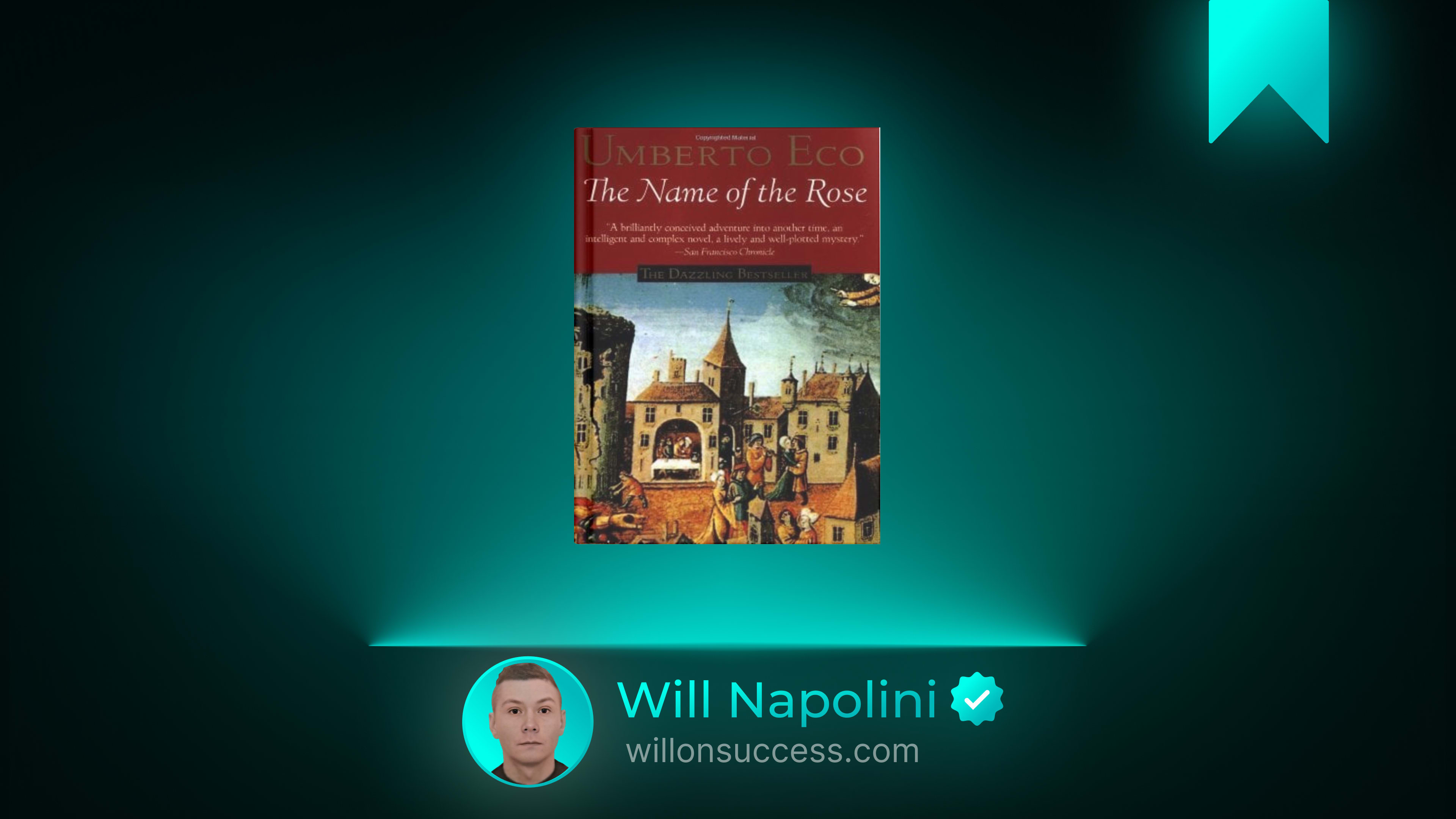
There is a particular kind of person who will burn a book to protect an idea. Not because the idea is weak, but because they have wrapped their entire identity around it, and the thought of someone reading it, questioning it, laughing at it, terrifies them more than fire.
I have met that person. Maybe you have too. Maybe, in some quiet corner of your own thinking, you have been that person.
Umberto Eco understood this fear so deeply that he built an entire cathedral of a novel around it. The Name of the Rose, published in 1980, is dressed as a medieval murder mystery. Seven monks die in seven days inside a remote Italian abbey. A brilliant Franciscan friar named William of Baskerville arrives to investigate, accompanied by his young novice, Adso of Melk, who narrates the whole story decades later as an old man looking back.
But the murders are the surface. What Eco is really investigating, across more than five hundred dense, luminous pages, is something far more unsettling: what happens when human beings decide they own the truth, and what they will do to keep it locked away.
If I could sit across the table from you and hand you one novel that would change the way you think about thinking itself, it would be this one.
A Monastery, a Library, and the Most Dangerous Book in the World
Let me set the scene, because the setting is not decoration. It is the argument.
The year is 1327. William and Adso arrive at a Benedictine abbey perched high in the mountains of northern Italy. They are there for a theological debate between the Franciscan order and representatives of the Pope, a dispute about whether Christ and his apostles owned property. It sounds dry. It is not. In Eco’s telling, this argument about poverty is really an argument about power, about who gets to define what is true and who must simply obey.
Then the monks start dying.
The first is found at the base of a cliff. The second is found in a vat of blood. Each death seems to echo a passage from the Book of Revelation, the apocalyptic trumpet blasts and plagues. The abbey is seized by terror. The monks believe the Devil is among them.
William does not believe in the Devil’s schedule. He believes in evidence, observation, the careful reading of signs. Where the other monks see supernatural punishment, he looks at mud on a shoe, a stain on a robe, the particular angle of a body. He reads the world the way a scholar reads a text: looking for meaning, but refusing to impose meaning that is not there.
And at the center of everything, hidden behind a locked door inside a labyrinthine library that no one is permitted to enter, is a book. One specific book. A book that a blind old monk named Jorge of Burgos has guarded for decades, and for which he is willing to kill.
The book, in Eco’s fiction, is the lost second volume of Aristotle’s Poetics, the one devoted to comedy and laughter.
Jorge does not want anyone to read it. Not because it is false. Because it is true. And its truth, he believes, would destroy everything.
The Man Who Guards the Door
I want you to sit with Jorge for a moment, because he is not a cartoon villain. He is something more recognizable and more troubling.
Jorge is old. He is blind. He has spent his entire life inside these walls, among these books. He was once the abbey’s most respected scholar. He knows the library the way a river knows its bed. And somewhere along the way, he decided that certain knowledge is too dangerous for human beings to possess. That some truths, if released, would unravel the moral order of the world. That laughter, specifically the kind of laughter Aristotle describes in that lost book, would erode the fear of God, and without that fear, there would be nothing left to hold civilization together.
So he poisons the pages. Anyone who turns them, who licks their fingers to separate the leaves, dies.
What strikes me every time I return to this novel is how reasonable Jorge sounds to himself. He does not think he is committing murder. He thinks he is protecting the faithful. He has built an entire theology of guardianship: truth is sacred, therefore it must be controlled. Knowledge is power, therefore it must be restricted. The ordinary monk, the ordinary person, cannot be trusted with ideas that might confuse or corrupt them.
You have heard this reasoning before. You have heard it in institutions, in families, in the quiet voice inside your own head that says, I had better not ask that question, because the answer might change everything, and I am not sure I can survive the change.
Eco wrote this novel as a semiotician, a scholar of signs and meaning. What he understood, and what he dramatizes with extraordinary skill, is that the impulse to control meaning is one of the oldest and most persistent human instincts. We do not merely want truth. We want to be the ones who decide what truth is, who gets to hear it, and when.
William’s Method: The Courage to Be Wrong
Against Jorge’s certainty, Eco places William’s curiosity. And this contrast is the beating heart of the book.
William is brilliant, but his brilliance is not what makes him effective. What makes him effective is his willingness to revise. He forms hypotheses. He tests them against evidence. And when the evidence contradicts his theory, he lets the theory go. He does not cling to his first interpretation because it is elegant or because he announced it publicly. He follows the signs wherever they lead, even when they lead him into embarrassment.
There is a passage in the novel, as I recall it, where Adso asks William whether he ever doubts his own reasoning. William’s answer, in essence, is that doubt is not the enemy of understanding. Doubt is the engine of it. The moment you stop doubting, you stop looking. And the moment you stop looking, you stop learning.
I think about this often. How many of us have built small libraries of certainty inside our minds? We have our beliefs, our frameworks, our explanations for why the world works the way it does. And we guard those shelves. We lock the doors. We decide that certain books, certain ideas, certain conversations are simply not to be opened, because opening them might force us to rearrange everything.
William walks through the world with his eyes open. Jorge walks through the world with the doors shut.
One of them solves the mystery. The other one burns with the library.
The Labyrinth Is Not the Enemy
The abbey’s library in the novel is a physical labyrinth. Rooms within rooms, staircases that double back, passages that lead nowhere, hidden chambers accessible only through specific sequences. It is a marvel of medieval architecture and a trap for anyone who enters without understanding its logic.
But Eco is not merely describing a building. The labyrinth is what knowledge looks like when you first encounter it. It is what any new field, any new skill, any new stage of life feels like when you step into it. Disorienting. Full of dead ends. Seemingly designed to make you feel lost.
William navigates the labyrinth not by memorizing every corridor but by understanding the pattern. He steps back. He looks for the structure beneath the confusion. He makes a map.
This is how I have learned to approach any problem that feels overwhelming. You do not need to see the entire maze. You need to find one reliable pattern, one thread you can follow, and then you follow it patiently, correcting course as you go. The labyrinth does not defeat you because it is too complex. It defeats you when you panic, when you start running in circles, when you decide the confusion means you are not smart enough or brave enough to be there.
You are smart enough. You are brave enough. You just need a thread.
What Laughter Has to Do with Your Life
I promised you this would be practical, and I mean to keep that promise. So let me talk about laughter.
Jorge’s great fear, in the novel, is that if people learn to laugh at sacred things, they will stop fearing them. And if they stop fearing them, they will start questioning them. And if they start questioning them, the entire structure of authority that Jorge has devoted his life to upholding will dissolve.
Think about what that means. Jorge is not afraid of laughter. He is afraid of what laughter makes possible: the freedom to see a powerful idea from a new angle, to notice its absurdity, to hold it up to the light and say, Wait. Is this actually true, or have I simply been told it is true for so long that I stopped checking?
This is not a trivial skill. This is, I believe, one of the most important intellectual and emotional capacities a person can develop. The ability to hold your own beliefs gently enough to examine them. The willingness to laugh at your own certainty. The courage to say, I might be wrong about this, and that possibility does not destroy me.
In your career, this looks like asking the question in the meeting that everyone else is thinking but no one will voice. In your relationships, it looks like admitting you overreacted, that your interpretation of what someone said was shaped more by your own insecurity than by their actual words. In your personal growth, it looks like picking up a book or listening to a perspective that challenges a belief you have held for twenty years, not because you are sure it will change your mind, but because you are willing to find out.
The person who cannot laugh at their own convictions has made those convictions into a prison. The person who can laugh, who can say, Well, I suppose I was being a little ridiculous there, has kept a door open.
The Fire at the End
I will not spoil every detail of the novel’s resolution, but I need to tell you how it ends, because the ending is where Eco’s deepest lesson lives.
The library burns.
The great labyrinth of books, the accumulated knowledge of centuries, the irreplaceable manuscripts, the hidden chambers, the locked doors. All of it goes up in flames. Adso, narrating as an old man, tells us that the ruins smoldered for days. The knowledge inside was lost. Not all of it. Some fragments survived. But the vast majority of it was gone, and no one could ever reconstruct what it had contained.
The first time I read that ending, I felt grief. A real, physical ache. All those books. All those voices. Gone.
The second time, I understood what Eco was saying. Knowledge is not a possession. It is not something you can lock in a room and keep safe forever. It is alive, or it is nothing. It exists in the act of reading, questioning, arguing, laughing, passing it from one mind to another. The moment you try to hoard it, to seal it away from the world for its own protection, you have already begun to destroy it. The fire merely finishes the job.
What survives is not the library. What survives is Adso, carrying the memory of what he saw and heard, writing it down decades later so that someone, someday, might read it and think differently.
You are, in your own life, both the library and the fire. You carry knowledge, experience, hard-won understanding. And you will lose some of it. Memories fade. Certainties crumble. The frameworks you built in your twenties do not always hold in your forties. The career you planned dissolves into something you did not expect. The person you were sure you would be at forty is not the person you become, and that is not failure. That is the fire clearing ground for something new.
What matters is not whether you preserved every volume. What matters is whether you read them while they were in your hands. Whether you let them change you. Whether you passed something along.
How This Applies on an Ordinary Thursday
Let me bring this down from the mountaintop, because wisdom that stays abstract is just decoration.
Here is what The Name of the Rose asks you to examine in your own life:
Where are you guarding a door? Is there a belief, a plan, a version of your own story that you have locked away from scrutiny? Not because it is true, but because opening it would be uncomfortable? You do not have to tear it down today. But you can acknowledge the lock. You can say, I am protecting this idea, and I should ask myself why.
Are you reading the signs, or imposing a pattern? William looks at evidence and lets it speak. The other monks look at evidence and force it to confirm what they already believe. When something goes wrong at work, in a relationship, in your health, do you investigate with genuine curiosity? Or do you reach for your preferred explanation because it is familiar? The next time you catch yourself saying, I know exactly why this happened, pause. Ask whether you know, or whether you have simply decided.
What would you do differently if you were allowed to be wrong? This is the question I would leave on a note card on your desk. Not What if I am wrong? as a source of anxiety. But If I discovered tomorrow that a belief I have held for years was mistaken, what would I do next? The answer to that question tells you how much freedom you have actually given yourself.
What are you not sharing because you are afraid it will be misunderstood, mocked, or lost? Adso writes his account because he cannot bear for the story to die with him. Whatever knowledge, experience, or truth you are carrying that feels too fragile or too strange to share with anyone, consider that its greatest danger is not mockery. Its greatest danger is silence.
Who Should Read This Book
I will be honest with you, because you deserve honesty more than you deserve enthusiasm.
The Name of the Rose is not an easy novel. Eco was a medievalist and a semiotician, and he writes like one. There are long passages of theological debate, Latin quotations, detailed descriptions of monastic architecture, and philosophical digressions that will test your patience if you are reading for plot alone. The first hundred pages, in particular, require you to slow down and let the world of the abbey assemble itself around you.
If you want a fast-paced thriller that happens to be set in a monastery, this will frustrate you. The mystery is genuinely compelling, but it is wrapped in layers of intellectual inquiry that Eco clearly loved as much as the plot.
But if you are a reader who enjoys being made to think, who finds pleasure in ideas as well as events, who has ever wondered about the relationship between knowledge and power, between faith and reason, between what we know and what we think we know, this novel will reward you richly. It is one of those rare books that works on every level simultaneously: as a mystery, as a historical novel, as a philosophical argument, and as a deeply human story about an old man remembering his youth.
It is especially valuable for anyone in a season of intellectual transition. If you are questioning assumptions you inherited, changing careers, rethinking your beliefs, or simply feeling that the map you have been using no longer matches the territory, William of Baskerville will feel like a friend.
One Small Step Before You Close This Page
Here is what I would ask you to do today. Not tomorrow. Today.
Choose one belief you hold about yourself, your work, or your future that you have never seriously questioned. Maybe it is the belief that you are not the kind of person who can learn a certain skill. Maybe it is the belief that a particular path is closed to you because of your age, your background, or a decision you made years ago. Maybe it is the belief that asking for help is weakness, or that changing your mind means you were foolish before.
Write that belief down. One sentence. Put it where you can see it.
Then ask yourself the question William would ask: What evidence do I actually have for this? And what evidence would I need to see before I would let it go?
You do not have to answer today. You do not have to solve it. You just have to open the door and look inside the room.
That is all. That is enough. That is where every honest inquiry begins.
Jorge locked the door and called it faith. William opened it and called it understanding. The library burned either way. The only question that ever mattered was whether anyone had read the books while they still could.
You still can. Go read yours.