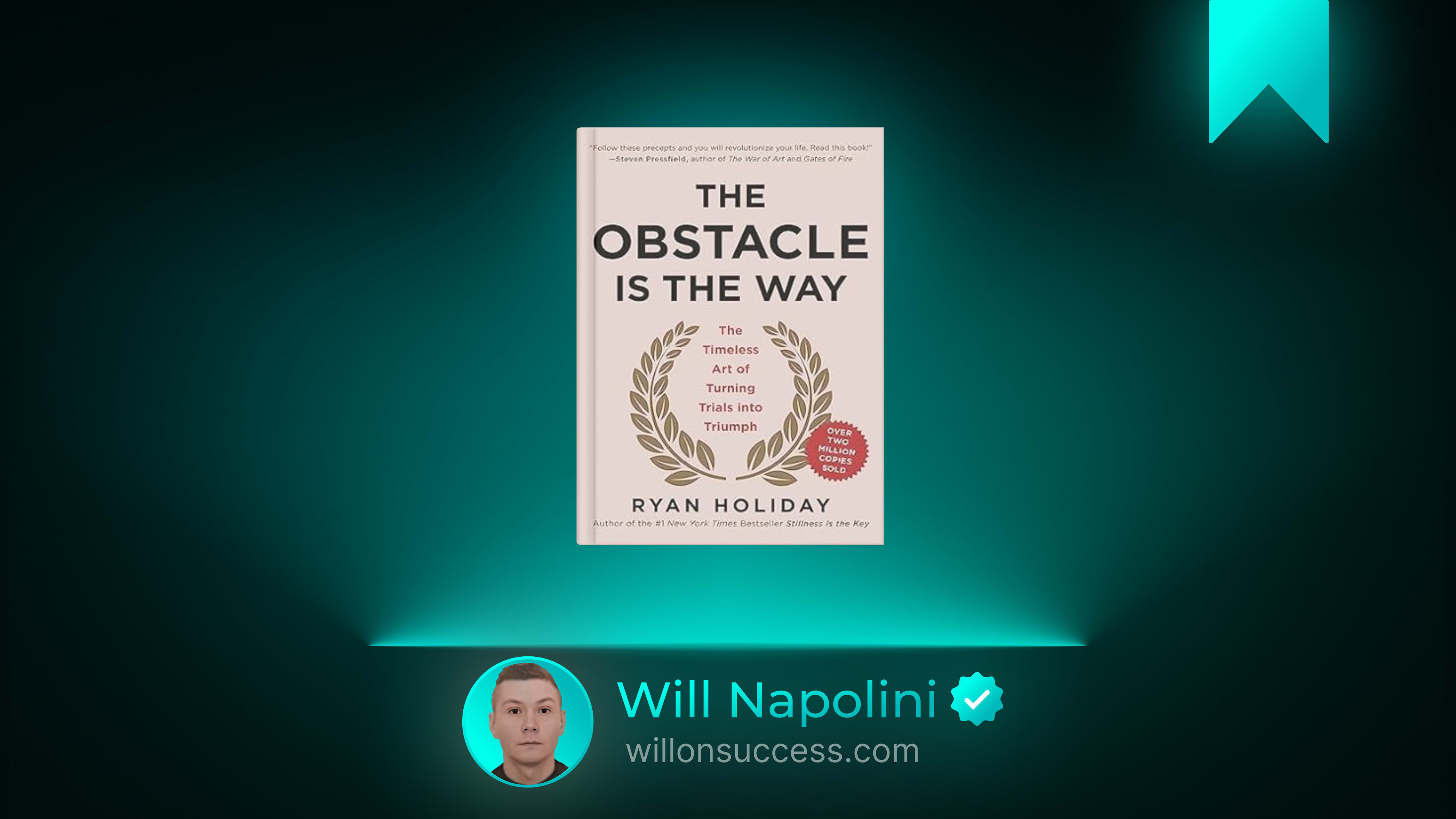
The Obstacle Is the Way: How the Thing Blocking You Is Actually the Path Forward
You hit the wall. Maybe it was the layoff you did not see coming. Maybe it was the project that collapsed after months of effort. Maybe it was the diagnosis, the breakup, the rejection email, the quiet Tuesday afternoon when you looked at your life and realized the plan you built has quietly stopped working.
And now you are standing in front of something solid and unmoving, and every instinct in you says: This is not supposed to be here. This is blocking the way.
I want to offer you a different reading of that moment. Not a cheerful one. Not a dismissive one. But one that, once you truly absorb it, changes the geometry of every difficulty you will face for the rest of your life.
What if the obstacle is not sitting in front of the path?
What if it is the path?
That is the central claim of Ryan Holiday’s The Obstacle Is the Way, and I have spent enough years stumbling through my own setbacks to tell you: it is not a platitude. It is a discipline. And like any discipline, it can be learned.
The Old Idea That Keeps Saving People
Holiday built this book around a single observation from Marcus Aurelius, the Roman emperor who ruled during plague, war, and political upheaval. Writing to himself in a private journal that was never meant to be published, Marcus noted that the impediment to action advances action. What stands in the way becomes the way.
Think about what he was actually saying. He was not celebrating suffering. He was not pretending that hardship is pleasant. He was describing a mechanism: the obstacle, once you stop wishing it were not there, becomes the very material you work with. The boulder in the road is not the end of the road. It is the next problem to solve, and solving it teaches you something the open road never could.
Holiday organizes this idea into three disciplines. Perception: how you choose to see the obstacle. Action: what you do about it, creatively and persistently. Will: how you endure what cannot be changed and find meaning inside it.
The structure is simple. The practice is not. But simplicity and ease have never been the same thing.
A Young Man Watching a Market Collapse
One of the stories Holiday tells that lodged itself in me involves John D. Rockefeller. In 1857, when Rockefeller was barely eighteen and working his first accounting job in Cleveland, the financial markets panicked. Banks failed. Fortunes evaporated overnight. Established men were ruined in a matter of weeks.
Most of the people around him saw catastrophe. Rockefeller, by Holiday’s account, watched something else. He watched the chaos closely, almost clinically. He noticed that panics created distortions. Assets became mispriced. Opportunities appeared that calm markets never reveal. Where others saw only destruction, he saw a strange and terrible kind of clarity.
Now, I am not telling you this so you can go become a nineteenth-century industrialist. That is not the point. The point is the shift in seeing. Rockefeller did not control the panic. He did not cause it. He could not stop it. But he controlled whether his mind would be governed by the panic or whether it would observe the panic, look for the structure inside the disorder, and act from that structure rather than from fear.
That shift is available to you. It is available the morning your biggest client cancels. It is available when the medical test comes back unclear. It is available when you realize the career you spent a decade building is shrinking beneath you.
You do not get to choose the event. You always get to choose the lens.
The Story You Tell About the Obstacle Matters More Than the Obstacle Itself
This is the discipline of perception, and it is where the book spends its first and, I think, most important section.
Holiday argues, drawing on Stoic philosophy, that events themselves carry no inherent verdict. A layoff is not automatically a catastrophe. A failure is not automatically a sentence. These things become catastrophes and sentences only when our interpretation makes them so.
You might be thinking: That sounds like denial. That sounds like pretending everything is fine.
It is not. There is a wide territory between “this is fine” and “this is the end of me.” The Stoic discipline of perception lives in that territory. It says: This is what happened. I will not add suffering to it by telling myself it means I am ruined, that it will never change, that I cannot bear it.
Your perception is the first domino. Get that one wrong, and every decision that follows is built on a crooked foundation. Get it even slightly right—this is hard, and hard things can be worked with—and you preserve your ability to think, to plan, to move.
I have seen this in my own life. The setbacks that broke me were rarely the setbacks themselves. They were the stories I layered on top of them. This proves I am not cut out for this. Everyone else manages fine. I will never recover. Those stories were the real weight. The event was heavy enough on its own. I did not need to add narration.
You do not need to pretend the obstacle is a gift. You only need to refuse the story that says it is a tombstone.
Move Before You Feel Ready, But Move With Direction
Perception clears the fog. Action is what you do once you can see again.
Holiday is careful here. He does not advocate frantic, undirected hustle. He is not saying just do something, anything, as long as you are moving. What he describes is closer to what a craftsman does when the wood grain turns out differently than expected. You do not throw the piece in the fire. You study the new grain. You adjust your cut. You work with what the material gives you.
The obstacles in your life will rarely respond to a single heroic charge. They respond to patient, creative, persistent effort. Holiday points to figures like Ulysses S. Grant, who was rejected, outmaneuvered, and doubted repeatedly during the Civil War, and who kept finding the next angle, the next adjustment, the next small action that kept momentum alive.
The principle underneath all of this is that action does not require permission from your feelings. You do not need to feel confident to begin. You do not need to feel inspired to take the next step. You need a direction and a willingness to be wrong, to adjust, and to take the step after that one.
A small decision becomes a direction, and a direction repeated long enough becomes a life. You are not waiting for the perfect plan. You are building the plan by moving through the problem one honest step at a time.
And here is something I wish someone had told me years ago: the obstacle often contains the skill you needed to learn anyway. The difficult boss teaches you a kind of patience and communication that a comfortable job never would. The failed business teaches you about money, timing, and your own blind spots in ways that a thriving one never forces you to learn. The obstacle is not just blocking your education. It is your education. You just have to be willing to attend the class.
Build an Inner Fortress That No Setback Can Breach
The third discipline is will, and it is the one most people skip because it feels passive. It is not.
Will, as Holiday describes it, is the practice of preparing your inner life so that external events do not have the power to destroy you. It is the difference between a tree with deep roots and one with shallow ones. The storm is the same for both. The difference is what happens underground.
The Stoics had a practice called premeditatio malorum—thinking in advance about what could go wrong. Not to become anxious. To become prepared. To look at your life and say: If I lost this, if that fell apart, if the worst plausible thing happened, could I still stand? Could I still think? Could I still act?
When you have already walked through the worst scenario in your mind, it loses a great deal of its power over you. You are no longer ambushed. You are no longer negotiating with fear in the middle of a crisis. You have already met it, considered it, and decided how you would respond.
Holiday also draws on the idea of amor fati—loving one’s fate. Not in a passive, resigned way. In the sense of saying: This is what happened. I will not waste energy wishing it were different. I will work with what is here.
You cannot always choose your circumstances. You can choose whether those circumstances get to define your inner life or whether your inner life remains your own regardless of what is happening outside.
That is not a small thing. In a world that hands you constant reasons to feel powerless, keeping your inner ground steady is one of the most quietly radical acts available to you.
What This Looks Like on an Ordinary Thursday
Let me bring this down from philosophy to the kitchen table, because that is where it has to live.
Suppose you have been passed over for a promotion you wanted. The old perception says: I am not good enough. This place does not value me. My career is stalled. The obstacle is now a verdict on your worth.
The discipline of perception asks you to separate the event from the story. You were passed over. That is the fact. Everything after that sentence is interpretation, and you get to choose which interpretation you build on. Maybe this is information. Maybe it reveals a skill gap, a relationship gap, a visibility gap. Maybe it reveals that this particular ladder is not the one you actually want to climb. The obstacle is now a diagnostic tool instead of a tombstone.
The discipline of action asks: what is the next useful step? Not a grand career overhaul. A conversation. A question. A skill to practice this week. One email to someone whose work you admire. One honest conversation with yourself about whether you want the title or whether you want the work.
The discipline of will asks: can you sit with the disappointment without letting it become your identity? Can you grieve the promotion you wanted without letting grief make your decisions for the next six months? Can you say, This stings, and I am still here, and I am still building something?
You do all three. Not perfectly. Not in a single afternoon. But you practice them, and over time they become less like strategies you apply and more like the way you see.
A Practice You Can Start Tonight
Holiday’s book is dense with historical examples and philosophical frameworks, and it would be easy to read it and feel inspired and then change nothing. So let me give you something specific.
Tonight, take one obstacle you are currently facing. It could be a problem at work, a strained relationship, a creative block, a financial pressure. Write it down in one sentence. No drama. Just the fact.
Then write three more lines beneath it.
First: What is the story I am telling myself about this? Not what happened. The narration you have built on top of it. Write it out and look at it. You may be surprised how much of your suffering lives in that second sentence, not the first.
Second: What is one small, concrete action I could take this week that moves me even slightly forward? Not the whole solution. One step. One phone call. One hour of focused work. One honest conversation.
Third: What might this obstacle be teaching me that I would not learn any other way? You do not have to love the answer. You just have to ask the question.
That exercise takes fifteen minutes. It will not solve the problem. But it will move you from being buried under the obstacle to standing beside it, looking at it, working with it. And that shift in position changes everything.
Who Should Pick This Book Up
If you are in a season of difficulty—if something has broken, stalled, or gone sideways—and you are tired of waiting for the storm to pass, this book will meet you where you are. It is especially useful if you tend to get stuck in the perception phase, replaying the injustice of a situation without moving toward action.
It will also serve you well if you are drawn to practical philosophy but find primary Stoic texts like the Meditations or the Discourses of Epictetus difficult to enter without a guide. Holiday translates those ideas into modern language and modern examples effectively.
A word of honesty: if you are in the middle of acute trauma, grief, or a mental-health crisis, this book’s emphasis on reframing and pushing forward may land too fast. Give yourself time. There is no moral requirement to find the silver lining before you have finished mourning. The Stoic framework is powerful, but it works best when you are ready to build, not when you are still bleeding. This is a book for the rebuilding phase, not the emergency room.
And if you prefer deeply researched academic philosophy over storytelling and historical anecdote, the book may feel a little light on sourcing. Its strength is accessibility and emotional resonance, not scholarly depth. Know what you are picking up.
One Small Step, Right Now
You do not need to overhaul your life tonight. You do not need to read three hundred pages before you can begin.
Here is what I would ask you to do. Just one thing.
The next time something goes wrong this week—and something will, because that is how weeks work—pause before you react. Three seconds. Five seconds. Long enough to feel the first hot wave of frustration or fear rise, crest, and begin to settle.
In that small pause, ask yourself one question: What does this obstacle need from me?
Not what you need from the obstacle. Not what you wish had happened instead. What does this particular problem, right now, require? Patience? A conversation? A plan? Rest? A single phone call?
Then do that one thing.
You start small. You stay steady. You let the obstacle teach you what it came to teach.
The wall in front of you is not the end of the road. It is the door. And doors, unlike walls, are meant to be opened.
Walk through.