The Good Life Handbook by Chuck Chakrapani: A Practical Map for Building a Life You Actually Want to Live
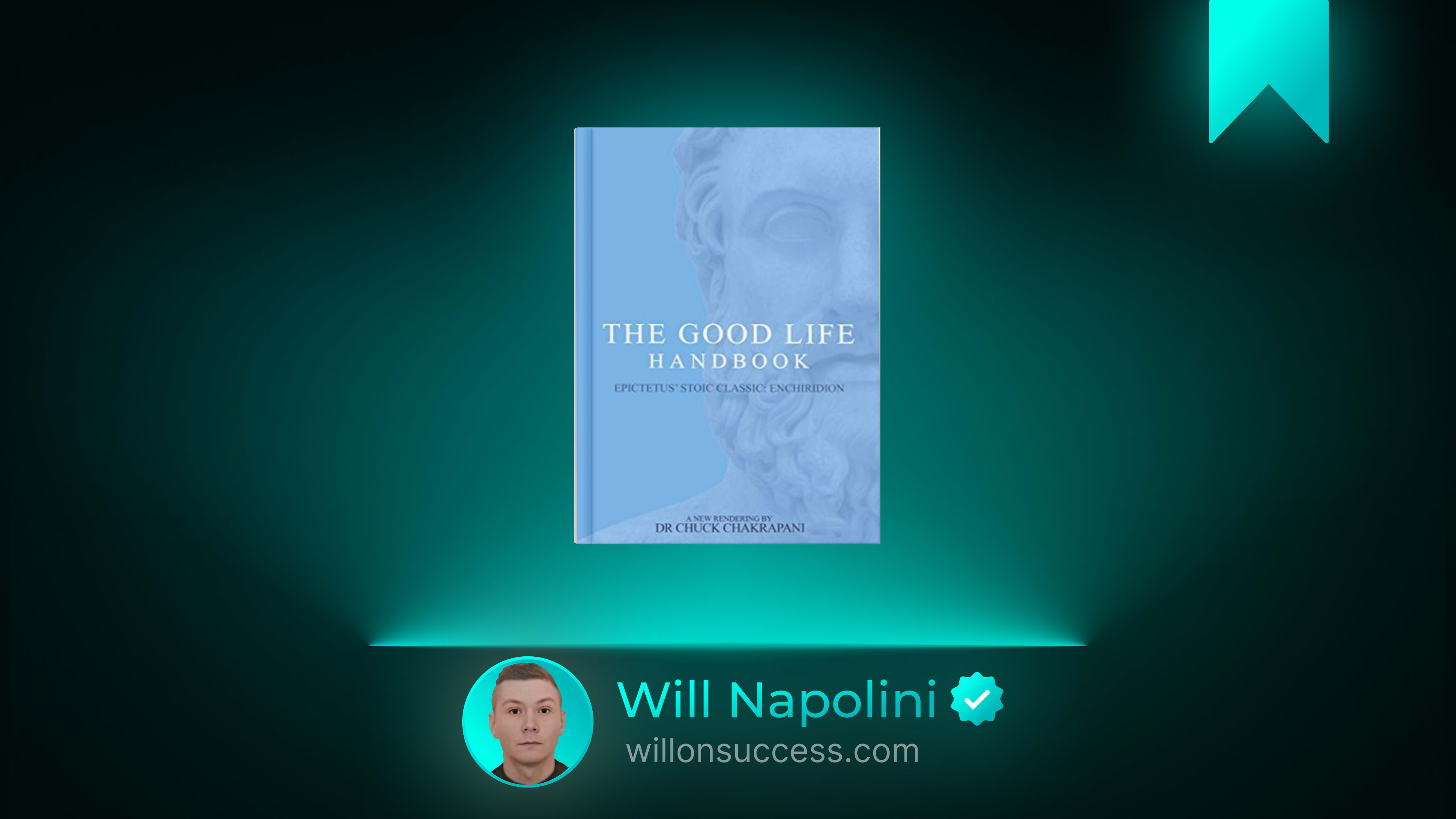
You have probably noticed something strange about the search for a good life. The more you chase it—the better job, the bigger house, the relationship that will finally make you feel complete—the further away it seems to drift. Like a horizon that recedes with every step forward.
And yet there are people who seem to have found it. Not people with perfect circumstances. Not people who won some cosmic lottery. Just people who wake up most mornings with a quiet steadiness, who handle difficulty without being destroyed by it, who seem to need less than you expected in order to feel genuinely content.
What do they know that you do not?
I think Chuck Chakrapani’s The Good Life Handbook answers that question, and it answers it in a way that is refreshingly free of mysticism, hustle culture, and vague affirmation. The answer is not complicated. But it is not easy either. And the distinction between those two words—complicated and easy—might be the most important thing you understand before you turn the first page.
The Big Idea: The Good Life Is a Daily Practice, Not a Future Destination
The central claim of this book is deceptively simple: the good life is not something you arrive at. It is something you practice.
Not tomorrow. Not after the promotion. Not once the kids are older or the debt is cleared or the anxiety finally quiets down. Today. In the small, unglamorous texture of an ordinary Tuesday.
Chakrapani draws heavily from Stoic philosophy—the tradition of Marcus Aurelius, Epictetus, Seneca—but he is not writing an academic treatise. He is writing a handbook. A field guide. The kind of book you keep on your nightstand and return to when life gets loud and you have forgotten what actually matters.
The premise is this: you already have access to the good life. It is not hidden behind a paywall or a credential or a geographic location. What stands between you and it is not a lack of resources. It is a set of unexamined habits, mistaken beliefs about what will make you happy, and a tendency to outsource your peace of mind to circumstances you cannot control.
The book’s work is to help you take that peace back. Not through force. Through clarity.
Philosophy Is Meant to Be Lived, Not Displayed
One thing I appreciate about Chakrapani’s approach is his insistence that philosophy without practice is decoration. You can read every Stoic text ever written, underline beautiful passages, share them on social media, and still live exactly as you did before. Nothing changes.
The ancient philosophers he draws from were not writing for libraries. They were writing for the marketplace, the battlefield, the sickbed, the courtroom. They were writing for people who had to make a decision by sundown and wanted to make it well. Their ideas were tools, not trophies.
This matters because it changes how you read. You do not read this book to feel informed. You read it to find one idea you can apply before lunch. One shift in perspective that changes how you handle the difficult email, the tense conversation, the temptation to scroll for two hours instead of doing the work that frightens you.
If I could sit across the table from you and hand you this book, I would say: do not read it all at once. Read a section. Close the book. Try it. See what happens. Come back tomorrow. That is how wisdom actually enters a life. Not in a flood. In drops, absorbed slowly.
The Discipline of Separating What Is Yours from What Is Not
If there is one principle that anchors the entire book, it is the distinction between what falls within your control and what does not.
This is not a new idea. Epictetus, a former slave who became one of history’s most influential teachers, built his entire philosophy on it. But Chakrapani makes it practical in a way that cuts through abstraction.
Here is what is yours: your effort, your attention, your honesty, your response to what happens, your decision about what to do next. Your character. Your choices in this moment.
Here is what is not yours: other people’s opinions, the economy, the weather, whether your application gets accepted, whether the person you love loves you back in the way you want, whether the project succeeds or fails despite your best work.
The suffering in most people’s lives—and I include myself in this—comes from gripping the second category as if it were the first. From tying your peace to outcomes you cannot guarantee. From building your self-worth on other people’s approval, market conditions, or the unpredictable machinery of the world.
And the freedom—the real, lived freedom—comes from releasing that grip. Not into passivity. Into focus. You pour your energy into what you can actually shape, and you meet what you cannot shape with something other than resistance. Acceptance, perhaps. Or simply the quiet acknowledgment that this, too, is part of the landscape, and you will walk through it.
This does not mean you stop caring. It means you stop letting caring destroy you. There is a difference, and learning to feel that difference in your body, in your daily decisions, is the work of a lifetime.
Virtue Is Not a Word for Sermons. It Is a Word for Tuesdays.
Chakrapani returns often to the four cardinal virtues of the Stoic tradition: wisdom, courage, justice, and temperance. And I know that in our modern vocabulary, “virtue” can sound stiff, moralistic, distant. Like something carved into a building you walk past without looking up.
But strip away the marble and the word becomes something remarkably practical.
Wisdom means seeing clearly. Not fooling yourself about what is happening, what you want, and what you are capable of changing.
Courage means acting despite fear. Not the absence of fear. The presence of it, and the decision to move forward anyway.
Justice means treating other people as real. Not as obstacles, not as audiences, not as instruments for your benefit. As people with their own struggles, dignity, and story.
Temperance means knowing when enough is enough. In food, in work, in ambition, in distraction. The discipline of not consuming more than you need simply because consumption feels like progress.
These are not abstract ideals. They are decisions you make dozens of times a day. The email you send with honesty instead of manipulation. The hard conversation you do not avoid. The second helping you skip. The colleague you treat with patience even though they frustrate you. The truth you tell yourself about where you actually are, rather than the more comfortable story you would prefer.
A small decision becomes a direction, and a direction repeated long enough becomes a character. And character, in the end, is the only thing that travels with you through every season of life.
Simplicity Is Not Poverty. It Is the Removal of Noise.
One of the quieter but more powerful threads in the book is the case for simplicity. Not asceticism. Not the romanticization of hardship. Just the honest observation that most of us carry far more than we need, and the weight of it makes us sluggish, anxious, and strangely joyless.
This applies to physical clutter, yes. But Chakrapani pushes further. He is talking about the clutter of obligations you accepted out of guilt. The commitments you made to people you do not actually care about impressing. The goals you inherited from a culture that equates more with better. The subscriptions, the habits, the relationships that drain you and that you keep maintaining because stopping feels like failure.
Simplicity, in this sense, is an act of courage. It requires you to say no. To disappoint people. To look like you are doing less. To sit with the discomfort of an empty evening and resist the urge to fill it with noise.
But what you gain on the other side is attention. And attention, I have come to believe, is the most valuable resource you possess. More valuable than money, because money without attention is just a number. More valuable than time, because time without attention is just duration.
Where your attention goes, your life goes. And a cluttered life scatters your attention into a hundred shallow streams instead of letting it deepen into a few meaningful rivers.
The Quiet Urgency of Remembering You Will Not Be Here Forever
The book does not shy away from death. And I am grateful for that, because I think most of us have made a quiet agreement to pretend it is not coming, and that pretense robs our days of their weight.
Chakrapani treats mortality not as a morbid fixation but as a clarifying lens. When you remember—truly remember, not as an intellectual fact but as a felt reality—that your time is finite, the trivial concerns lose their grip. The argument about who was right in 2019 becomes absurd. The need to impress strangers evaporates. The project you have been postponing for three years suddenly feels urgent.
This is not meant to induce anxiety. It is meant to induce presence. To help you notice that the person sitting across from you at dinner will not always be there. That the morning light coming through your kitchen window is not guaranteed. That the body carrying you through the world is doing you a kindness you will not always have.
You do not need to meditate on death for an hour. You need one honest moment, once a day, where you let the finitude of things touch you. Where you let it make you tender instead of numb.
That tenderness is not weakness. It is the doorway to actually living instead of merely managing.
Relationships as Practice, Not Performance
The book also speaks to how we treat other people, and here Chakrapani’s wisdom is gentle but firm. The good life is not built in isolation. It is built in the quality of your attention when someone is speaking. In the patience you extend when someone is slow, confused, or difficult. In the decision to assume good intent before assuming malice.
This does not mean becoming a doormat. Boundaries are part of justice—part of treating yourself as a person with dignity, too. But within the boundaries you set, you can still choose generosity. You can still choose to see the other person as struggling rather than attacking. You can still choose to respond rather than react.
I have found that most of the regrets people carry at the end of their lives are not about careers or bank accounts. They are about the harsh word they did not need to say. The visit they postponed. The forgiveness they withheld because pride felt safer than vulnerability.
You do not have to wait for the end to feel that weight. You can set it down today. In one conversation. One choice to be kinder than the moment strictly requires.
Who Should Read This Book
The Good Life Handbook is for you if you are tired of performance-based living. If you have achieved things and still feel a quiet hollowness underneath. If you want philosophical grounding without academic density. If you are looking for a book that meets you where you are—imperfect, busy, occasionally lost—and offers small, workable shifts rather than grand reinvention.
It is particularly well suited for people who are drawn to Stoic ideas but find the primary texts intimidating or repetitive. Chakrapani translates and organizes in a way that respects your time.
It may be less useful if you are looking for a step-by-step productivity system or a specific framework for career advancement. This book is about the interior architecture of a life. It will not optimize your calendar. It will change why you are filling it.
It is also worth noting that the book draws from a specific philosophical tradition. If you are looking for spiritual or religious guidance rooted in a particular faith, this may complement that search but will not replace it.
One Small Step
Here is what I would ask you to do before you go to sleep tonight.
Take two minutes. Sit somewhere quiet. And ask yourself one question: What is one thing I spent energy worrying about today that was not actually within my control?
Do not judge yourself for worrying. Just notice it. Name it. And then ask: What was within my control in that situation? Maybe it was your effort. Your tone. Your decision to ask for help. Your choice to walk away.
Write down one sentence. Just one. About what you can actually do tomorrow that belongs to you. Not to the outcome. Not to the other person. To you.
Then close the notebook. Set it aside. And let the evening be the evening.
That small act—naming what is yours, releasing what is not, and choosing one intentional step forward—is the entire philosophy of this book compressed into two minutes.
You do not need to overhaul your life tonight. You need one honest moment of clarity. And then tomorrow, another. And the day after, another.
The good life is not waiting for you at the end of a long, exhausting sprint. It is hiding in the next small choice you make with your eyes open.
It has been there all along. You just needed to slow down enough to see it.
And now you can.