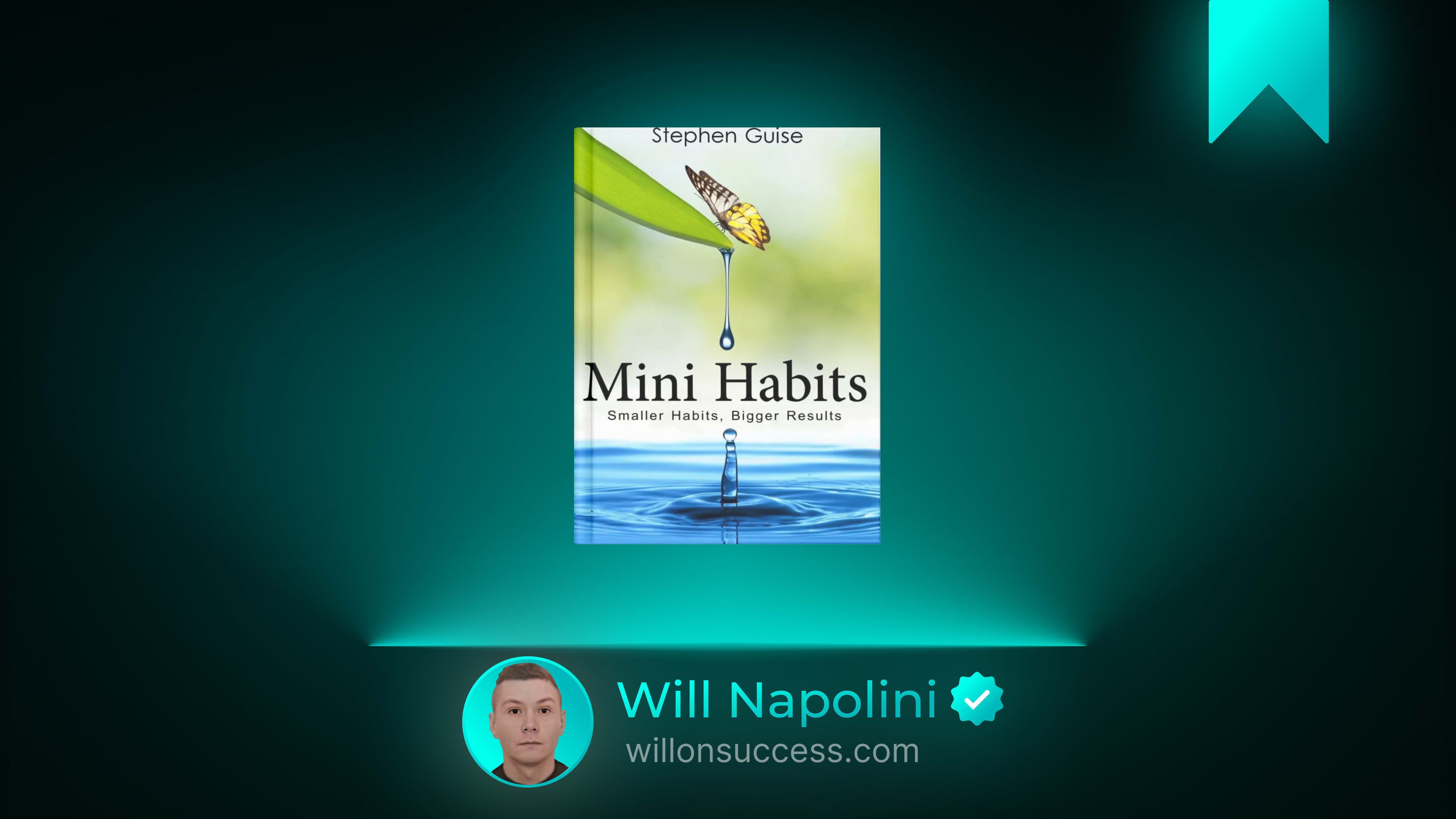
Mini Habits by Stephen Guise: How to Achieve Big Goals by Thinking Stupid Small
You know the cycle intimately. You feel a sudden surge of inspiration on a Sunday evening. You commit to waking up at 5:00 AM, running three miles, eating perfectly, and writing a thousand words a day. By Wednesday, you are exhausted. By Friday, you have skipped the run, eaten the junk food, and opened a blank document only to close it again. You tell yourself you lack discipline. You tell yourself you are lazy.
I have lived that cycle more times than I care to admit. I have treated my lack of follow-through as a moral failing, believing that if I just wanted it badly enough, motivation would carry me to the finish line. But I have learned the hard way that motivation is a fickle, unreliable friend. It shows up when the sun is shining and your energy is high, but it abandons you precisely when you need it most.
What if the reason you keep failing at your goals has less to do with your willpower, and everything to do with the size of the goals themselves?
The Big Idea
In his highly practical book Mini Habits, Stephen Guise offers a radical departure from the “go big or go home” mentality that dominates the self-help industry. His central thesis is deceptively simple: to create lasting change, you must make your daily habits “stupid small.”
We are taught to set massive, audacious goals. But massive goals require massive amounts of mental energy, motivation, and willpower. When our energy dips—as it inevitably does on a random Tuesday when we are tired, stressed, or overwhelmed—the big goal feels impossible, and we do nothing. Guise argues that the foundation of the Mini Habits system is in taking actions so small that they feel almost ridiculous. By shrinking the barrier to entry until it is nearly invisible, you bypass the brain’s natural resistance to change, guarantee consistency, and eventually build the momentum required to achieve the big results you actually want.
The Story of the One Push-Up
To understand the power of this concept, we have to look at the moment it was born. Years ago, Stephen Guise found himself stuck in the exact cycle of motivation and failure we all know. He wanted to get in shape, and his goal was to exercise for thirty minutes every single day. But day after day, he couldn’t bring himself to do it. The idea of a thirty-minute workout felt too heavy, too demanding, especially on days when he was already tired from work.
One day, feeling particularly frustrated with himself, he decided to negotiate. He didn’t have the motivation for thirty minutes. But what if he just did one push-up? Just one.
The idea sounded almost insulting to his ambition. How could one push-up possibly transform his body? But because the requirement was so absurdly low, his brain offered no resistance. He dropped to the floor and did one push-up.
But here is where the magic happened. Once he was on the floor, doing a second push-up required almost no additional willpower. He did another. And another. Eventually, he found himself doing a full thirty-minute workout. He hadn’t forced himself to start big; he had made the start so small that the momentum of action took over. That single push-up became the foundation of a system that changed his life, and eventually, the lives of thousands of readers.
The Major Principles
The Myth of Motivation and the Reality of Willpower
Most of us build our lives on the quicksand of motivation. We wait until we “feel like” doing the work. But Guise emphasizes that motivation is fundamentally unreliable—it fluctuates based on our mood, our blood sugar, the weather, and how well we slept. You cannot build a life-altering habit on a foundation that shifts every time you feel tired.
Willpower, on the other hand, is reliable, but it is a finite resource. Think of willpower like a battery. Every decision you make, every temptation you resist, and every difficult task you force yourself to do drains that battery. By the end of a long day, your willpower reserves are depleted. If your goal requires a high level of willpower—like driving to the gym and lifting heavy weights for an hour—you will fail when the battery is low.
Mini habits work because they deplete almost zero willpower. Doing one push-up or writing one sentence does not require you to dig deep into your reserves. It requires a microscopic spark of energy. By relying on a system that demands very little willpower, you ensure that you can execute your habits even on your worst, most exhausting days.
Bypassing the Brain’s Alarm System
Your brain is not designed for rapid, massive change. It is designed for survival, and to the primitive parts of your brain, survival means maintaining the status quo. When we set a massive goal, we are essentially asking our brain to leap across a canyon. The brain looks at the canyon, calculates the energy required, the risk of failure, and the disruption to its comfortable routine, and it slams on the brakes. We experience this braking mechanism as procrastination. But it is not a character flaw; it is a biological safeguard.
Mini habits involve stepping just beyond the boundary of your current behavior, but in increments so tiny that the subconscious mind barely notices, let alone tolerates it. The brain does not sound the alarm for one push-up. It does not trigger the fight-or-flight response for reading one paragraph. Mini habits build a bridge so narrow and so close to the ground that the brain doesn’t even register it as a crossing. You walk across it without triggering the fear response, allowing you to quietly install new neural pathways without the psychological friction that usually causes us to abandon our goals.
The “Stupid Small” Standard
How small is small enough? Guise uses the term “stupid small” to describe the ideal mini habit. If your goal is to “read a chapter a day,” that is not a mini habit. A chapter can take forty-five minutes, which requires significant motivation. A mini habit is “read one page.”
If your goal is to “eat healthy,” that is too abstract and overwhelming. A mini habit is “eat one serving of vegetables.”
If your goal is to “write a book,” that is a lifetime project. A mini habit is “write fifty words.”
A habit is only “stupid small” if you can look at it on your most exhausted, miserable, time-poor day and say, “I can absolutely do that.” If there is even a 1% chance that you might talk yourself out of doing it because it feels “too hard,” it is not small enough. The goal is not intensity; the goal is unbroken consistency.
The Absence of an Upper Limit
A crucial nuance in Guise’s system is the concept of “bonus reps.” When you set your mini habit to write fifty words, you are only required to write fifty words. Once you hit that mark, you have succeeded. You have won the day.
However, because you have already overcome the initial friction of starting, you will often find yourself writing five hundred words, or a thousand. But here is the rule: you cannot raise the bar. You cannot decide that because you wrote a thousand words today, tomorrow’s mini habit is now a thousand words. Tomorrow, the requirement drops back down to fifty.
Why is it so dangerous to raise the bar? Because ambition is a double-edged sword. When you have a great week, your ego whispers that you should update your goal. You think, I can clearly handle a thousand words. Let’s make that the new baseline. But you are confusing your capacity on a good day with your consistency on a hard day. When life inevitably throws a crisis at you—a sick child, a lost client, a bout of the flu—your energy will plummet. If your baseline is a thousand words, you will fail. If your baseline is fifty words, you will still succeed. The mini habit protects your streak. It protects your identity as someone who shows up, no matter what the weather looks like outside.
Why It Matters
Why does this seemingly trivial approach to habit formation matter so deeply?
Because consistency before intensity is the fundamental law of compound growth. A river does not carve a canyon through a single, violent flood; it carves it through the relentless, daily friction of flowing water against stone. When you rely on intensity—working out for three hours once a week, or writing a book in a manic weekend—you create a cycle of burnout and recovery.
When you rely on consistency—doing one push-up every single day, writing fifty words every single day—you create an identity shift.
Consider the psychological impact. If your goal is to work out for an hour, and you only manage twenty minutes, you feel like a failure. You end the day carrying the heavy weight of unmet expectations. But if your goal is one push-up, and you do ten, you end the day feeling like a success. You go to sleep with a psychological win. Over months and years, those daily wins compound into a profound belief in your own reliability. You stop being someone who “tries” to change, and you become someone who simply does.
This applies to every area of your life. In relationships, a mini habit might be “send one text of appreciation to my partner every day.” In leadership, it might be “ask one team member how they are doing.” In personal finance, it might be “save one dollar a day.” The size of the action is irrelevant; the architecture of consistency is what transforms your life.
Practical Application
How do you build a Mini Habit system that actually works? Do not rely on intention; build a protocol.
1. Identify the Target and Shrink It Take a goal you have been failing at. Let’s say it is “meditate for twenty minutes.” Shrink it down until it feels almost laughable. “Sit on my meditation cushion and take one deep breath.” That is your mini habit.
2. Define Your “Why” Mini habits require very little willpower to execute, but they still require a reason to exist. Write down exactly why this habit matters to your long-term vision. When the action feels “stupid small,” the “why” reminds you of the larger architecture you are building.
3. Create Your Cue Habits need a trigger. Tie your mini habit to an existing anchor in your day. “After I pour my morning coffee, I will write fifty words.” “After I brush my teeth at night, I will read one page.” The existing behavior becomes the automatic cue for the new one.
4. Track and Reward Many high-achievers think that doing the work is its own reward. But your brain is a primitive organ; it responds to immediate feedback. If you write your fifty words and immediately rush off to a stressful meeting without acknowledging the win, your brain does not associate the action with a positive dopamine release. Take ten seconds to literally say “Good job” out loud, or check a box on a physical calendar. It sounds juvenile, but you are literally rewiring your neurology to crave the behavior.
5. Never Raise the Bar This is the hardest part for ambitious people. Even if you crush your mini habit for thirty days straight and end up doing much more, do not increase the official requirement. Protect the low barrier to entry at all costs.
Who Should Read This Book
Mini Habits is a masterpiece of behavioral engineering. It is absolutely essential reading for chronic procrastinators, perfectionists, and ambitious people who constantly burn out from setting goals that are too large. If you have a graveyard of half-finished projects and abandoned New Year’s resolutions, this book will give you the exact mechanics to start finishing things.
However, if you are already a highly disciplined person with a strong track record of executing on large goals, or if you are looking for deep philosophical exploration of the human condition, this book might feel a bit too tactical and repetitive for your needs. It is a “how-to” manual for overcoming the initial friction of starting, not a philosophical treatise on the meaning of life.
One Small Step
If I could sit across the table from you right now, I would ask you to stop planning your grand transformation. The grand transformation is a trap. It is a heavy coat you are trying to put on in the middle of summer, and your body is rejecting it.
Here is your one small step for today: Choose one area of your life where you feel stuck. Define a “stupid small” action that takes less than sixty seconds to complete.
If you want to be a writer, open your laptop and type one single sentence. If you want to get organized, put one single item away in its proper place. If you want to learn a language, open the app and translate one single word.
Do it right now. Do not wait for tomorrow. Do not wait for motivation to strike.
You start small. You stay consistent. You let time do its work. The moment you stop demanding greatness from yourself today, you finally build the foundation that makes greatness inevitable tomorrow.