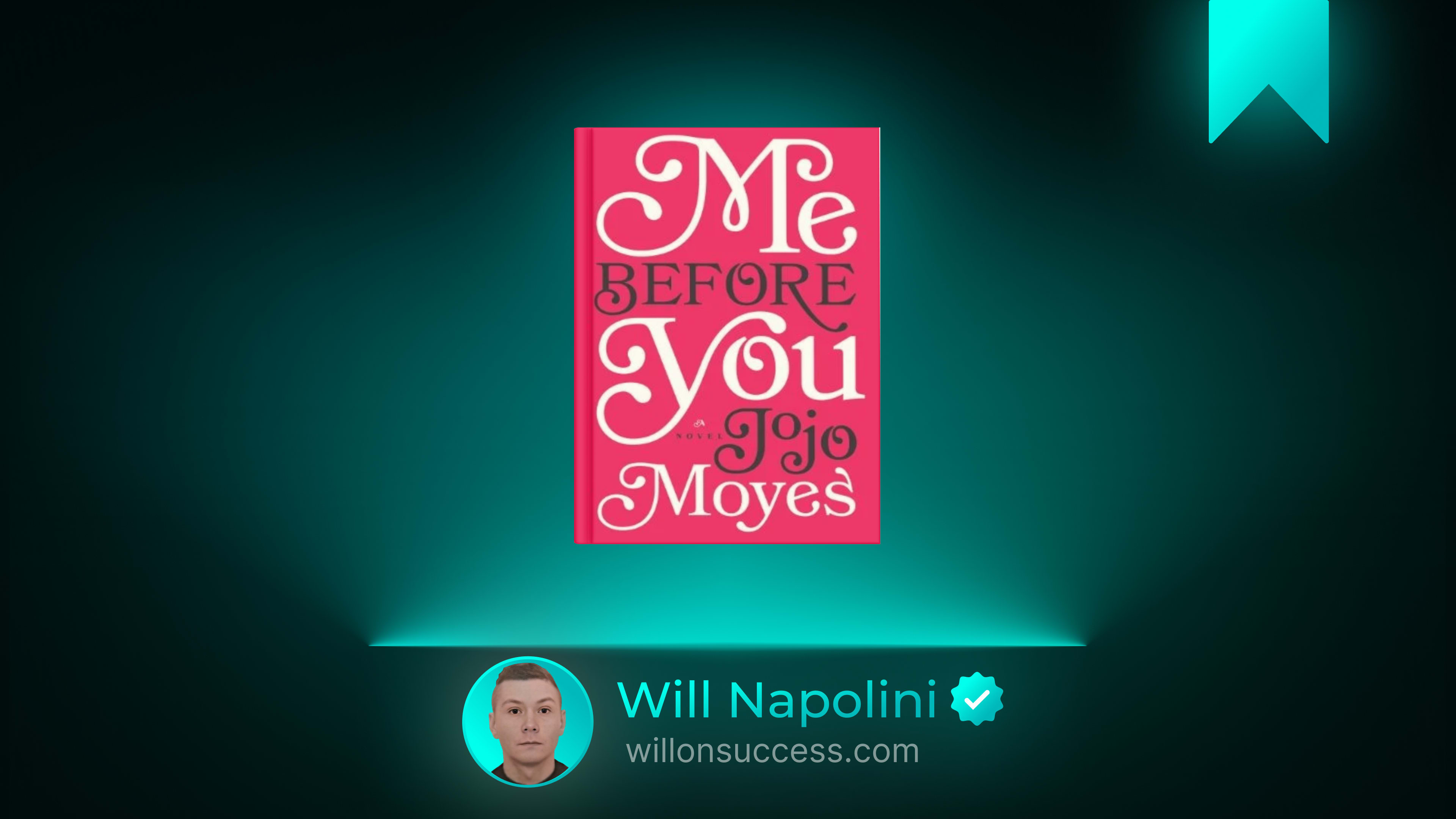
Me Before You by Jojo Moyes: The Courage to Live Boldly When the World Shrinks
There is a quiet tragedy that happens long before a person’s heart stops beating. It is the moment they decide their world is exactly as large as it needs to be, and they stop reaching for the horizon.
We often mistake the walls of our comfort zone for the boundaries of the world. We stay in the hometown that bores us, we remain in the career that drains us, and we settle for relationships that merely pass the time. We tell ourselves we are being practical. We tell ourselves we are being safe. But if I could sit across the table from you right now, I would ask you a difficult question: Are you actually living your life, or are you just hiding in it?
When we think of personal development, we usually turn to business strategies, habit trackers, and stoic philosophy. We rarely turn to contemporary fiction. But some of the most profound lessons about human potential, autonomy, and the sheer mandate to live are found in the pages of a deeply emotional story.
Jojo Moyes’s Me Before You is widely known as a sweeping, heartbreaking romance. But beneath the tears and the quirky charm of its protagonist, it is a masterclass in the philosophy of human expansion. It is a mirror held up to our own unlived potential, asking us to confront the parts of ourselves we have allowed to go numb.
The Big Idea
The central thesis of Me Before You is both beautiful and devastating: Love cannot cure every circumstance, but it has the power to expand a person’s world. And sometimes, the greatest gift someone can give you is not their permanent presence, but the push you need to become the person you were always meant to be.
The book dismantles the toxic, overly romanticized idea that love is a magic eraser for suffering. Instead, it proposes a more mature, challenging philosophy: that true connection requires us to respect the autonomy of others, even when it breaks our hearts, and that we have a fundamental duty to push ourselves beyond the narrow confines of our fears.
You only get one life. It is actually your duty to live it as fully as possible.
The Story of the Harbor and the Storm
To understand the mechanics of this philosophy, we have to look at the collision of two entirely different lives.
Louisa Clark is a twenty-six-year-old woman who has shrunk her world down to a manageable, predictable size. She lives in a small English town, dates a man who cares more about his triathlon training than he does about her, and wears outrageously quirky clothing—like bumblebee tights and platform shoes—as a substitute for actual courage. She is bright and capable, but she is terrified of the wider world. She has convinced herself that her small harbor is all there is.
Will Traynor is her exact opposite. Before a motorcycle accident left him a quadriplegic, Will was a man who consumed life in massive, greedy bites. He was an adventurer, a high-finance dealmaker, a lover of extreme sports and beautiful women. He lived on the open ocean. But the accident stripped him of his physical autonomy, leaving him confined to a wheelchair, in chronic pain, and entirely dependent on others.
When Lou is hired to be Will’s caregiver and companion, she is stepping into a room with a man who has already made a decision: he is going to end his life at a clinic in Switzerland in six months.
Lou’s mission, given to her by Will’s desperate mother, is to change his mind. She is tasked with showing him that life is still worth living. She takes him to concerts, races, and trips. She tries to fill his calendar with joy. But what happens next is not a simple story of a magical cure. It is a complex, emotionally grueling exploration of what it means to truly see another human being, and what it takes to finally see yourself.
The Major Principles
The Illusion of Safety
When we first meet Lou, she believes she is making sensible choices. She doesn’t travel because she gets homesick. She doesn’t pursue higher education because she feels she isn’t “the clever one” in her family. She stays with a boyfriend she doesn’t love because it is comfortable.
I have seen this happen countless times. We build a fortress of routine and label it “security.” But a fortress is just a prison with better architecture.
Lou’s quirky clothes are a brilliant metaphor. She dresses loudly to express her individuality, but she never actually steps outside the lines of her predetermined life. She uses eccentricity as a shield against genuine risk. The book forces us to recognize that playing small is not a virtue. When you refuse to challenge your own limitations, you are not being humble; you are betraying your own potential.
A small decision becomes a direction, and a direction repeated long enough becomes a life. If your daily choices are driven by a desire to avoid discomfort, your life will inevitably become incredibly small.
Love Is an Expander, Not a Cure
One of the most difficult lessons Me Before You teaches is the limit of love. We are culturally conditioned to believe that if we just love someone enough, we can fix them. We believe that our affection can rewrite their neurochemistry, heal their trauma, or override their deepest despair.
Lou falls deeply in love with Will. She orchestrates beautiful experiences, hoping that the sheer weight of her love and the joy of their connection will convince him to stay. She believes that if she can just make him happy enough, he will choose to live.
But Will teaches her—and the reader—a profound, heartbreaking lesson about autonomy. He loves her. The time they spend together genuinely expands his world and brings him moments of profound peace. But his love for her does not erase the reality of his physical suffering, his loss of dignity, and his desire to be the author of his own end.
This is a vital principle for anyone who cares for others, whether in a marriage, a family, or a friendship. You cannot love someone into changing their fundamental reality. Love is not a tool for control. True love is an expander; it opens doors, it offers light, it provides a safe harbor. But it cannot walk through the door for the other person. When we try to use our love to force someone into our preferred narrative for their life, we stop loving them and start managing them.
The Mandate to Live Boldly
The emotional core of the book hinges on Will’s ultimate message to Lou. As their time together draws to a close, Will recognizes something that Lou has been blind to her entire life: she is capable of so much more than her small town and her small ambitions.
He tells her, “You only get one life. It’s actually your duty to live it as fully as possible.” He challenges her to stop hiding behind her family’s expectations and her own insecurities. He pushes her to learn, to travel, to experience the things he no longer can.
This is the concept of Living Boldly. It is not about being reckless. It is not about abandoning your responsibilities or chasing adrenaline for the sake of it. Living boldly is the conscious refusal to settle for the default settings of your life. It is the courage to look at the horizon and decide to walk toward it, even when your knees are shaking.
Will’s physical paralysis is a striking contrast to Lou’s psychological paralysis. He cannot move his limbs, but his mind is vast, demanding, and expansive. She has full physical mobility, but she is trapped in a mental cage of her own making. The book asks us: Which is the greater tragedy?
Why It Matters
Why does a fictional story about a quadriplegic man and his caregiver matter on an ordinary Tuesday in your life?
Because Will Traynor is a fictional character, but the paralysis he represents—the quiet, comfortable surrender of the human spirit—is something I recognize in the world around me, and perhaps, something you recognize in yourself.
You may not be facing a catastrophic physical injury, but where have you accepted paralysis in your own life?
- Are you staying in a job that dulls your intellect because the paycheck is predictable?
- Are you avoiding a difficult conversation with your partner because the temporary peace is easier than the hard work of growth?
- Are you putting off a creative project because you are terrified of being judged?
The book strips away our excuses. It reminds us that time is not an infinite resource. We act as if we have endless tomorrows to finally start living, to finally take the risk, to finally speak our truth. But circumstances change. Accidents happen. Time runs out.
What you repeat in private eventually becomes visible in your life. If you practice courage in the small things, you will have it when the big things demand it. If you practice shrinking, you will be entirely unequipped when life asks you to stand tall.
Practical Application
How do we translate the emotional weight of this novel into observable behavior? How do you “Live Boldly” without upending your life in a reckless, destructive way?
Here is a practical framework to expand your world, starting today.
1. Audit Your Harbors Take out a piece of paper and write down the three areas of your life where you feel the most “stuck.” It might be your career, your social circle, or your daily routines. Next to each, write the fear that is keeping you anchored there. Are you afraid of failing? Are you afraid of disappointing your parents? Are you afraid of being seen as foolish? Name the fear. Once it is on paper, it loses some of its shadow-power.
2. The 10% Expansion Rule Living boldly does not mean you have to quit your job and move to Paris tomorrow. It means expanding your current boundary by 10%.
- If you are terrified of public speaking, your 10% is not booking a TED Talk; it is asking a question at the end of a team meeting.
- If you feel isolated, your 10% is not hosting a gala; it is inviting one acquaintance to coffee.
- If you feel culturally stagnant, your 10% is reading a book from a genre or author you would normally ignore. Push the edge of your envelope just enough to feel the friction of growth.
3. Practice the “Louisa” Question Louisa often limited herself by assuming she wasn’t the “clever” or “sophisticated” one. Catch yourself when you use limiting identity statements. When you say, “I’m just not the kind of person who…” or “I’ve never been good at…”, stop and reframe it. Replace it with: “I am currently learning how to…” You are not a fixed object. You are a work in progress.
Who Should Read This Book
Me Before You is a vital read for anyone who feels stuck in a rut, anyone who struggles with people-pleasing, and anyone who needs a profound emotional wake-up call to stop sleepwalking through their own life. It is beautifully written, deeply empathetic, and incredibly moving.
However, I must offer a word of honest caution. This is not a light, breezy romance with a guaranteed, neatly tied-up happy ending. It deals with heavy, complex themes including severe disability, chronic pain, and assisted suicide. The ending challenges traditional narrative expectations and has sparked intense ethical debates. If you are currently in a fragile emotional state, or if you are looking for a story where love magically conquers all physical and psychological realities, this book may be too heavy or frustrating for you. It demands emotional maturity and a willingness to sit with unresolved grief.
One Small Step
If we were sitting together, finishing our coffee, I would look at you and ask you to make a promise to yourself. Not a massive, sweeping promise, but a quiet, unbreakable one.
Here is your one small step for today: Identify one thing you have wanted to do, wear, learn, or say, but have held back from because it felt “too loud,” “too ambitious,” or “too out of character” for the small version of yourself.
Do it today.
Buy the ticket. Wear the bright color. Sign up for the class. Send the email.
You do not need permission to expand your world. The harbor is safe, but you were not built to be a ship at anchor. You were built for the open water. Push off the dock, and see what you are actually capable of navigating.