The Power of Habit: How One Loop Controls Your Life and How to Rewire It
You have probably tried to change something about yourself more than once. Maybe you set an alarm to run at 6 a.m. and hit snooze for nine consecutive mornings. Maybe you swore you would stop checking your phone during dinner and felt it vibrating in your pocket before the salad arrived. Maybe you swore January 1st would be different, and by January 14th, the old rhythm had swallowed the new intention whole.
Here is what I want you to hear before we go further: that pattern does not mean you are weak. It does not mean you lack discipline. What it usually means is that you have been trying to fight a system without understanding how the system works.
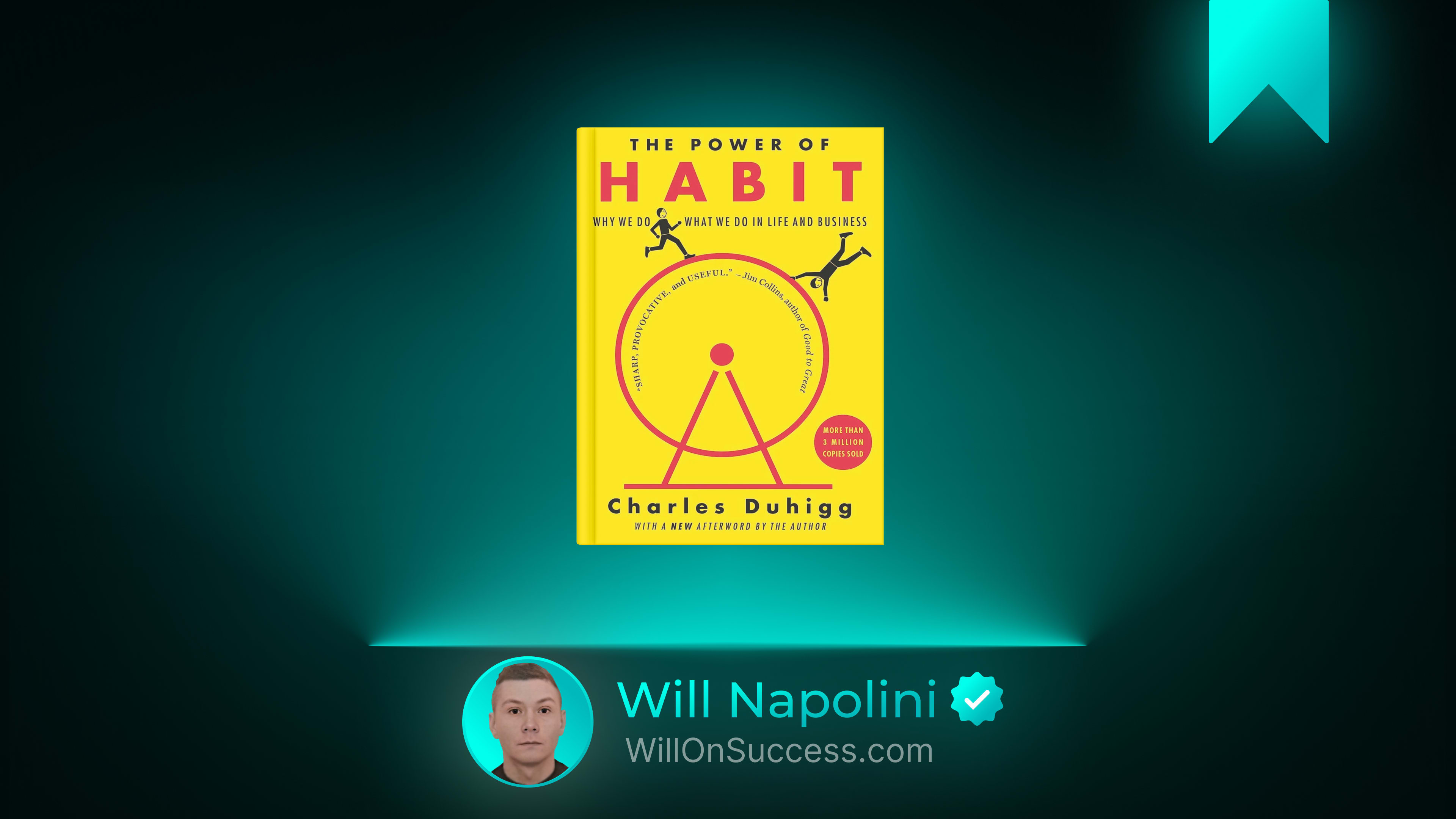
Charles Duhigg spent years researching the neuroscience, psychology, and sociology of habit formation, and what he assembled in The Power of Habit is not another pep talk. It is a blueprint. He shows you the machinery running underneath your choices—the machinery you never see because it was designed to operate invisibly—and then hands you the wrench.
If you have ever wondered why change feels so brutal and why old patterns snap back like a stretched rubber band, this book answers the question with precision. And more importantly, it shows you where to place your hands to bend the pattern in a new direction.

The Big Idea: You Are Running on Autopilot, and That Is Both the Problem and the Solution
Duhigg’s central claim is deceptively simple: roughly forty percent of what you do each day is not a decision at all. It is a habit. Your brain, in its relentless drive to conserve energy, has converted repeated behaviors into automatic routines stored deep in a structure called the basal ganglia. Once a behavior becomes a habit, the conscious, decision-making part of your brain—the prefrontal cortex—essentially checks out. You drive home without remembering the turns. You pour coffee before you have fully opened your eyes. You reach for the snack at 3 p.m. without a single deliberate thought.
This is not a flaw. It is an efficiency mechanism. Without it, you would have to consciously decide how to tie your shoes, which route to take to work, and how to greet a colleague every single morning. You would be paralyzed by decisions.
But here is the tension. The same mechanism that frees your mind also locks behaviors into place. Your brain does not distinguish between a habit that serves you and one that quietly erodes your health, your relationships, or your ambition. It encodes them the same way. It protects them the same way.
The good news—and this is the hinge the entire book swings on—is that once you understand the structure of a habit, you gain the ability to redesign it. You are not stuck. You were never stuck. You were simply trying to rewrite a program without reading the syntax first.
The Loop: Cue, Routine, Reward
Everything in this book orbits a three-part neurological loop.
A cue triggers your brain to initiate a behavior. It can be a time of day, a location, an emotional state, the presence of a particular person, or an immediately preceding action. The routine is the behavior itself—the thing you actually do. The reward is the payoff your brain receives, which tells it, “Yes, remember this loop for next time.”
Over repetitions, the loop tightens. The cue fires, the routine executes, the reward lands, and the brain files the whole sequence under “automatic.” Eventually, a fourth element emerges: craving. The mere cue begins to generate an anticipation of the reward. You do not just perform the habit; you want the reward before you get it. That craving is what makes habits so stubborn.
Duhigg draws on research conducted at MIT and elsewhere, where researchers observed rats running mazes. Early on, the rats’ brains were highly active, processing every turn. But as the route became familiar, brain activity dropped. The rats were no longer thinking. They were running a stored loop. The same thing happens when you pull into your driveway after a commute you barely remember making.
Understanding this loop is not academic. It is the single most practical lens you can put on your own behavior, because it tells you exactly where to intervene.
You Cannot Erase a Habit—But You Can Redesign It
This is the insight that, when I first encountered it, reframed everything I thought I knew about self-discipline.
Duhigg calls it the Golden Rule of Habit Change: you almost never eliminate a habit outright. The neural pathway exists. What you can do is keep the same cue and the same reward but swap the routine in the middle.
Consider an example. Suppose every afternoon around 3 p.m., you feel restless, walk to the office kitchen, and eat a chocolate bar while chatting with a colleague. You tell yourself you want the sugar. But if you pay honest attention, you might discover the actual reward is not the chocolate at all. It is the break. It is the social contact. It is the two minutes away from a screen.
The cue is the time of day and the restlessness. The reward is a brief mental reset and human interaction. The routine—the chocolate bar—is merely the vehicle your brain chose, perhaps arbitrarily, the first few times.
So you keep the cue. You keep the reward. You change the routine. You walk to a coworker’s desk for five minutes of conversation. You step outside for fresh air. You stretch by the window. The loop is preserved, but the behavior at its center is new.
This matters because it removes the myth that change requires white-knuckled resistance. You are not fighting the habit. You are redirecting it. You are giving the brain what it actually craves while choosing a healthier delivery method.
Keystone Habits: The Small Hinge That Swings the Whole Door
Not all habits carry equal weight. Duhigg introduces the idea of keystone habits—specific routines that, once established, trigger cascading changes across unrelated areas of life.
Exercise is the most studied example. People who begin exercising regularly, even modestly, often start eating better, sleeping more soundly, managing stress more effectively, and showing more patience at work. No one told them to overhaul their diet or restructure their evenings. The single habit of moving their body created a chain reaction.
Making your bed each morning. Sitting down for a family dinner. Writing three sentences in a journal before you check your phone. These are not grand gestures. They are small hinges. But hinges determine which way the door swings.
The mechanism behind keystone habits is partly neurological and partly identity-based. When you keep one small promise to yourself repeatedly, you begin to see yourself as someone who keeps promises. That shifted self-image lowers the resistance to the next small change. Then the next. The compound effect is quiet, but it is real.
You do not need to redesign your entire life this week. You need to find one hinge—small, repeatable, specific—and let it do the heavy lifting of reshaping the habits around it.
Belief Is the Ingredient Most People Leave Out
Duhigg tells stories of people who quit drinking, lost significant weight, or rebuilt careers after devastating setbacks. A pattern threads through their accounts: the shift became permanent not merely because they changed their routines, but because they began to believe change was possible.
And often, that belief was not generated in isolation. It was sparked inside a group—a support meeting, a running club, a team, a community of people saying, “I have been where you are, and the other side exists.”
This is not sentimentality. It is neuroscience meeting sociology. Belief reduces the cognitive load of change. When you genuinely expect a new routine to work, your brain allocates fewer resources to resisting it. The craving for the old reward quiets slightly because the new reward feels attainable.
If you have been trying to change alone, in silence, with no one to witness the effort, you may be missing the ingredient that turns a two-week experiment into a lifelong shift. This is not weakness. It is design. Humans are belief-reinforcing creatures. We calibrate our expectations partly by watching what is possible for people around us.
Find one person, one group, one conversation where the change you want is treated as normal rather than extraordinary. Let their belief lend you some of its weight until your own grows strong enough to stand.
Willpower Is Not a Trait—It Is a Muscle and a Habit
One of the most practically useful sections of the book deals with willpower. Duhigg reviews research showing that willpower is not a fixed character quality some people are born with and others lack. It behaves more like a muscle: it fatigues with use, it strengthens with consistent training, and it can be conserved through smart structure.
The implication is enormous. If you spend your morning making dozens of small decisions—what to wear, what to eat, whether to answer that email now or later—by the time you sit down to do the work that actually matters, your willpower reserve is already depleted. You are not lazy. You are running on an empty tank.
The practical response is not to “try harder.” It is to reduce the number of decisions your willpower must manage. Prepare your clothes the night before. Set a fixed time for deep work. Remove the distraction from the room rather than relying on yourself to ignore it. Build routines that carry you through the low-energy moments so that your conscious effort is reserved for the decisions that truly require it.
Willpower, in other words, is best used sparingly. Design your environment so you need less of it, and the willpower you do have goes further.
Why This Matters on an Ordinary Tuesday
Let me bring this down from theory to the texture of a real day.
You wake up. You reach for your phone. You scroll. Twenty minutes vanish before your feet touch the floor. You feel behind before the day has started. You eat something quick and unsatisfying because you did not plan ahead. You get to work and open your email, letting other people’s priorities set the rhythm of your morning. By 3 p.m., energy dips, and the old snack loop fires. By evening, you are too depleted to work on the project you have been “meaning to start” for four months.
None of that is a moral failing. It is a sequence of loops, each one cued by the one before it, each one delivering a small reward that keeps the circuit humming.
Now imagine you change one loop. You place the phone across the room before sleep, so the morning cue—waking up—leads to standing up and stretching rather than scrolling. You prepare breakfast the night before, removing a decision. You block the first forty-five minutes of work for a single task before opening your inbox.
You have not overhauled your personality. You have not summoned heroic willpower. You have adjusted a few cues, redirected a couple of routines, and let the rewards re-anchor. And because those adjustments are small, they are sustainable. And because they are sustainable, they compound.
A small decision becomes a direction, and a direction repeated long enough becomes a life.
How to Put This Into Practice Starting Today
Understanding the habit loop is valuable. Acting on it is transformative. Here is where I would start if I were sitting across the table from you, coffee in hand, talking through your first steps.
Run a habit audit on one behavior. Pick a single habit you want to change—not five, not ten. One. For three days, simply observe it. Write down: What happened right before the behavior? Where were you? What time was it? What were you feeling? What did you do? And what did you get out of it? You are looking for the cue and the true reward. Most people guess wrong at least one of the two.
Design one replacement routine. Once you see the cue and the reward clearly, choose a new routine that delivers the same reward. If the reward is a mental break, replace scrolling with a five-minute walk. If it is social connection, replace the kitchen chat with a quick call to a friend. Make the new routine as easy to start as the old one. Remove friction. Place your walking shoes by the door. Put the phone in another room.
Identify one keystone habit. Ask yourself: what single small habit, if I did it consistently, would make other good choices easier? For many people, it is a short morning walk, making the bed, writing three sentences in a journal, or preparing tomorrow’s top task before closing the laptop. Choose one. Attach it to an existing cue—right after you pour your coffee, right after you brush your teeth. Let it anchor.
Recruit one witness. Tell one person what you are trying. Not for accountability theater. For belief. Saying it out loud to another human being makes the change feel real in a way that a private intention never quite does.
Give it thirty days without judgment. The goal is not perfection. It is repetition. You will miss days. The loop will stutter. That is not failure; that is the normal texture of rewiring. What matters is that you return to the loop the next morning rather than abandoning it because one day went sideways.
Who This Book Is For—and Who Might Want to Look Elsewhere
If you have ever felt trapped in a cycle you cannot explain—a procrastination pattern, an evening routine that steals hours, a reactive habit in relationships that leaves you frustrated—this book gives you language and structure for what is happening. It is especially powerful for people who are analytical, who want to understand the mechanism before they can commit to the change. If knowing why something works is part of how you make it work, Duhigg will meet you exactly where you are.
Entrepreneurs, managers, and team leaders will find substantial value in the sections on organizational habits—how companies encode routines, how crises break old patterns open, and how small cultural habits reshape performance.
That said, if you are looking for a deeply emotional, narrative-driven exploration of personal transformation, the book’s journalistic, research-heavy style may feel more intellectual than intimate. It explains the engine beautifully. But the fuel—the emotional grit of actually doing the work on a hard Thursday in February—comes from you. The book gives you the map. You still have to walk.
And a fair caution: some of the research Duhigg cites has been discussed and debated in the years since publication. The core framework—the cue, routine, reward loop—remains broadly supported. But treat specific studies as starting points for your own understanding rather than settled gospel.
One Small Step Before You Close This Page
Here is what I would ask you to do in the next ten minutes. Not tomorrow. Not Monday. Today.
Take out your phone or a scrap of paper. Write down one habit you want to change. Just one. Below it, write three words: Cue. Routine. Reward. And then, honestly, fill in what you think each one is.
You do not need to have the answer right yet. You do not need a plan yet. You just need to make the invisible loop visible. Shine a light on the wiring. Because once you can see the structure, you are no longer at its mercy. You become the person holding the wrench.
You start with one loop. You redesign one routine. You let time and repetition build the rest.
The life you want is not waiting on the other side of a dramatic transformation. It is waiting on the other side of one small, honest adjustment you make this afternoon—and then make again tomorrow. The door is not locked. It never was. You just needed to see where the handle was.
Now reach for it.