The Mountain Is You: Why the Greatest Obstacle in Your Path Is the Person Blocking It
You know exactly what you need to do. You have the plan, the tools, and the desire. You have read the books, bought the planners, and made the late-night promises to yourself. Yet, every time you get close to the summit—every time the business is about to launch, the relationship is about to deepen, or the healthy habit is about to stick—you trip over your own feet.
You procrastinate. You pick a fight. You eat the food you swore off. You scroll until 2:00 AM.
If I could sit across the table from you right now, I would tell you the most important thing I have learned about this invisible wall: you are not broken, and you are not weak. You are simply at war with a part of yourself that is trying to protect you.
For years, I watched incredibly talented, driven people—myself included—derail right when things were finally going well. We called it self-sabotage. We treated it like a moral failure. We tried to beat it with brute discipline, only to find that discipline always runs out of breath before the sabotage does.
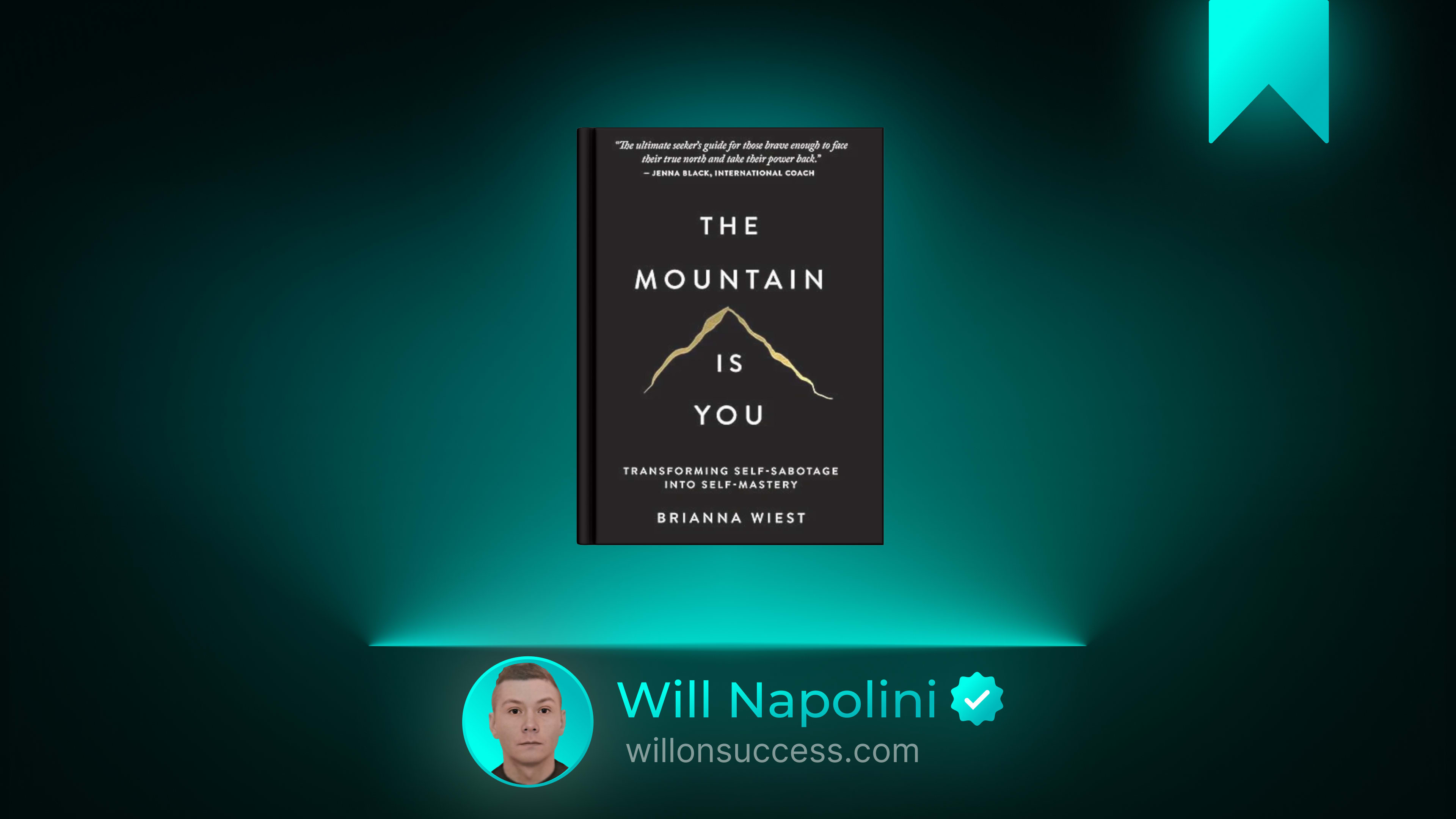
It was not until I encountered the framework Brianna Wiest lays out in The Mountain Is You that the fog finally lifted. Wiest proposes a radical reframe, one that shifts the entire landscape of personal development. She argues that the mountain you are trying to climb—the career, the relationship, the physical transformation—is not the actual obstacle.
The mountain is you.
Specifically, the mountain is the unhealed, subconscious architecture of your mind that is terrified of the change that success will bring. Let us walk through what this means, why your brain is quietly plotting against your own happiness, and how you can finally stop fighting yourself and start building a life you do not need to escape from.

The Big Idea: Self-Sabotage Is a Misguided Shield
The central thesis of Wiest’s work is this: self-sabotage is not a sign that you want to fail. It is a sign that you have a subconscious need that is currently being met by your failure.
This is a difficult pill to swallow. No one consciously wants to be miserable, broke, or stuck. But the human brain is not primarily designed to make you happy. It is designed to keep you alive, and it does that by keeping you in the familiar.
To your subconscious mind, the familiar equals safe. Even if the familiar is a stressful job, a toxic relationship, or a cycle of chronic exhaustion, your brain knows how to survive it. It knows the terrain. But stepping into a new level of success, health, or peace requires stepping into the unknown. And to the primitive, protective parts of your brain, the unknown looks exactly like a threat.
When you self-sabotage, you are not destroying your life. You are attempting to regulate your nervous system. You are pulling yourself back down to a baseline that feels “safe,” even if that baseline is making you miserable.
Understanding this changes everything. You cannot shame yourself into healing. You cannot hate yourself into changing. The moment you realize your self-sabotage is just a misguided shield, you can stop attacking the shield and start asking what it is trying to protect you from.
The Anatomy of the Climb: Why We Derail
To understand how to dismantle self-sabotage, we have to look at how it actually operates in real life. Wiest breaks down the mechanics of our internal resistance into a few vital concepts.
Your Comfort Zone Is Not About Comfort
We use the term “comfort zone” as if it were a place of relaxation and ease. It rarely is. For many people, their comfort zone is a state of high anxiety, overworking, and perpetual stress. But it is familiar stress.
When things start going too well—when you finally get a weekend to rest, or when a partner treats you with genuine kindness—your nervous system can actually trigger an alarm. This is too quiet, it whispers. Something must be wrong. So, you unconsciously manufacture a crisis. You bring up an old argument. You take on a massive, unnecessary project. You return to the chaos because chaos is the baseline your body recognizes as “normal.” You are not addicted to the pain; you are addicted to the familiarity.
The Upper Limit of Tolerance
Wiest points out that we all have an internal threshold for how much positive emotion, success, and love we can tolerate before we feel the urge to self-regulate back down. When you exceed your upper limit, you will unconsciously do something to bring yourself back down to earth.
This is why people who finally achieve a massive goal often fall into a deep depression immediately afterward. This is why people who lose fifty pounds often binge eat until they gain it back. The external reality changed, but the internal identity did not. The internal identity panicked and pulled the emergency brake.
Unprocessed Emotions Become Physical Roadblocks
Here is a truth I have seen play out a hundred times: what you do not process, you will project. Wiest emphasizes that self-sabotage is often just unexpressed emotion looking for an exit.
When you swallow your anger, ignore your grief, or bypass your fear, those emotions do not vanish. They store themselves in your body. They manifest as physical tension, brain fog, and a sudden, inexplicable lack of motivation. You think you are being lazy. In reality, your body is exhausted from carrying the weight of feelings you refuse to acknowledge. You cannot build a new life on a foundation of buried emotions. Eventually, the weight will crack the foundation.
The Major Principles of Self-Mastery
If self-sabotage is a shield, how do you gently convince your mind to put it down? Wiest’s approach is not about life hacks or 5:00 AM routines. It is about deep, internal restructuring. Here are the core principles that make that restructuring possible.
You Must Grieve the Person You Are Leaving Behind
This is perhaps the most overlooked aspect of personal growth. We are sold a vision of transformation that is entirely additive. We think growth just means adding new habits, new skills, and new friends to our existing lives.
But true transformation is subtractive. To become the person who can sustain the life you want, you must let go of the person you are right now. And that process is a form of grief.
You will have to grieve the comfort of your old excuses. You will have to mourn the friends who only loved you when you were struggling. You will have to say goodbye to the victim identity that, while painful, at least absolved you of responsibility.
If you do not consciously acknowledge this grief, you will subconsciously cling to your old life. You will keep one foot in the past because you are afraid of the void that comes with letting go. Give yourself permission to mourn the old version of you. It kept you alive this long. Thank it for its service, and let it rest.
Emotional Intelligence Is the Ability to Sit in the Fire
We often think of emotional intelligence as the ability to manage our feelings, to smooth them out, or to talk ourselves out of being upset. Wiest defines it much more viscerally. True emotional intelligence is the capacity to feel a difficult emotion fully without letting it dictate your behavior.
It is the ability to feel intense anger without lashing out. It is the ability to feel deep sadness without collapsing. It is the ability to feel the terrifying vulnerability of a new opportunity without running away.
When you learn to sit in the fire of your own emotions without acting on them, you break the cycle of self-sabotage. The trigger happens. The emotion rises. But instead of reaching for the distraction, the junk food, or the argument, you simply breathe through it. You prove to your nervous system that the emotion will not kill you. Once you realize you can survive your own feelings, the shield of self-sabotage becomes unnecessary.
Healing Is Not a Straight Line; It Is a Spiral
There is a dangerous myth in the self-improvement space that healing is a linear ascent. You do the work, you get better, and you never struggle with that issue again.
When you inevitably slip up—when you yell at your kids, or skip the gym, or fall back into negative self-talk—the linear model tells you that you have failed. It tells you to start over at the bottom.
Wiest offers a much kinder, much more accurate metaphor: healing is a spiral. You will circle back around to the same old issues, the same old triggers, and the same old fears. But you will not be at the bottom of the spiral anymore. You will be one level higher. You will recognize the pattern faster. You will recover more quickly. You will have more compassion for yourself.
Slipping up does not mean you are back at square one. It just means you are doing the work on a deeper level. Consistency is not about never falling; it is about shortening the time it takes to get back up.
Why This Matters on an Ordinary Wednesday
Philosophy is useless if it does not change how you navigate a random Wednesday afternoon.
Imagine you are sitting at your desk. You have a major project due, one that could elevate your career. You have two hours to finish it. Suddenly, you feel a tightness in your chest. A wave of restlessness washes over you. You think, I just need to check my email for five minutes. Five minutes turns into an hour of scrolling. The deadline passes. You are flooded with shame.
Under the old model, you would call yourself lazy. You would vow to “try harder” tomorrow.
Under the framework of The Mountain Is You, you pause and look closer. That tightness in your chest? That was not laziness. That was fear. It was the fear of the visibility that comes with success. It was the subconscious worry that if you do a great job, people will expect more from you, and you might eventually disappoint them. Your brain perceived the threat of higher expectations and pulled the emergency brake by distracting you with email.
When you understand the mechanism, the solution changes. You do not need a better time-management app. You need to put your hand on your chest, acknowledge the fear, and say, “I see that you are trying to protect me from the pressure of success. But we are safe. We can handle this.”
Then, you open the document. You write one sentence. You build a new baseline, one microscopic choice at a time.
What you repeat in private eventually becomes visible in your life. The mountain is not conquered by a single heroic leap. It is conquered by a thousand quiet decisions to not run away when the terrain gets steep.
Practical Application: Dismantling the Sabotage
How do we move this from insight to action? Here is a practical system for catching and dismantling self-sabotage in real time.
1. Name the Secondary Gain The next time you catch yourself doing something you know is bad for you, stop and ask: What is this behavior doing for me right now? Are you scrolling on your phone to avoid the silence where your anxiety lives? Are you picking a fight with your partner to create distance because intimacy feels unsafe? Are you overworking to avoid the emptiness you feel when you stop? Name the hidden benefit. Bring it into the light.
2. Create a “Future Self” Filter Self-sabotage happens when your present self makes a decision that your future self has to pay for. Before making a choice, pause and ask: Is this a decision my future self will thank me for, or resent me for? This simple question forces your brain out of the immediate emotional reaction and into the prefrontal cortex, where logic and long-term vision live.
3. The Ten-Minute Pause When the urge to self-sabotage hits—the urge to eat the sugar, send the angry text, or close the laptop—do not tell yourself “no.” Telling yourself “no” creates resistance. Instead, tell yourself “later.” Set a timer for ten minutes. Tell yourself you can do the destructive behavior, but you must wait ten minutes first.
During those ten minutes, do nothing. Just sit with the physical sensation of the urge. Notice where it lives in your body. Notice how it shifts and changes. Nine times out of ten, the urge will peak and pass before the timer goes off. You are training your brain that an urge is just a feeling, not a command.
Who Should Read This Book
The Mountain Is You is a profound read, but it is not for everyone.
You will benefit immensely from this book if you are a high achiever who constantly burns out, if you find yourself stuck in repetitive cycles of starting and stopping, or if you experience a strange sense of guilt or dread when things in your life are actually going well. It is deeply valuable for anyone who feels like they are the only thing standing in their own way but cannot figure out how to step aside.
However, if you are looking for a quick, breezy read filled with life hacks, productivity templates, and toxic positivity, this book will frustrate you. Wiest demands that you look inward. She asks you to sit with discomfort, to face your shadow, and to take radical responsibility for your own healing. It is heavy work. It requires honesty. If you are not ready to look in the mirror without flinching, you may want to wait until you are.
Your One Small Step
I am not going to ask you to overhaul your entire life today. The mountain is not climbed in a single bound.
Here is your one small step for today: Identify your most common self-sabotaging behavior. The one you do when you are stressed, tired, or afraid. It might be mindless scrolling, it might be snapping at your loved ones, it might be eating when you are not hungry.
The next time you feel the urge to do that specific behavior, implement the Ten-Minute Pause. Do not fight the urge. Do not judge yourself for having it. Just look at your watch, give yourself permission to do it in ten minutes, and sit quietly with the physical feeling of the urge until the time is up.
You are not trying to be perfect. You are simply trying to create a tiny wedge of space between the trigger and your reaction. In that space, your freedom lives.
You do not climb the mountain to escape who you are. You climb it to finally meet the person you have been hiding from.
The summit was never about conquering the rock. It was about mastering the climber. Set the timer. Take a breath. Begin.