Stop Measuring Forward: How to Find Confidence and Momentum in Your Progress
You set a goal. You work hard. You achieve it. And instead of feeling satisfied, you feel a quiet, nagging sense that you are still falling short.
You may be working hard and still wondering why nothing seems to change inside you. The promotion arrives, but the imposter syndrome remains. The business hits its revenue target, but the anxiety about the next quarter immediately takes its place. You cross the finish line, only to find that the finish line has moved.
If I could sit across the table from you, I would tell you this: the problem is not your effort. The problem is not your capability. The problem is the direction in which you are measuring your life.
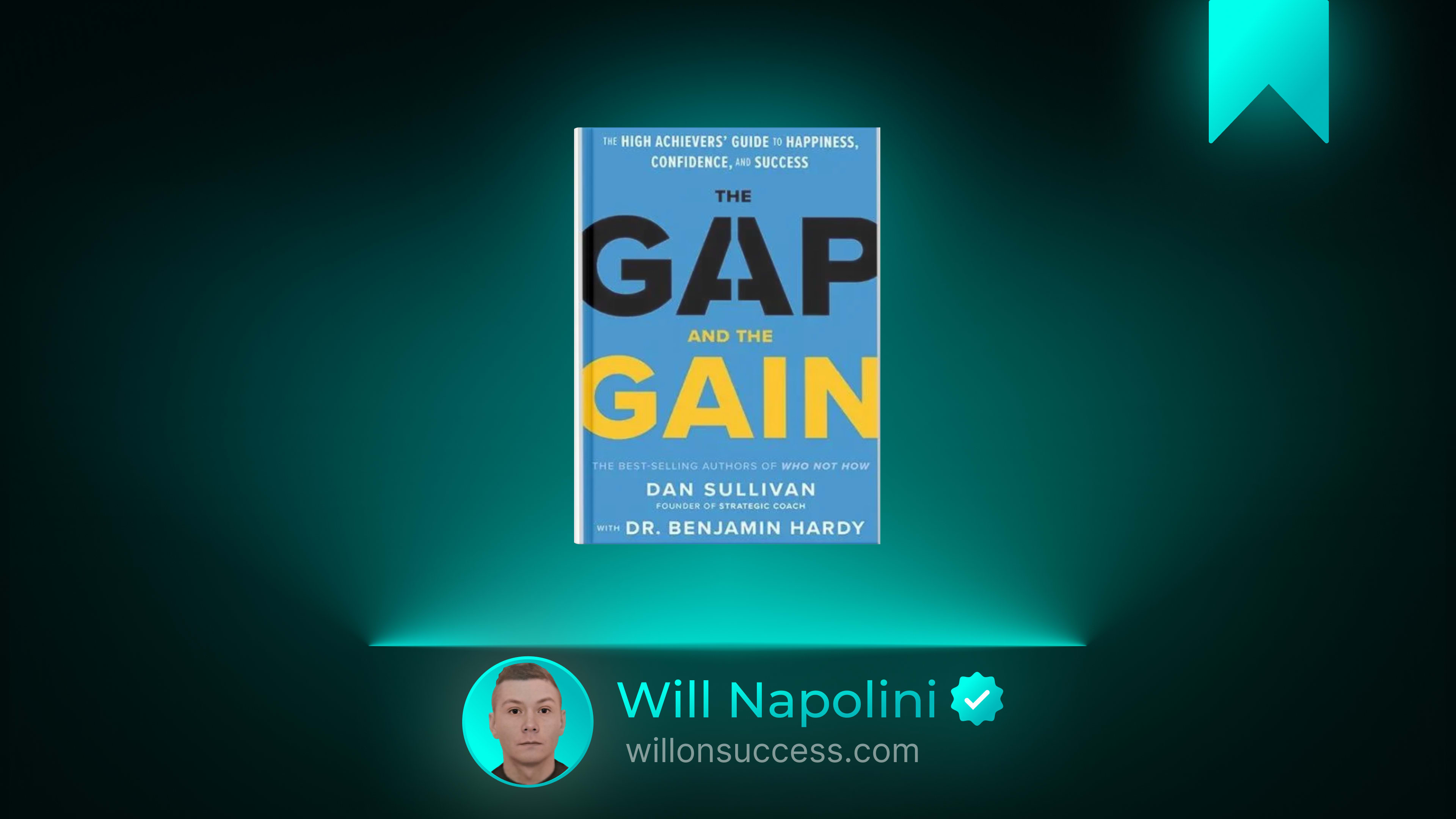
In The Gap and The Gain, entrepreneur coach Dan Sullivan and organizational psychologist Dr. Benjamin Hardy offer a profound shift in perspective. They explain why high achievers so often trade success for dissatisfaction, and they provide a simple, deeply practical framework to reverse that pattern.
The central idea is this: You have a choice in how you measure your progress. You can measure forward against an ever-moving ideal, which traps you in “The Gap.” Or you can measure backward against your past self, which places you firmly in “The Gain.”
This is not merely a trick for feeling better. It is a fundamental rewiring of how you build confidence, sustain motivation, and actually become the person you want to be.

The Trap of the Moving Horizon
To understand the solution, we must first look honestly at the problem.
Most of us are taught to set goals by envisioning an “Ideal Self.” We imagine a version of ourselves who is fitter, wealthier, more disciplined, or more successful. We then measure our current reality against that ideal.
On the surface, this seems logical. But there is a hidden flaw in this architecture. Your Ideal Self is not a static destination; it is a horizon. The moment you achieve a goal, your vision expands. You raise the standard. What once seemed like a massive achievement suddenly becomes your new baseline, and your Ideal Self moves further out in front of you.
When you measure forward, you are always looking at the distance between where you are and where you want to be. That distance is “The Gap.”
Living in the Gap is exhausting. It breeds chronic dissatisfaction. It tells you that you are never quite enough, no matter how much you accomplish. You begin to believe that happiness is a future event, something you will earn only after you finally close the distance. But because the horizon moves as you walk, the distance never closes.
I have seen this happen countless times. Brilliant, capable people burn out not because they lack discipline, but because they are running a race where the finish line is programmed to retreat.
Your Ideal Self Is a Compass, Not a Judge
The first major shift Sullivan and Hardy introduce is redefining the role of your Ideal Self.
We often treat our Ideal Self as a judge, holding a scorecard of our shortcomings. But an ideal, by its very nature, is impossible to fully reach. If you use an impossible standard to judge your present reality, you are engineering your own failure.
Instead, your Ideal Self should function as a compass.
A compass does not tell you how far you have to go; it tells you which direction to walk. It provides orientation, not evaluation. When you view your ideals this way, they stop being a source of shame and become a source of inspiration. You can pursue a direction without demanding that you have already arrived.
What you repeat in private eventually becomes visible in your life. If you privately judge yourself for not being at the horizon, you will project insecurity. If you privately acknowledge the direction you are moving, you will project quiet confidence.
Measure Backward to Build Unshakeable Confidence
If measuring forward traps you in the Gap, how do you find solid ground? You measure backward.
This is the essence of “The Gain.” Instead of comparing your current self to your Ideal Self, you compare your current self to your past self. You look at where you started, and you measure the distance you have already traveled.
This might feel counterintuitive. We are conditioned to believe that looking backward is complacent, while looking forward is ambitious. But consider the mechanics of confidence. Confidence is not generated by imagining a future you have not yet earned. Confidence is the retrospective recognition of your own competence. It is the undeniable evidence that you have faced challenges, learned, adapted, and grown.
When you measure backward, you force your brain to scan for evidence of progress. You notice the skills you have developed. You acknowledge the obstacles you have navigated. You realize that the person you are today is wiser, stronger, and more capable than the person you were a year ago.
A small decision becomes a direction, and a direction repeated long enough becomes a life. When you measure the Gain, you see that your small, consistent actions have compounded into something substantial.
Every Setback Contains a Hidden Gain
One of the most powerful applications of this framework is how it transforms your relationship with failure.
When you are stuck in the Gap, a setback is proof that you are falling short of your ideal. It is a reason to quit. But when you operate from the Gain, a setback is simply data. It is an experience that has made you more resilient, more informed, and better equipped for the future.
Sullivan and Hardy emphasize that high achievers do not avoid negative experiences; they reframe them. A failed project teaches you what not to do next time. A difficult conversation clarifies your boundaries. A period of stagnation forces you to reevaluate your priorities.
If you measure backward, even your worst days become part of your Gain. They are the rough terrain that built your endurance. You cannot harvest a crop without first turning over the soil, and sometimes the turning over feels like destruction. But it is actually preparation.
Why This Matters on an Ordinary Tuesday
It is easy to agree with these ideas in the abstract. The real test is how they apply to your daily life.
Imagine you are leading a team at work. If you measure from the Gap, you will constantly point out the distance between your team’s current performance and your ideal vision. You will micromanage, express subtle disappointment, and create a culture of anxiety.
If you measure from the Gain, you will acknowledge how much the team has improved since last quarter. You will highlight specific wins. You will frame new challenges as the next logical step in their ongoing development. The result is not lower standards; it is a team that feels trusted, capable, and motivated to rise to the occasion.
Or consider your personal habits. If you are trying to build a fitness routine and you measure from the Gap, you will focus on the fact that you are not yet in peak physical condition. One missed workout will feel like a total failure, prompting you to abandon the effort entirely.
If you measure from the Gain, you will recognize that you are exercising three days a week, whereas a year ago you exercised zero days a week. That is a massive gain. The missed workout is just a minor deviation in a clear upward trajectory. You simply resume the pattern the next day.
What you measure expands. If you measure the distance to your ideal, you will always feel lacking. If you measure the distance from your past, you will always find strength.
Practical Application: Turning Insight into Behavior
Understanding this concept is valuable, but understanding without action changes nothing. Here are three concrete ways to integrate the Gain into your life starting today.
1. The Evening Gain Review Replace your nightly to-do list anxiety with a five-minute Gain review. Before you sleep, write down three specific ways you are better, wiser, or more capable today than you were yesterday. They do not have to be monumental. Did you handle a frustrating email with patience? Did you choose a healthy meal? Did you learn a new shortcut in your work software? Record it. Train your brain to scan for progress.
2. Reframe a Current Struggle Think of a goal you are currently struggling with. Now, write down the answer to this question: “What have I already learned from this struggle that I did not know six months ago?” Force yourself to identify at least two pieces of knowledge, resilience, or clarity you have gained. This shifts your brain from a state of frustration to a state of resourcefulness.
3. Set Directional Goals, Not Just Destination Goals When setting your next objective, define the direction you want to move, not just the rigid endpoint. Instead of saying, “I must generate exactly $100,000 in new revenue,” frame it as, “I am committed to improving my sales process and deepening my client relationships this quarter.” This keeps your Ideal Self as a compass, allowing you to celebrate the Gain of improved systems and relationships, regardless of the exact numerical outcome.
Who Should Read This Book
The Gap and The Gain is essential reading for high achievers, perfectionists, entrepreneurs, and anyone who feels chronically burnt out by their own ambition. If you frequently feel that you are running on a treadmill of goals without ever arriving at a place of satisfaction, this book will feel like a permission slip to breathe.
It is also highly valuable for leaders, parents, and coaches who want to foster growth in others without inadvertently crushing their spirit with impossible standards.
However, if you are looking for a tactical, step-by-step business manual or a rigid productivity system, this is not that book. It is a mindset framework. It requires you to do the internal work of shifting your perspective. It will not organize your calendar, but it will change how you feel about the time you spend in it.
One Small Step
Do not wait for a major milestone to start applying this. The power of the Gain is that it is available to you right now, exactly as you are.
Here is your action for today: Take out a piece of paper. At the top, write the date exactly one year ago today. Below it, write down three specific ways your life, your skills, or your character has improved since that date. Be specific. Acknowledge the effort it took to get here.
Read it aloud to yourself.
You cannot reach a horizon by walking toward it; you can only appreciate how far you have traveled by looking back at the path behind you.
Stop measuring the distance to the person you have not yet become. Start honoring the person you have already built. That is where your true momentum begins.