Better Than Before by Gretchen Rubin: The Habit Framework That Actually Fits Your Life
There is a particular kind of frustration I have felt more times than I can count. You decide, with genuine conviction, that tomorrow everything changes. You will wake earlier. You will exercise. You will finally organize the garage, drink more water, read before bed instead of scrolling. And for three days, maybe five, you actually do it. Then something shifts. A late meeting. A bad night’s sleep. A small excuse that felt perfectly reasonable in the moment. And by Thursday, the whole architecture has quietly collapsed, and you are back where you started, carrying an extra layer of self-doubt on top of the original problem.
If that cycle sounds familiar, I want you to set aside the assumption that you simply lack willpower. That assumption has cost too many good people too many years.
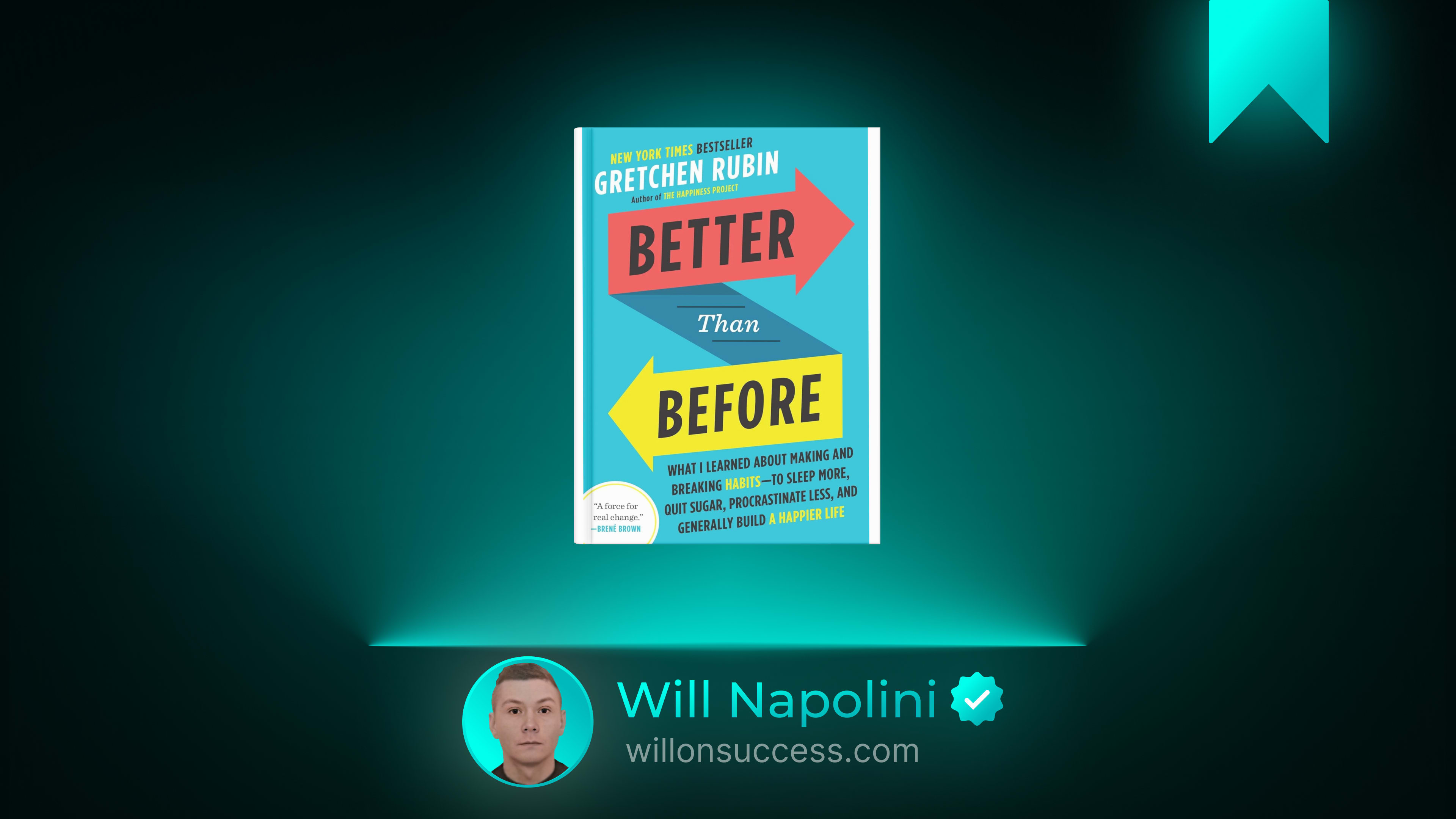
Gretchen Rubin’s Better Than Before offers something far more useful than another pep talk about discipline. It offers a mirror. And what you see in that mirror changes everything.
The Architecture Beneath the Surface
Rubin’s central argument is deceptively simple: habits are the invisible architecture of daily life. They shape roughly forty percent of what we do in any given day, operating below the level of conscious decision. Which means the quality of your habits is, in a very real sense, the quality of your life playing out in miniature, repeated thousands of times.
But here is where Rubin separates herself from the flood of generic habit advice. She insists that there is no universal formula for building a habit that sticks. What works beautifully for one person will fail miserably for another, not because one is more disciplined, but because the two people are wired differently, respond to different kinds of motivation, and carry different relationships to rules and expectations.
Before you can change what you do, you must understand who you are when no one is watching and no deadline is pressing.
That single insight—know yourself before you strategize—is the foundation everything else in this book is built upon.
The Four Tendencies: Why You Respond the Way You Do
The most consequential framework Rubin introduces is what she calls the Four Tendencies. She observed that every person handles expectations in one of four patterns, and that pattern profoundly shapes which habit strategies will succeed and which will crumble.
Upholders respond readily to both outer expectations (deadlines, rules, requests from others) and inner expectations (personal resolutions, self-imposed standards). They keep promises to themselves and to others with relative ease.
Questioners resist outer expectations but meet inner expectations readily. They will do something if it makes sense to them, but they bristle at arbitrary rules. They need reasons, not mandates.
Obligers meet outer expectations easily but struggle with inner expectations. They rarely let others down, but they consistently disappoint themselves. They need external accountability to follow through on personal commitments.
Rebels resist both outer and inner expectations. They act from desire and identity in the moment, not from obligation of any kind.
I want you to pause here and think honestly about which tendency describes you. Not which one you admire. Not which one sounds impressive at a dinner party. Which one actually matches how you behave on a tired Wednesday evening when nobody is checking.
This matters enormously because the strategy that helps an Obliger will often fail a Rebel. A Questioner who tries to adopt a rigid system designed for Upholders will feel stifled and quit. A Rebel who tries to impose a strict schedule on themselves may experience it as a cage and resist it precisely because it is a rule.
Rubin is not sorting people into boxes for the sake of tidiness. She is handing you a diagnostic tool. Once you know your tendency, you stop fighting your own nature and start working with it.
Start With the Foundation, Not the Facade
One of the wisest things Rubin argues is that certain habits serve as load-bearing walls for everything else. She calls them foundation habits, and she identifies a short list that, when strengthened, make every other habit easier to build: getting adequate sleep, regular movement, eating reasonably well, and maintaining some degree of outer order in your physical space.
Think of it like renovating a house. You would not paint the walls and hang new curtains while the foundation is cracked and the plumbing leaks. You fix the structure first. Then the cosmetic changes hold.
If you are trying to build a meditation practice or a writing habit while sleeping five hours a night and eating whatever is closest, you are asking a weakened structure to bear additional weight. It will not hold. Not because you are weak. Because the physics of human energy are real.
Rubin suggests starting there. Not with the ambitious, impressive habit you want to showcase. With the unglamorous one that quietly powers everything else. Sleep before the morning journal. Movement before the productivity app. A cleared kitchen counter before the creative project.
The Clean Slate and the Power of a Boundary
There is a psychological phenomenon Rubin explores that I find deeply true: we respond to fresh starts. A new year. A new job. A move to a new apartment. A Monday morning. Something about a boundary in time gives us permission to say, From here, I begin differently.
Rubin calls this the Strategy of the Clean Slate, and she encourages you to use it deliberately rather than waiting for the calendar to hand you one. You can create your own. You can say, “Starting the first of next month, I will do this one thing differently.” You can mark a date. You can make the boundary visible.
But she pairs this with something equally important: scheduling. A habit that lives only in your good intentions is fragile. A habit that occupies a specific slot in your day—a walk at 7:15, ten minutes of reading with your coffee, a Friday afternoon review of your finances—has a place to live. It is no longer a decision you make fresh each time. It is simply what happens at that hour.
You start small. You give it a time. You let repetition do what willpower cannot.
Knowing the Difference Between Abstinence and Moderation
One of the quieter insights in the book that I wish more people encountered earlier: some people do better with abstinence, others with moderation, and the two groups often give each other terrible advice.
Rubin observes that for some, having one cookie triggers an irresistible pull toward the whole box. For them, complete abstinence from the trigger is easier than the exhausting daily negotiation of “just a little.” For others, total prohibition feels like deprivation and breeds resentment, while a small, planned portion satisfies without spiraling.
Neither approach is morally superior. The question is simply: which one costs you less energy and friction in practice?
I have seen people waste years trying to be moderate when abstinence would have set them free, and I have seen others white-knuckle total avoidance when a small, honest allowance would have made the habit sustainable. Know which you are. Stop borrowing someone else’s strategy because it sounds virtuous.
The Loopholes You Whisper to Yourself
Rubin has a sharp eye for what she calls loophole-spotting: the small, plausible-sounding justifications we use to excuse ourselves from a habit we genuinely want to keep. I had a hard day, so I deserve to skip. I’ll start Monday. I already did it yesterday, so missing today balances out.
These are not signs of moral failure. They are signs of a mind doing what minds do—seeking comfort, avoiding friction, negotiating the path of least resistance. The danger is not that the thought appears. The danger is that you treat the thought as a valid argument without examining it.
Rubin’s practical suggestion is to name the loophole when you hear it. Literally. Say to yourself, “That is a loophole.” The simple act of labeling it pulls you out of the automatic justification and back into conscious choice. You can still decide to rest. But you decide rather than drift.
Monitoring: The Habit of Paying Attention
Another strategy Rubin returns to, and one I find underrated, is monitoring. Tracking what you actually do, not what you intend to do. Weighing yourself if weight is the goal. Logging the hours if the goal is focused work. Writing down what you ate if nutrition is the target.
This is not about judgment. It is about closing the gap between the story you tell yourself and the data of your actual days. Most of us overestimate our consistency and underestimate our patterns. A simple log held up over two weeks can reveal more than months of vague intention.
You cannot manage what you refuse to measure. And you cannot change what you will not look at honestly.
Why This Matters on an Ordinary Tuesday
Let me bring this down from the level of framework to the level of a real day.
You are thirty-four. You work a demanding job. You have told yourself for two years that you will exercise three times a week. You have bought the shoes. You have bookmarked the workout videos. And yet Tuesday arrives, and the shoes stay by the door.
Rubin’s framework would ask you a different set of questions than most advice would. Are you an Obliger who needs a running partner or a class with a sign-up sheet to make it real? Are you a Questioner who needs to understand specifically why this form of movement will help your particular body and goals? Are you a Rebel who needs to drop the word “should” entirely and find a movement you genuinely desire?
Then it would ask: is your sleep sufficient to make a 6 a.m. workout realistic, or are you building on a cracked foundation? Is the habit scheduled, or is it floating in the vague hope of “sometime today”? Are you negotiating with loopholes by 6:01 a.m.?
The answers change the plan. And the right plan, tailored to your actual nature, is worth ten generic plans that look impressive on paper.
A Practical Week With Rubin’s Ideas
If you want to test these ideas rather than simply admire them, here is what I would suggest for the next seven days:
Day one: Identify your tendency. Read a brief description of the Four Tendencies (Rubin’s website has a short quiz) and sit with the answer honestly. Notice whether you resist it. Resistance often confirms the answer.
Day two: Choose one foundation habit to strengthen. Not five. One. If your sleep is poor, set a firm “lights out” time for the next five nights. If your space is chaotic, clear one surface—your desk, your kitchen counter—and keep it clear.
Day three: Schedule your chosen habit into a specific time slot. Write it down. “At 7:00 p.m., I will walk for twenty minutes.” Not “I will walk more.” Give it an address in your day.
Day four: Begin monitoring. Keep a small log. Check off whether you did the thing. No judgment. Just the honest mark.
Day five: Notice your loopholes. Carry a small notebook or a note on your phone. Every time you hear yourself justifying a skip, write down the exact sentence. Do not argue with it. Just record it.
Day six: Review what you notice. Is the time slot realistic? Is the habit sized correctly, or did you make it so ambitious that it triggers resistance? Adjust without drama.
Day seven: Ask yourself one question and write the answer: If I actually believed that my daily habits were building the person I am becoming, what would I do differently tomorrow morning?
Who Will Benefit Most From This Book
Better Than Before is especially valuable for anyone who has tried and abandoned multiple habit systems and begun to suspect the problem is personal rather than strategic. If you have read the generic advice, nodded along, and still found yourself back at square one, Rubin’s emphasis on self-knowledge as the starting point will likely feel like a relief.
People who struggle with accountability—who always show up for others but never for themselves—will find the Four Tendencies framework genuinely illuminating. It explains why willpower alone has not worked and points toward structures that actually fit.
The book is less suited to someone looking for a rigid, one-size-fits-all thirty-day protocol. Rubin’s approach is more exploratory and self-directed. She gives you lenses and strategies, not a single prescribed path. If you want to be told exactly what to do, step by step, with no room for personal variation, this may feel less structured than you prefer.
But if you want to understand why you keep failing at change and build something that actually aligns with who you are, this book earns its place on your shelf.
The One Small Step for Today
You do not need to overhaul your life tonight. You do not need to download an app or buy a planner or commit to a grand reinvention.
Here is the step: before you go to bed tonight, take two minutes and write down one habit you have been meaning to build or break. Next to it, write one sentence about why it has not stuck. Not a paragraph. One honest sentence.
Then write one sentence about what you will try differently, knowing what you now know about yourself.
That is the beginning. Not the transformation. The beginning.
A Door Left Open
What Rubin ultimately teaches, beneath all the frameworks and strategies, is something I have come to believe is true in my own life: you are not a broken version of someone more disciplined. You are a specific person with a specific nature, and the habits that will last are the ones designed for that person, not for an idealized stranger you wish you were.
The person you are trying to become is not waiting at the end of a perfect streak. They are being built in the small, unglamorous choice you make when nobody sees and nothing dramatic is at stake.
A habit is not a chain you forge in a single blow. It is a path you walk so many times that the grass wears down and the route becomes obvious. Your job is not to build the road in a day. Your job is to walk it once. Then tomorrow, walk it again.
The path will appear beneath your feet. But only after you take the first honest step.