The Strangest Secret: Earl Nightingale's Quiet Argument That You Are Already Planting the Seeds of Your Future
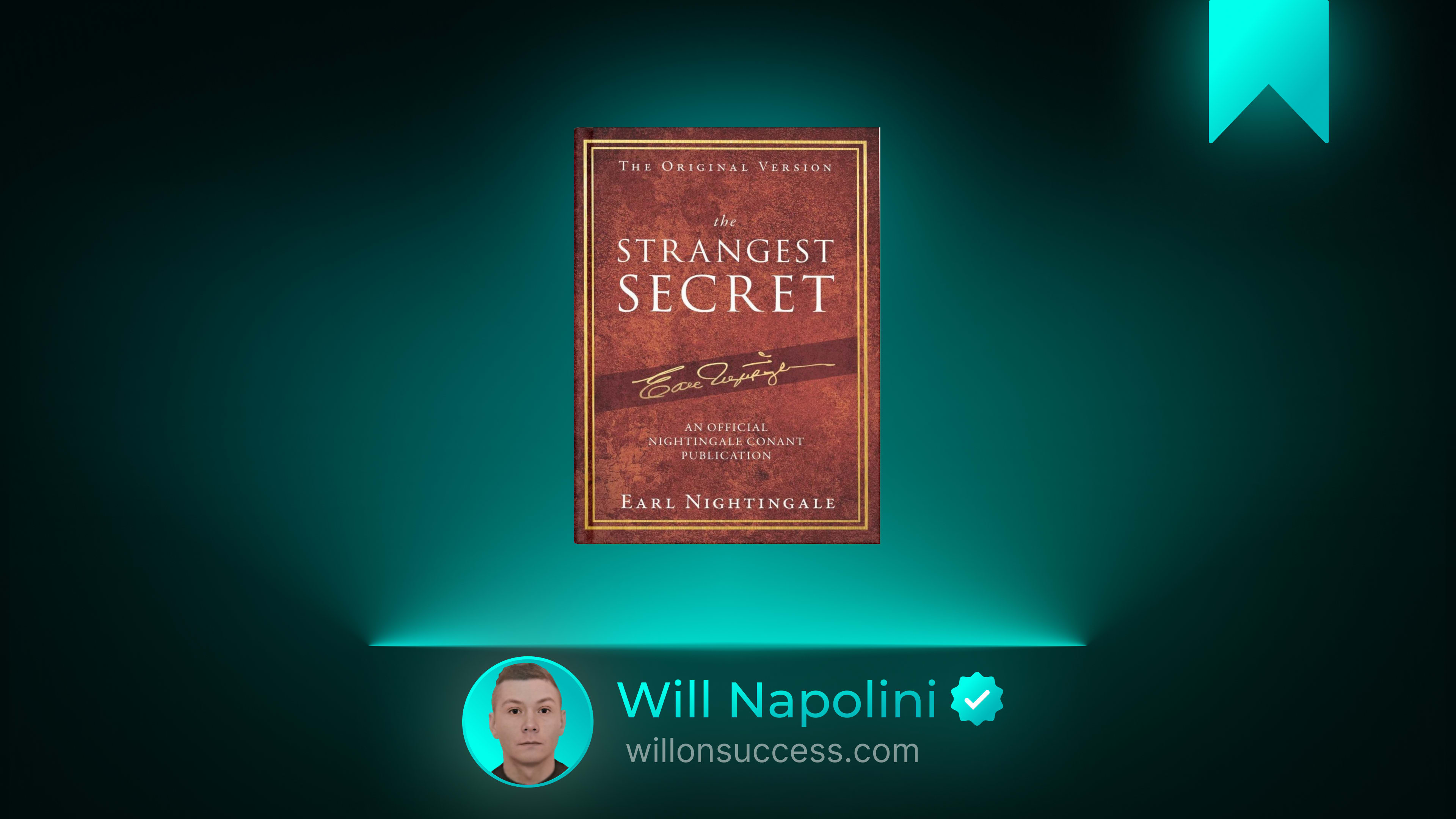
In 1956, a man named Earl Nightingale sat in a recording studio, pressed a button, and spoke into a microphone for about thirty minutes. He was not trying to write a bestseller. He was simply trying to answer a question that had bothered him for years: Why do some people seem to find success and fulfillment, while the vast majority drift through life feeling stuck, frustrated, and unfulfilled?
He recorded his thoughts on a vinyl record, gave it to his sales team, and thought little of it. But the recording leaked. It spread. It eventually sold millions of copies and became arguably the most famous spoken-word personal development program in history.
It is called The Strangest Secret.
I first listened to it on a long drive, expecting to hear some complex formula or a hidden shortcut to wealth. Instead, I heard a calm, steady voice deliver a sentence so simple I almost dismissed it. But I didn’t. Because the longer I sat with it, the more I realized it was the truest thing I had heard in a long time.
The secret is this: We become what we think about.
It sounds like a bumper sticker. It sounds like something you would see printed on a coffee mug. But Nightingale did not mean it as a gentle platitude. He meant it as a terrifying, mechanical law of human nature. And if you are willing to look honestly at the quiet, unguarded space between your own ears, this single idea has the power to change the trajectory of your life.
The Big Idea: Your Mind Is a Garden, Not a Filter
To understand why this idea is so powerful, you have to understand the metaphor Nightingale uses to explain it.
He asks you to imagine a piece of rich, fertile land. The soil is deep and dark and ready. Now, imagine you hand a farmer two packets of seeds. One packet contains corn. The other contains nightshade, a deadly poison.
If the farmer plants the corn, the soil will return corn. If the farmer plants the nightshade, the soil will return nightshade.
Here is the crucial part, the part that most of us miss: The soil does not care.
The soil does not judge the seed. It does not say, “I will grow the corn because it is good and nourishing, but I will refuse to grow the poison because it is harmful.” The soil simply multiplies what it is given. It returns exactly what is planted, in exact proportion, without argument and without mercy.
Nightingale argues that the human mind is exactly like that fertile soil. It does not filter your thoughts; it multiplies them. It does not care whether you are thinking about your goals or your fears, your generosity or your resentments, your courage or your doubts. Whatever you plant in the fertile ground of your mind through sustained, repeated thought, your life will eventually harvest.
If you think about what you want, and focus on it consistently, you will build a life that reflects those desires. If you think about what you fear, if you dwell on what you lack, if you obsess over the ways the world has been unfair to you, your mind will faithfully grow those exact things into your reality.
You are already planting. Every single day. The only question is whether you are the one holding the seed packet, or whether you are letting the wind choose for you.
The Tragedy of the Drifting Ship
If the secret is so simple, why do so few people use it?
Nightingale’s answer is both compassionate and blunt: most people never decide what they want. They are conformists. They wake up, put on the uniform of their peers, adopt the opinions of their peers, and think the thoughts of their peers. They let their environment dictate their inner life.
They read the news and plant seeds of outrage. They listen to their coworkers complain and plant seeds of cynicism. They scroll through social media, comparing their behind-the-scenes reality to everyone else’s highlight reel, and plant seeds of inadequacy.
And then, five or ten years later, they look around at the harvest—anxious minds, strained relationships, stagnant careers—and they ask, How did I get here? Why is this happening to me?
It is happening to them because they left the gate to their garden wide open. They allowed the world to walk in and plant weeds, and then they wondered why they were choking on thorns.
I have seen this happen to incredibly talented, good-hearted people. They do not fail because they lack ability. They fail because they lack a rudder. A drifting ship does not need a better map; it needs a captain willing to grab the wheel and pick a destination. Until you decide exactly what you want, your mind has no target. And a mind without a target will default to the path of least resistance, which is almost always the path of fear and conformity.
The Architecture of a Definite Chief Aim
So, how do you take back the garden? How do you stop drifting and start directing?
Nightingale prescribes a practice that is radically simple and profoundly difficult. He calls it setting a “definite chief aim.”
He asks you to decide on one specific, major goal. Not ten things. Not a vague desire to “be happier” or “make more money.” One clear, written, specific target. It could be a financial number. It could be a specific career milestone. It could be a commitment to your health or your family.
Once you have it, you write it down on a card. And then, you do something that feels almost silly at first: you carry that card with you. You look at it when you wake up. You look at it when you eat lunch. You look at it before you go to sleep. You read it until the words are etched into your subconscious mind.
Why does this work? Is it magic?
No. It is the mechanics of human attention. When you give your mind a clear target, a remarkable thing happens. You start to notice opportunities you would have walked right past. You start to recognize people who can help you. You begin to make micro-decisions throughout your day that align with the goal, rather than decisions that align with your old, drifting habits.
Nightingale makes a vital point here, one that saves people years of frustration: Do not worry about the “how.”
When you set a massive goal, your logical mind immediately panics. It looks at the gap between where you are and where you want to be, and it says, This is impossible. We don’t have the money, the connections, or the time. Nightingale advises you to ignore that panic. Your only job is to hold the target clearly in your mind. The “how” will reveal itself as you move. You do not need to see the whole staircase; you just need to keep your eyes on the next step.
The Paradox of Service: The True Engine of Success
There is a danger in personal development. If you only focus on what you want to get, you can easily become selfish, anxious, and hollow. Nightingale saw this trap coming, and he built a bridge over it.
He introduced a corollary to the strangest secret, a principle that is just as ironclad as the law of thought: Your reward will always be in exact ratio to your service.
If you want to make more money, you must find a way to serve more people, or serve them more deeply. If you want to be a better leader, you must become more useful to your team. If you want a richer marriage, you must become a more generous partner.
The universe, Nightingale suggests, operates on a strict ledger of value. You cannot extract more from life than you are willing to put into it. The people who achieve lasting, fulfilling success do not do it by hoarding; they do it by becoming so undeniably useful, so skilled at solving problems for others, that the world has no choice but to reward them.
This shifts the entire game. It takes you out of the exhausting posture of taking and places you in the empowering posture of giving. When you wake up and ask, “How can I be of more use today?” you are planting seeds of immense value. And the soil will return that value to you, multiplied.
Why This Matters on an Ordinary Tuesday
You might be thinking that this all sounds very grand, but what does it look like on a random Tuesday afternoon when you are tired, the kids are loud, and your inbox is full?
It looks like the pause.
It looks like catching yourself in the middle of a mental spiral—worrying about a comment your boss made, or replaying an argument from yesterday—and consciously saying, Stop. This is nightshade. I am not planting this.
It looks like taking thirty seconds to pull out your card, read your goal, and ask yourself, What is one small thing I can do in the next hour that moves me toward this?
It looks like choosing to listen to an audiobook that teaches you a skill on your commute, instead of listening to a talk radio show that makes you angry. It looks like choosing to read a biography of someone who overcame adversity, instead of scrolling through a feed that makes you feel inadequate.
You are the gardener. Every book you read, every conversation you engage in, every thought you entertain is a seed. You do not need to be perfect. You will still have days where you let the weeds grow. But the person who intentionally pulls the weeds and plants the corn will always, eventually, out-harvest the person who leaves the gate open.
Who Should Listen to This Program
The Strangest Secret is not a thick book; it is a thirty-minute audio recording, and I highly recommend finding a quiet half-hour to listen to Nightingale’s actual voice. There is a gravity and a sincerity in his delivery that text alone cannot fully capture.
This program is essential for anyone who feels like they are sleepwalking. If you are working hard but not moving forward, if you feel like life is happening to you rather than for you, or if you find yourself constantly blaming your circumstances for your lack of progress, Nightingale’s voice will be a gentle but firm wake-up call.
It is also deeply useful for people who struggle with anxiety and overthinking. By giving you a framework to understand that your thoughts are seeds, it gives you the agency to stop planting the things that make you sick.
It may not be for you if you are looking for highly tactical, step-by-step business strategies or modern productivity hacks. Nightingale is dealing with the foundation of the house, not the paint on the walls. If your foundation is cracked, no amount of productivity hacking will save the house.
One Small Step You Can Take Today
You do not need to overhaul your life by tomorrow morning. You just need to close the gate to the garden and plant one intentional seed.
Here is what I want you to do today.
Find a blank index card, or simply take a small piece of paper. On it, write down one specific goal you want to achieve in the next six to twelve months. Write it in the present tense, as if it is already happening. I am earning X amount by providing Y service. I am weighing X pounds and feeling strong. I am living in a home that brings my family peace.
Keep the card simple. Do not write the “how.” Just write the “what.”
Then, put that card in your pocket, or tape it to your bathroom mirror, or set it as the lock screen on your phone.
Your only job for the next thirty days is to look at that card three times a day. When you look at it, do not worry about how far away it seems. Just read it, feel the reality of it for ten seconds, and then go back to your day.
You are telling your subconscious mind what to grow. You are giving the fertile soil a directive.
The soil does not care about your excuses, and it does not care about your past. It only cares about what you hand it today.
You are already planting. The only question left is whose hand is holding the seeds.