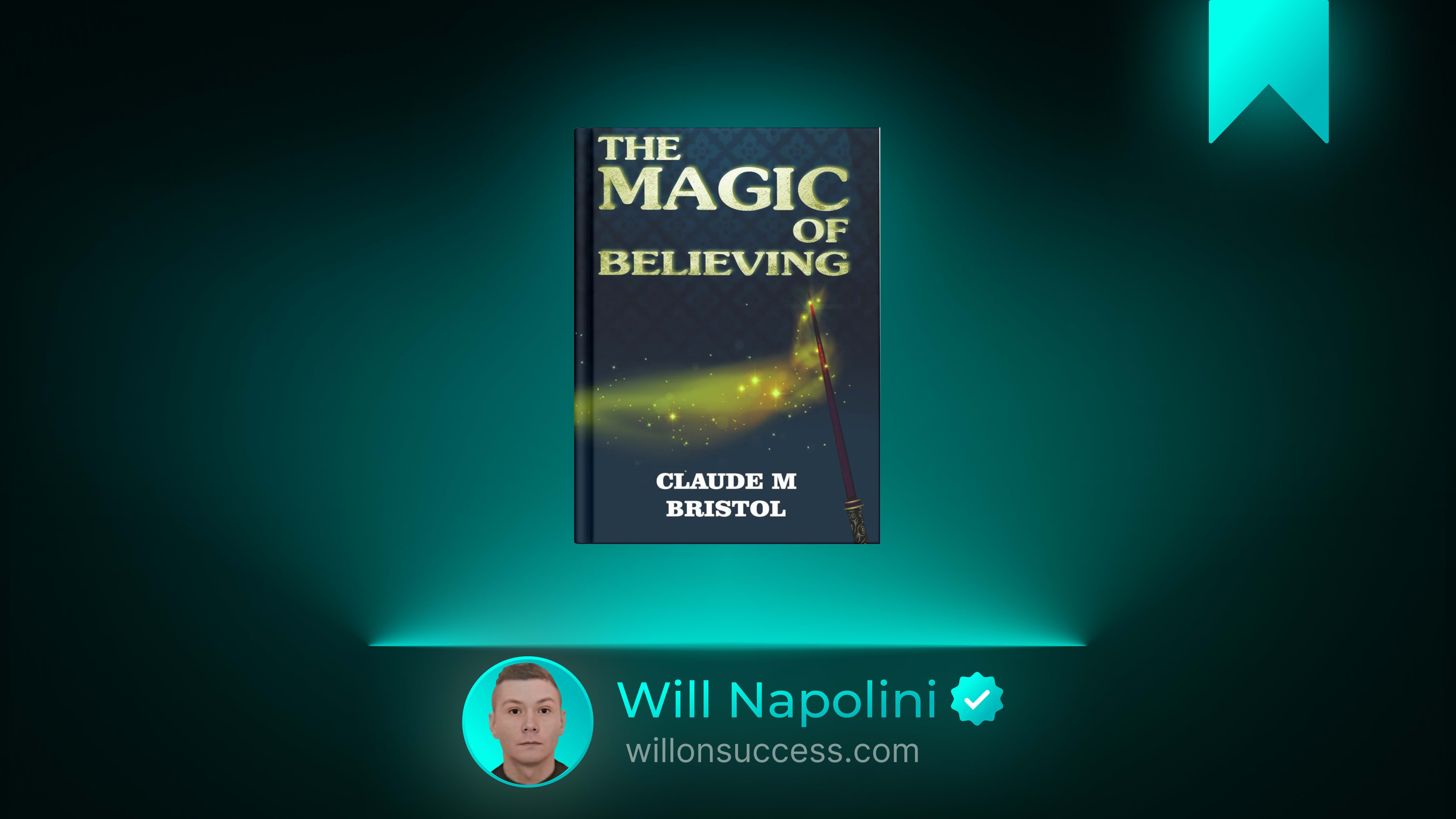
The Magic of Believing by Claude M. Bristol: Why What You Truly Believe Shapes Everything You Build
There is a gap that most people never close, and it has nothing to do with talent, opportunity, or effort.
It is the gap between wanting something and genuinely believing it is possible for you.
You can want a better career, a stronger relationship, financial stability, or a creative life with every conscious fiber of your being. You can work long hours, read books, attend seminars, and set goals every January. And still, something quietly holds you in place. Not laziness. Not lack of intelligence. Something deeper. A quiet, persistent voice beneath the surface that says, This isn’t really for you. This isn’t how your story goes.
Claude M. Bristol spent nearly two decades studying that voice. His 1948 book, The Magic of Believing, is not a collection of feel-good platitudes. It is a practical argument, built from years of interviewing successful people across industries, that belief is not a mood you wait to feel. It is a force you can build, direct, and use. And until you do, everything else you try will feel like pushing a boulder uphill.
I want to walk you through what Bristol discovered, because I think it addresses the exact place where most of us get stuck. Not at the starting line. Not at the finish line. But in that long, uncertain middle where the results haven’t shown up yet and your confidence starts to leak.
The Operating System Beneath Your Effort
Bristol’s central claim is deceptively simple: what you genuinely believe about yourself and your possibilities determines the range of outcomes you will accept, pursue, and ultimately create.
Not what you hope. Not what you wish. Not what you think would be nice. What you believe, in the deepest, most automatic layer of your mind.
He drew a distinction that I still find remarkably useful. Your conscious mind chooses. It sets goals, makes plans, says “I want to earn more” or “I want to write that book” or “I want to be the kind of parent who shows up.” But your subconscious mind builds. It takes whatever dominant impression you feed it and works on it relentlessly, shaping your habits, your reactions, your self-image, your tolerance for risk, your sense of what you deserve.
If your conscious mind says, “I am going to build a business,” but your subconscious holds the quiet conviction, “People like me don’t build businesses,” then every decision you make will bend back toward that deeper belief. You will hesitate at the moment that matters. You will sabotage a promising opportunity without fully understanding why. You will feel a strange relief when things return to familiar, smaller ground.
Bristol did not frame this as mystical thinking. He framed it as mechanics. The subconscious, he argued, does not judge whether an idea is true or false. It accepts what is impressed upon it with enough feeling and repetition, and then it organizes your behavior to match.
That insight, written nearly eighty years ago, still explains why so many capable people plateau. They are not fighting a lack of skill. They are fighting an old, unquestioned belief running quietly in the background.
Bristol’s Method: Belief as Something You Construct
One of the things I appreciate about this book is that Bristol does not leave you floating in abstraction. He was a journalist and a lawyer before he became a writer, and his mind was practical. He wanted to know: How does a person actually build belief when it isn’t already there?
His answer came in several layers, and together they form something like a training program for the inner life.
The written word as a programming tool. Bristol placed enormous emphasis on writing your goals and desires down by hand. Not typing them into an app. Not thinking them vaguely before sleep. Writing them, physically, with pen on paper, in clear and specific language. His reasoning was that the physical act of writing slows the mind, forces specificity, and impresses the idea more deeply than thought alone. The hand teaches the mind.
He encouraged readers to write out their primary goal as though it were already accomplished, in present tense, with emotional detail. Not “I hope to someday have a business that earns enough to give me freedom,” but a vivid, specific description of the life as though it were already unfolding. The purpose was not to delude yourself. The purpose was to give the subconscious a clear image to work toward, rather than a fog of vague wishing.
The mirror technique. Bristol described a practice that sounds almost too simple to matter, and yet many readers over the decades have reported it shifted something fundamental. The practice is this: stand before a mirror, look directly into your own eyes, and speak aloud what you believe about yourself and your future. Speak it with conviction, as though addressing someone you love and want to encourage.
The reason this works, Bristol suggested, is that most of us have never looked at ourselves with genuine, steady encouragement. We criticize. We compare. We look away. The mirror practice forces a confrontation with your own self-image and gives you the chance to revise it, deliberately, one sentence at a time.
Mental imagery as rehearsal. Bristol urged his readers to spend quiet minutes each day visualizing their desired outcome in rich sensory detail. Not as a fantasy escape, but as a rehearsal. He believed the subconscious responds to vivid, emotionally charged images almost as strongly as it responds to lived experience. By rehearsing success in the mind, you reduce the fear of the unfamiliar. You make the desired future feel less foreign. You give your nervous system permission to move toward it rather than flinch away.
Faith before evidence. This is perhaps the hardest principle in the book, and the most important. Bristol observed that most people wait to believe until they see proof. They want evidence first: evidence that they are capable, that the market will respond, that the relationship will hold, that the skill will develop. But Bristol argued that the order must often reverse. You must extend a measure of belief before the evidence arrives, because the evidence frequently depends on the actions that belief makes possible.
You do not need blind, reckless faith. You need enough belief to take the next step. Then the next. And the evidence accumulates behind you like footprints on a path you could not see from the starting point.
Why Doubt Is Not the Enemy You Think It Is
I want to be honest about something, because I think Bristol is honest about it too, and because a mentor who only talks about possibility without acknowledging difficulty is not a mentor. They are a salesperson.
Doubt is not a flaw. It is not proof that you are weak or that the book’s ideas do not apply to you. Doubt is often the residue of real experience. You tried something before and it did not work. Someone you trusted dismissed you. You failed publicly, or privately in a way that still stings. Those experiences wrote something into your subconscious, and pretending they did not happen is not the same as overcoming them.
Bristol understood this. He did not say, “Ignore your fear.” He said, in effect, acknowledge it, and then choose what you will feed. Because the subconscious will build from whatever you give it the most emotional attention. If you spend your evenings rehearsing every reason it will not work, you are programming just as surely as the person who rehearses success. You are simply programming a different outcome.
The work, then, is not to eliminate doubt. The work is to stop letting doubt be the only voice in the room.
You can hear the doubt and still write the sentence. You can feel the fear and still make the call. You can carry the uncertainty and still take the next small step. Belief, in Bristol’s framework, is not the absence of fear. It is the decision about which direction you will walk while the fear is still talking.
What This Looks Like on an Ordinary Tuesday
Let me bring this down to the ground, because principles that stay abstract do not change lives.
Suppose you have been wanting to transition into a new career but have not made a serious move. You tell yourself it is because the timing is wrong, the economy is uncertain, you need one more certification. And maybe some of that is true. But Bristol would ask you a harder question: Do you genuinely believe you are the kind of person who succeeds at that kind of work? Or do you carry a quiet conviction that it is for other people, people with different backgrounds, different confidence, different luck?
If the answer is the latter, no amount of networking strategy or résumé polishing will fully solve the problem, because the hesitation is upstream of the tactics.
On an ordinary Tuesday, applying Bristol’s ideas might look like this:
You sit down for ten minutes before the day’s noise begins. You write, by hand, a clear description of the work you want to be doing a year from now. Not a vague wish. A specific picture. The kind of problems you are solving. The people you are working alongside. The feeling of competence and contribution. You write it in the present tense, as though it is already unfolding.
Then you spend three minutes with your eyes closed, picturing yourself in that role. Not as a fantasy. As a rehearsal. You imagine the texture of the day, the conversations, the small satisfactions. You let yourself feel the quiet pride of being someone who belongs there.
Then you take one concrete action that the old belief would have talked you out of. You send the email. You sign up for the course. You tell one person out loud what you are working toward.
That is not magic. That is architecture. You are building a new self-image, one deliberate repetition at a time. And self-image, once rebuilt, changes what you will attempt, what you will tolerate, and what you will accept from your own life.
The Compound Effect of Small Beliefs
One of Bristol’s quieter insights, and the one I return to most often, is that belief does not arrive in a thunderclap. It accumulates.
You do not wake up one morning fully convinced of your own capability. You build that conviction the way a stone wall is built. One stone. Then another. Then another. Each kept promise to yourself is a stone. Each small act of courage is a stone. Each morning you choose the harder right over the easier wrong, you lay another course.
A small decision becomes a direction, and a direction held long enough becomes a life.
This is why Bristol emphasized consistency over intensity. He did not ask his readers to overhaul their entire self-concept in a weekend. He asked them to repeat the practice daily, patiently, the way a musician practices scales. Not because the scales are the music, but because without them, the music never comes.
You start small. You stay steady. You let the repetitions do their quiet work.
And one day, often without a clear moment of arrival, you realize the voice that once said this isn’t for you has gone quiet. Not because you shouted it down. Because you outgrew it. Because the evidence of your own small, consistent actions became louder than the old story.
Who This Book Is For, and Who It May Not Be
I want to be straightforward here. The Magic of Believing was written in 1948, and it carries the cadence and assumptions of its era. The prose is sometimes formal. Some examples feel dated. Readers looking for a modern, research-heavy, neuroscience-backed treatment of belief and mindset may find the book thin in places where they want citation and mechanism.
If you are someone who needs extensive scientific scaffolding before an idea feels credible to you, you may want to supplement Bristol with more contemporary work on neuroplasticity, cognitive behavioral principles, or the psychology of self-efficacy. The underlying ideas hold up, but the packaging is of its time.
That said, for the reader who is stuck not from a lack of information but from a lack of inner permission, this book can land with surprising force. If you know what you want to do but cannot seem to make yourself fully commit, if you sense that an old story about who you are is quietly governing your choices, if you have read every strategy book on the shelf and still feel held in place by something you cannot name, Bristol is speaking to you.
The book is also valuable for anyone in a season of rebuilding. After a failure, a loss, a divorce, a career collapse. When the old identity has been stripped away and you are not yet sure who you are becoming. Bristol’s framework gives you a way to begin constructing the next self-image deliberately, rather than waiting for circumstances to hand you one.
One Step You Can Take Before You Close This Page
I do not want to leave you with inspiration and no direction. Inspiration without a next step is just a pleasant feeling that fades by Thursday.
So here is what I would invite you to do today. Not tomorrow. Not after you have thought about it more. Today.
Take a blank sheet of paper and a pen. Sit somewhere quiet. Write one sentence that describes what you genuinely want your life to look like in one specific area, one year from now. Write it in the present tense, as though it is already true. Make it specific enough that you can picture it. Make it personal enough that it stirs something in your chest when you read it back.
Then sign your name beneath it. Put the paper somewhere you will see it tomorrow morning. Beside your coffee. On your desk. Taped to the bathroom mirror.
That is the first stone. You do not need to build the whole wall today. You need to lay one stone and believe that the wall is possible.
Bristol wrote this book because he had seen too many capable people living far below their range, not because they lacked skill, but because they had never been taught that belief was a skill too. Something you could practice. Something you could strengthen. Something you could aim at a target and trust to carry you forward.
You do not have to be someone else to begin. You do not have to feel ready. You do not have to silence every doubt before you take the first step. You simply have to decide, today, what you are willing to believe about yourself, and then give that belief something to work with.
The life you want is not waiting for you to become worthy of it. It is waiting for you to believe you are already on the way.
So pick up the pen. Write the sentence. And begin.