The Laws of Human Nature by Robert Greene: Why Understanding People Starts With Understanding Yourself
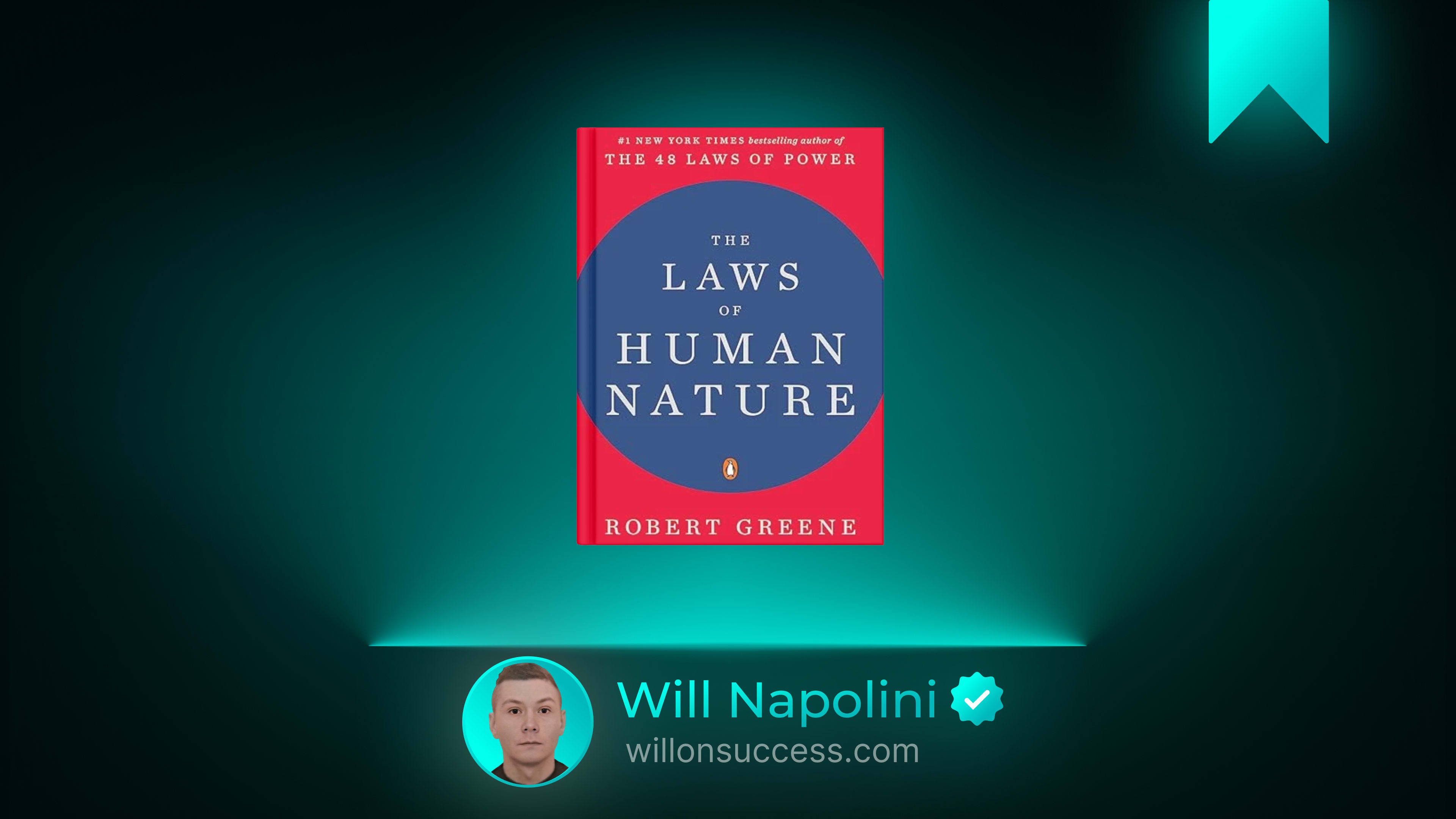
There is a version of yourself you have never fully met. Not the one you present in meetings, not the one you curate for friends, not even the one you think about when you lie awake at two in the morning. There is a deeper layer—patterns, impulses, old wounds, quiet envies, and automatic reactions that steer your choices long before your conscious mind catches up. And until you meet that version of yourself honestly, you will keep repeating the same mistakes while wondering why life feels stuck.
Robert Greene spent years studying this hidden layer. In The Laws of Human Nature, he distills what history, psychology, philosophy, and careful observation teach us about why people do what they do—including why you do what you do. The book is not a collection of tricks for manipulating others. It is something far more demanding and far more valuable. It is a mirror.
And like any honest mirror, it shows you things you might prefer not to see.
But here is what I have learned after sitting with these ideas for a long time: the discomfort of seeing yourself clearly is nothing compared to the cost of remaining blind. Every strained relationship, every repeated failure, every quiet resentment you carry—most of it traces back to some unconscious pattern you have never named. Greene’s book gives you the language to name those patterns. And once you can name them, you can begin to change them.
The Central Idea: You Are Not as Rational as You Believe
If I could sit across the table from you and share one insight from this book, it would be this: you are far more governed by emotion, habit, and unconscious drive than you realize. And that is not a flaw to be ashamed of. It is a starting condition to be understood.
Greene argues that most people move through life half-asleep at the wheel of their own behavior. They react instead of respond. They project their insecurities onto others. They chase what they think they want while ignoring what actually motivates them. They judge others harshly while excusing themselves generously. And they do all of this without noticing.
The book’s eighteen laws are not commandments. They are descriptions of forces already operating inside you and everyone around you. The Law of Irrationality. The Law of Narcissism. The Law of Compulsive Behavior. The Law of Envy. The Law of Grandiosity. The Law of Conformity. Each one names a current that pulls beneath the surface of your daily decisions.
The promise of the book is not that you will eliminate these forces. You cannot. They are woven into being human. The promise is that you can see them. And seeing them gives you a choice you did not have before.
You move from being controlled by your nature to working with it.
The Mask You Wear and the Mask You Miss
One of the ideas Greene returns to throughout the book is the gap between who people appear to be and who they actually are. He calls this the law of role-playing. In social life, everyone wears a mask—not out of malice, but out of necessity. We perform competence, confidence, kindness, or indifference depending on what the situation seems to require.
You already know this about other people. You have met the colleague whose charm dissolves the moment they are challenged. You have watched the friend whose generosity always comes with an unspoken ledger. You sense the performance.
But here is the harder question Greene asks: Do you see your own mask?
Most of us are excellent at detecting other people’s performances and remarkably blind to our own. You might present yourself as easygoing while quietly keeping score of every slight. You might frame your people-pleasing as kindness when it is actually fear of abandonment dressed in a pleasant outfit. You might call your stubbornness “integrity” because the alternative—admitting you are afraid of looking wrong—feels unbearable.
I have watched this play out in my own life more times than I would like to admit. The moments where I was most certain of my own objectivity were almost always the moments I was most deeply rationalizing. Greene’s framework gave me a way to pause and ask: Am I seeing this clearly, or am I seeing what protects my self-image?
That single question, asked honestly, changes everything.
The Shadow You Refuse to Name
Perhaps the most challenging law in the book is what Greene calls the Law of Repression. The idea is straightforward but unsettling: the qualities you most dislike in other people are often the qualities you have buried in yourself. The arrogance that infuriates you. The neediness you cannot stand. The aggression you pretend you never feel.
You did not destroy those parts of yourself. You pushed them underground. And underground, they do not disappear. They leak. They show up as sudden outbursts, passive-aggression, self-sabotage, or an intensity of judgment toward others that is wildly disproportionate to the situation.
Greene is not asking you to act on every dark impulse. He is asking you to acknowledge that those impulses exist. Because the person who says “I would never feel that” is far more dangerous than the person who says, “Yes, that is in me, and I choose what to do with it.”
Think of it like this. A river you dam does not vanish. The pressure builds silently until the wall cracks. But a river you channel—whose force you acknowledge and direct—can power something. Your anger can become boundaries. Your envy can become information about what you actually want. Your fear can become preparation instead of paralysis.
The goal is not to become a different person. The goal is to become a complete person. One who is no longer ambushed by their own hidden motives.
Your Environment Is Selecting Your Behavior for You
Greene devotes significant attention to the Law of Conformity, and this is where the book becomes urgently practical. When you are inside a group—a workplace, a family, a social circle, an online community—something shifts in your cognition. You begin to absorb the group’s emotions, assumptions, and standards without realizing it. Your critical thinking softens. Your desire to belong overrides your desire to be accurate.
This is not weakness. It is biology. Humans are social animals, and for most of our history, being cast out of the group meant death. Your brain still treats social exclusion as a survival threat.
But knowing this changes how you navigate it. If you understand that proximity shapes you—that you slowly become the average of the emotional tones, ambitions, and standards surrounding you—then you gain a lever. You can choose your environments with more intention. You can notice when a group is pulling you toward cynicism, laziness, or cruelty. You can step back and ask, Is this my thought, or did I absorb it from the room?
I have seen people spend five years in a workplace that rewarded complaint over initiative, and then wonder why their own ambition quietly eroded. They did not lose it in a single dramatic moment. It dissolved slowly, like salt in warm water, because the environment made dissolution the path of least resistance.
You do not need to cut every difficult person out of your life. But you do need to notice what you are absorbing. And sometimes you need to protect your inner climate the way you would protect a young plant from frost.
The Long View: Elevating Your Perspective
One of the quieter but more transformative ideas in the book is the Law of Shortsightedness. Greene observes that most people are trapped in the present moment’s emotional weather. They overreact to today’s insult, today’s setback, today’s minor inconvenience. They make decisions based on how they feel right now, which is almost always the worst possible basis for a decision that will affect them for years.
The antidote is not suppression. It is elevation. It is training yourself to widen the frame.
When something provokes you, Greene suggests stepping back and asking: Will this matter in six months? In five years? What would I advise a friend in this exact situation? What pattern am I reacting to, and when did that pattern start?
This is not about becoming cold or detached. It is about giving yourself enough space between stimulus and response that your values get to choose your action instead of your amygdala.
You start small. You pause before replying to the email that made your jaw tighten. You sleep on the decision instead of deciding at midnight. You ask yourself whether you are responding to what actually happened or to a story you are telling yourself about what happened. Over time, that pause becomes your greatest advantage. Not because the world stops being difficult, but because you stop being at its mercy.
Why This Matters on an Ordinary Tuesday
Let me bring this down from philosophy to Tuesday afternoon.
You are in a meeting. A colleague dismisses your idea with a wave of their hand. Your chest tightens. Your first impulse is to either shut down completely or fire back with something sharp.
Without awareness, you do one of those two things. You go home irritated. You rehearse the conversation in the shower. You mention it to your partner with more heat than the event deserves. You lose sleep.
With awareness—with Greene’s framework running quietly in the background—you notice the tightening. You recognize it. This is the old wound of not being taken seriously. This is not really about my colleague. This is about a feeling I have carried since I was nineteen and a professor laughed at my question.
You do not have to solve that wound in the meeting. You just have to not let it drive the car. You take a breath. You restate your idea calmly or let it go. You move on. The evening belongs to you instead of to a three-second interaction.
That is what these laws actually do. They do not make you superhuman. They give you back the few seconds between trigger and reaction. And those few seconds are where your entire quality of life lives.
Who Should Read This Book
If you are someone who finds yourself repeating the same relational patterns, attracting the same conflicts, or feeling quietly controlled by emotions you cannot name—this book will feel like someone finally turning on a light in a room you have been navigating by touch.
If you lead people, manage teams, raise children, or maintain long relationships, the sections on empathy, defensiveness, and group dynamics alone are worth the price of admission. Greene gives you a framework for understanding why people resist you, not just that they resist you.
If you are drawn to history and biography as teaching tools, the book is rich with them. Greene draws on figures spanning centuries to illustrate each law, and the stories are as instructive as the principles.
That said, I will be honest with you. This is not a quick read. It is dense, and at nearly six hundred pages, it asks for patience. If you are looking for a light, breezy afternoon of inspiration, this is not that book. It is a study. It rewards slow reading and reflection. Some readers may find Greene’s tone occasionally detached or his historical examples overwhelming. If you prefer brevity, you might read selectively—choosing the three or four laws that resonate most with your current struggle—and return to the others later.
But if you are willing to sit with it, the book will repay your attention many times over.
A Practical Beginning
You do not need to master all eighteen laws this week. You need one point of entry.
Here is what I would suggest. For the next seven days, choose one law—perhaps the one that made you slightly uncomfortable when you read about it, because discomfort is usually a sign of relevance—and observe it in your own life without judgment.
If you choose the Law of Irrationality, simply notice when your emotions are making decisions for you. Not to fix it. Just to see it. Write down one sentence each evening: Today, I reacted from emotion instead of clarity when…
If you choose the Law of Narcissism, notice where you are seeking validation instead of connection. Where you are performing instead of being present.
If you choose the Law of Envy, notice the small sting you feel when someone gets what you want. Do not judge the sting. Just acknowledge it. Ask yourself what it is telling you about your own unmet desires.
Seven days. One law. One sentence each night.
That is enough to begin. That is enough to shift something.
The Door Ahead
What Greene is really teaching, beneath all the historical examples and psychological frameworks, is something ancient and simple: the unexamined life is lived by your patterns instead of by your choices. You do not owe anyone a dramatic transformation. You do not need to become a different person by Friday. You need only to become a slightly more honest observer of yourself than you were yesterday.
You start with one pattern you recognize. You name it without shame. You give yourself the choice you never had when you were unconscious. You repeat that small act of awareness until it becomes who you are.
And here is what I want you to carry with you when you close this page: awareness is not a destination you arrive at once. It is a practice you return to every morning, like stretching a stiff muscle. Some days you will forget. Some days you will react on autopilot and catch yourself only hours later. That is not failure. That is the work. The fact that you noticed—even late—means the pattern is losing its grip.
You are not broken. You are simply becoming conscious of the machinery you have been running all along. And consciousness, even imperfect consciousness, is the beginning of freedom.
So tonight, before you sleep, ask yourself one question. Just one.
What did I do today that I did not fully choose?
Do not answer quickly. Sit with it. Let the honest answer surface.
And tomorrow, you will walk into the world a little more awake than you were today. That is enough. That is where everything changes.