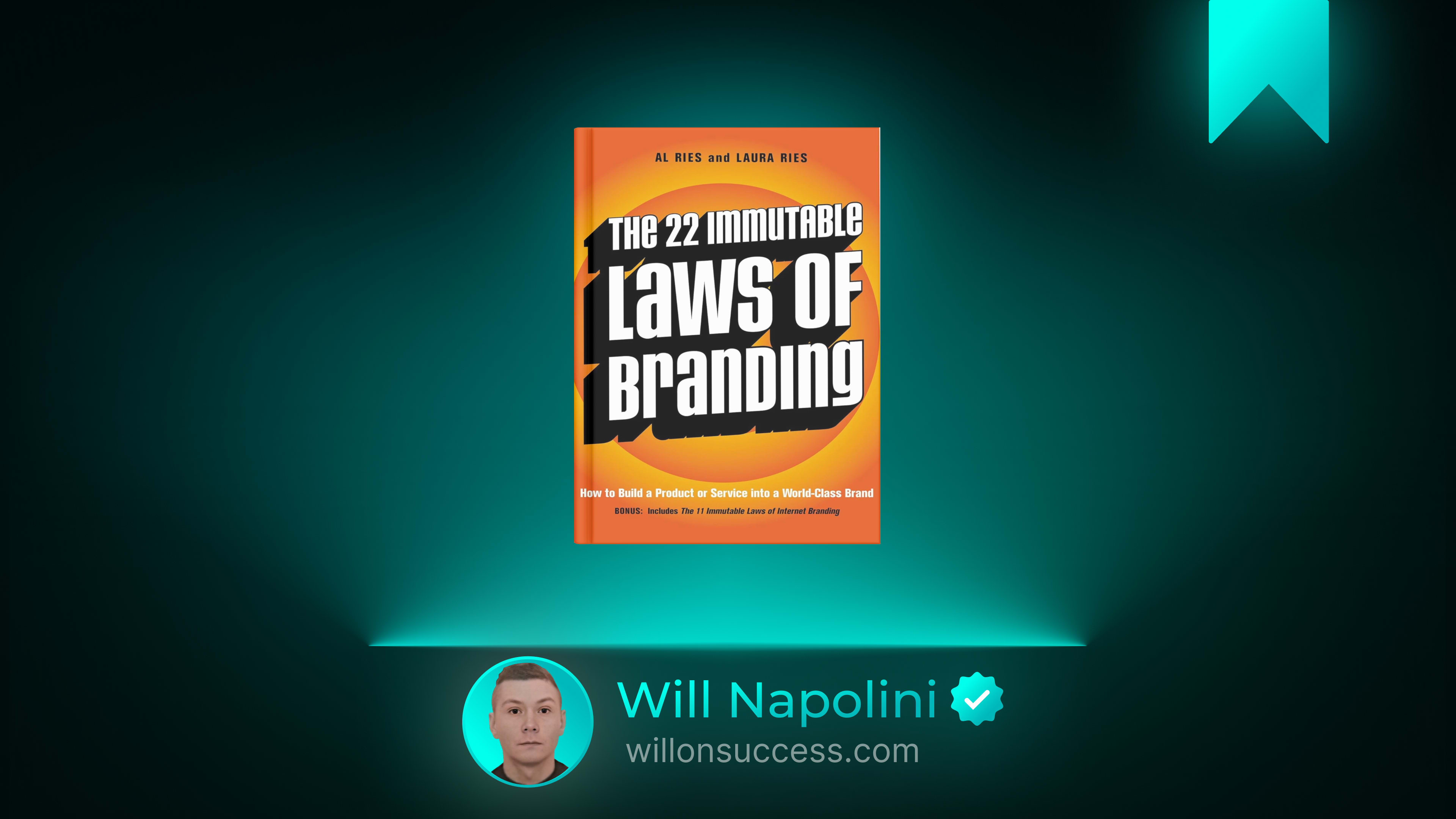
The 22 Immutable Laws of Branding Summary: How to Own Your Space in a Crowded World
I want to show you a dangerous trap that catches almost everyone who is trying to build something meaningful.
It is the belief that to be successful, you must be everything to everyone.
You may be working incredibly hard, adding new skills to your resume, taking on extra projects at work, and trying to appeal to every type of client or colleague. You tell yourself that you are being versatile. You tell yourself that you are keeping your options open. But deep down, you feel exhausted. You feel scattered. And worse, you feel entirely forgettable.
If I could sit across the table from you right now, I would tell you that this exhaustion is not a sign that you lack work ethic. It is a sign that you are violating a fundamental law of human perception.
Years ago, I realized that the rules governing how businesses build lasting companies are the exact same rules that govern how individuals build lasting careers. The human mind does not change its operating system just because you are a corporation instead of a sole proprietor.
This realization led me to a brilliant, no-nonsense book by Al Ries and Laura Ries: The 22 Immutable Laws of Branding. While it is written for business leaders and marketers, its underlying philosophy is a masterclass in personal clarity, strategic focus, and the courage to say no.
Here is what I have learned from their work, and how you can use it to stop being a well-kept secret and start becoming unforgettable.
The Big Idea: You Are Not What You Do; You Are What You Own in the Mind
The central thesis of The 22 Immutable Laws of Branding is deceptively simple: A brand is not a logo, a slogan, a color palette, or a feeling. A brand is a single, focused idea that owns a specific word or concept in the mind of the prospect.
When we hear this, we usually think of massive corporations. But let us translate this to your life. Your “brand” is your reputation. It is the singular concept that people associate with you when you are not in the room.
The authors argue that the human mind is deeply resistant to change and incredibly limited in its bandwidth. It does not want to process complex, nuanced, multi-faceted identities. It wants to file you away in a neat, simple category. If you try to force the mind to accept you as a “creative, analytical, empathetic, aggressive, detail-oriented, big-picture thinker,” the mind will simply reject the filing and forget you entirely.
To be remembered, you must sacrifice the many for the one. You must find the single word you want to own, and then align every action, every project, and every word you speak to that single concept.
The Mental Ladder: How Perception Actually Works
Before we look at the specific laws, you need to understand the mechanism of how the mind processes value. The authors introduce a concept called the “mental ladder.”
For every category in life, the mind builds a ladder. There is a ladder for “software,” a ladder for “coffee,” and a ladder for “consultants.” On each ladder, there are rungs.
If you are the leader in your field, you are on the top rung. If you are second, you are on the second rung. The crucial insight here is that the mind rarely remembers more than a few rungs on any given ladder. If you are on the fifth rung, you are essentially invisible to the conscious mind.
When I first understood this, it changed how I viewed my own career. I realized that trying to outwork the person on the top rung of my ladder was a fool’s errand. The mind has already decided who is on top. If you want to win, you do not fight for a lower rung on a crowded ladder. You either find a way to displace the leader, or you build a brand new ladder where you get to stand on the top rung.
This is not about arrogance. It is about understanding the physics of human attention.
Your Power Shrinks When You Try to Be Everything
The Law of Expansion and Contraction
One of the most counterintuitive ideas in the book is the relationship between a brand’s scope and its power. The authors state that the power of a brand is inversely proportional to its scope.
When a brand tries to expand its line to cover more products, more demographics, or more use cases, it loses its power. Conversely, when a brand contracts—when it narrows its focus and says no to opportunities—it actually grows stronger.
Think of a magnifying glass. When you hold it loosely and let the sunlight spread out, it merely warms the paper. But when you adjust the lens and contract the light into a single, tight focal point, it can start a fire.
You may be working hard and still wondering why nothing is changing because your light is spread too thin. You are offering ten different services, trying to maintain five different social media personas, and saying yes to every networking opportunity. You are warming the room, but you are not starting a fire.
I have seen professionals burn out because they refused to contract. They believed that adding one more skill to their repertoire would make them more valuable. But in the mind of the audience, adding more often dilutes the core message. If you are known as a “reliable accountant,” and you suddenly start offering “creative web design,” you do not become a double threat. You become a confusing option. The mind prefers a specialist over a generalist every single time.
You Can Only Own One Word
The Law of Singularity and The Law of the Word
A brand can only own a single word or concept in the mind of the prospect. This is the Law of Singularity. And the ultimate goal of your strategy should be to own that word. This is the Law of the Word.
Volvo owns “safety.” FedEx originally owned “overnight.” BMW owns “driving.”
Notice what these words are not. They are not slogans. “Safety” is not a slogan; it is a concept. “Just Do It” is a slogan, but it is not the word the brand owns.
What is the single word you want to own?
If I were to ask your colleagues, your clients, or your friends to describe you in one word, what would it be? If they hesitate, or if they give you three different words, you do not have a brand. You have a blur.
Choosing your word is not about picking the most impressive word. It is about picking the most true word, and then having the discipline to defend it. If your word is “clarity,” then every email you send, every presentation you give, and every project you take on must be an exercise in clarity. If you take on a project that is inherently messy and confusing, you are violating your own law.
Owning a word requires the courage to let some people down. If you own “speed,” you will lose the clients who want “cheap.” That is not a failure; that is the system working exactly as intended.
The Strategy Depends on Your Position
The Law of the Ladder
As we discussed with the mental ladder, your strategy must change depending on where you currently stand. The authors outline brilliant strategic moves based on your position, which translate perfectly to personal career growth.
If you are on the top rung (the leader), your job is to defend. You do this by reinforcing your core word and blocking competitors from entering your space. You stay focused.
If you are on the second rung, your job is to attack. But you do not attack the leader’s strength; you attack their weakness. If the leader is known for being comprehensive but slow, you do not try to be more comprehensive. You become the fast, agile alternative.
But what if you are on the third, fourth, or fifth rung? The authors are blunt here: you cannot win by playing the same game better. If you are a mid-level manager in a massive, highly competitive department, trying to out-work the director will only lead to exhaustion.
The solution is to create a new ladder. Redefine your category.
Instead of being a “mid-level marketing manager,” become the “expert in AI-driven customer retention.” You have just built a new ladder, and because you defined it, you are automatically on the top rung. You stop competing on their terms and start competing on yours.
Why This Matters on an Ordinary Tuesday
It is easy to read about the laws of branding and think, “That is great for a corporation launching a new product. But I am just trying to get through my work week.”
But consider what happens when you apply these laws to your daily life.
When you embrace the Law of Contraction, you stop saying yes to meetings that do not serve your core purpose. You stop taking on tasks just to prove you can. Your Tuesday becomes quieter, more focused, and infinitely more productive.
When you embrace the Law of the Word, your decision-making becomes effortless. When an opportunity arises, you simply ask, “Does this reinforce my core word?” If the answer is no, you decline. You no longer suffer from decision fatigue because your filter is built for you.
When you understand the Law of the Ladder, you stop feeling inadequate because you are not the top expert in a massive, crowded field. You gain the confidence to pivot, to niche down, and to build a space where you are the undisputed authority.
These laws do not just build better companies. They build saner, more focused, and more effective human beings.
Practical Application: Turning Principles into Behavior
Understanding these laws is only the first step. Action before intention. Here is how you can apply them to your life starting today.
1. Conduct a Contraction Audit
Look at your current professional and personal commitments. List everything you are doing. Now, ask yourself: “Which of these activities are diluting my core message?” Identify the bottom 20% of tasks, projects, or obligations that take up your time but do not reinforce the single word you want to own. Eliminate, delegate, or pause them for the next thirty days.
2. Define Your Single Word
Take a piece of paper and write down the three words you most want to be known for. Now, force yourself to cross out two of them. You are only allowed to keep one. Once you have that single word, write it at the top of your daily planner. Before you send an important email, before you speak in a meeting, ask yourself: “Does this reflect my word?”
3. Check Your Ladder Position
Identify the “ladder” you are currently climbing in your career or industry. Where are you on it? If you are on the top two rungs, double down on your core strengths and defend your position. If you are on the third rung or lower, stop trying to climb the existing ladder. Spend one hour this week brainstorming how you can combine your unique skills to create a completely new category—a new ladder where you can stand at the top.
Who Should Read This Book
The 22 Immutable Laws of Branding is essential reading for entrepreneurs, business owners, and marketers who are struggling to differentiate their products in a crowded market. It will save you from spending thousands of dollars on aesthetic rebrands that do not actually change how the market perceives you.
However, it is equally valuable for anyone managing their own career, freelancers, consultants, and professionals who feel stuck in the middle of their industry.
Who might find it less useful? If you are looking for a book on graphic design, visual aesthetics, or the tactical execution of social media marketing, this is not it. This book is about the deep, psychological strategy of perception. It is about the foundation, not the paint.
One Small Step
You do not need to overhaul your entire life today. You just need to create a small shift in momentum.
Here is your one small step: Identify one commitment, project, or habit you currently have that dilutes your focus. It is something you do out of obligation, but it does not align with the single word you want to own.
Cancel it, decline it, or pause it for the next seven days.
Notice how it feels to reclaim that time and mental energy. Notice the relief of saying no.
The Courage to Be One Thing
We live in a culture that constantly encourages us to expand. We are told to diversify our income, multiply our skills, and broaden our appeal. We are terrified that if we narrow our focus, we will miss out on an opportunity.
But the deepest lesson of The 22 Immutable Laws of Branding is that true power does not come from addition. It comes from subtraction.
You do not become unforgettable by trying to mean everything to everyone. You become unforgettable by deciding to mean one thing, completely, and refusing to compromise it.
The world does not need more people who are trying to be everything. It needs people who have the courage to be exactly one thing, deeply and undeniably. Find your word. Build your ladder. And let everything else fall away.