Escaping the Trap of 'Either/Or': How to Make Decisions That Actually Hold Up
There is a specific kind of paralysis that sets in when you are facing a major life decision. You sit at your kitchen table, staring at a blank notebook, turning the same two options over and over in your mind. Should I stay in this secure job that drains me, or should I quit and risk everything to start my own business? Should I move across the country for this relationship, or should I stay here and protect my independence?
You weigh the pros. You weigh the cons. You lose sleep. You ask your friends for advice, and when they give it, you find reasons why it doesn’t apply to you.
If I could sit across the table from you right now, I would tell you something that might surprise you: The reason you are stuck is rarely because the choice is too hard. You are stuck because you have been tricked into believing there are only two choices at all.
We spend our lives agonizing in a room with only two doors, wondering which one to walk through, never realizing we could just open a window.
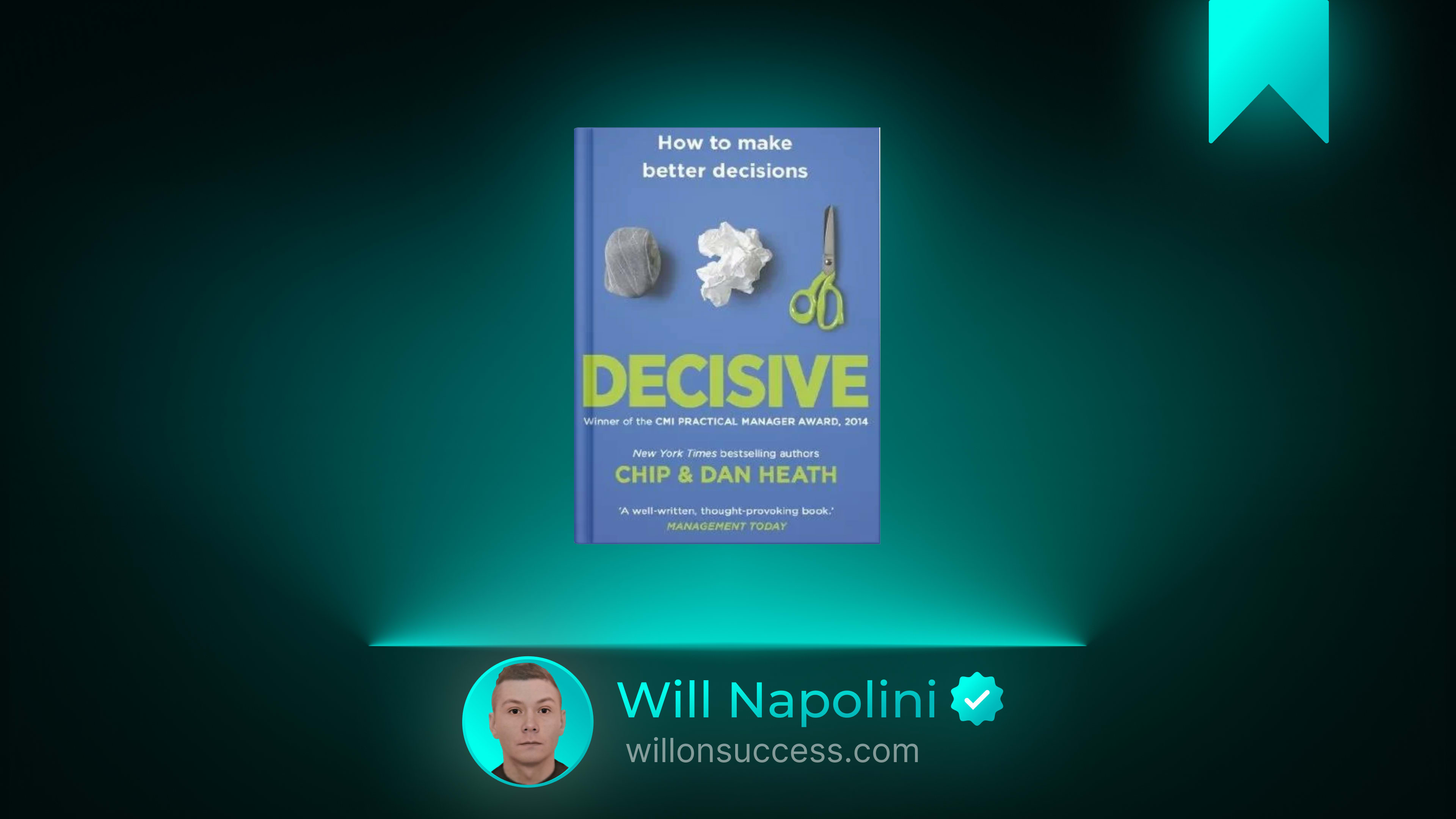
I have watched brilliant, capable people paralyze themselves for years because they did not understand the mechanics of their own minds. We tend to believe that good decision-making is a matter of raw intelligence, or “trusting your gut,” or simply having more willpower. But Chip and Dan Heath, in their deeply practical book Decisive: How to Make Better Choices in Life and Work, argue that this is entirely backward.
You do not need more intuition. You do not need to be smarter. You need a better process. Because your brain, as remarkable as it is, is wired with predictable flaws. And until you build a system to bypass those flaws, you will keep making the same kinds of mistakes, no matter how hard you think.
The Big Idea: The Four Villains of Decision Making
The Heath brothers begin with a humbling premise: Human beings are fundamentally flawed decision-makers. Evolution equipped our brains to survive on the savanna, not to navigate the complex, long-term strategic choices of the modern world.
When we make a choice, our thinking is routinely hijacked by four “villains”:
- Narrow Framing: We artificially restrict our choices to a binary “this or that,” ignoring the vast spectrum of alternatives.
- Confirmation Bias: We naturally seek out information that supports what we already want to do, and we ignore data that contradicts it.
- Short-Term Emotion: We allow the visceral, temporary feelings of the present moment to override our long-term values and goals.
- Overconfidence: We are far too certain about how the future will unfold, assuming our predictions are facts.
You cannot simply “try harder” to defeat these villains. They are baked into your neurology. What you can do, however, is adopt a counter-process. The Heaths call it the WRAP framework: Widen your options, Reality-test your assumptions, Attain distance before deciding, and Prepare to be wrong.
This is not a list of motivational platitudes. It is an architectural blueprint for building a decision that will hold up when the weather gets rough.
The Story of the Empty Office: A Lesson in Perspective
To understand how powerful a shift in process can be, we have to look at one of the most famous corporate turnarounds in history, which the Heaths use to anchor their work.
In the mid-1980s, Intel was losing its dominance in the memory chip market to Japanese competitors. The company’s co-founders, Andy Grove and Gordon Moore, were agonizing over what to do. They were emotionally attached to memory chips; it was the product that had built the company. The “either/or” frame was suffocating them: Do we fight a losing battle to save our core business, or do we concede defeat?
One day, Grove looked at Moore and asked a brilliant, perspective-shifting question: “If we got kicked out and the board brought in a new CEO, what do you think he would do?”
Moore thought for a moment and replied, “He would get us out of memories.”
Grove stood up and said, “Why shouldn’t you and I walk out the door, come back in, and do it ourselves?”
They did exactly that. They walked out, left their emotional baggage in the hallway, walked back in as “new” CEOs, and pivoted Intel to microprocessors. It saved the company and changed the trajectory of the computing world.
Grove did not suddenly become smarter in that moment. He simply used a tool to bypass short-term emotion and narrow framing. He forced himself to look at the problem through the eyes of someone who was not burdened by the past.
This is the essence of Decisive. You do not need to be a genius to make a genius-level decision. You just need to know how to step outside your own head.
Widen Your Options: Escaping the “Either/Or” Trap
The first villain, narrow framing, is the most insidious because it feels like clarity. When you ask, “Should I break up with my partner or stay?” you feel like you are tackling the problem. But you have defined the universe of possibilities down to two extreme poles.
The Heaths introduce a brilliantly simple tool to break this trap: The Vanishing Options Test.
Imagine that your current top two options are suddenly taken off the table. You cannot stay in your current job, and you cannot take the new job you were just offered. What else would you do?
Suddenly, your brain is forced to work. You might realize you could take a sabbatical. You could pivot to a different department. You could start consulting on the side. You could move to a smaller company in a different industry. By artificially removing your default choices, you force your brain to search the wider landscape.
Another tool they offer is multitracking. Instead of pursuing one option at a time, keep two or three options alive simultaneously. If you are hiring for a role, interview three finalists deeply rather than falling in love with the first decent candidate. If you are designing a product, have two teams build two different prototypes. Multitracking keeps you honest, because it provides a built-in point of comparison. It prevents you from settling for the first thing that looks “good enough.”
Reality-Test Your Assumptions: Defeating the Echo Chamber
Once you have a few options, the second villain arrives: confirmation bias. We are our own worst lawyers. When we lean toward a choice, we unconsciously start building a legal case to justify it. We highlight the positive reviews, we downplay the risks, and we ask our most supportive friends for their opinions.
To reality-test your assumptions, you have to deliberately invite disagreement. The Heaths suggest a practice they call considering the opposite. Force yourself to ask: What would have to be true for this option to be the wrong choice?
You also need to change the way you ask for advice. If you ask a colleague, “Do you think this marketing campaign is good?” they will likely tell you what they think you want to hear. But if you ask, “What is the biggest vulnerability in this campaign that I am not seeing?” you give them permission to be honest.
But the most powerful way to reality-test is not to think more; it is to act a little. The Heaths call this ooching—running small, low-risk experiments to test your assumptions.
If you think you want to go to law school, do not just research the curriculum. Go ask a lawyer if you can shadow them for a week, or interview three burned-out attorneys about the worst parts of their job. If you think you want to move to a new city, do not just look at Zillow. Go rent an Airbnb in that neighborhood for a week in the rainiest month of the year.
You cannot think your way out of a confirmation bias. You have to bump up against reality. Put your toe in the water before you dive into the deep end.
Attain Distance Before Deciding: Quieting the Noise of the Present
The third villain is short-term emotion. When we are making a decision, our current emotional state acts like a loud, distorting megaphone. If you are angry, every risk looks like a threat. If you are infatuated, every red flag looks like a charming quirk. If you are exhausted, the easiest option looks like the best option.
The Heaths borrow a brilliant framework from business writer Suzy Welch called the 10/10/10 rule. When you are caught in the grip of a highly emotional decision, force yourself to ask three questions:
How will I feel about this decision in 10 minutes? How will I feel about it in 10 months? How will I feel about it in 10 years?
The 10-minute question forces you to acknowledge the immediate, visceral payoff or pain (the relief of sending an angry email, the anxiety of having a hard conversation). The 10-month question forces you to look at the medium-term consequences. But the 10-year question pulls you up to the altitude of your core values.
I have seen this rule save marriages and careers. It creates a wedge between the stimulus and your response. It reminds you that the person you are right now, in this highly charged emotional state, is not the person who has to live with the consequences.
We treat our future selves like strangers we are trying to impress, rather than partners we are trying to protect. Attaining distance is simply the act of extending empathy to the person you will be tomorrow.
Prepare to Be Wrong: Building a Margin for the Unknown
The final villain is overconfidence. We assume that once we make the decision, the future will unfold exactly as we planned. We build our lives on best-case scenarios, and when reality inevitably deviates, we are caught entirely off guard.
Daring decision-makers do not just predict the future; they prepare for their own ignorance. The Heaths suggest two primary tools for this.
The first is bookending the future. Instead of making a single prediction (“This new product will make $1 million”), estimate the lower and upper bounds. (“It might make $200,000, or it might make $3 million”). Then, ask yourself: If the lowest bookend happens, how will we survive? If the highest bookend happens, how will we handle the surge? This prevents you from betting the farm on a single, fragile assumption.
The second tool is the tripwire. A tripwire is a pre-committed trigger that forces you to re-evaluate a decision in the future. It is a promise you make to your future self to prevent you from falling into the “sunk cost fallacy.”
For example, you might say: “I am going to invest in this new business venture. But I am setting a tripwire. If we have not reached 500 active users by December 31st, we will shut it down without debate.”
Without a tripwire, human beings will rationalize failure forever. We will say, “We just need one more month,” or “The market is just slow right now.” A tripwire removes the emotion from the pivot. It allows you to make a bold choice today, knowing you have built a safety net of rationality for tomorrow.
Why This Matters on an Ordinary Tuesday
You might be thinking that this level of rigor is only necessary for Fortune 500 CEOs or people buying a house. But the architecture of your life is built entirely out of small, ordinary decisions.
Every time you choose how to spend your Saturday, you are making a decision about your values. Every time you choose whether to speak up in a meeting or stay quiet, you are making a decision about your career trajectory. Every time you choose to scroll on your phone instead of talking to your child, you are making a decision about your relationships.
If you rely on “gut feeling” for these daily choices, you will simply be reacting to your most recent meal, your current mood, or the last article you read.
A good decision is not judged by its outcome, because luck plays a massive role in life. You can make a brilliant, well-researched decision and still fail because of a market crash. You can make a reckless, impulsive decision and get rich because you got lucky.
But over a lifetime, luck evens out. Process compounds. If you consistently use a process that widens your options, tests your biases, creates emotional distance, and prepares for the unknown, you will inevitably build a life of greater agency, fewer regrets, and deeper alignment with who you actually want to be.
Practical Application: Three Exercises to Build Your Process
Understanding the WRAP framework is valuable, but a process only works if you use it. Here are three concrete ways to apply this to your life this week.
1. Run the Vanishing Options Test on Your Biggest Dilemma Identify the decision that is currently keeping you up at night. Write down the two options you have been agonizing over. Now, cross them both out. Assume a force outside your control has made both of those choices impossible. Set a timer for ten minutes and write down three entirely different paths you could take. You do not have to choose one of them. But simply generating them will break the psychological lock of the “either/or” trap and introduce fresh oxygen into your thinking.
2. Conduct a “Pre-Mortem” on Your Next Project Before you launch your next initiative, sign the lease on your new apartment, or commit to a major project, gather your stakeholders (or just sit down with a journal) and run a pre-mortem. Say: “Imagine it is one year from now, and this decision was a total, unmitigated disaster. What went wrong?” Write down the specific failures. By forcing yourself to look at the downside before you are emotionally invested in the upside, you will spot the tripwires you need to set today.
3. Apply the 10/10/10 Rule to an Avoided Conversation Think of a difficult conversation you have been putting off because of short-term emotion (fear of conflict, awkwardness, or guilt). Run it through Suzy Welch’s framework. In 10 minutes, you will feel anxious and uncomfortable. In 10 months, you will likely feel a sense of relief and clarity that the truth is finally out in the open. In 10 years, you will be glad you had the courage to address it rather than letting it quietly rot the foundation of the relationship. Let the 10-year perspective give you the courage to make the call today.
Who Should Read This Book
Decisive is for anyone who has ever looked back at a major life choice and thought, How did I not see that coming? It is for leaders who want to build teams that make rigorous, unbiased choices. It is for chronic overthinkers who need a structured way to break out of analysis paralysis. And it is for impulsive decision-makers who need a system to force them to slow down and look at the road ahead.
It is highly practical, deeply researched, and written with the engaging, story-driven clarity that the Heath brothers are known for.
It may be less useful for someone looking for deep, therapeutic exploration of why they self-sabotage or fear success. This book is a cognitive and behavioral toolkit, not a psychoanalytic one. It will not heal your childhood wounds, but it will give you a highly effective flashlight to navigate the dark room those wounds put you in.
What makes it genuinely worth your time is its profound respect for human limitation. The Heaths do not ask you to become a flawless, purely rational being. They ask you to accept that you are human, and to build a scaffolding that supports you when your humanity gets in the way.
One Small Step
You do not need to overhaul your entire life today. You do not need to map out the next ten years of your career before dinner.
You just need to do one thing.
Think of one decision you have been delaying because it feels too heavy, too complex, or too risky. Take out a piece of paper and draw a line down the middle. On the left side, write down everything you stand to lose if you make the change. On the right side, write down everything you stand to lose if you stay exactly where you are.
We are incredibly good at calculating the cost of action. We are terrible at calculating the cost of inaction.
Look at the right side of that page. That is the price of your current comfort. Once you see it clearly, the fear of the unknown often becomes smaller than the fear of the known.
A decision is not a blind leap into the dark. It is a bridge you build, plank by plank, before you ever take a step. Start laying the first plank today.