What a Dying Professor Taught Me About Living Well
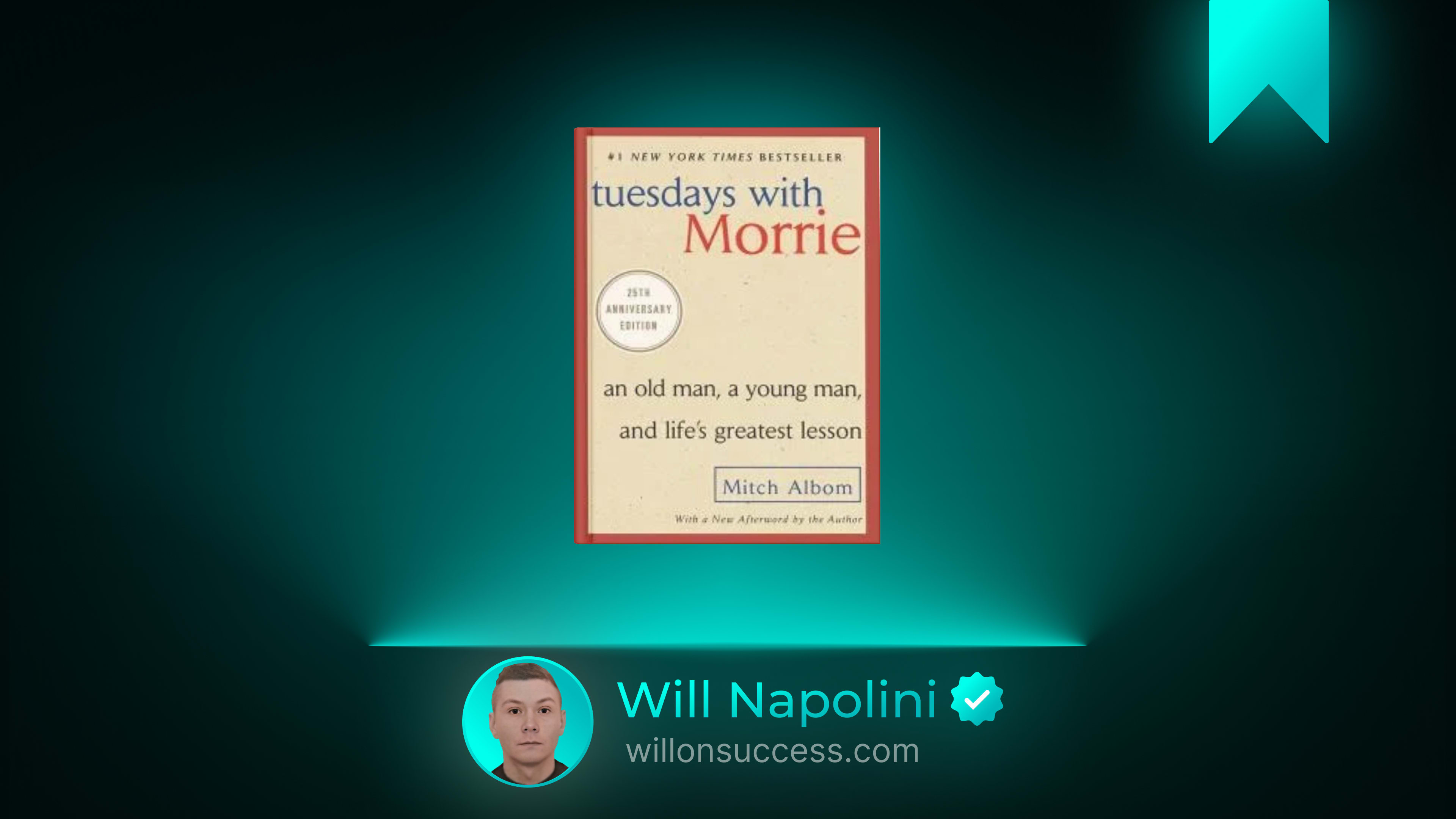
I have learned that most of us are sleepwalking through our lives.
We are not asleep in the literal sense. We are working. We are scrolling. We are planning. We are worrying. But we are rarely awake to what actually matters. We confuse movement with progress. We confuse accumulation with fulfillment. We confuse being busy with being alive.
Mitch Albom was one of us. He was a successful sports journalist, climbing the ladder, chasing deadlines, building a career that looked impressive from the outside but felt hollow on the inside. He had lost touch with the person who used to care about ideas, about connection, about the soul of things.
Then he heard that Morrie Schwartz, his favorite college professor, was dying of ALS.
Morrie was not just a teacher. He was the kind of mentor who saw you. Really saw you. In college, Mitch had promised to stay in touch. He didn’t. Life got in the way. Career got in the way. The comfortable drift of adulthood got in the way.
But when Mitch heard Morrie was sick, something pulled him back. He visited. Then he visited again. And again. Every Tuesday, for sixteen weeks, until Morrie took his last breath.
These were not casual visits. They were final lectures. But unlike the classes Mitch had taken years before, these were not about sociology or theory. They were about life. About love. About work. About family. About forgiveness. About death.
Morrie knew he was dying. He did not pretend otherwise. He did not rage against the inevitable. Instead, he used his remaining time to distill everything he had learned into a curriculum for living. He called it his “final thesis.”
And here is what I want you to understand: You do not need to be dying to take this class. You only need to be willing to pay attention.
Detaching From the Culture That Confuses You
One of the first things Morrie taught Mitch was about the water we swim in without noticing.
Morrie called it “the culture.” By this, he meant the dominant values of our society: the belief that more is better, that youth is superior to age, that material success equals personal worth, that speed is a virtue, and that vulnerability is weakness.
He told Mitch, “Don’t let the culture wash away your values.”
This is harder than it sounds. The culture is loud. It is everywhere. It is in the advertisements telling you that you are not enough unless you buy this car, wear this brand, or look like this image. It is in the workplace rewarding hours logged over impact made. It is in the social media feeds comparing your behind-the-scenes to everyone else’s highlight reel.
Morrie’s insight was simple but radical: If you do not define your own values, the culture will define them for you. And the culture’s values are designed to keep you consuming, not living.
I have seen this happen to good people. I have seen talented individuals burn out chasing promotions they didn’t actually want. I have seen families drift apart because everyone was too busy building a resume to build a relationship. I have seen people reach the top of the mountain only to realize they climbed the wrong one.
The problem is not ambition. The problem is unconscious ambition. It is moving fast in a direction you never chose.
Morrie suggested a practice: detachment. Not detachment from life, but detachment from the cultural narrative. He encouraged Mitch to question everything. Why do I want this? Who told me this was important? Is this true for me, or is it just what I’ve been trained to believe?
This is not cynicism. It is clarity.
When you detach from the culture’s definition of success, you create space to discover your own. You stop asking, “How can I get more?” and start asking, “What is enough?” You stop measuring your life in dollars and start measuring it in moments.
You may be working hard right now, wondering why you still feel empty. It may be because you are succeeding at a game you never wanted to play.
Love Is the Only Rational Answer
If there is one sentence that captures the heart of Morrie’s teaching, it is this: “Love wins. Love always wins.”
This sounds sentimental. It sounds like something you would find on a greeting card. But Morrie did not mean romantic love, or the fleeting excitement of new attraction. He meant something far deeper. He meant the fundamental human need to connect, to care, and to be cared for.
He told Mitch, “Without love, we are birds with broken wings.”
In our modern world, we often treat love as optional. We prioritize career, independence, self-sufficiency. We view dependence as a flaw. We guard our hearts because getting hurt is painful. So we build walls. We keep things superficial. We stay busy so we don’t have to feel the ache of loneliness.
Morrie argued that this is a mistake. A fatal one.
He believed that human beings are not designed to go it alone. We are social creatures. We thrive in community. We wither in isolation. And the only thing that sustains us through the difficulties of life—through illness, through loss, through aging—is the knowledge that we are loved and that we love others.
This is not just emotional advice. It is practical survival strategy.
Think about the hardest moments in your life. The grief. The failure. The fear. What got you through? Was it your bank account? Your job title? Your follower count? Or was it the hand of a friend? The voice of a partner? The presence of someone who simply sat with you?
Morrie was losing his body. He could no longer walk. He could no longer feed himself. He was becoming increasingly dependent on others. And yet, he said he had never felt more alive. Why? Because he allowed himself to be loved. He accepted help. He gave love in return. He deepened his connections even as his physical world shrank.
He taught Mitch that loving someone is not a risk. It is the only rational choice. Because in the end, when everything else falls away—when the career ends, when the money runs out, when the body fails—love is what remains.
You may be holding back right now. You may be protecting yourself from pain. But I would ask you: What is the cost of that protection? Is it worth the loneliness? Is it worth the shallow connections? Is it worth arriving at the end of your life with no one to hold your hand?
Love is risky. But isolation is deadly.
Forgiveness Is a Gift You Give Yourself
One of the most powerful chapters in the book deals with regret.
Morrie had regrets. He admitted them freely. He regretted not staying in touch with friends. He regretted working too hard at times. He regretted moments of pride or distance.
But he did not let regret poison him. Instead, he practiced forgiveness.
He told Mitch, “Forgive yourself. Forgive others. Don’t wait.”
This is difficult advice. We live in a culture that holds grudges. We replay arguments in the shower. We nurse wounds from years ago. We tell ourselves stories about how we were wronged, how we were misunderstood, how we were betrayed. These stories become part of our identity. We carry them like heavy stones in our pockets, wondering why we are so tired.
Morrie’s perspective was different. He saw forgiveness not as letting someone else off the hook, but as freeing himself. Holding onto anger, he realized, was like drinking poison and expecting the other person to die.
He also emphasized forgiving yourself. Many of us are our own harshest critics. We beat ourselves up for past mistakes. We dwell on opportunities missed, words spoken in anger, paths not taken. We punish ourselves long after the event has passed.
Morrie urged Mitch to make peace with his past. To acknowledge the mistakes, learn from them, and then let them go. To understand that he was doing the best he could with the knowledge he had at the time.
This does not mean ignoring responsibility. It means releasing the shame that prevents growth.
I have learned that you cannot build a future on a foundation of self-hatred. You cannot move forward if you are constantly looking backward in judgment. Forgiveness is the bridge between who you were and who you are becoming.
Ask yourself: Who are you still angry with? Who are you still punishing? And most importantly, who are you refusing to forgive?
It may be time to put the stone down.
Death Teaches Us How to Live
The title of the book includes the word “dying,” and for good reason. Morrie was dying. He did not hide it. He did not pretend he was getting better. He spoke openly about his declining health, his fears, his frustrations.
And in doing so, he taught Mitch—and us—one of the most important lessons of all: Confronting death makes life more vivid.
Most of us live as if we have infinite time. We postpone joy. We delay reconciliation. We put off dreams. We say, “I’ll do that when I retire,” or “I’ll say that when the time is right,” or “I’ll visit them next year.”
But Morrie knew there might not be a next year. There might not even be a next month. This awareness did not make him depressed. It made him urgent. It made him present. It made every cup of coffee, every conversation, every breeze on his face feel precious.
He told Mitch, “Once you learn how to die, you learn how to live.”
This sounds paradoxical. But think about it. When you realize that time is finite, you stop wasting it. You stop arguing about trivial things. You stop caring about opinions that don’t matter. You stop chasing things that won’t bring satisfaction. You focus on what is essential.
Death is not the enemy of life. Indifference is.
Morrie’s illness forced him to strip away the non-essential. He could no longer work. He could no longer travel. He could no longer control much of anything. So he focused on what he could control: his attitude, his connections, his presence.
He showed Mitch that aging is not a decline to be feared, but a process to be embraced. Each stage of life has its gifts. Youth has energy. Middle age has experience. Old age has wisdom. If you reject old age, you reject the culmination of your life’s learning.
We live in a youth-obsessed culture. We dye our hair. We filter our photos. We hide our wrinkles. We act as if aging is a disease to be cured. Morrie saw it differently. He saw it as natural. As inevitable. As part of the cycle.
By accepting death, he was able to fully inhabit life.
You do not need to be terminally ill to learn this lesson. You only need to remember that your time is limited. That one day, you will take your last breath. That one day, the people you love will be gone.
This is not morbid. It is motivating. It is the fire that burns away the trivial and leaves only the gold.
Creating Your Own Meaning
Perhaps the most empowering idea Morrie shared was this: You create your own meaning.
There is no pre-written script. There is no universal rulebook that says, “Do X, and you will be happy.” Society offers templates: go to school, get a job, buy a house, raise kids, retire. But these are not guarantees of fulfillment. They are just options.
Morrie encouraged Mitch to examine his life and decide what mattered to him. Not what mattered to his parents. Not what mattered to his boss. Not what mattered to the culture. But what mattered to him.
For Morrie, meaning came from teaching, from connecting, from giving. For you, it might come from creating, from exploring, from serving, from building. The source is less important than the intentionality.
The danger is drifting. It is letting life happen to you rather than making life happen. It is waking up at sixty and realizing you spent forty years living someone else’s dream.
Morrie’s classroom was his living room. His textbook was his experience. His exam was his daily choices. And he passed with flying colors because he chose his values consciously.
You have that same power. You can decide today what matters. You can decide to prioritize relationships over revenue. You can decide to value peace over prestige. You can decide to measure success by joy rather than jewelry.
But you must decide. No one else will do it for you.
Why This Book Matters Now
Tuesdays with Morrie was published in 1997, but it feels more relevant today than ever.
We are more connected than any generation in history, yet we report higher levels of loneliness. We have more information at our fingertips, yet we struggle with wisdom. We have more comforts, yet we suffer from anxiety and depression.
We are drowning in noise and starving for signal.
Morrie offers signal. He offers a quiet, steady voice reminding us of what we already know but have forgotten: That love matters. That connection matters. That kindness matters. That how we treat each other matters more than what we accumulate.
This book is not a complex philosophical treatise. It is simple. Some might call it simplistic. But simplicity is not the same as shallow. Water is simple. Air is simple. And we cannot live without them.
Morrie’s wisdom is like water. It is basic. It is essential. It is life-giving.
Who Should Read This Book
This book is for anyone who feels like they are running on a treadmill that is moving too fast.
It is for the young professional who is successful but unfulfilled.
It is for the parent who is so busy providing for their family that they forget to be present with them.
It is for the person grieving a loss and searching for meaning.
It is for the aging individual who fears irrelevance.
It is for anyone who has ever asked, “Is this all there is?”
However, if you are looking for a tactical guide to productivity, a step-by-step plan for wealth, or a scientific analysis of happiness, this is not that book. Morrie does not give you hacks. He gives you perspective. He does not give you shortcuts. He gives you truth.
If you are unwilling to slow down, to reflect, to confront uncomfortable truths about your priorities, you may find this book frustrating. It requires patience. It requires humility. It requires a willingness to be changed.
But if you are ready to sit in the classroom of life and learn from someone who has lived it fully, this book is a gift.
One Small Step
Knowledge without action is merely entertainment. Morrie did not just talk about living; he lived. He practiced what he preached. He showed up. He loved. He forgave. He let go.
So here is my challenge to you. Do not just close this article and move on to the next thing. Do not just nod in agreement and forget.
Take one small step today.
Choose one person you love. It could be a partner, a parent, a child, a friend. Someone you have been distant from, or someone you simply haven’t expressed your appreciation to lately.
Reach out to them. Not with a text. Not with a like. But with a call. Or better yet, a visit.
Tell them you appreciate them. Tell them why they matter to you. Be specific. Be vulnerable. Be present.
And then, listen. Listen to their response. Listen to their story. Listen to their heart.
Do this not because it is a task, but because it is an investment in what actually lasts.
Because in the end, when the noise fades and the lights go out, the only thing that remains is the love we gave and the love we received.
Start building that legacy today.
One conversation. One moment. One Tuesday at a time.