The Wisdom of Not Panicking: What The Hitchhiker's Guide to the Galaxy Teaches Us About Navigating an Unpredictable Life
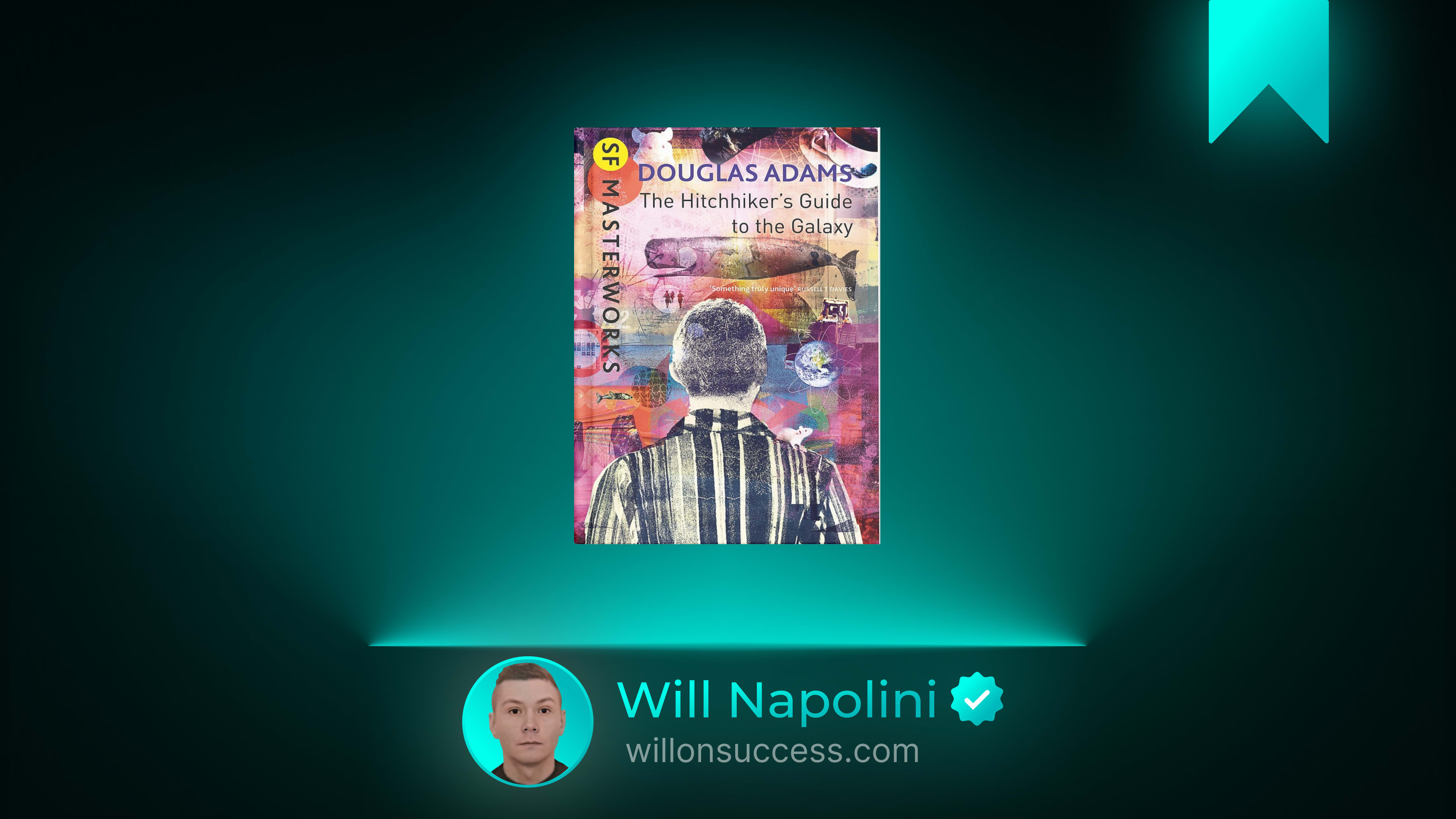
There is a moment in most of our lives when the plans we carefully constructed are suddenly and unceremoniously bulldozed. Not because we failed, and not because we lacked discipline, but simply because the universe has decided to build a hyperspace bypass right through our living room.
When the ground drops out from beneath you, the instinct is to freeze, to fight, or to panic. We grip the edges of our lives and demand an explanation. But what if the most powerful response to absolute chaos is not to demand answers, but to take a breath, remember the two most important words in the English language, and keep moving?
I have spent years studying how people respond to crisis, both in my own life and in the lives of those I mentor. What I discovered was that the most resilient people share a very specific trait: they refuse to let panic write their story. They understand that while they cannot control the bulldozers, they have absolute authority over their internal response.
The Big Idea
On the surface, The Hitchhiker’s Guide to the Galaxy by Douglas Adams is a brilliant, absurd science fiction comedy. It is filled with two-headed galactic presidents, depressed robots, and poetry so bad it can be used as a weapon. But if you look past the interstellar jokes, you will find a profound philosophical guide to surviving a world that makes very little sense.
Adams understood something that many of us spend decades trying to learn: the universe is vast, wildly unpredictable, and largely indifferent to our carefully laid plans. Rather than proposing a single, grand, discoverable meaning to existence, the book argues that when you are thrown into the unknown, your survival and your happiness depend entirely on your adaptability, your sense of perspective, and your ability to remain calm when everything goes wrong.
The Story of the Unlikely Survivor
Consider the journey of Arthur Dent. He wakes up on a Thursday morning to find his house being demolished to make way for a local bypass. Minutes later, he discovers that his best friend is an alien, and that the entire planet Earth is about to be demolished to make way for a galactic bypass. In the span of a single hour, Arthur loses his home, his planet, and his entire frame of reference.
He is thrust into a universe that operates on bureaucracy, absurdity, and sheer randomness. Yet, Arthur survives. He does not survive by conquering the galaxy, acquiring immense wealth, or becoming a superhero. He survives by learning to accept the absurdity of his situation, relying on his companions, and clinging to the foundational advice printed on the cover of the galaxy’s most popular electronic book: Don’t Panic.
Arthur’s journey is a mirror for our own. We all experience moments where our personal “Earth” is destroyed. A business fails. A relationship ends. A health crisis upends our reality. We are all, at various points, Arthur Dent—standing in our dressing gowns, staring at the rubble of our expectations.
The Power of “Don’t Panic”
The cover of the Guide bears these words in large, friendly letters. It is easy to read this as a simple joke, but it is actually the most practical piece of psychological advice you will ever receive.
When a crisis hits, our nervous system floods with stress hormones. We catastrophize. We imagine the worst possible outcomes. Panic narrows your vision; calm expands it. When you panic, you lose access to the rational, creative parts of your brain. You revert to pure survival instincts, which in the modern world usually look like lashing out, quitting, or hiding.
“Don’t panic” does not mean “ignore the danger.” It means “refuse to let your fear dictate your next move.” It is a command to protect your cognitive function. You cannot stop the demolition crew, whether they are literal or metaphorical. But you can control your breathing. You can choose to observe the chaos without becoming the chaos. The moment you stop panicking, you reclaim your agency.
The Illusion of the “Ultimate Answer”
In the story, a supercomputer named Deep Thought spends seven and a half million years calculating the Answer to the Ultimate Question of Life, the Universe, and Everything. The answer, famously, is 42. It is a perfectly precise, mathematically sound answer, but it is entirely useless because no one actually knows what the question was.
How often do we do this in our own lives? We obsess over finding the “right” career, the “perfect” partner, or the “one true purpose,” believing that if we just figure out the ultimate answer, everything will magically fall into place. We treat our lives like math problems waiting to be solved.
Adams is reminding us that meaning is not something you calculate; it is something you experience. If you spend your whole life waiting for the universe to hand you a grand, pre-written purpose, you will miss the actual life happening right in front of you. The search for a single, objective meaning is a trap. The questions you ask, the experiences you pursue, and the connections you build along the way are infinitely more valuable than a static, final answer.
The Towel as a Symbol of Readiness
The Guide states that a towel is about the most massively useful thing an interstellar hitchhiker can have. You can wrap it around you, sleep on it, use it as a sail, or ward off ravenous beasts. But more importantly, the Guide notes that if a non-hitchhiker discovers you have a towel, they will automatically assume you are someone who has their act together.
In personal development terms, the towel represents your foundational resilience. It is your emergency fund, your daily habits, your physical health, your emotional regulation. It is the quiet competence you build when no one is watching.
When you carry your “towel”—when you have built a life grounded in simple, durable, versatile habits—you project a quiet confidence. You build the foundation. You trust the foundation. You let the foundation carry you when the ground inevitably gives way. You do not need to know exactly what the future holds if you know you have the tools to adapt to it.
Perspective is the Antidote to Self-Importance
Adams constantly juxtaposes the mundane with the cosmic. Earth is destroyed not by a dramatic, cinematic alien invasion, but by a mid-level bureaucratic filing error. This is hilarious, but it is also deeply liberating.
We carry our embarrassments, our failures, and our anxieties as if they are the center of the universe. We replay awkward conversations in our heads and agonize over minor setbacks. They are not the center of the universe. Recognizing your own smallness in the vastness of time and space is not depressing; it is freeing. It allows you to take your work seriously without taking yourself too seriously. It gives you permission to fail, to experiment, and to laugh at your own mistakes. When you zoom out, the stakes feel lower, and the joy of the journey returns.
Why It Matters
You may be working hard right now, building a life, a career, or a relationship, and you may feel the constant, low-grade anxiety that it could all be swept away by forces outside your control. The economy shifts, industries change, health fails, or a “hyperspace bypass” appears in your plans. If your sense of security relies on the world behaving predictably, you will live in a state of perpetual fragility. You are trying to navigate a wild ocean using a map drawn for a swimming pool.
If I could sit across the table from you right now, and you were telling me about the sudden collapse of your five-year plan, here is what I would tell you: the plan wasn’t the point. The person you became while building the plan was the point.
If you internalize the lessons of the Guide, your foundation shifts. You stop demanding that the universe make sense, and you start trusting your ability to navigate it when it doesn’t. True resilience has very little to do with preventing the storm, and everything to do with knowing how to fly your ship through it.
Practical Application
How do you translate sci-fi comedy into a Tuesday morning? Concepts are only as valuable as the behaviors they produce. Here is how you can apply these principles today:
- Create your “Don’t Panic” protocol. When you receive the bad email, the sudden bill, or the unexpected setback, institute a mandatory pause before you react. Do not send the angry reply. Do not make the rash decision. Give yourself ten minutes, or ten hours, to let the initial wave of panic wash over you and recede. Only act from the calm that follows.
- Identify and pack your “Towel.” What is one foundational habit or resource that makes you feel capable no matter what happens? It might be a robust savings account, a morning routine that grounds you, a commitment to daily reading, or a network of trusted friends. Invest in your towel this week. Build the systems that make you resilient by default.
- Stop searching for “42”. If you are paralyzed by a major life decision because you are trying to find the “perfect” choice, reframe the problem. Instead of asking, “What is the ultimate right answer?” ask, “What is the most interesting next step?” Take the step. Action generates data, and data clarifies the path forward. You can always adjust your course later.
Who Should Read This Book
This book is essential reading for anyone who feels overwhelmed by the unpredictability of modern life, or who takes their personal setbacks a little too heavily. It is a brilliant palate cleanser for the overly serious, the perfectionists, and the chronic over-thinkers. It is a reminder that you do not need to have it all figured out to have a wonderful life.
It may not be the right book if you are looking for a rigid, step-by-step framework for financial success, or if you prefer your philosophy served without a heavy dose of absurdity and British humor. But if you need to remember how to laugh at the chaos and find your footing in the unknown, it is an absolute masterpiece.
One Small Step
Today, find a physical towel. It sounds ridiculous, but do it. Fold it neatly and place it somewhere visible in your workspace or your home. Let it serve as a quiet, tactile reminder that you are prepared, that you are resilient, and that you have built a foundation capable of handling the unexpected.
When the universe inevitably throws you a curveball, look at the towel, take a deep breath, and smile. You can stop waiting for the cosmos to hand you the ultimate answer, and simply find the courage to step into the beautiful, absurd unknown with a better question.