The Thorn Birds: What a Story About Impossible Love Teaches Us About the Price of Wanting
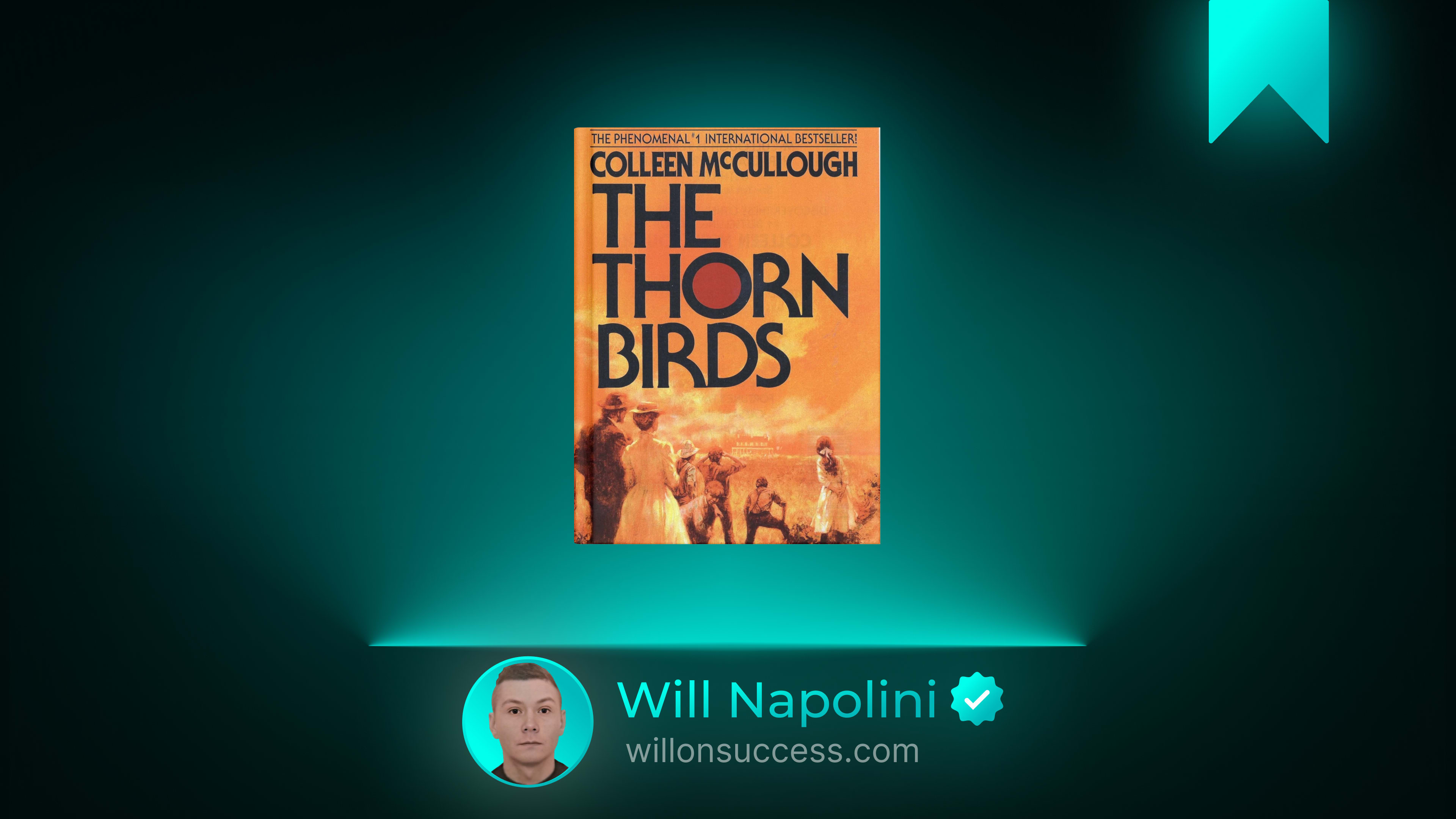
There is an old legend that Colleen McCullough places at the heart of her novel, and I have not been able to stop thinking about it for years. A bird, the story goes, searches its entire life for a single thorn tree. When it finally finds one, it impales itself upon the sharpest thorn. And in the agony of that piercing, it sings. It sings more beautifully than any living creature has ever sung. And then it dies.
The legend says that the most beautiful thing in the world is purchased with the greatest suffering. That the song and the wound are not separate events. They are the same event.
McCullough built a novel around that idea. And what she built is not merely a love story, though it is one of the most aching love stories ever written. It is a long, slow examination of what happens when people want something they cannot have, or have something they are too proud to keep, or choose a life that looks magnificent from the outside while quietly starving them from within.
If you have ever loved someone you could not have, chosen a path because it looked impressive rather than because it felt true, or carried a silence inside you for so long that you forgot it was not part of your skeleton, this book will find you.
Let me tell you what it teaches.
The Story at Its Center
The novel spans more than fifty years, from the early 1900s through the late 1960s, and follows the Cleary family across the vast, punishing landscape of the Australian outback. But the gravitational center of everything is Meggie Cleary, and the man she loves from the time she is a child: Father Ralph de Bricassart, a Catholic priest with ambition as deep as his tenderness.
Ralph is drawn to Meggie with a force he cannot fully deny and will never fully act upon. He loves her. That is not ambiguous. But he also loves the Church, or rather, he loves what the Church can make him. A cardinal. A figure of power and influence. A man whose life means something beyond one small station in the dust of New South Wales.
And so he chooses. Again and again, across decades, he chooses. And each time, the choice costs Meggie something she will spend years trying to recover.
Meggie, in turn, makes her own choices. She marries Luke O’Neill, a man who looks like Ralph but possesses none of Ralph’s depth, largely because he is available and Ralph is not. She bears children. She endures. She waits. She stops waiting. She takes what she wants, once, in a way that is both brave and desperate. And the consequences of that one act ripple through the rest of the novel in ways she cannot foresee.
Around Meggie, McCullough builds a constellation of lives. Her mother, Fee, who carries a grief so old and so sealed that it has become indistinguishable from her personality. Her brothers, who live and die in the rhythms of Drogheda, the great sheep station that is as much a character as any person in the book. And later, Meggie’s own children, Justine and Dane, who inherit their mother’s longings in forms she does not recognize until it is very late.
This is not a story with a neat resolution. It is a story about the long arc of consequence.
The Thorn Is Chosen, and That Is the Tragedy
What struck me most, reading this novel, is that McCullough does not write her characters as victims of fate. Ralph is not ambushed by his ambition. He sees it clearly. He understands what he is giving up. He chooses the Vatican over Meggie’s kitchen table, and he does it with his eyes open, and the novel lets him feel the full weight of that decision without excusing it.
Meggie, too, is not simply acted upon. Her marriage to Luke is a choice made from loneliness and stubbornness. Her later decisions carry their own logic, their own hunger, their own cost. McCullough grants her characters the dignity of agency even when their choices wound them.
And I think that is the hardest truth the book asks you to sit with. We are not always done in by circumstance. Sometimes we walk toward the thorn. Sometimes we see it clearly, understand what it will cost, and press forward anyway because the song on the other side feels worth the piercing. Ralph knows. Meggie knows. Fee knew, decades before either of them.
The question the novel leaves you holding is not “Was it worth it?” It is “Did you choose it honestly, or did you pretend you had no choice at all?”
Silence Is the Inheritance That Travels Farthest
Three generations of women anchor this book: Fee, Meggie, and Justine. And what passes between them is not primarily wisdom or wealth. It is silence.
Fee carries a secret grief from before the novel begins, a love that was taken from her, a life she was forced into. She does not speak of it. She locks it behind a face so composed that her children mistake her restraint for coldness. Meggie grows up believing her mother simply does not feel deeply. And so Meggie learns to bury her own feelings, to endure, to wait, to want quietly.
Then Justine grows up watching her mother endure and decides, fiercely, that she will not. She will leave. She will build a career. She will not tie herself to a place or a man or a pattern. And in some ways, she succeeds. But she also inherits a version of the same emotional distance, the same difficulty with vulnerability, just expressed through ambition instead of silence.
I have seen this pattern in real life so many times it aches. A parent who never says “I love you” does not merely withhold a phrase. They hand their child a blueprint for how love is supposed to sound, and the child builds a life around that silence. Not because they want to. Because they never saw another way.
McCullough shows you the pattern across fifty years so that you can see it clearly. And once you see it, you can ask yourself where it is operating in your own family. What silence are you carrying that was never yours to keep? What are you not saying, and who is learning from your example that this is how love is supposed to look?
Ambition Without Honesty Becomes a Beautiful Cage
Ralph de Bricassart is one of the most compelling characters in fiction because McCullough refuses to make him a villain. He is intelligent, charismatic, genuinely tender. He cares for the Cleary family. He cares for Meggie. His feelings are not false.
But he builds a life on a foundation of division. He wants the Church and he wants Meggie. He wants power and he wants intimacy. He wants to be a man of God and he wants to be a man who is loved by one woman in a small house at the edge of the world. He wants all of it. And because he will not grieve the parts he cannot have, he spends decades in a quiet, elegant agony that he mistakes for devotion.
I have known people like Ralph. Maybe you have too. People who are enormously successful by every visible measure and privately hollow. Who built the life they said they wanted and discovered, somewhere around the second decade, that the wanting was never quite honest. That they chose the impressive path because the true path terrified them. That they called it duty because calling it fear would have required them to change.
McCullough does not condemn Ralph. She lets him age. She lets him feel the absence. She lets the reader see that the cage he built is gilded, spacious, admired by everyone who looks at it from the outside. And that he is still inside it. And that the door was never locked.
The Land Endures, and So Do You
One of the things McCullough does magnificently is make the Australian outback a living presence. Drogheda, the sheep station where the Clearys live and work, is not a backdrop. It is a force. The droughts come. The fires come. The heat presses down until the air itself feels like a weight. And then the rain comes, and the land drinks, and life pushes up through the cracked soil as if nothing happened.
The people in this novel are shaped by that rhythm. They lose things. They lose people. They lose years to decisions they cannot undo. And then they get up the next morning and shear the sheep and mend the fences and keep going. Not because they are heroic. Because stopping is not an option the land offers.
There is a kind of endurance in this book that I find deeply honest. It is not the triumphant endurance of someone who overcomes. It is the quiet, bone-deep endurance of someone who simply continues. Who makes tea. Who feeds the children. Who walks the paddocks in the early morning when the grief is freshest and the light is softest and no one is watching.
You do not always get a breakthrough. Sometimes you get a Tuesday. And you handle the Tuesday. And the Tuesday becomes a week, and the week becomes a year, and one morning you realize the grief has changed shape. Not gone. Changed shape. Like a river finding a new channel after the flood.
What This Story Asks of You
I do not read novels to extract lessons the way I might read a book of strategy. But some stories reach into you and rearrange something, and this one does.
It asks: What are you enduring that you have mistaken for your only option?
It asks: Who are you not telling the truth to, and how long have you been calling that silence strength?
It asks: Are you building a life that looks magnificent to other people while quietly starving yourself inside it?
And perhaps most gently: What would it cost you to say, out loud, to the person who needs to hear it, the thing you have been carrying alone?
These are not comfortable questions. McCullough does not write comfortable novels. She writes long ones, patient ones, ones that make you sit with a character’s bad decision for two hundred pages and feel the full consequence before you are allowed to look away. But the discomfort is purposeful. It loosens something. It makes you look at your own thorn and ask whether you chose it, or whether you simply never gave yourself permission to choose differently.
Who Should Read This Book
If you love sweeping, character-driven fiction that spans generations and refuses to rush, this book will reward your patience richly. If you are drawn to stories about love that is complicated, imperfect, and never quite resolved, this is one of the finest ever written. If you have an interest in Australian history, rural life, or the quiet architecture of family secrets, McCullough gives you all of it in vivid, unsparing detail.
A word of honesty: this is a long novel. Over five hundred pages. It moves deliberately, and the early sections, which establish the Cleary family and the landscape of Drogheda, require you to slow down and let the world build around you. If you prefer tight, plot-driven thrillers, the pacing may test you. But the patience it asks is the patience the land itself teaches. You settle in. You let the rhythm take you. And when the story tightens its grip, you will not want to put it down.
It is also worth noting that the book deals with themes of unrequited and forbidden love, loss, death, and the constraints placed on women across much of the twentieth century. These are handled with emotional honesty, not sensationalism, but they carry weight.
One Small Step
You do not need to read five hundred pages tonight. But if this story has reached you, if something in the idea of the thorn bird made your chest tighten, here is what I would gently suggest.
Take ten minutes. Sit somewhere quiet. And ask yourself one question: What is the thing I want most that I have convinced myself I cannot have?
Do not solve it. Do not build a plan. Just name it. Say it out loud if you can, or write it on a piece of paper. “I want to leave.” “I want to say I love you.” “I want to stop performing a life that exhausts me.” “I want to grieve something I was never allowed to grieve.”
Naming it does not fix it. But it pulls the thorn far enough out that you can finally see it clearly. And you cannot choose differently while you are still pretending the wound is not there.
Meggie Cleary spent a lifetime learning that lesson in the hardest way, across decades of dust and silence and longing on a sheep station at the edge of the world. You do not have to spend a lifetime. You just have to be willing to look.
The bird does not sing because the thorn does not hurt. It sings because it finally stopped pretending the thorn was not there, and in that honesty, something beautiful and terrible and utterly alive breaks open. Your song is waiting on the other side of whatever you have been refusing to name. Go find your thorn. Look at it honestly. And then, gently, decide whether it is still the one you choose.