The Architecture of Resourcefulness: What a 125-Year-Old Book Teaches Us About Creating Wealth from Nothing
We live in an era that is deeply, almost pathologically, obsessed with scale.
If you open your phone today, you will be inundated with stories of twenty-somethings who built a software application, secured millions in venture capital, and disrupted an entire global industry before their twenty-fifth birthday. We are taught that to create wealth, you must invent something unprecedented. You must build a massive audience. You must change the world.
And so, when we look at our own lives—our modest savings accounts, our ordinary skills, our quiet neighborhoods—we feel a paralyzing sense of defeat. We tell ourselves the most dangerous lie in the modern economy: “I don’t have the capital, I don’t have the connections, and I don’t have the genius to start.” So we wait. We wait for the perfect idea, the perfect funding, the perfect moment. And while we wait, our lives remain exactly the same.
But what if the fundamental mechanics of wealth creation have not changed in over a century? What if the secret to financial freedom is not found in a Silicon Valley boardroom, but in the quiet, unglamorous observation of the world immediately in front of you?
If I could sit across the table from you right now, I would ask you to set down the heavy burden of needing to be a “disruptor.” I would tell you that you do not need to change the world to build a life of profound independence. You only need to be useful to one small corner of it.
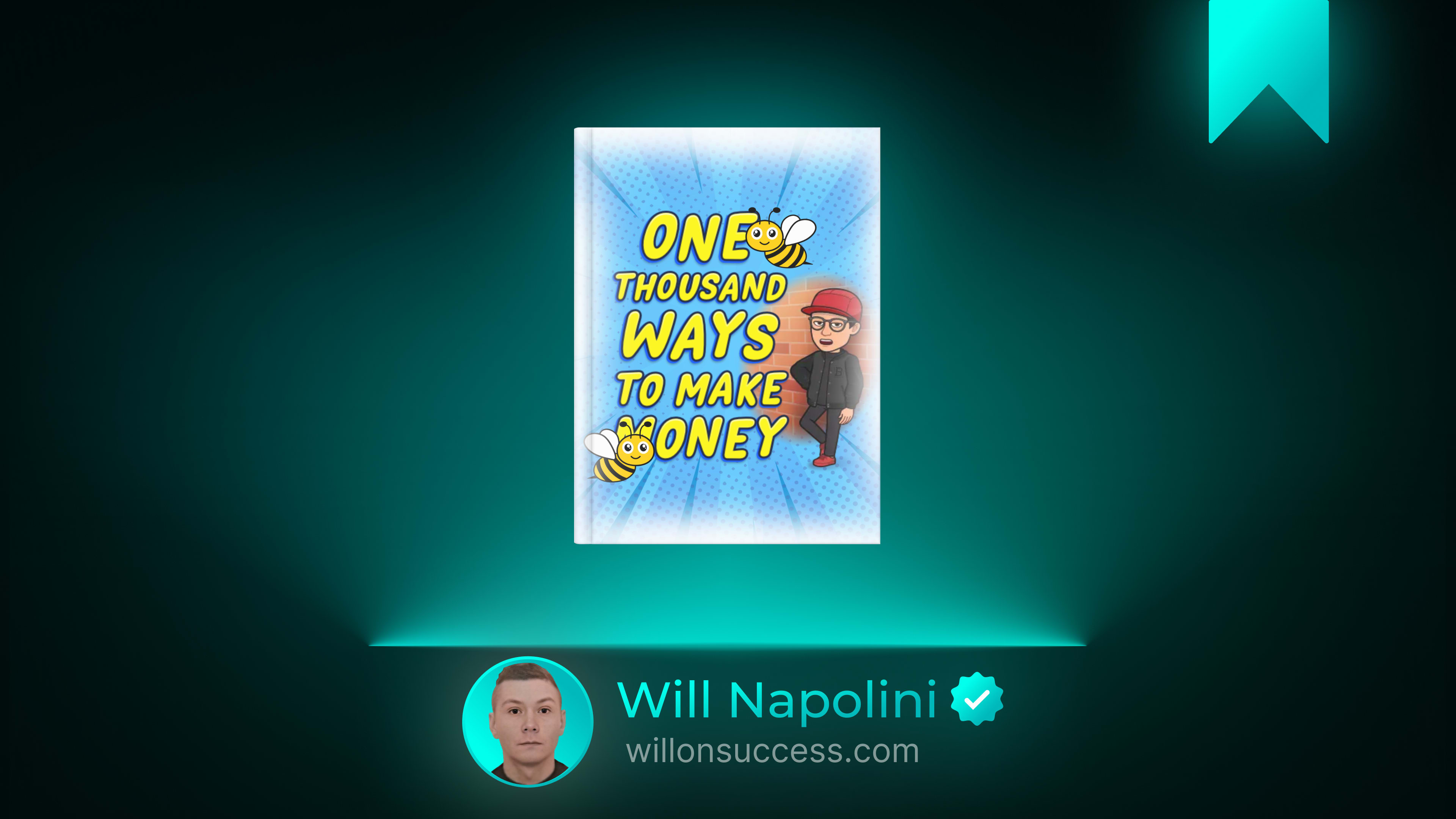
In 1899, an author writing under the name Page Fox published a fascinating, sprawling encyclopedia titled One Thousand Ways to Make Money. It was not a book of high finance, stock market speculation, or corporate strategy. It was a catalog of ordinary people doing extraordinary things with the raw materials immediately available to them. It featured people raising poultry, mending umbrellas, cultivating rare herbs, brokering local goods, and turning household waste into sellable products.
Reading it today, it is easy to smile at the quaint, Victorian examples. But beneath the surface of these historical oddities lies a profound and timeless thesis: Wealth is not created by having resources. Wealth is created by being resourceful. Money is simply a receipt you receive for solving a problem, easing a friction, or providing a service that someone else is too busy, too tired, or too unskilled to do themselves.
When you understand this, the world stops being a place where you are locked out, and becomes a landscape of hidden doors.
The Myth of the Missing Capital
The single greatest barrier to creating a new income stream is not a lack of money; it is the belief that you need money to begin. We look at a business idea and immediately calculate the cost of a website, the inventory, the marketing budget, and the LLC registration. We price ourselves out of our own dreams before we have even laid the first brick.
Page Fox’s 1899 catalog is a masterclass in the art of the zero-capital start. The people in his book did not wait for a bank loan. They looked at the literal dirt beneath their feet, the spare hours in their evenings, and the discarded materials in their communities, and they asked, “What can be made from this?”
I have learned that capital is a tool, but it is not the spark. The spark is observation. When you have no money, you are forced to use your imagination, your sweat, and your time. This is not a disadvantage; it is a crucible. It forces you to validate your idea in the real world before you risk your life savings on it.
Think of the craftsman who wants to build a chair but has no wood. He does not sit and complain about the lumber yard. He walks into the forest, finds fallen branches, and learns to carve. Resourcefulness is the muscle that builds the foundation; capital is merely the paint you apply once the house is standing. If you cannot build a micro-enterprise with zero dollars, you will simply lose a million dollars faster if someone hands it to you.
The Architecture of Friction
How do you actually find a way to make money? Most people try to sit in a quiet room and “think of a good idea.” This is almost always a waste of time. Ideas do not fall from the sky; they rise from the ground. They rise from friction.
Every single viable business in Fox’s book solved a specific, localized annoyance. Someone noticed that people hated cleaning their own windows. Someone noticed that widows needed help managing their small gardens. Someone noticed that local farmers had excess fruit that was rotting, while city dwellers were paying a premium for preserves.
The entrepreneur is simply a person who builds a bridge over a friction point.
In your own life, you are surrounded by friction every single day. You hear your colleagues complain about the clunky software they have to use. You hear your neighbors lament the lack of reliable dog walkers. You notice that local businesses have terrible, outdated websites. You feel the frustration of trying to organize your own digital files.
Stop looking for a “billion-dollar idea.” Start looking for a “ten-dollar annoyance.” The most reliable, enduring income rarely comes from inventing a new human desire; it comes from taking an existing, painful chore and doing it efficiently, reliably, and with dignity for someone who would rather pay you than do it themselves.
The Dignity of the Micro-Enterprise
We suffer from a modern disease I call “scale paralysis.” We have been conditioned to believe that if a business cannot scale to a million users, or if it requires our physical labor, it is not a “real” business. We look down on the side hustle, the service trade, and the micro-enterprise.
But there is a profound, quiet dignity in the micro-enterprise.
Page Fox championed the small, manageable venture. A business that generates an extra $1,000 a month, requires only ten hours of your week, and carries zero debt is not a failure because it isn’t a Fortune 500 company. It is a masterpiece of personal freedom. It is the difference between renting your life from an employer and owning a piece of your own time.
When you build something small, you retain control. You do not have to answer to a board of directors. You do not have to compromise your character to appease venture capitalists. You can build a business that fits your life, rather than shrinking your life to fit a business. You become a craftsman of your own livelihood, tending to it like a garden, pulling the weeds, and harvesting the fruit at your own pace.
The Power of the “Newsboy” Mentality
One of the recurring archetypes in historical wealth-building is the newsboy. The newsboy did not have a salary. He did not have a safety net. He bought a stack of papers for a few cents, and his income was directly, brutally tied to his effort, his charm, and his willingness to stand on a busy corner in the freezing rain.
There is a deep psychological transformation that happens when you transition from an “employee mindset” to a “newsboy mindset.” As an employee, you are paid for your time, regardless of the value you create. You are shielded from the direct feedback of the market. As an independent creator or micro-entrepreneur, you are paid strictly for the value you deliver.
This sounds terrifying, but it is actually deeply liberating. It teaches you that your income is not a fixed number determined by a boss; it is a dial that you can turn by increasing your skill, your effort, or your usefulness. When you realize that the market will pay you for solving its problems, you stop waiting for permission to succeed. You simply walk out into the world, find a problem, and solve it.
Why This Matters on an Ordinary Tuesday
It is easy to read about 19th-century entrepreneurs and view their world as a simpler, more accessible place. But human nature has not changed. The mechanics of value exchange remain exactly the same, even if the tools have evolved from mending umbrellas to automating spreadsheets.
Think about your current professional life. Are you frustrated because you feel underpaid and undervalued? You are likely waiting for the institution you work for to recognize your worth and grant you a raise. But institutions are slow, bureaucratic, and risk-averse.
Applying the philosophy of One Thousand Ways to Make Money shifts your agency back into your own hands. Instead of waiting for a promotion, you look at the friction in your industry. What is the modern equivalent of “mending umbrellas”? Perhaps it is taking the messy, unorganized data from three different software platforms and creating a clean, automated weekly dashboard for your boss. You do it on your own time. You present it. You have just created a new product. You have proven your value in the open market of ideas.
In your personal life, this mindset cures the anxiety of economic uncertainty. When you know how to spot friction and build a bridge over it, you realize that you are never truly helpless. If the economy shifts, if your industry is disrupted, you know how to look at the raw materials around you and build a new stream of income. You are no longer a fragile leaf blown by the economic winds; you are a builder with a toolbox.
How to Reclaim Your Resourcefulness Today
Understanding that wealth comes from solving problems is valuable, but understanding without action changes nothing. If you want to stop waiting for capital and start building your own independence, you must begin applying these principles immediately.
1. Conduct a “Friction Audit” For the next three days, carry a small notebook. Do not try to think of business ideas. Instead, write down every single time you hear someone (including yourself) say the words: “I hate doing this,” “This is so annoying,” or “I wish someone would just handle this.” Whether it is assembling flat-pack furniture, organizing digital photo albums, or waiting in line at the post office, write it down. Friction is the raw ore of entrepreneurship. Find the annoyance, and you have found the market.
2. Practice Skill Arbitrage Look at the skills you already possess from your day job or your hobbies. Are you excellent at formatting presentations? Are you good at negotiating with contractors? Are you highly organized? Now, look at the people around you who lack those skills and have more money than time. Your first “way to make money” does not require learning to code or starting a podcast. It requires packaging a skill you already have and offering it to someone who is drowning in the exact problem you know how to solve.
3. The “Embarrassingly Small” Launch Pick one small friction point you identified. Create an offer to solve it for exactly one person. Do not build a website. Do not print business cards. Do not register an LLC. Simply reach out to one neighbor, one former colleague, or one local business owner and say, “I noticed you struggle with X. I am starting a small service doing Y. I will do it for you this weekend for $50 to prove it works.” Swallow your pride. Embrace the micro-enterprise. Let the market validate your idea before you invest your ego into it.
Who Needs to Read This Book
One Thousand Ways to Make Money is a vital historical artifact, but its underlying philosophy is mandatory reading for the modern employee who feels trapped, the aspiring entrepreneur paralyzed by perfectionism, and the creative who believes they need a patron to survive. It is for anyone who needs to be reminded that the economy is not a walled garden you need a ticket to enter; it is an open field waiting to be cultivated.
However, if you are looking for a modern, step-by-step technical manual on how to run Facebook ads, optimize a Shopify store, or trade cryptocurrency, this book will not help you. The specific tactics of 1899 are long dead. What survives, and what you must absorb, is the posture of the entrepreneur. It teaches you how to look at the world, not as a consumer, but as a creator.
Your First Step Toward Independence
You do not need to quit your job today. You do not need to risk your life savings. You do not need to invent the next great technological breakthrough.
You only need to prove to yourself that you can create value out of thin air.
Here is what I want you to do today. Look around your immediate environment—your home, your garage, or your digital desktop. Find one thing that is broken, cluttered, or unused. Fix it, organize it, or package it. Then, find a way to offer that solution, or the physical item itself, to someone else for a small exchange of value. List it online. Offer the service to a neighbor.
Do not do it to get rich. Do it to break the psychological chain that tells you money is only given to you by an employer.
A journey of a thousand miles begins with a single step, but a life of freedom begins with a single, self-directed transaction. You have the tools. You have the mind. The raw materials are sitting right in front of you. Stop waiting for permission to build, step out into the world, and find the friction only you can smooth away.