Thinner Leaner Stronger: The Simple Science That Cuts Through Every Fitness Myth You've Been Sold
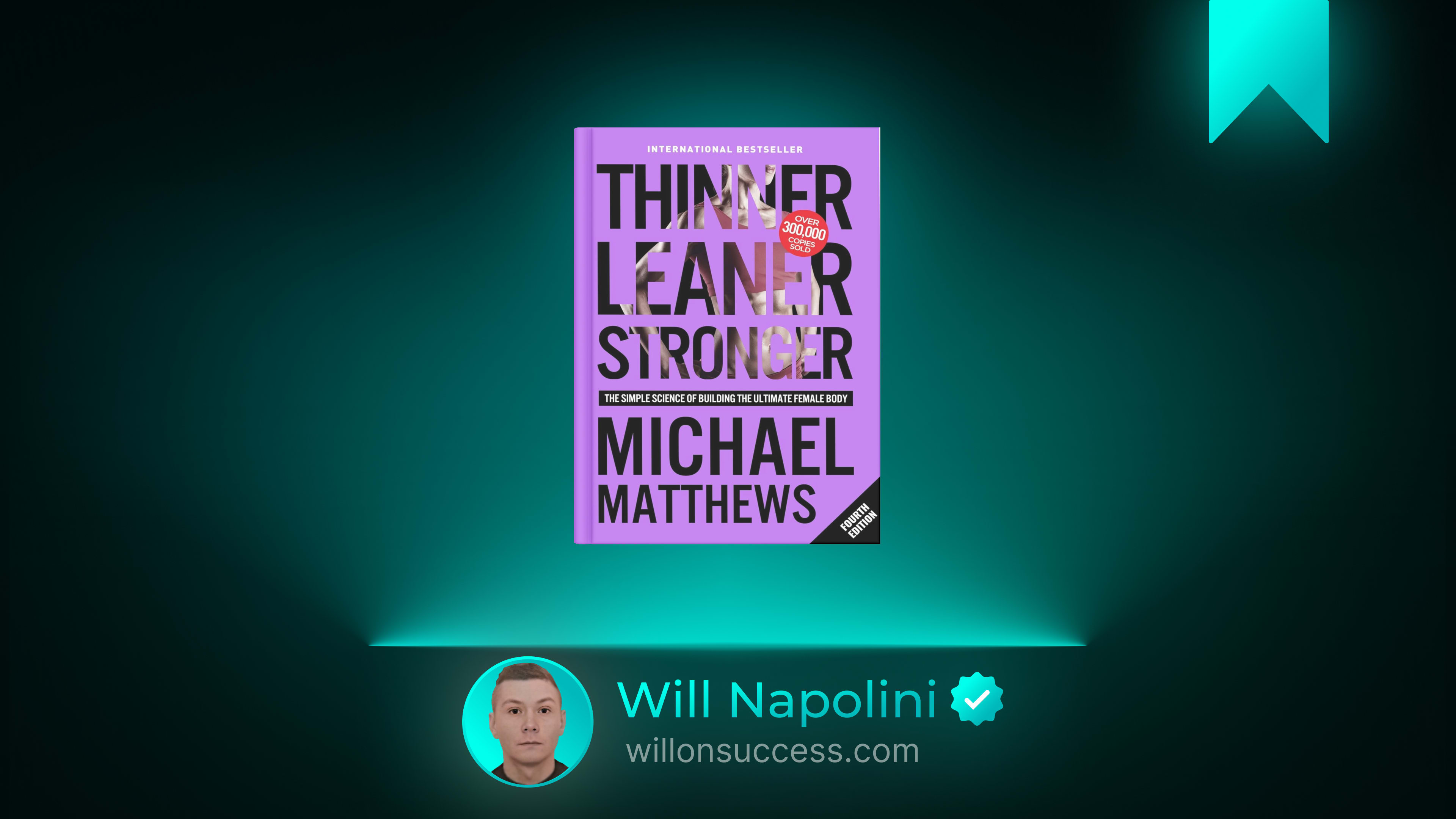
Have you ever stood in a gym, surrounded by machines you don’t understand, ads telling you to shrink yourself, influencers selling you a twelve-week “transformation,” and a quiet voice in your head whispering, There has to be something simpler than all of this?
I want you to hear me clearly: there is.
Michael Matthews wrote Thinner Leaner Stronger for the woman who has been exhausted, confused, and quietly demoralized by an industry that profits from her uncertainty. The book is not a new secret. It is the removal of secrets. It takes the actual physiology of how a woman’s body builds muscle, loses fat, and changes shape, and it lays those mechanics on the table in plain language, free of marketing, free of shame, free of the suggestion that you need to earn the right to feel strong.
If you have ever started a diet on Monday, abandoned it by Thursday, and blamed yourself for lacking willpower, this book will reframe the entire conversation. The problem was never your discipline. The problem was that nobody handed you the actual instructions.
The Big Idea: Your Body Responds to Physics, Not Marketing
Matthews’ central argument is almost disarmingly simple. Body composition—how much fat you carry relative to how much muscle you have—is governed by a small number of well-understood physiological principles. You do not need a proprietary supplement stack. You do not need to do ninety minutes of cardio six days a week. You do not need to fear carbohydrates, dread the squat rack, or accept the myth that lifting weights will make you “bulky.”
What you need is a clear understanding of energy balance, a structured approach to progressive strength training, and the patience to let small, repeated efforts compound over months.
That is the whole architecture. Everything else is decoration, distraction, or a sales pitch.
I have watched people spend years circling the edges of fitness—buying programs, switching diets every three weeks, punishing themselves with exercise they hate—because no one ever told them the foundation is only three or four bricks wide. Matthews tells you. He builds the house from those bricks, and he does it without making you feel foolish for not having known them already.
The Myth Machine: Why You’ve Been Confused on Purpose
One of the most valuable things this book does is name the problem before solving it. Matthews spends meaningful time dismantling the specific myths that keep women stuck:
The “bulk” fear. The idea that lifting moderate-to-heavy weights will make a woman look like a bodybuilder is, physiologically, almost impossible without the use of performance-enhancing drugs and years of extreme, specialized training. Women produce a fraction of the testosterone that drives that kind of hypertrophy. What lifting actually produces in most women is a denser, more defined, more capable body—not a larger one.
Spot reduction. You cannot crunch away belly fat or do endless leg lifts to thin your thighs. Fat loss is systemic. It comes from a sustained caloric deficit applied to the whole body, not from exercising one area repeatedly.
The cardio treadmill. Hours of steady-state cardio are not the most efficient path to body recomposition. They burn calories in the moment but do little to build the muscle tissue that raises your resting metabolic rate over time. Matthews does not say cardio is worthless. He says it has been wildly overvalued as a primary tool.
“Clean eating” perfectionism. The notion that one slice of pizza or one square of chocolate will undo your progress is not science. It is anxiety dressed up as nutrition.
These myths are not accidents. They are profitable. Confusion sells programs. Fear sells supplements. Perfectionism keeps you subscribing. Matthews is not subtle about this, and I appreciate that he is not. You deserve to know that the maze you have been running through was designed to keep you running.
The Three Pillars That Actually Move the Needle
Energy Balance Is the Foundation, Not the Enemy
At its core, losing fat requires consuming fewer calories than your body expends over time. Gaining muscle requires adequate protein and a training stimulus. That is not a revolutionary statement, but Matthews treats it with a respect that most fitness content does not. He explains how to calculate your needs, how to set macronutrient targets that preserve muscle while reducing fat, and—crucially—how to do this without turning every meal into a moral exam.
The book advocates a flexible approach to food. You hit your protein target. You stay within a reasonable caloric range. You eat foods you enjoy. You do not need to eliminate entire food groups or perform penance for eating bread. Sustainability is not a consolation prize. It is the strategy.
What I find most important here is the psychological shift this creates. When you understand that a single meal does not determine your outcome—that the meaningful unit of time is the week, the month, the season—you stop oscillating between restriction and guilt. You stop starting over every Monday. You simply continue.
Progressive Overload Is the Engine of Change
If energy balance governs whether you lose fat, progressive overload governs whether you build the body you actually want underneath that fat loss. Matthews lays out a structured strength-training program built around compound movements—squats, deadlifts, bench presses, overhead presses, rows—and the principle is straightforward: over time, you lift a little more weight, or you complete a little more volume, than you did before.
This is not about going to failure every session. It is not about destroying yourself in the gym. It is about showing up three to four times a week, performing a small number of well-chosen exercises with good form, and adding a small increment of difficulty over weeks and months.
Think of it like laying bricks. No single brick transforms the wall. But each brick placed on top of the last, day after day, eventually produces a structure that could not have existed any other way. Your strength, your muscle, your posture, your confidence—these are built brick by brick, rep by rep, week by week. There is no shortcut, but there is also no mystery.
Consistency Outperforms Intensity Every Time
Matthews returns again and again to the idea that the best program is the one you will actually follow. Not the most advanced. Not the most punishing. The one that fits your schedule, your energy, your life. A moderate workout done four times a week for a year will outperform a brutal program done intensely for three weeks before you burn out and quit.
This principle reaches far beyond the gym. I have seen it in every domain of growth I have studied. The person who writes two hundred words a day for a year outpaces the person who writes five thousand words in a feverish weekend and then stares at a blank page for a month. The person who saves a small amount consistently builds more wealth than the person who waits for a windfall. Small, repeated actions are not the consolation for those who lack intensity. They are the mechanism by which durable change actually happens.
What This Looks Like on an Ordinary Tuesday
Let me make this concrete, because abstract principles only help you if they survive contact with a real day.
You wake up. You eat a breakfast that includes a meaningful portion of protein—eggs, Greek yogurt, a smoothie with protein powder—because you know that protein supports satiety and muscle repair. You do not agonize over whether the banana was “allowed.” You eat the banana.
You go to work. You sit at your desk. At lunch, you choose a meal that roughly fits your targets, but you do not weigh every gram of rice. You use your hand as a guide. You eat until you are satisfied, not stuffed.
In the evening, you go to the gym. You warm up. You squat. You press. You row. You follow the program Matthews outlines, adding a small amount of weight when the previous weight starts to feel manageable. The workout takes forty-five minutes. You are not drenched in sweat. You are not crawling out the door. You are tired in a satisfying, earned way.
You go home. You eat dinner. Maybe it is chicken and vegetables. Maybe it is pasta with a protein-rich sauce. You do not feel guilty. You go to bed.
Tomorrow, you do it again. And the day after. And the week after that. And in three months, you look in the mirror and realize the change happened so gradually you almost missed it—until you couldn’t.
That is the entire method. No detox. No shred phase. No thirty-day challenge. Just the quiet, cumulative power of doing the right thing repeatedly.
The Psychological Layer Nobody Talks About
Matthews does not ignore the mental game, and I am grateful for that, because the mental game is where most people quietly lose.
He addresses the all-or-nothing thinking that makes one “off” meal feel like a total failure. He addresses the impatience that makes you quit at week three because you do not yet look different in photographs. He addresses the comparison trap that makes you measure your month two against someone else’s year five.
The reframe he offers is not “be positive.” It is “be accurate.” You are not failing. You are in the early stages of a process that takes longer than a marketing cycle wants you to believe. Progress in body composition is slow, nonlinear, and often invisible until it is suddenly visible. Like a seed underground, the most important work is happening where you cannot yet see it.
Your job is not to force the sprout. Your job is to keep watering.
Who Should Read This Book
If you are a woman who has felt overwhelmed, misled, or quietly shamed by the fitness industry, this book will feel like someone finally turning on the lights in a room you have been stumbling through in the dark. It is especially valuable if you are new to strength training or if you have been doing mostly cardio and wondering why your body is not changing the way you expected.
If you are already experienced with nutrition tracking and progressive overload programming, the material may feel familiar. Matthews’ contribution is not new science. It is clear, myth-free, well-organized presentation of existing science, aimed specifically at women who have been underserved or misinformed by mainstream fitness culture.
One honest caveat: the book is prescriptive. Matthews tells you what to do with confidence, and for many readers that directness is a gift. If you prefer a more exploratory, intuitive approach to food and movement, the structured tracking and programming may feel rigid at first. But even then, the underlying principles—energy balance, progressive overload, consistency—are worth absorbing, even if you adapt the delivery to suit your personality.
A Practical Starting Point
You do not need to overhaul your entire life this week. You need one honest starting point.
Here is what I would suggest:
This week, choose one compound movement. A squat. A deadlift. A push-up variation if you are brand-new. Learn the form. Watch a clear instructional video. Perform three sets of eight repetitions, three times this week. That is all. You do not need a full program today. You need the first brick.
Track your protein for three days. Not to restrict. Not to judge yourself. Just to see where you actually are. Most people discover they are eating far less protein than they assumed. Knowing your starting number is not criticism. It is information. And information is the beginning of choice.
Give yourself permission to be a beginner. You do not owe anyone a transformation timeline. You are allowed to be in week one for as long as week one takes.
One Small Step You Can Take Today
Before you go to bed tonight, write down one strength-training exercise you will perform tomorrow or the day after. Just one. Write the number of sets and reps you will aim for. Write it on a sticky note. Put it on your bathroom mirror.
That is not a workout plan. That is a decision. And a decision, made concrete and visible, is the first thread you pull to unravel the entire knot of “I’ll start when I’m ready.”
You are ready. You have been ready longer than you know.
The body you want is not hiding behind a secret supplement or a twelve-week program. It is hiding behind consistency, patience, and the willingness to do a small thing repeatedly until it becomes a large thing. You do not need to be extraordinary tomorrow. You need to be present, and you need to add one more brick.
The wall builds itself, brick by brick, if you simply keep showing up to lay them.